When I left off in Part 1, I had just arrived in Punakha after days spent in Thimphu and the open quiet of the Phobjikha Valley.
Part 2 continues the journey from there, beginning on Day 6 of my 11 days in Bhutan — moving west through Punakha, back toward Thimphu, into the lesser-visited Haa Valley, and finally on to Paro and the climb to Tiger’s Nest. If you missed the first half of the trip, you can read Part 1 here.
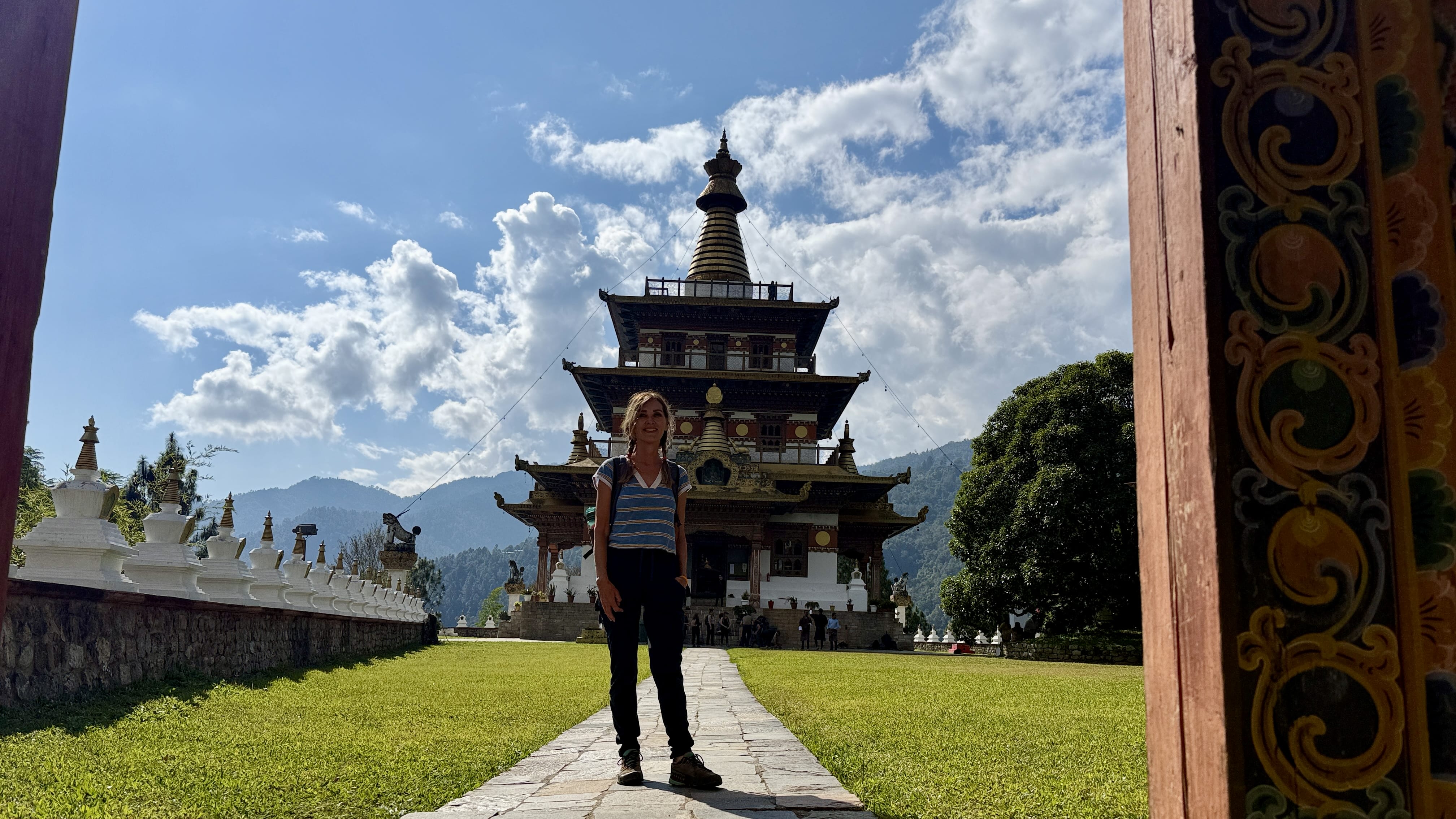
We started the morning with a hike up to Khamsum Yulley Namgyal Chorten, a hilltop temple commissioned by the Queen Mother—mother of Bhutan’s current king—for peace and protection.
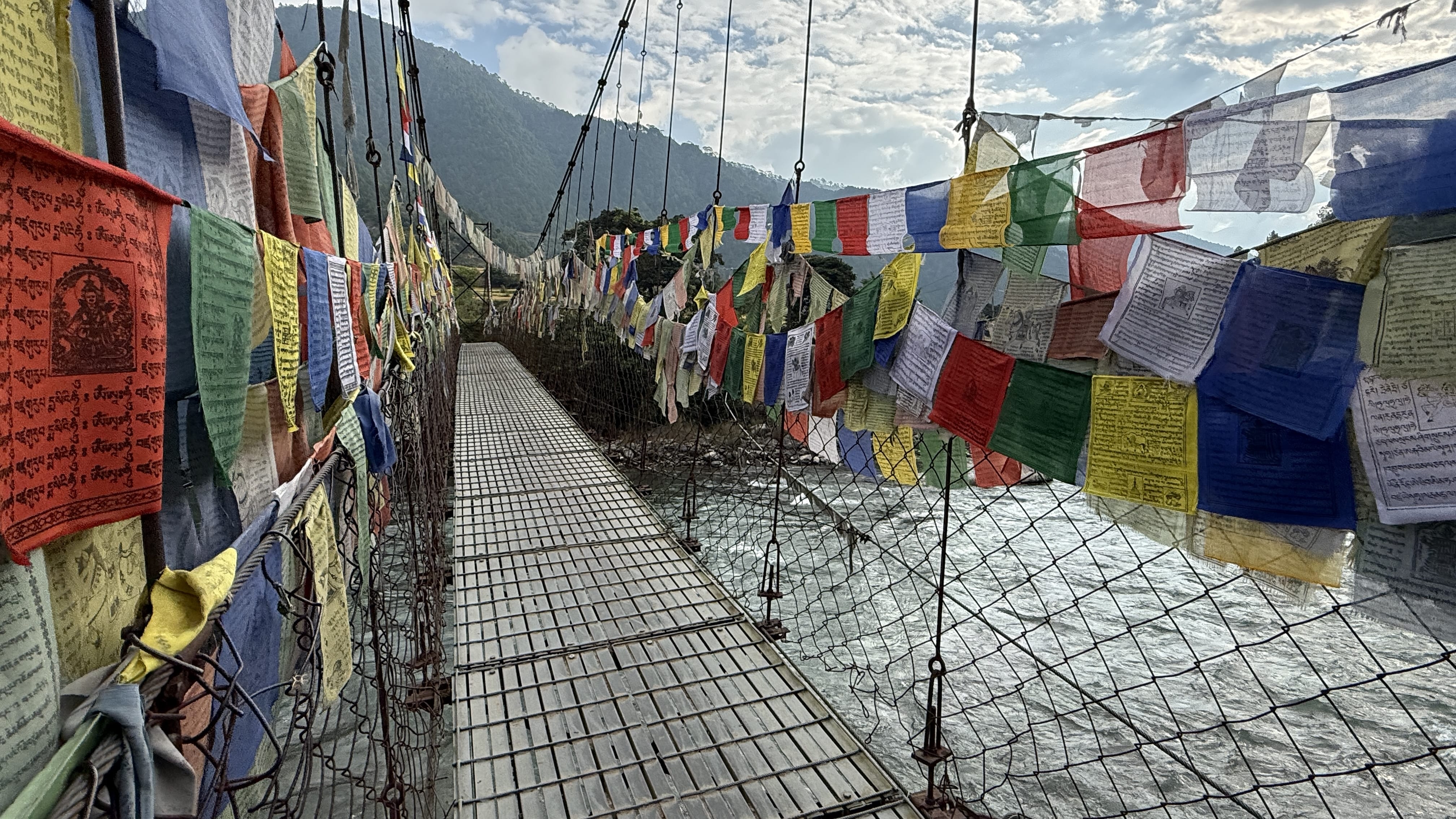
To reach the trail, we crossed a small suspension footbridge over the Mo Chhu. I loved it—not just because of the gentle sway of the bridge, but because of the prayer flags lining the cables as the river rushed below. I don’t know why, but everything looks better wrapped in prayer flags. And with all of them snapping in the wind as I crossed, it felt like the prayers were already in motion.
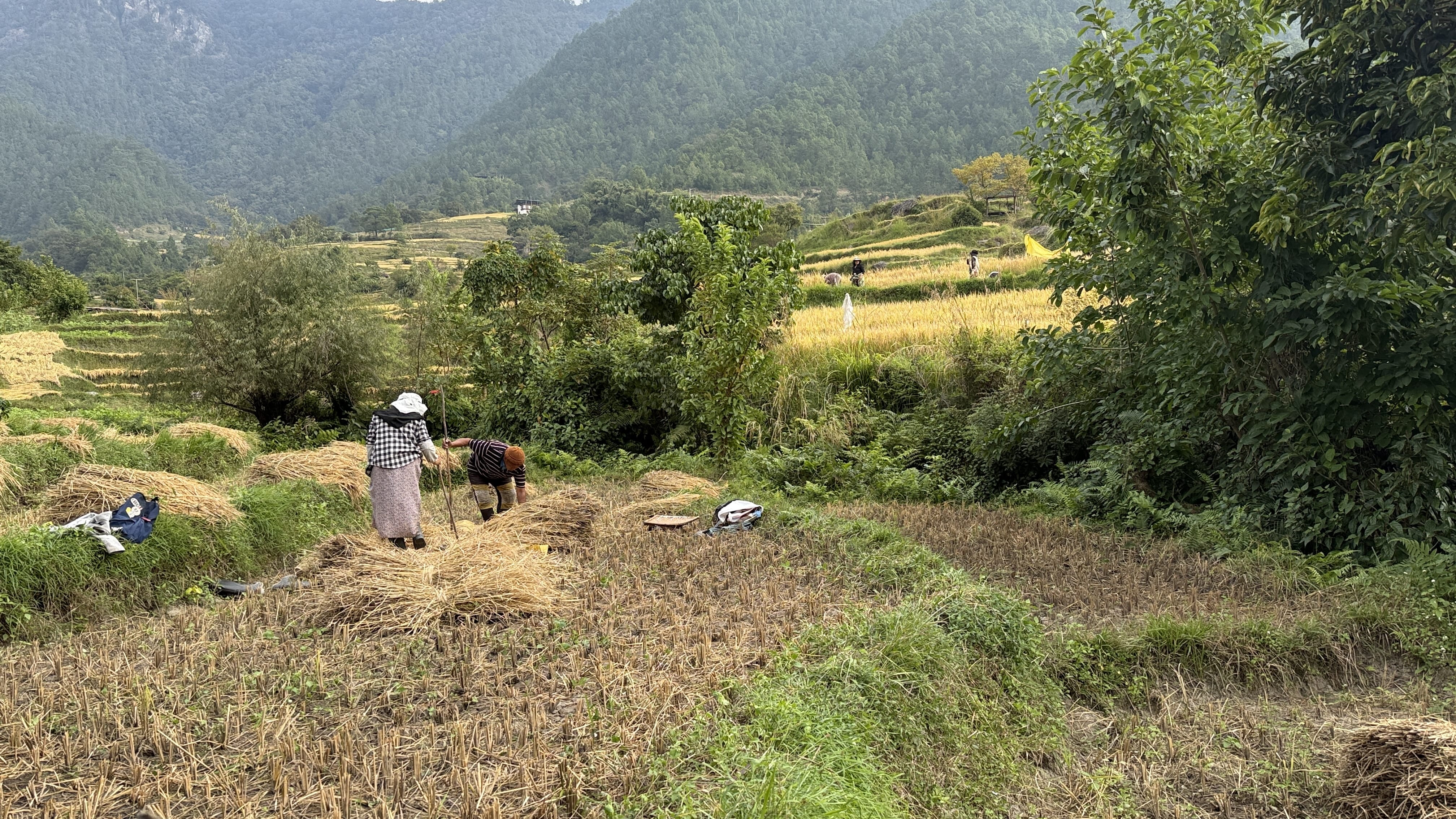
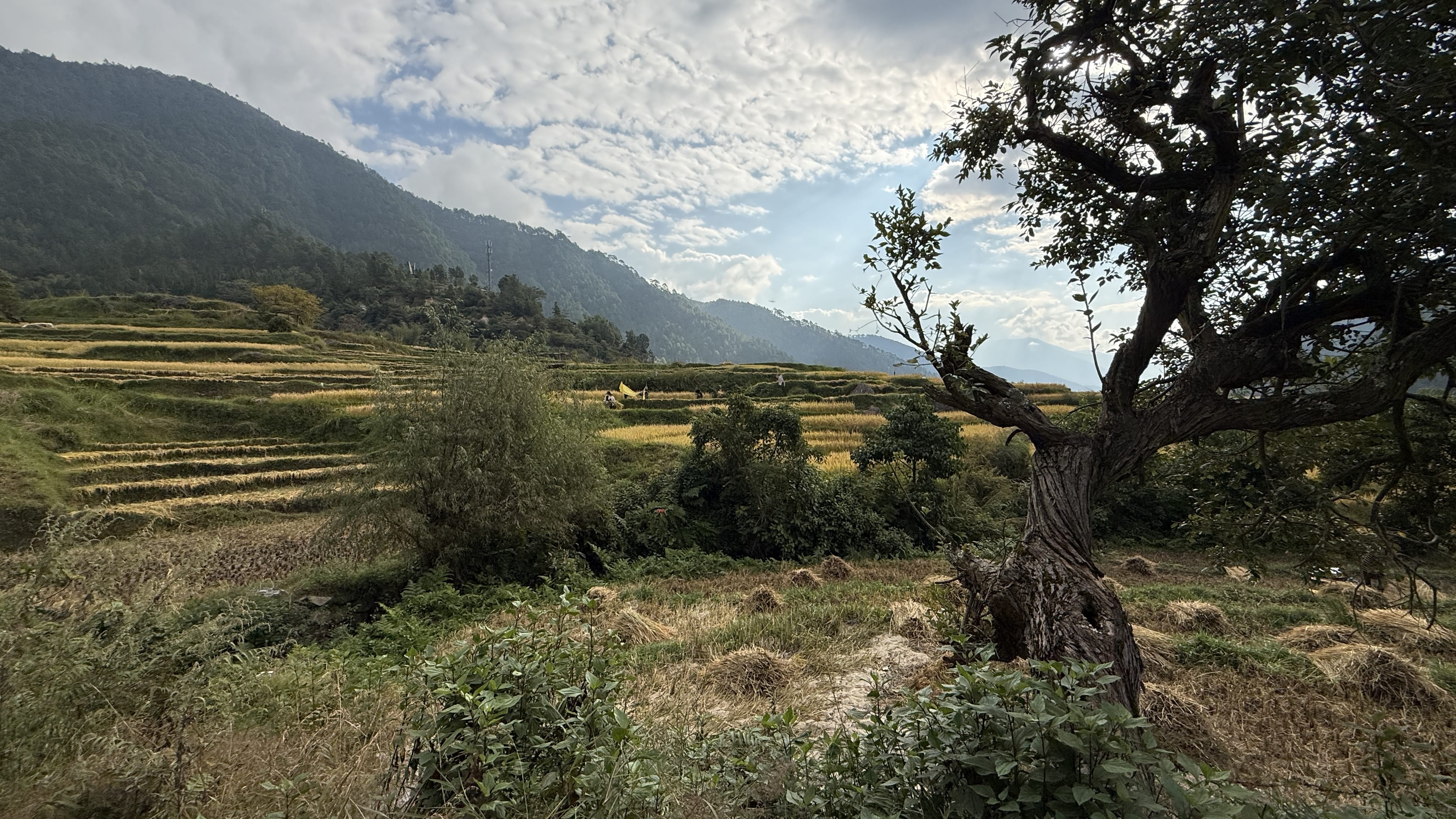
On the other side, the path began gently, winding through terraced farmland where red and white rice lay spread out to dry in the sun, the fields stepping down the hillside in neat, layered rows. Farmers worked quietly among them.
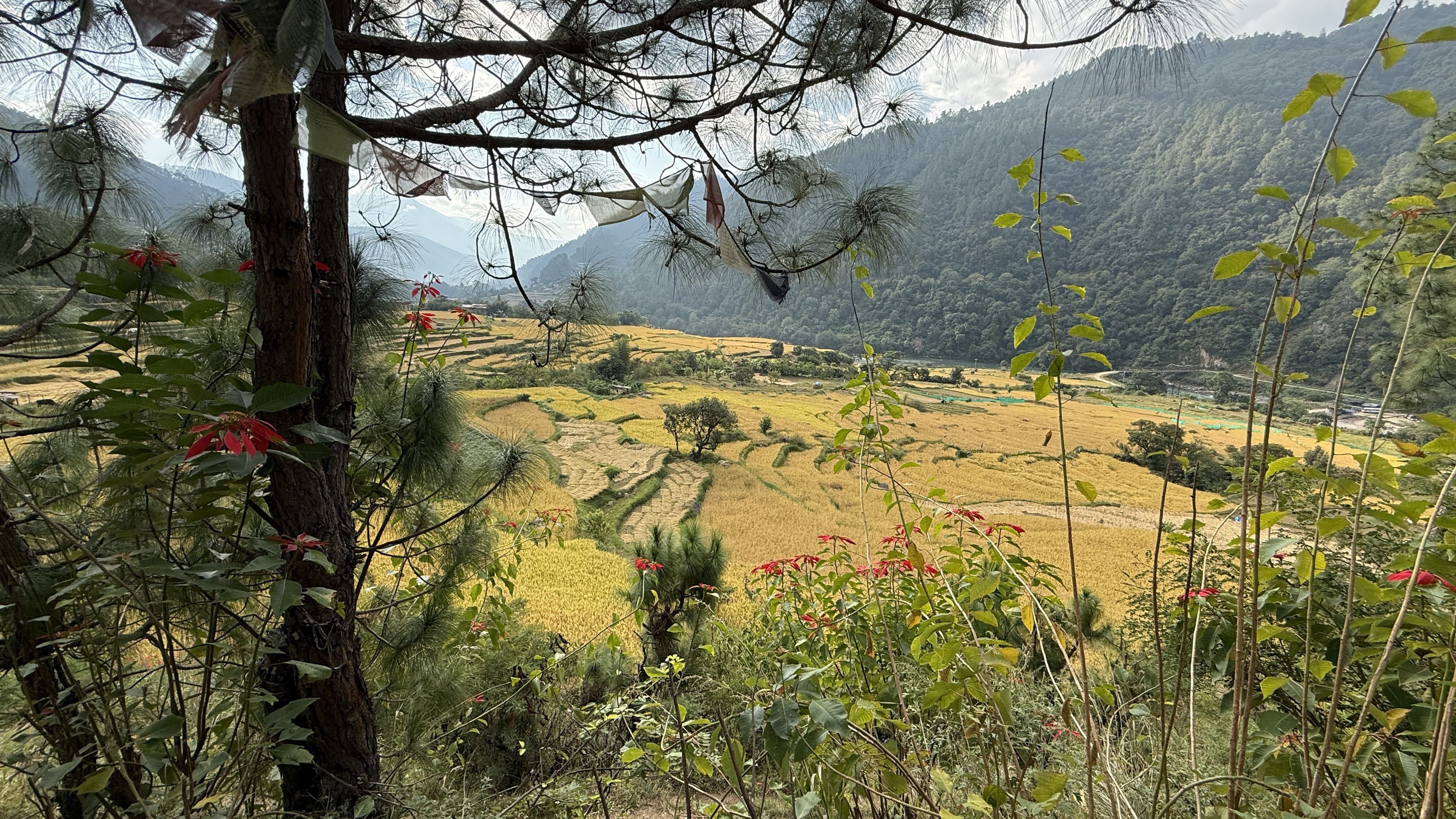
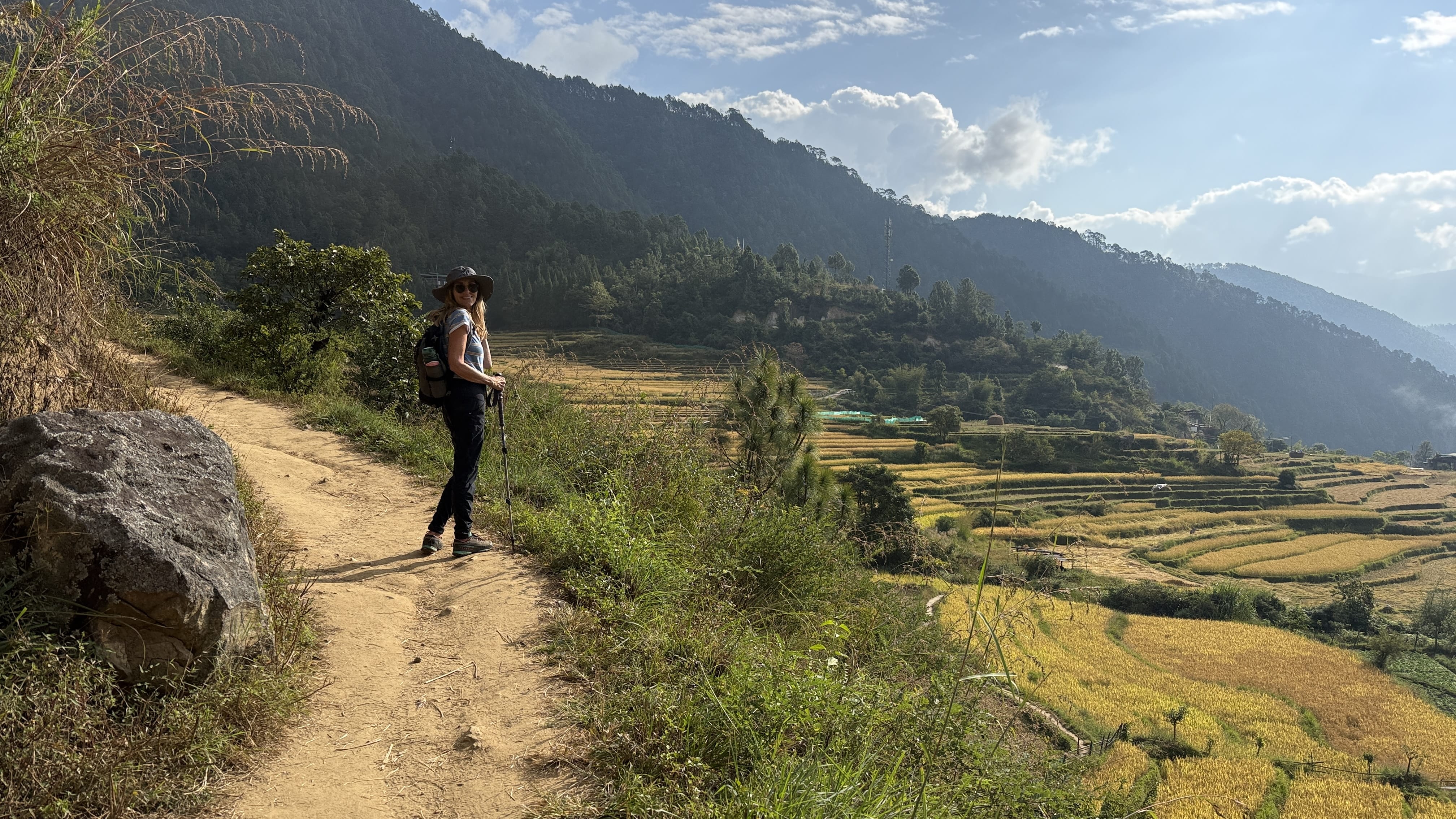
As the path climbed higher, the landscape slowly opened up. The river below came in and out of view, cutting through the valley, while layers of green hills and distant mountains stacked up one behind the other. The higher I climbed, the quieter it felt — fewer voices, fewer distractions — just birds and the steady rhythm of walking.
I tend to hike either a little ahead or a little behind, and I like that space to take it all in. I enjoy the social part of travel, but I’ve learned you miss a lot when you’re caught up in conversation.
By the time I reached the top, the chorten felt almost suspended above the valley, bright and intricate against the muted greens and golds of the terraced fields below. It was beautiful, but also quietly calming.
After the hike, six of us decided to go white-water rafting on the Mo Chhu River, also known as the Female River. Most of the rapids were Class II, with a couple of Class III sections—nothing too wild, but still a lot of fun. Rafting is also done on the nearby Pho Chhu, the Male River,
I ended up on the back right side of the raft, which turned out to be the wettest place to sit. Oh, and our raft—it had definitely seen better days. The inflatable seat in front of me—the one you’re meant to brace your foot under—was about 50% deflated, but thankfully it never became an issue.
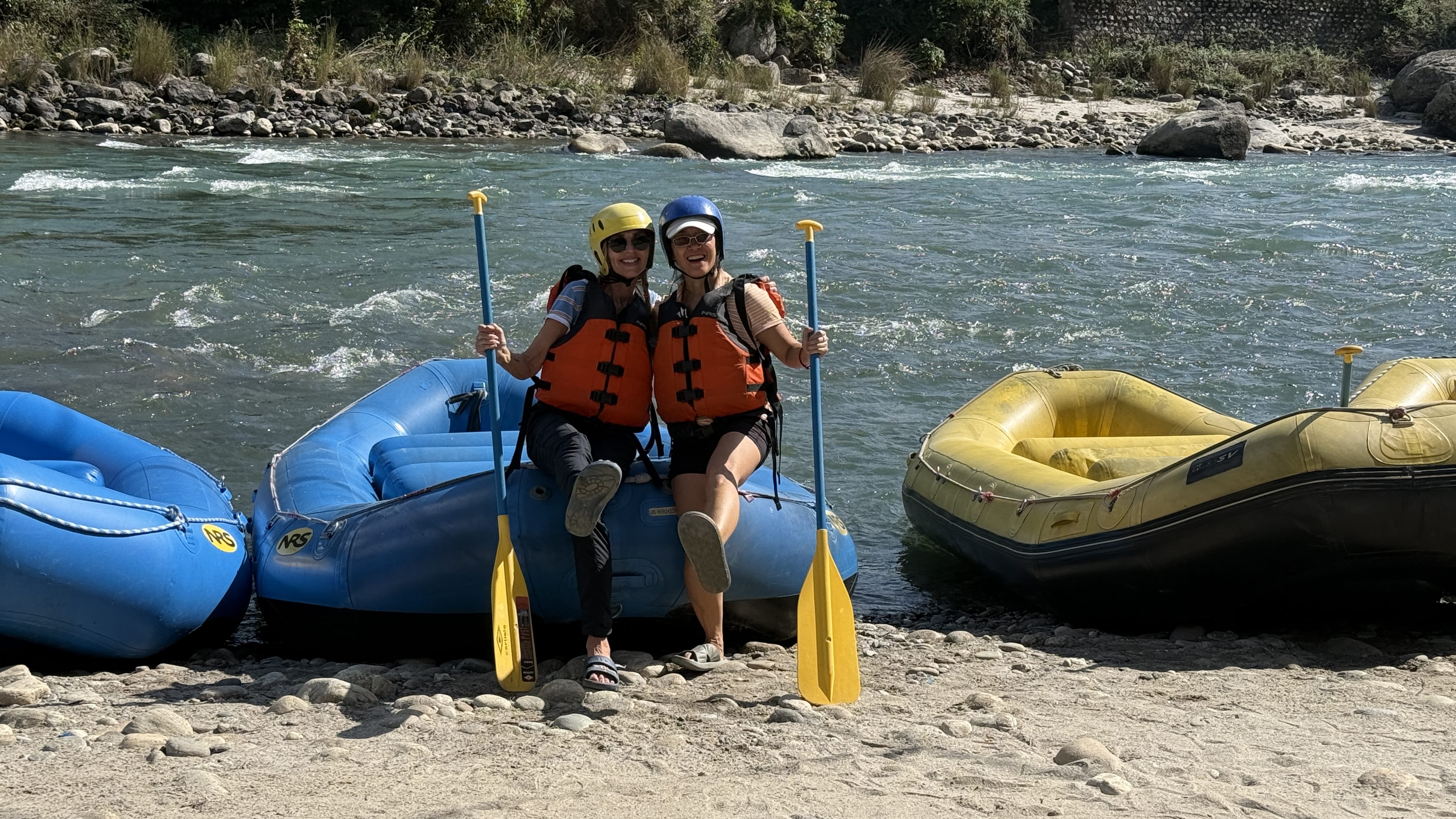
Drifting past rice fields, small villages, and forested hillsides, with Punakha Dzong gradually coming into view in the distance, felt surreal. I kept thinking, I’m rafting in Bhutan. One of those small, pinch-yourself moments.

Oh, and the raft I was riding in…when I watched them load it onto the top of the vehicle afterward, I laughed out loud. The bottom was held together with at least three long strips of duct tape, a few already peeling away. It made me grateful that only one of the seat in the raft had deflated. Still—duct tape and all—it was a fantastic ride.
After our rafting trip, we stopped for a picnic lunch by the river, which sounds idyllic. In reality, we were packed in at long fold-out tables on metal folding chairs under a canopy, surrounded by other tourists and a few locals. And lunch? Another buffet—this one just happened to be outdoors.
I’m not really complaining so much as noticing that by this point it had become kind of funny. I don’t think I’ve ever traveled anywhere where so many meals were buffets.
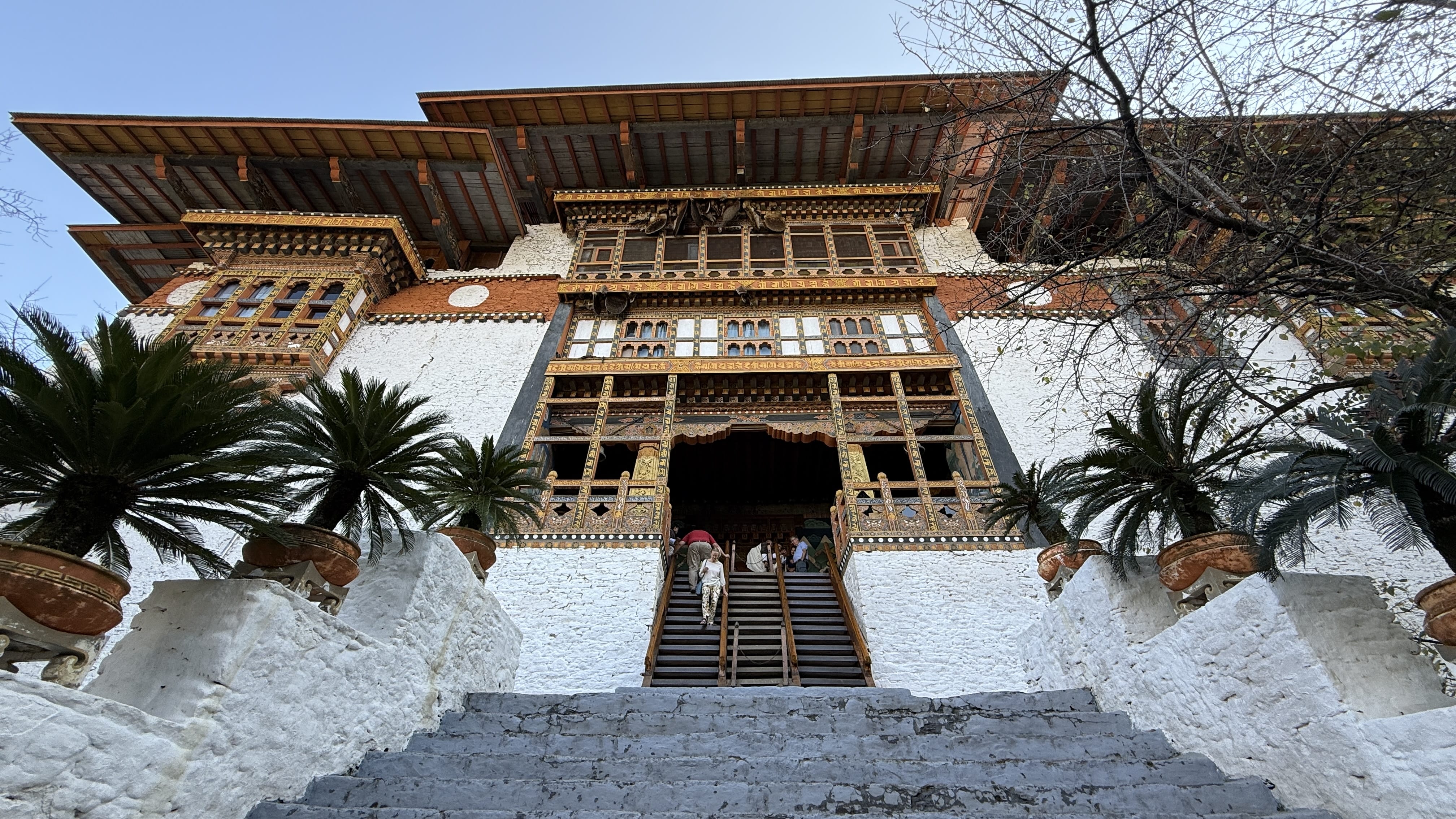
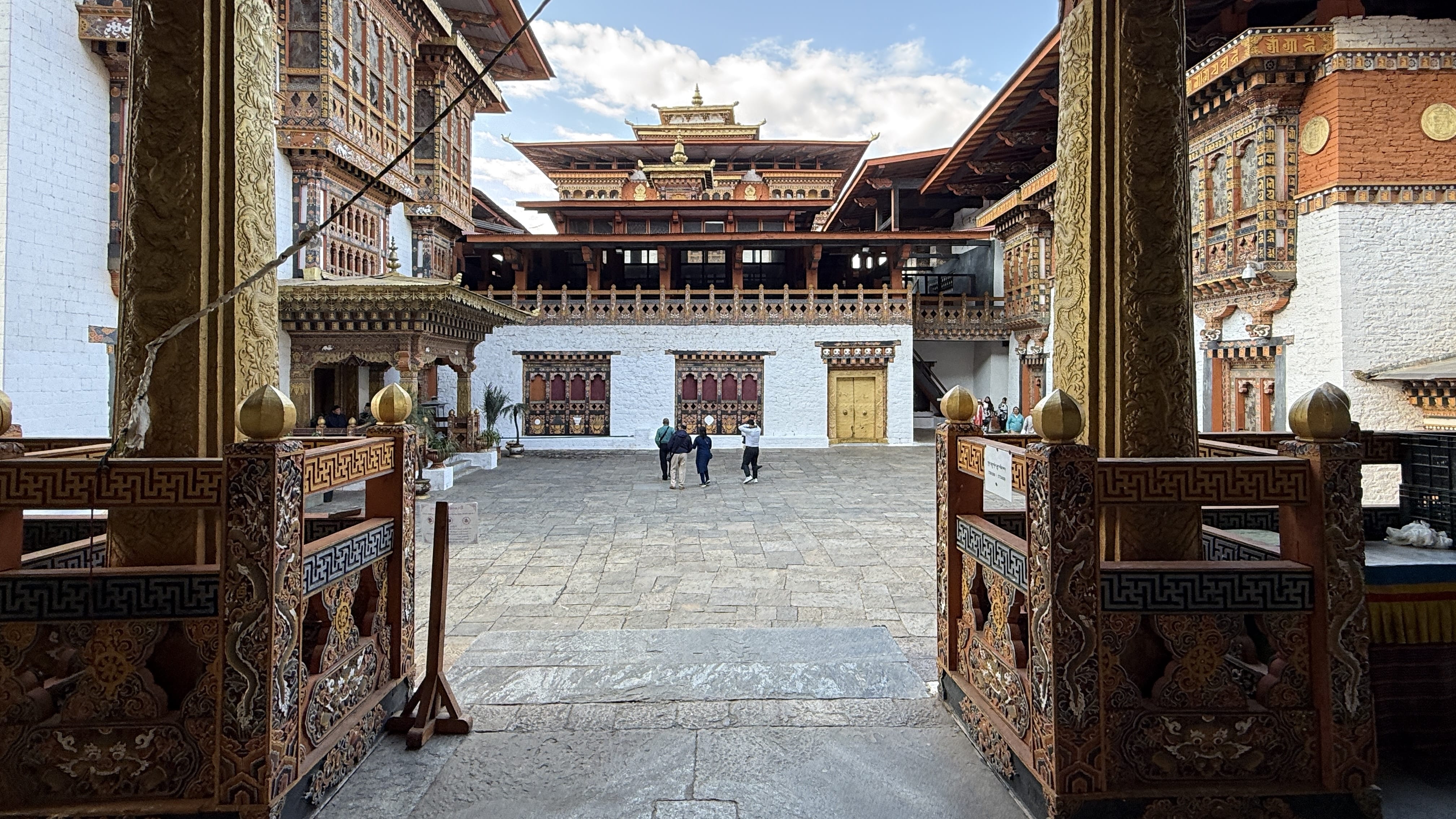
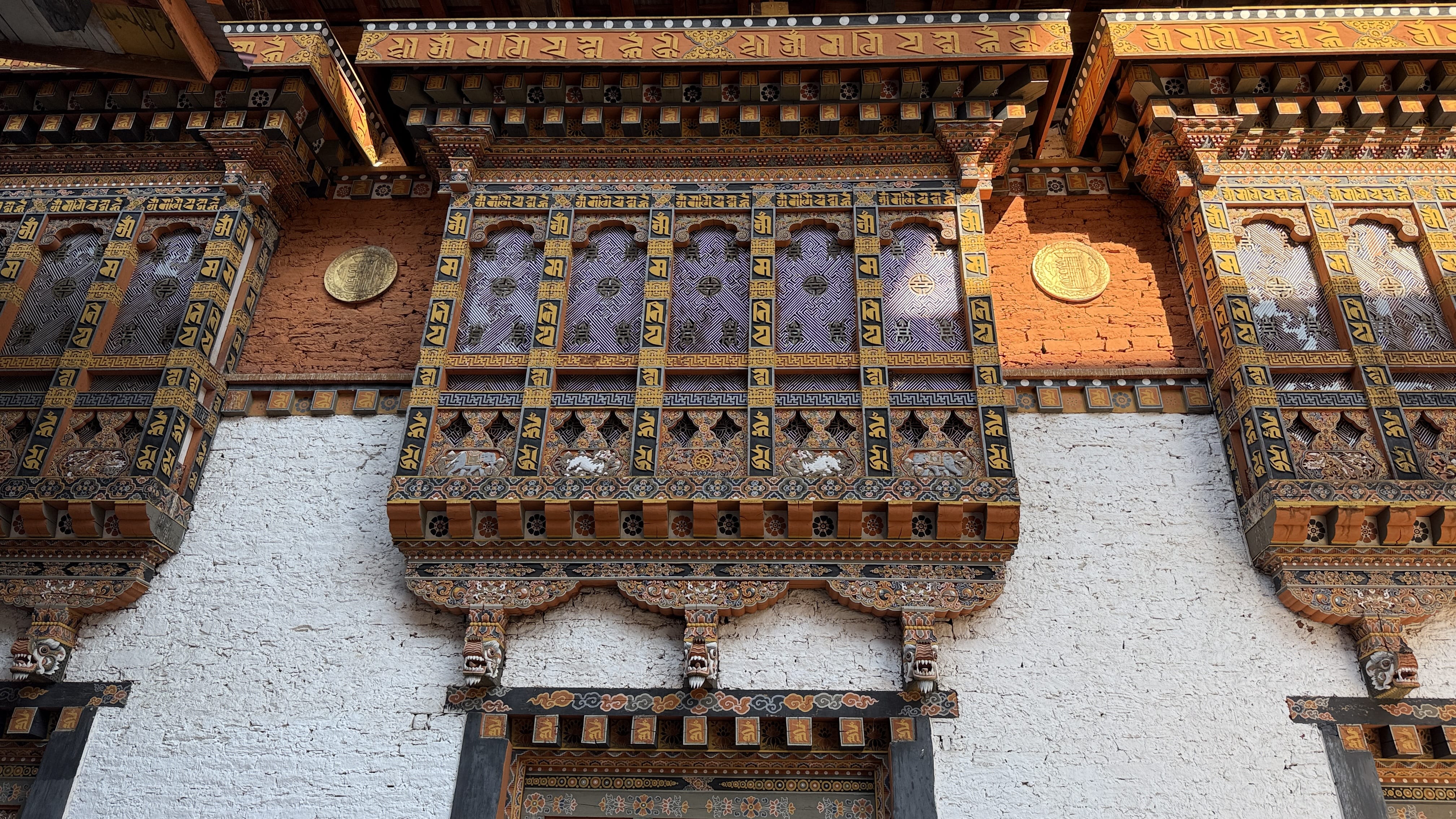
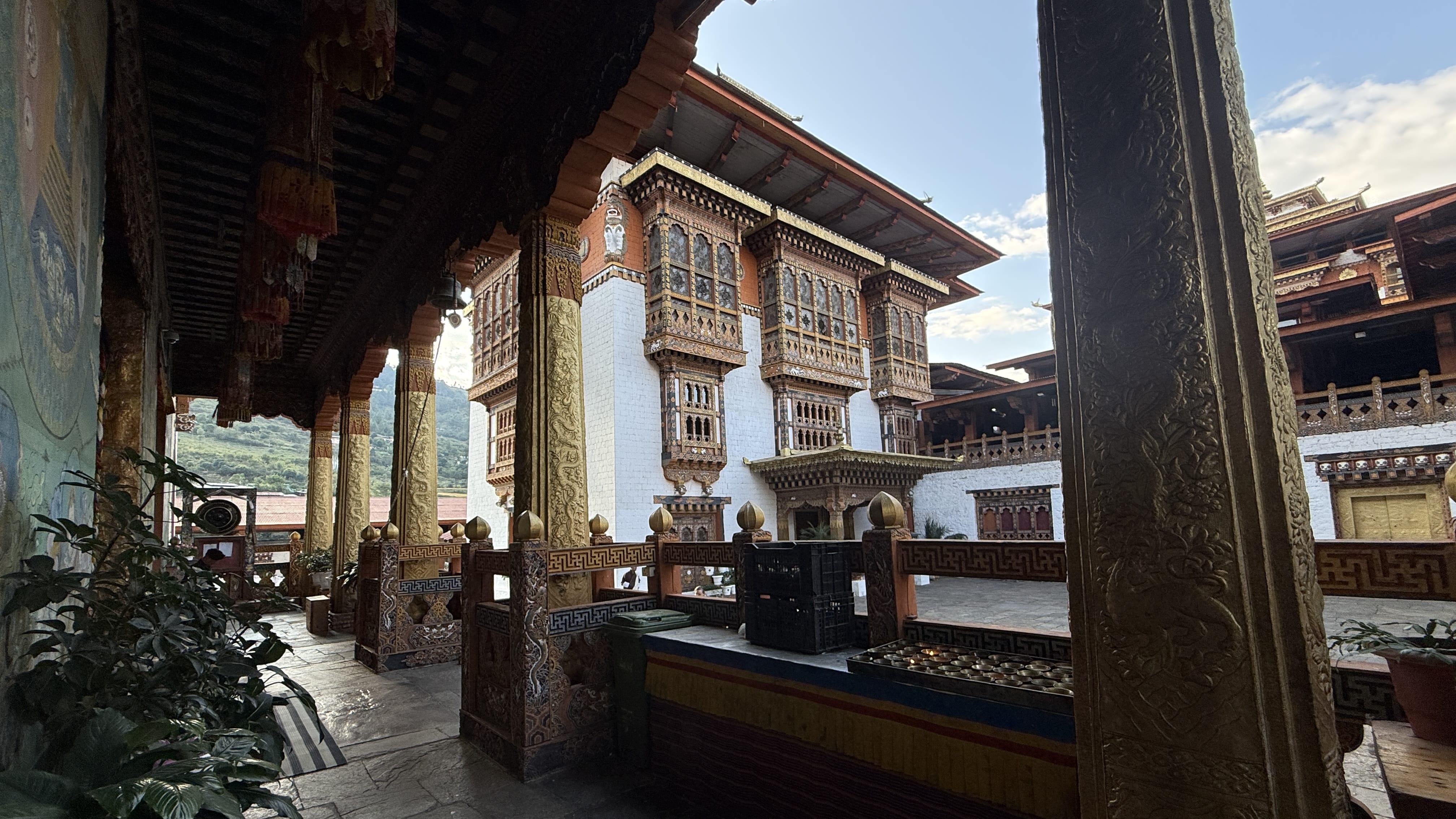
After lunch, we headed to Punakha Dzong, also known as the Palace of Great Bliss. I’d been impressed by every temple so far—we could even see this one from our hotel, since it sat directly across the river—but in person, it was on another level.

The dzong is massive, intricate, and genuinely stunning, from the 35 gold-topped columns in the main assembly hall to the detailed thangka-style paintings and the monumental statues of Guru Rinpoche, the Buddha, and the Unifier (Shabdrung Ngawang Namgyal).
It is also the winter residence of Bhutan’s monastic body,
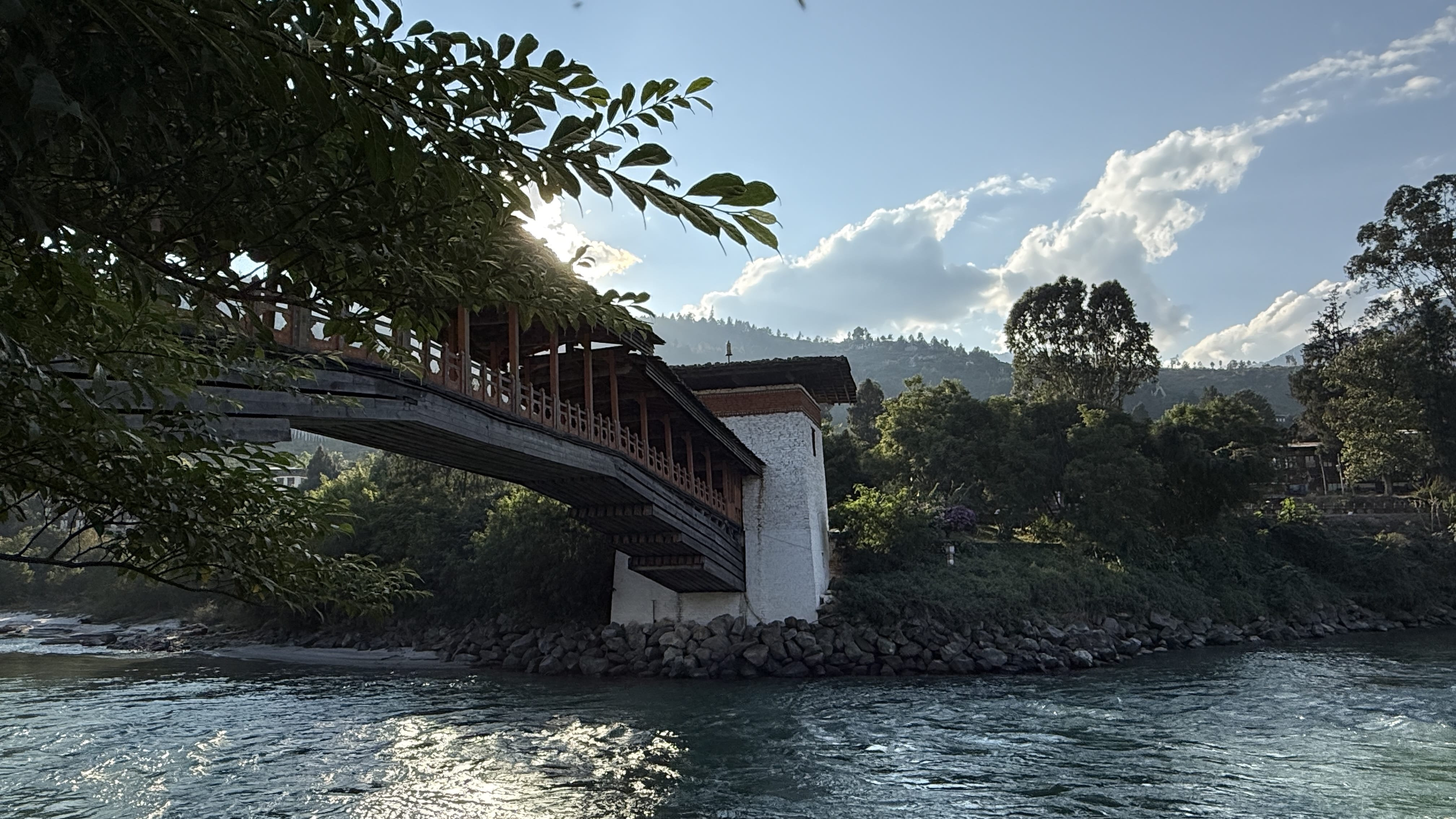
From the dzong, we followed a riverside path to the Punakha Suspension Bridge, one of the longest suspension bridges in Bhutan, stretching more than 500 feet across the river. It sways just enough to make it fun, but not enough to ever feel scary.

By the time we returned to the hotel, I had that tired-but-happy feeling that comes from a day that offers more than you can fully process at once. A hike, rafting, a dzong, a suspension bridge — Bhutan has alot to offer.
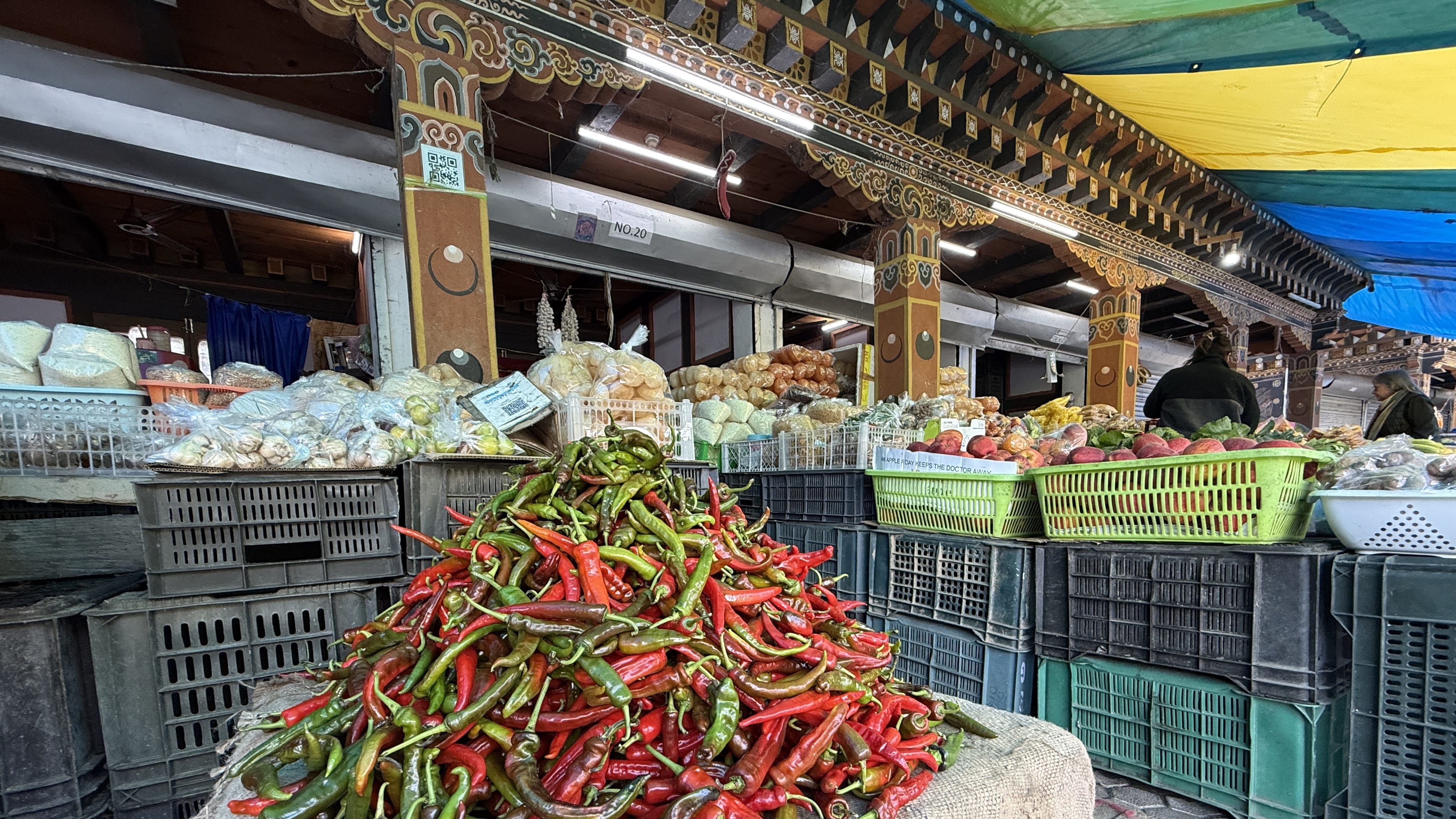
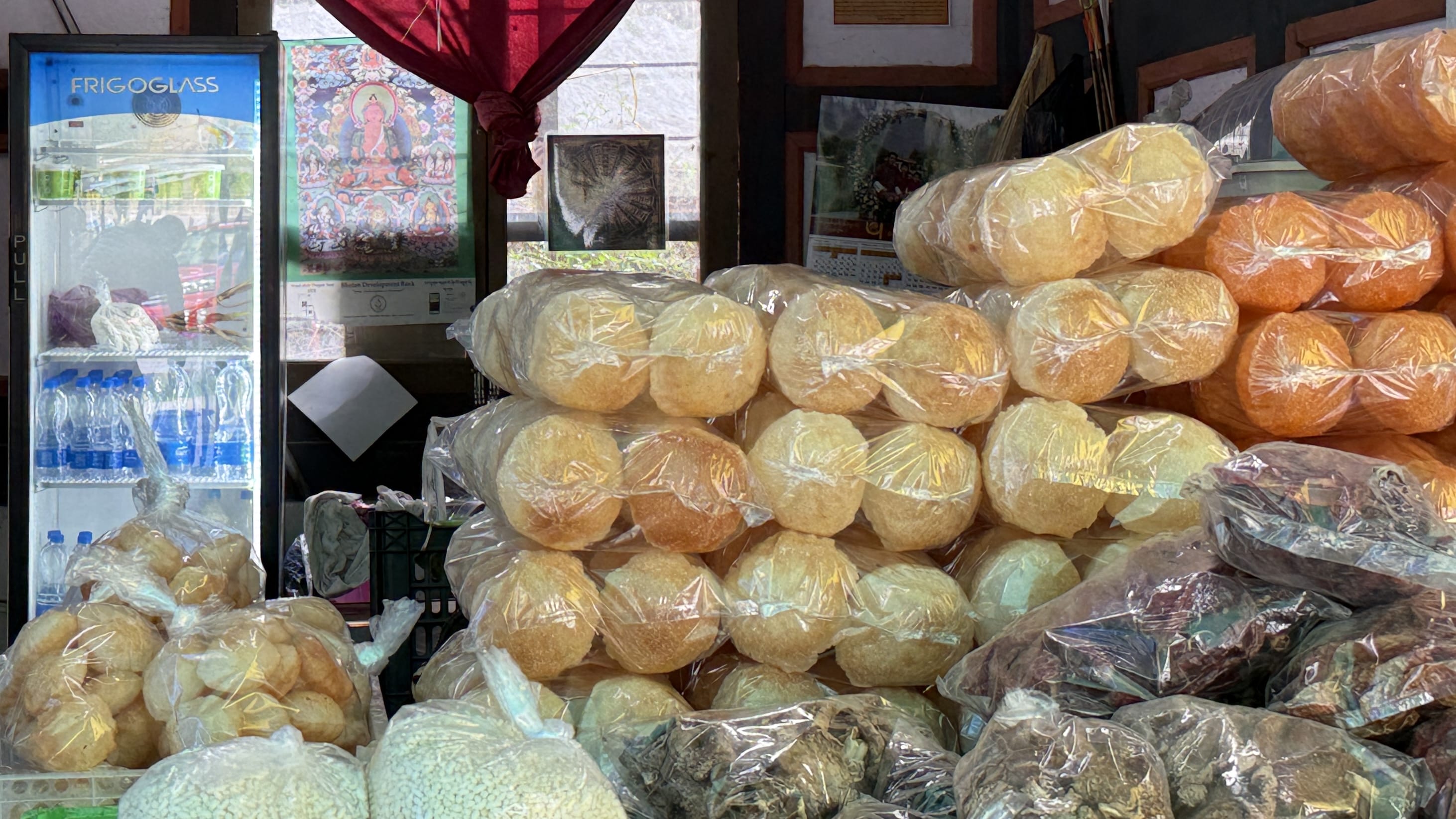
Our first stop was the Bichulum Farmers Market, small but lively, with tables piled high with fresh produce. There were also local snacks—puffed rice balls, roasted peanuts, and brightly colored khabsay, the deep-fried noodle ribbons often made for Losar, the Bhutanese New Year.
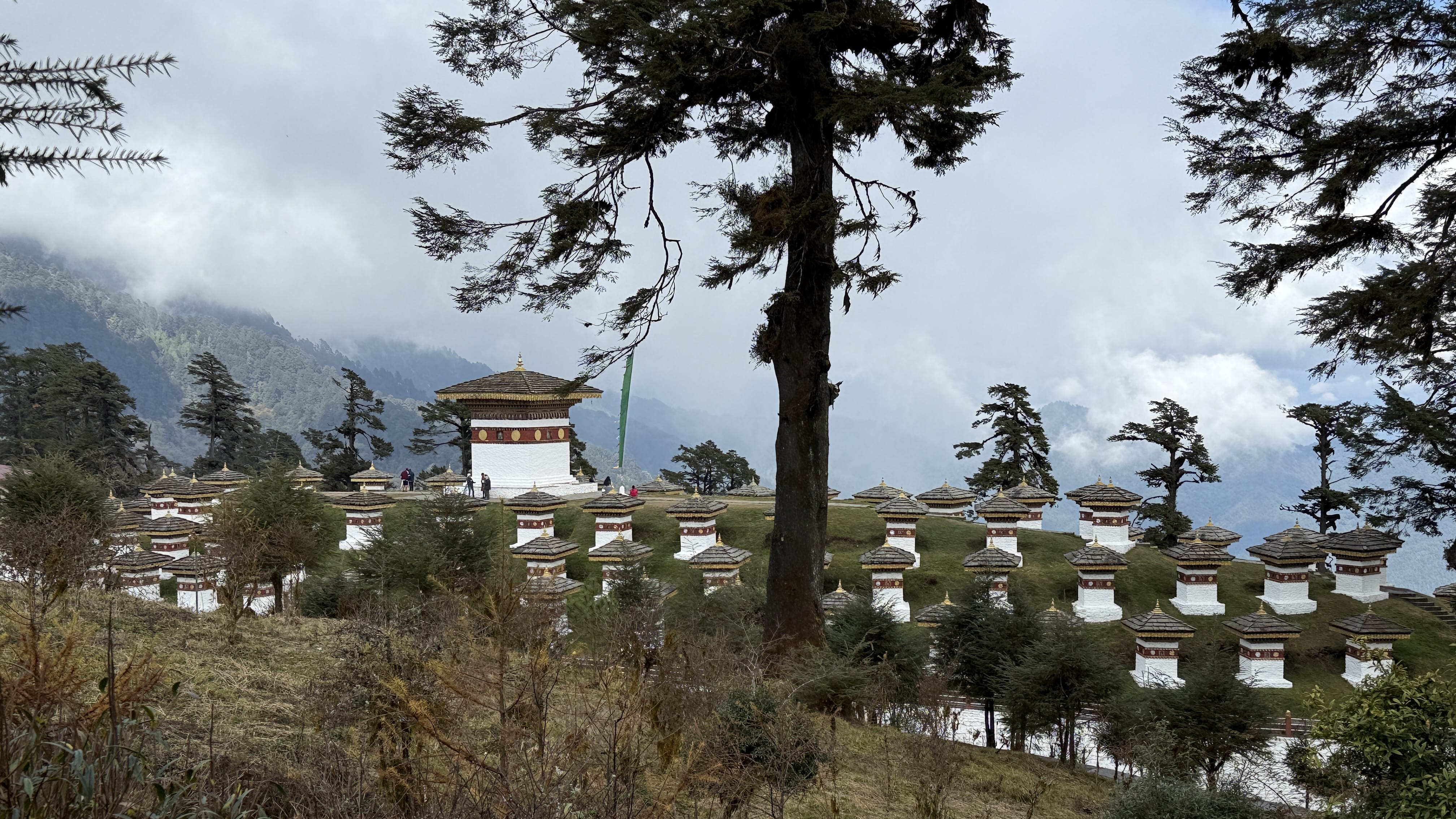
We stopped again at Dochula Pass, which felt much calmer than earlier in the trip. With fewer people around, it was easier to walk among the 108 chortens and actually take in the views. Every so often, the clouds shifted, offering brief glimpses of the Himalayas behind the mist.
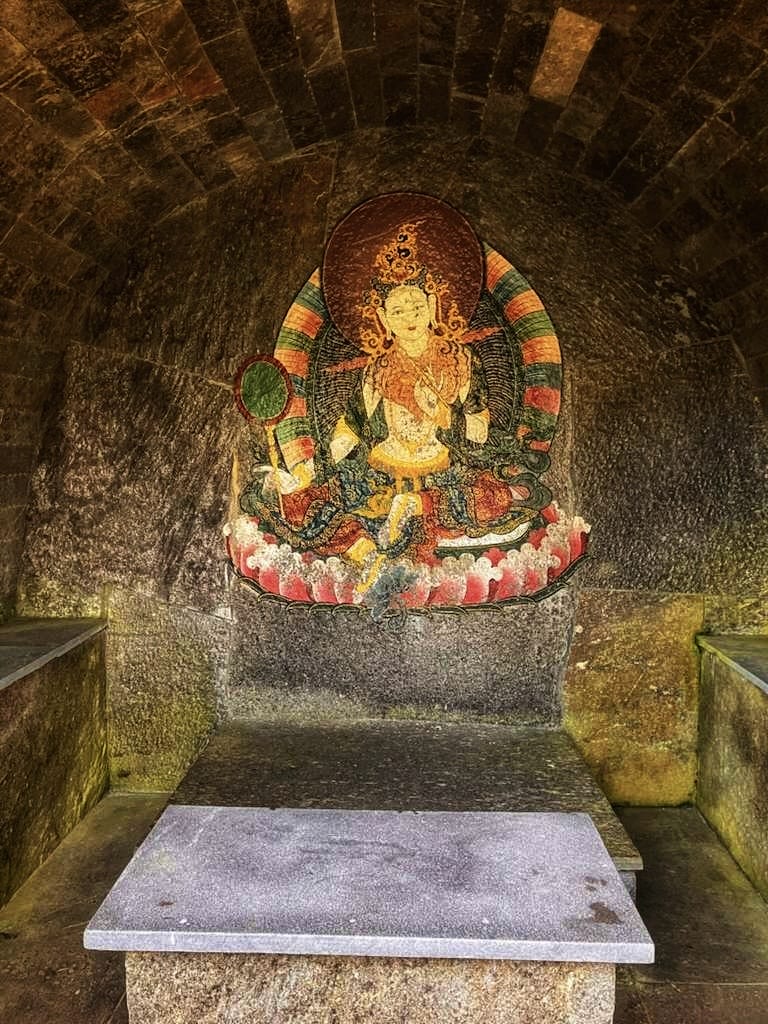
Across the road, our guide pointed out a narrow uphill path that I would have completely missed on my own. It led to an area of small meditation caves built into the hillside, It led to a small cluster of meditation caves built into the hillside, their entrances easy to overlook because they were carved directly into the earth, with moss and grass growing over the tops.
Inside, the walls were beautifully painted with Buddhist designs. If you didn’t know they were there, you could walk right past without ever noticing. I only had time to find two of them before we had to move on. I would have loved more time to wander up there.
After lunch, we stopped at Buddha Dordenma, the massive statue overlooking Thimphu — 169 feet tall, sitting high above the city.

Inside, the statue opens into a temple-like interior filled with row after row of smaller Buddha figures — around 125,000 of them — arranged with careful symmetry and set behind glass in shelving that wraps around the space. There was gold everywhere. You’ll have to take my word for it (and my memory), because, as is usually the case, photography isn’t allowed inside.
The space was opulent, but it worked.
The interior also included several much larger statues—Buddha, Guru Rinpoche, and Zhabdrung Ngawang Namgyal—a combination we saw again and again in monasteries (or gompas) throughout Bhutan.
Our final stop before the hotel was Pangrizampa College of Astrology and Astronomy. The temple here felt noticeably darker than others we’d visited — deep blacks, rust tones, and earthier colors instead of bright reds and golds.

We’d been told we’d get astrology readings, which sounded fascinating… but what we actually got was the quick tourist version: lucky numbers, lucky colors, good days, bad days. Not the deep spiritual insight we’d imagined, but still an interesting stop — and the setting itself was beautiful.
By late afternoon, we were back in Thimphu for the night.
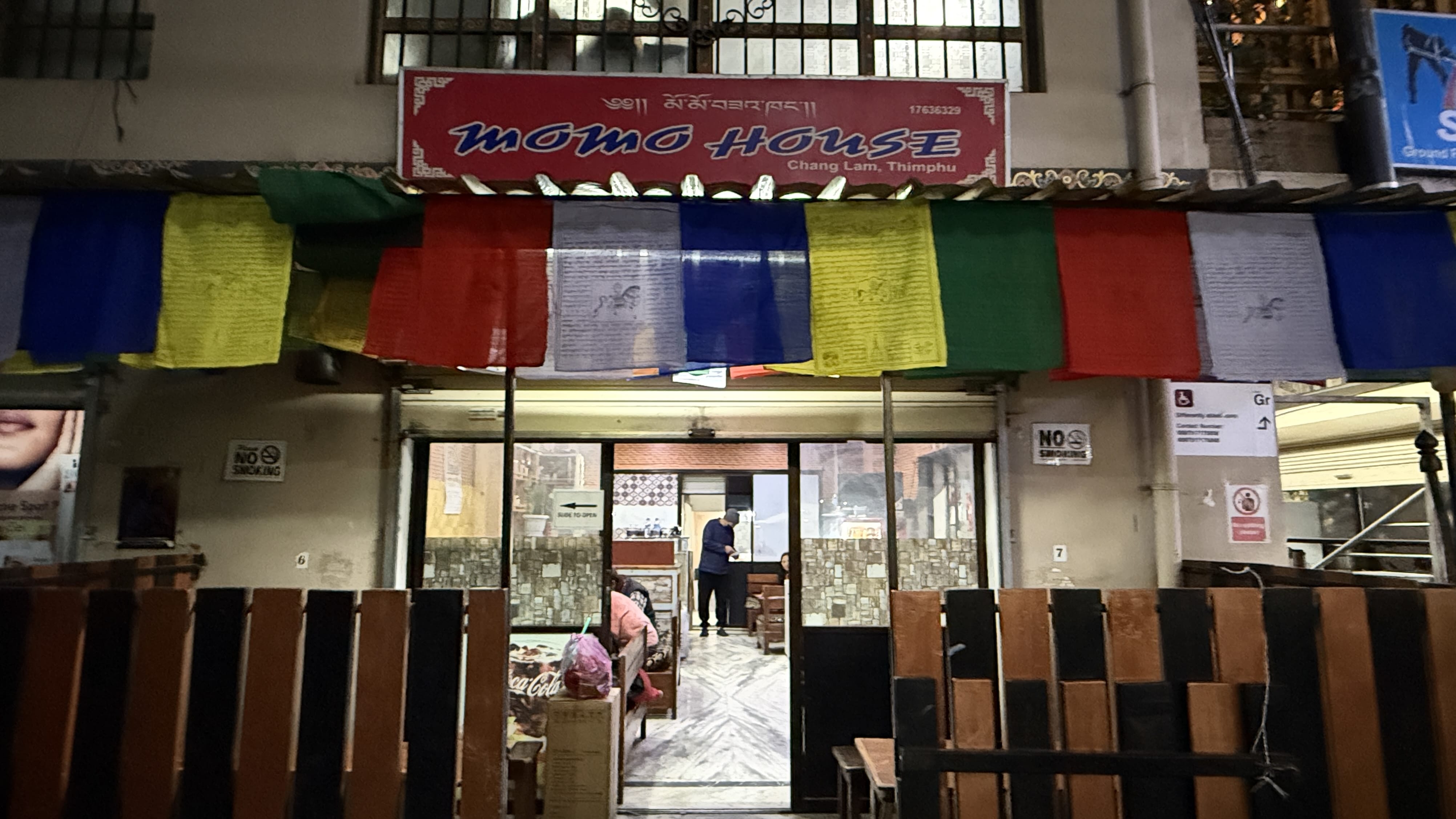
Back in Thimphu, I decided to skip the group buffet and find a small local spot instead—I was really craving momo. After wandering around for a bit, I stopped at a place literally called Momo House. It was busy and packed with what looked like locals, which always feels like a good sign.
I went inside, grabbed a table, and was just about to order when I was told they were completely out of momo for the day. At 6 p.m.
A restaurant called Momo House. With no momo. Go figure.
Tomorrow we’d head west to the Haa Valley, one of Bhutan’s quieter, least-visited regions.
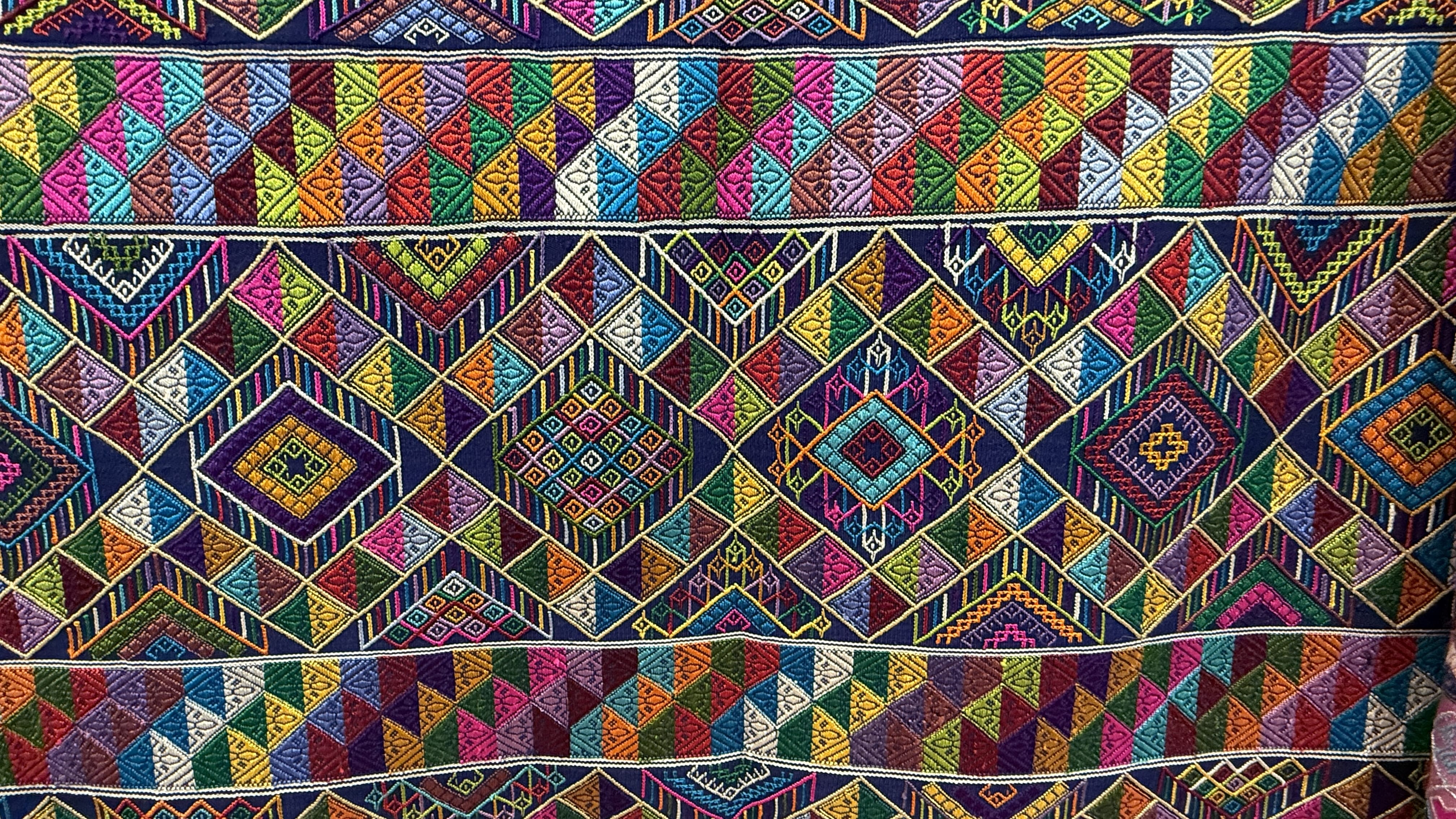
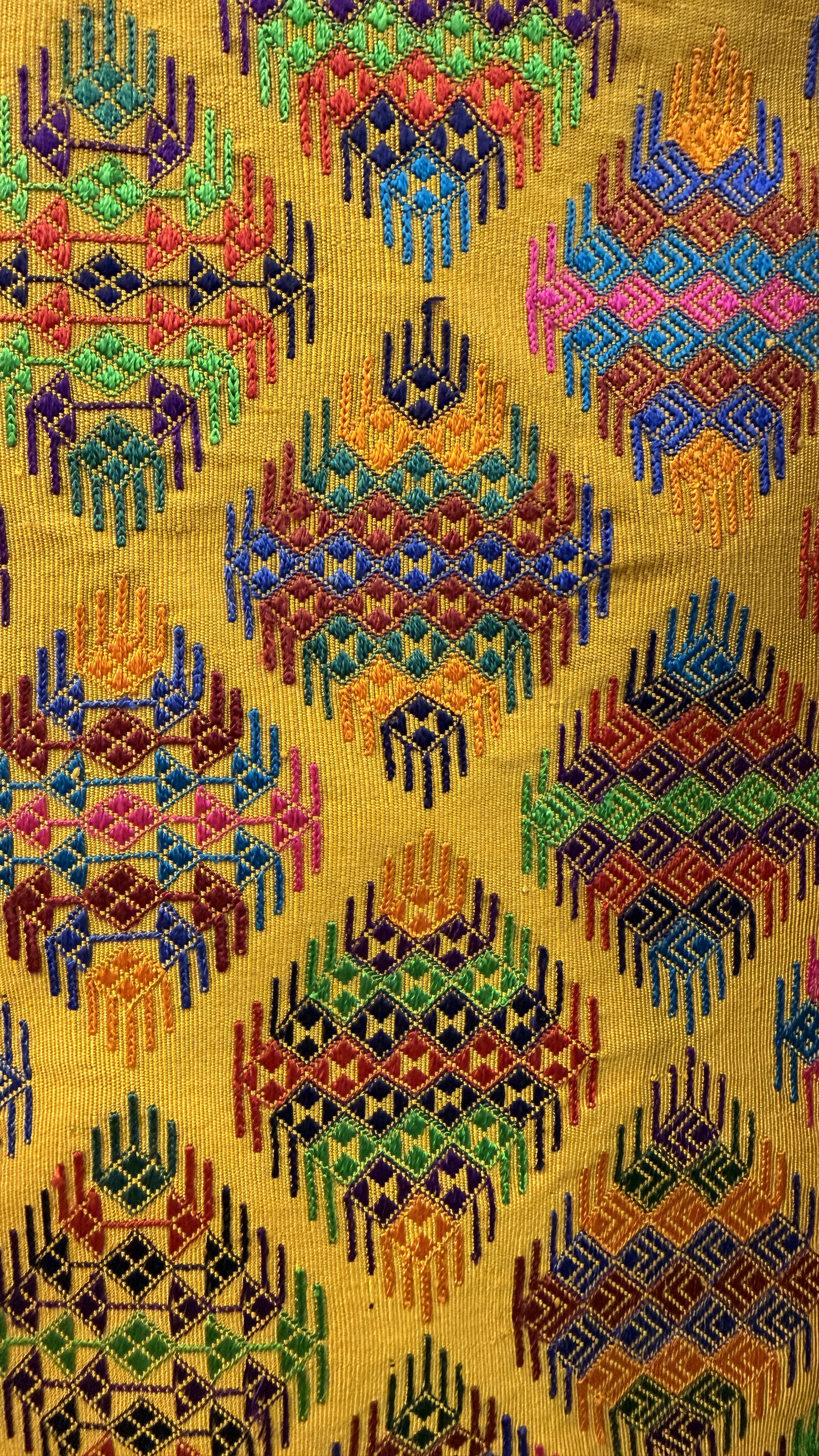
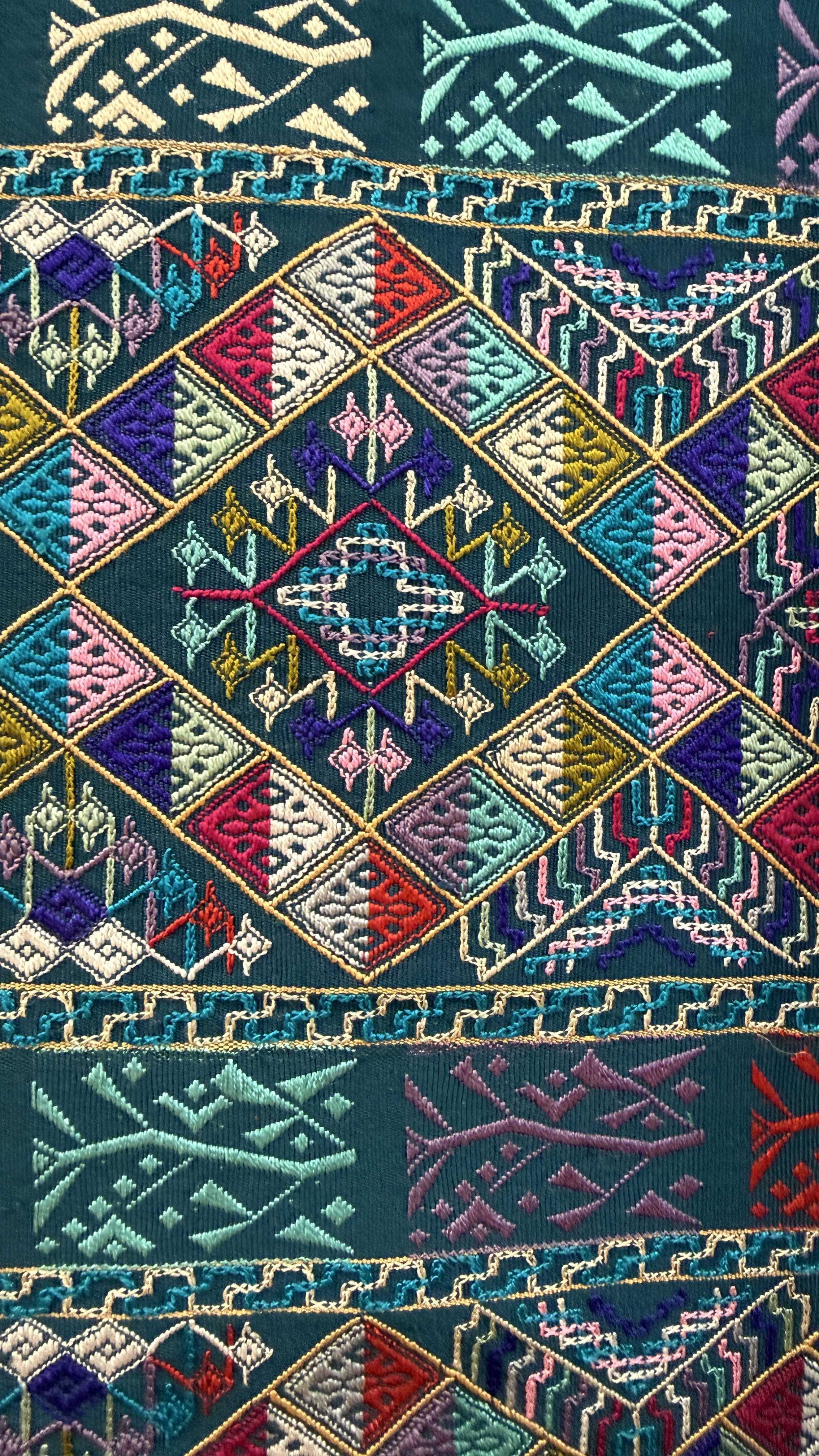
We started the morning with a visit to the Gagyel Lhundrup Weaving Centre, a small workshop where women create intricate textiles on backstrap looms.
Upstairs in the showroom, the finished pieces were striking—bold colors, geometric designs, and incredibly detailed workmanship.
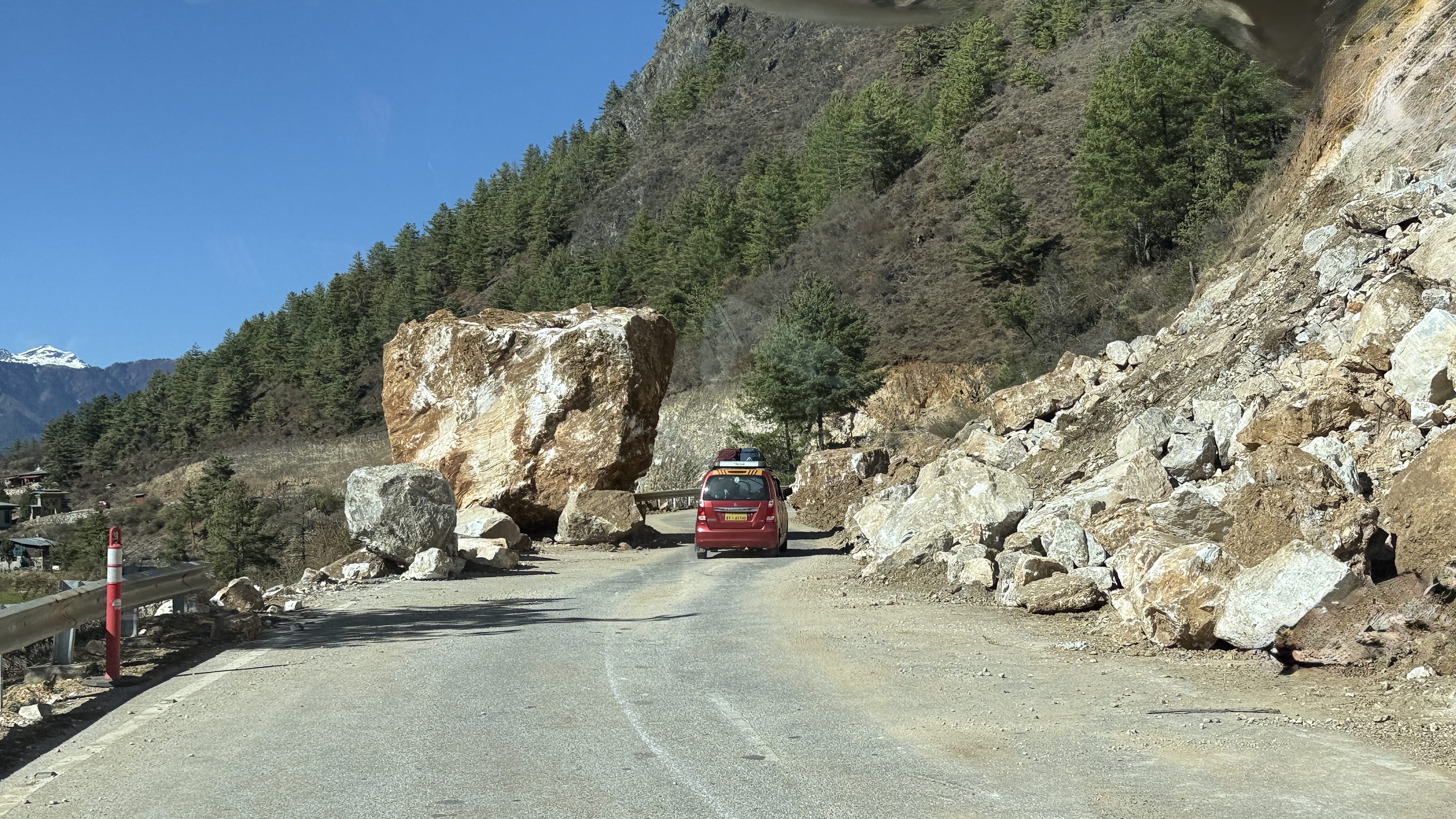
From there, we began the roughly 2.5-hour drive west toward the Haa Valley. The final 60 kilometers were intense — narrow, twisting mountain roads, often without guardrails, and scattered with debris from recent landslides.
There were easily forty or more landslide sections: boulders, tree trunks, entire chunks of hillside collapsed across the road. Each time I thought we’d passed the worst of it, another appeared around the next bend. Still, though, the scenery was beautiful — deep valleys, layered mountain ridges, and villages far below.
Near Haa Valley, rooftops were covered in bright red chilies drying in the sun, like a patchwork quilt spread across the hills. I’d seen chilies drying in other parts of Bhutan, but nowhere near this many rooftops covered at once. They clearly love those chili peppers.
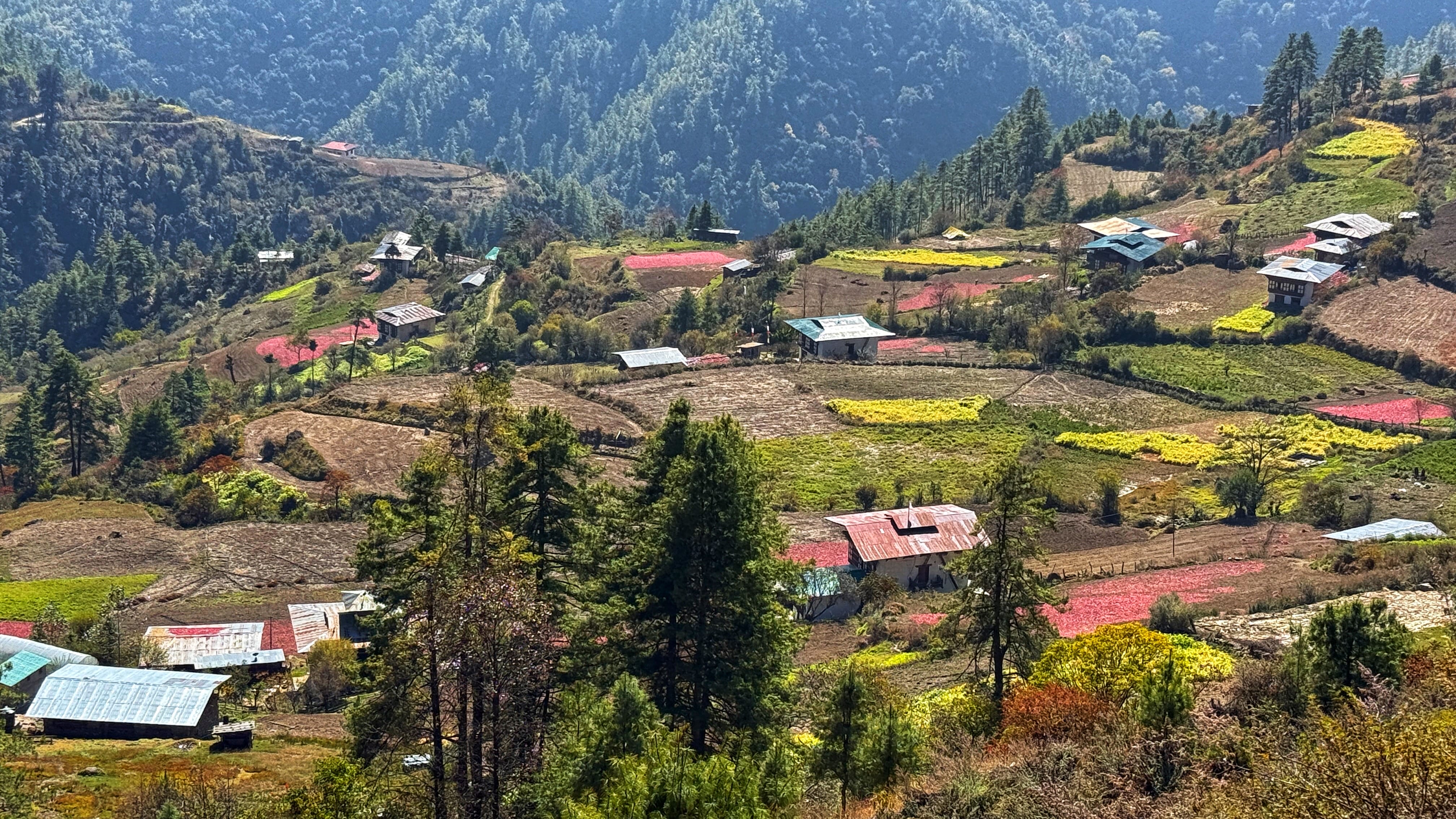
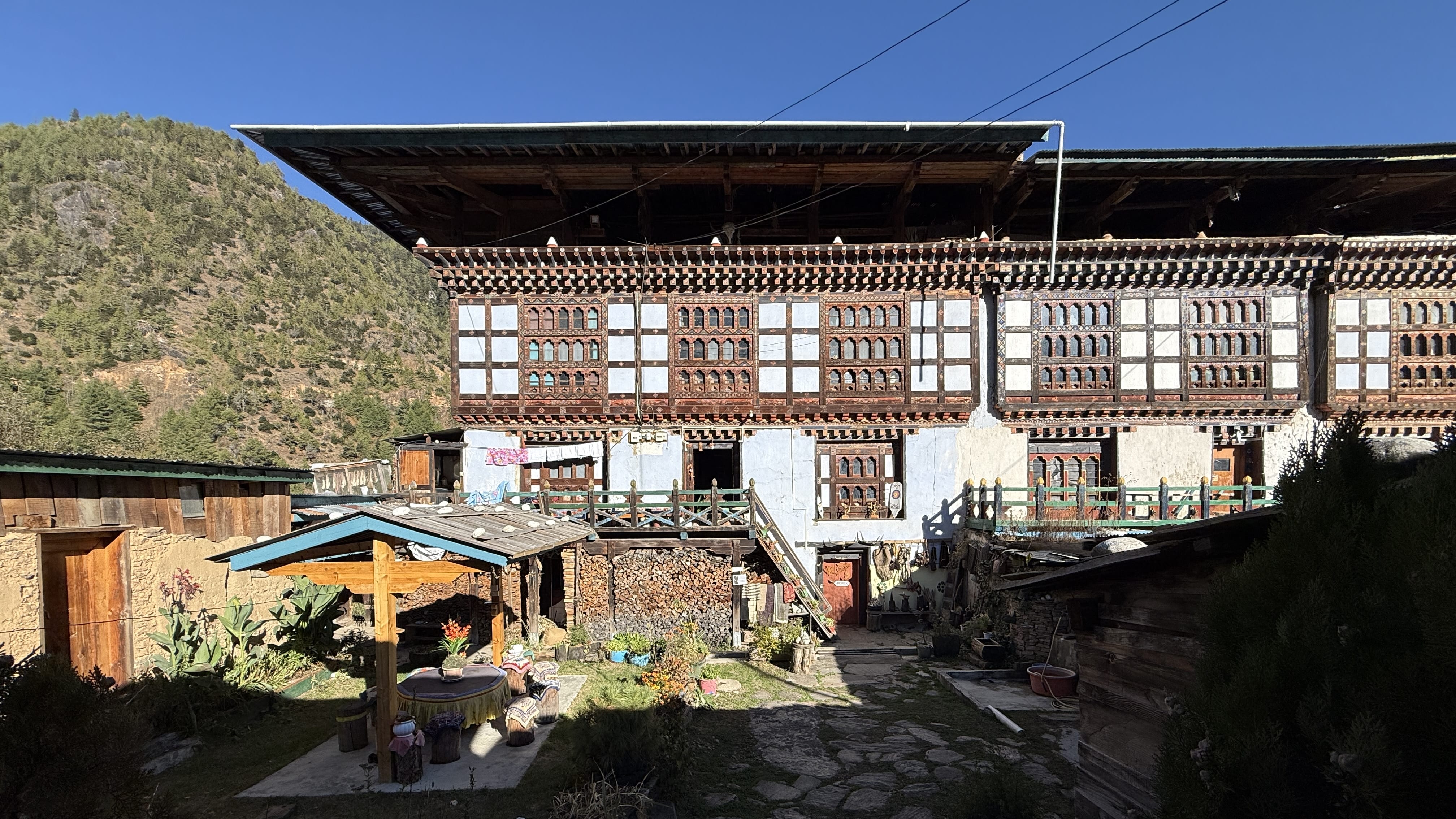
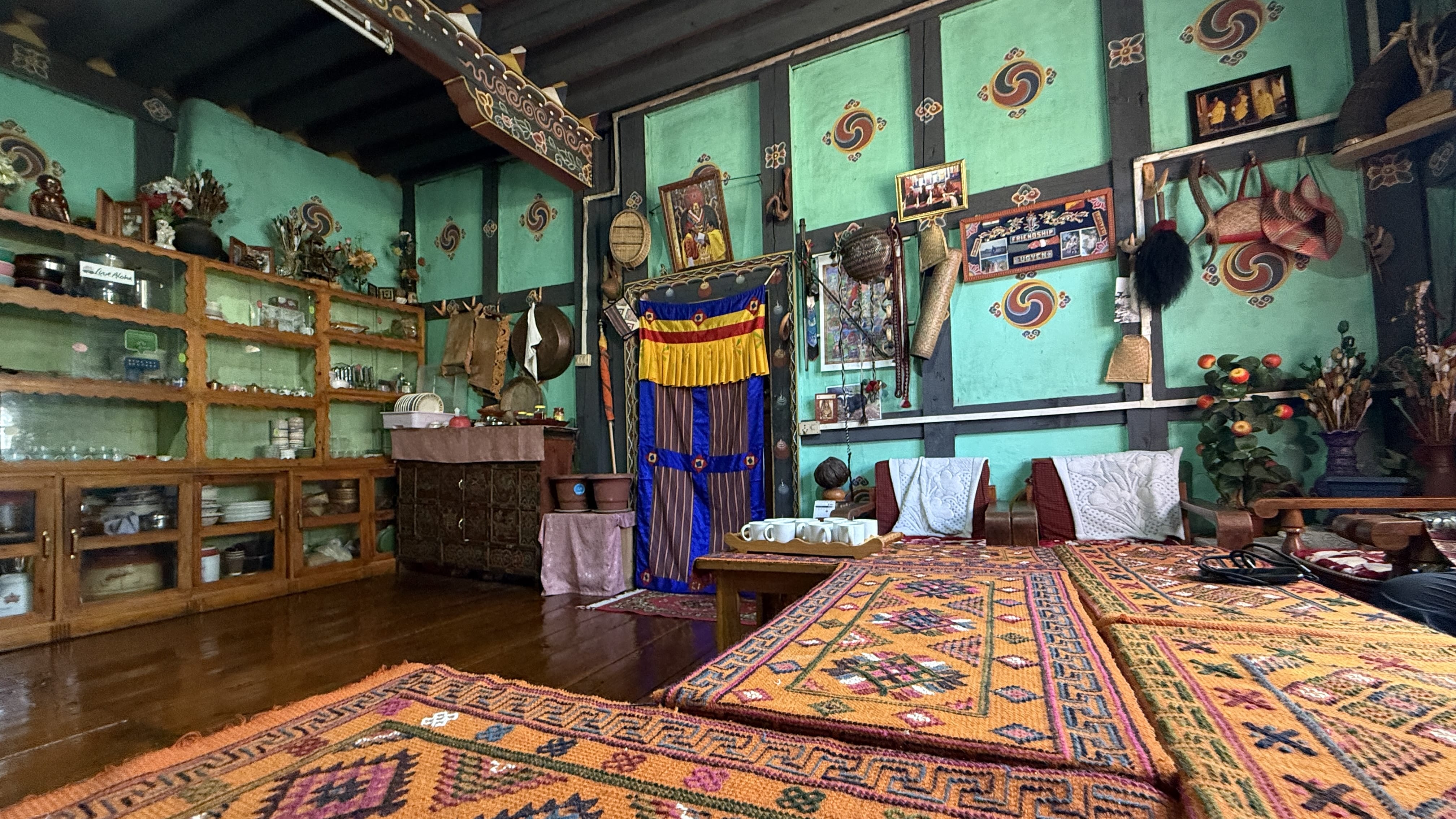
We finally reached Haa and checked into Ugyen Homestay in the mid-afternoon, where we were welcomed into the house by our hosts, Ugyen and his wife, Doley. We were first shown into a sitting room lined with long mats along the walls and offered tea and coffee, but it was cold, so we were soon moved into the kitchen instead.
Unlike the sitting room, the kitchen had a woodstove burning steadily, making the whole space wonderfully warm. After freezing in the other room, it felt perfect. Like in the sitting room, we sat on mats on the floor, coffee in hand, while Doley quietly continued preparing lunch. There were no tables, chairs, or couches like we’re used to back home—just floor seating.
Lunch turned out to be a full-on feast. Doley cooked everything on a simple two-burner stove. We had homemade buckwheat momos (something I’d read about and had been hoping to try), along with an assortment of Bhutanese dishes: red rice, sautéed turnip greens, cabbage with chilies, carrots, green beans, and a pot of ema datshi, the classic Bhutanese chili-and-cheese dish.
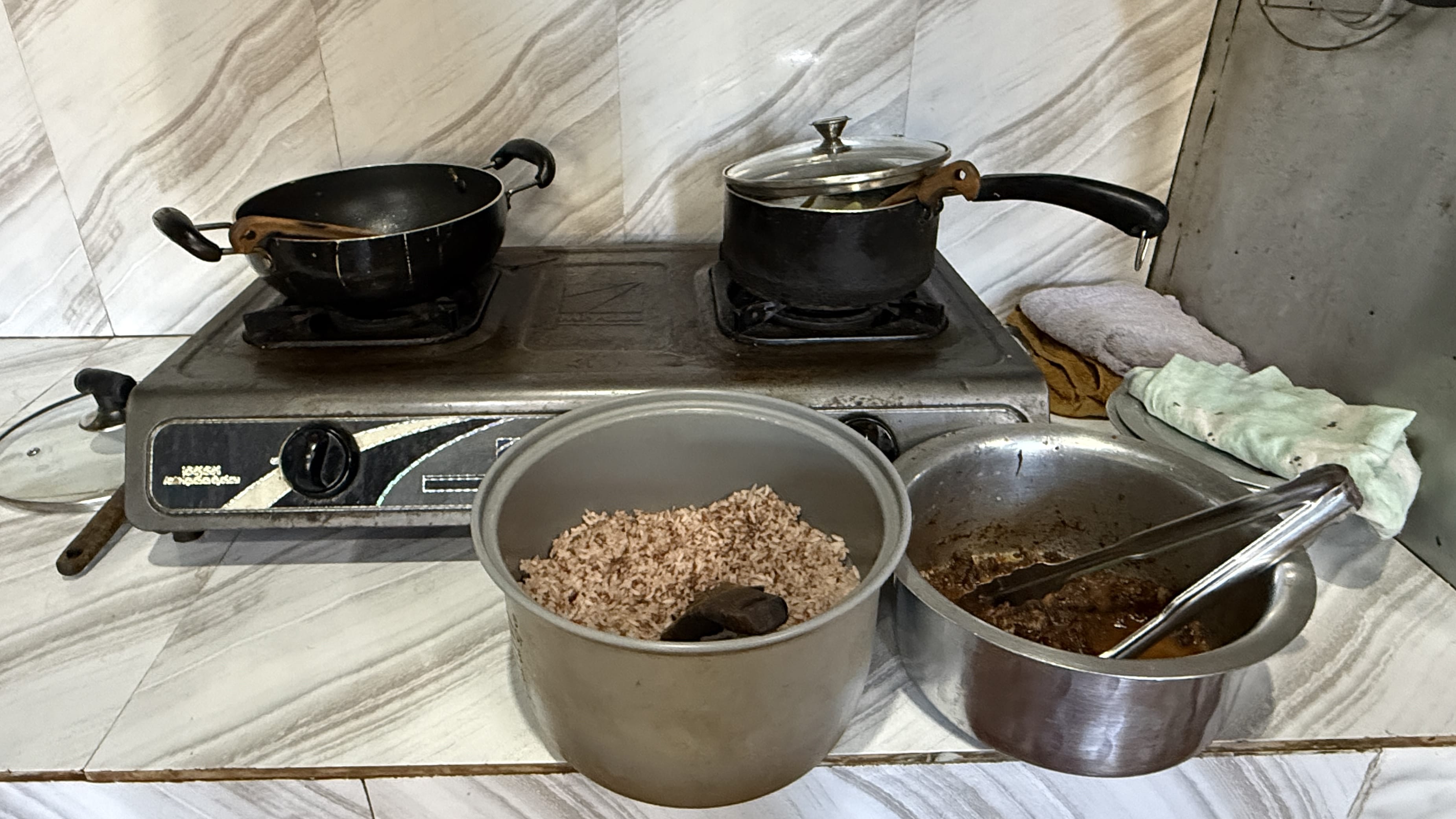
One of the pots held sikam paa, made with thick slabs of dried pork belly cooked until the fat turned almost jelly-like—not something I ate, but still interesting to see as part of a traditional home-cooked meal. The pots she cooked in doubled as serving dishes and were placed on the floor, with our mats arranged around the food. We were given utensils, though our hosts ate with their hands, as is customary here. Everything I tried was delicious.
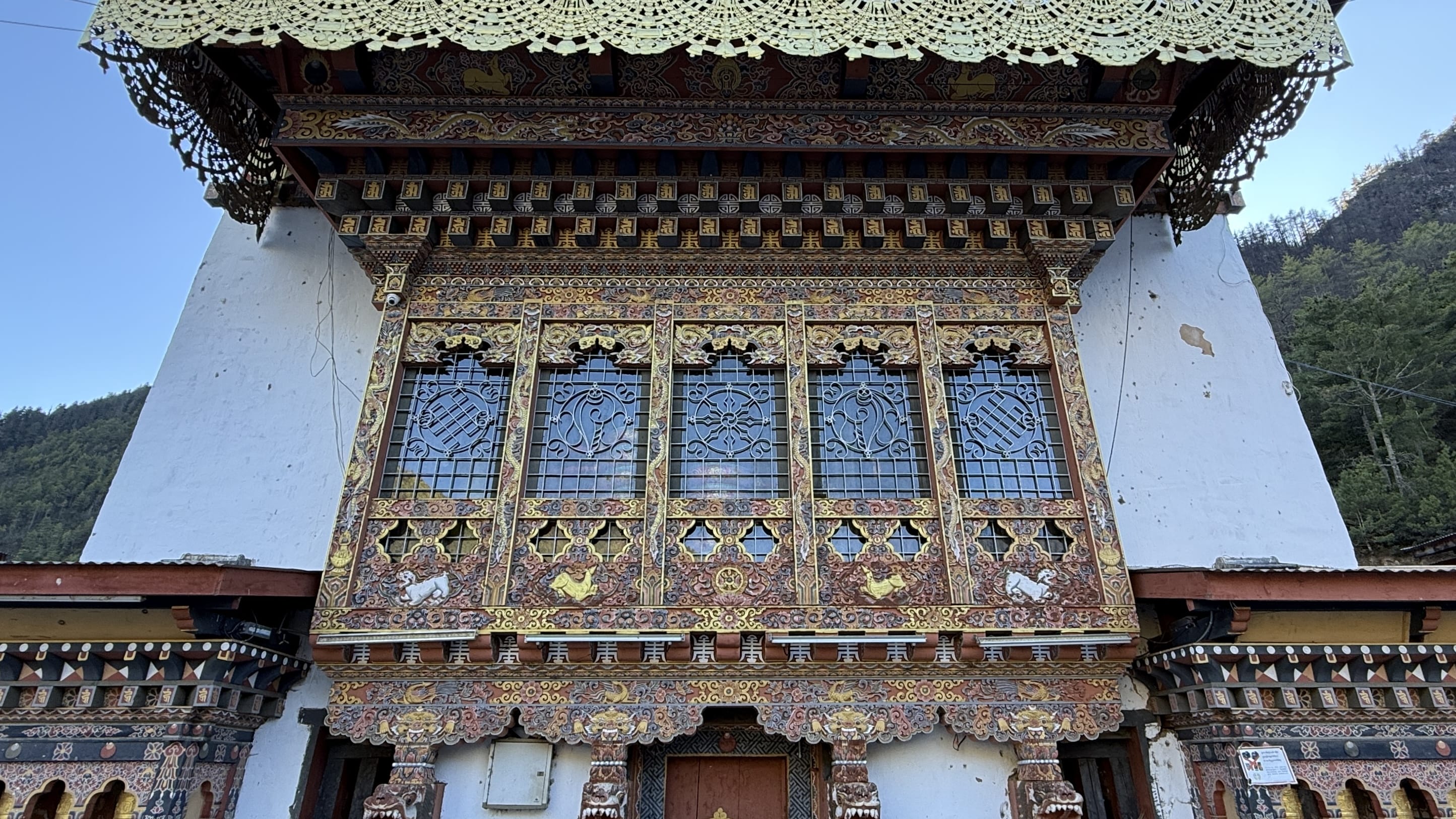
After lunch, we walked to Lhakhang Karpo, the White Temple, which dates back to the 7th century and was built during the reign of the Tibetan emperor Songtsen Gampo. Though parts of it have been restored, the temple still feels very old. Inside, the colors were darker and more muted than in other temples I’d visited—deep greens and worn earth tones that felt especially timeworn.

The White Temple is connected to its sister site, Lhakhang Nagpo, the Black Temple, located nearby. According to legend, a white dove and a black dove were released to determine the locations of the two temples; where each bird landed, a temple was built. Together, the two sites form the spiritual heart of the Haa Valley. We would visit the Black Temple the following day.
The Haa Valley has been open to foreign travelers for roughly 20 years (since around 2002), yet it still felt remarkably untouched: family farms, traditional houses, quiet villages, and long stretches of forested mountains.
While Doley prepared dinner, we shared some local beer as Ugyen told us about his family and the home they lived in—one that has been passed down through generations for over 200 years. It’s a very large home, with Ugyen and his family living on one side and, if I remember correctly, his uncle on the other.
After dinner, before heading to my room, I stepped outside. It felt like the perfect setting for looking up at the stars, and sure enough, it was. With no light pollution around, the sky was clear and filled with stars.
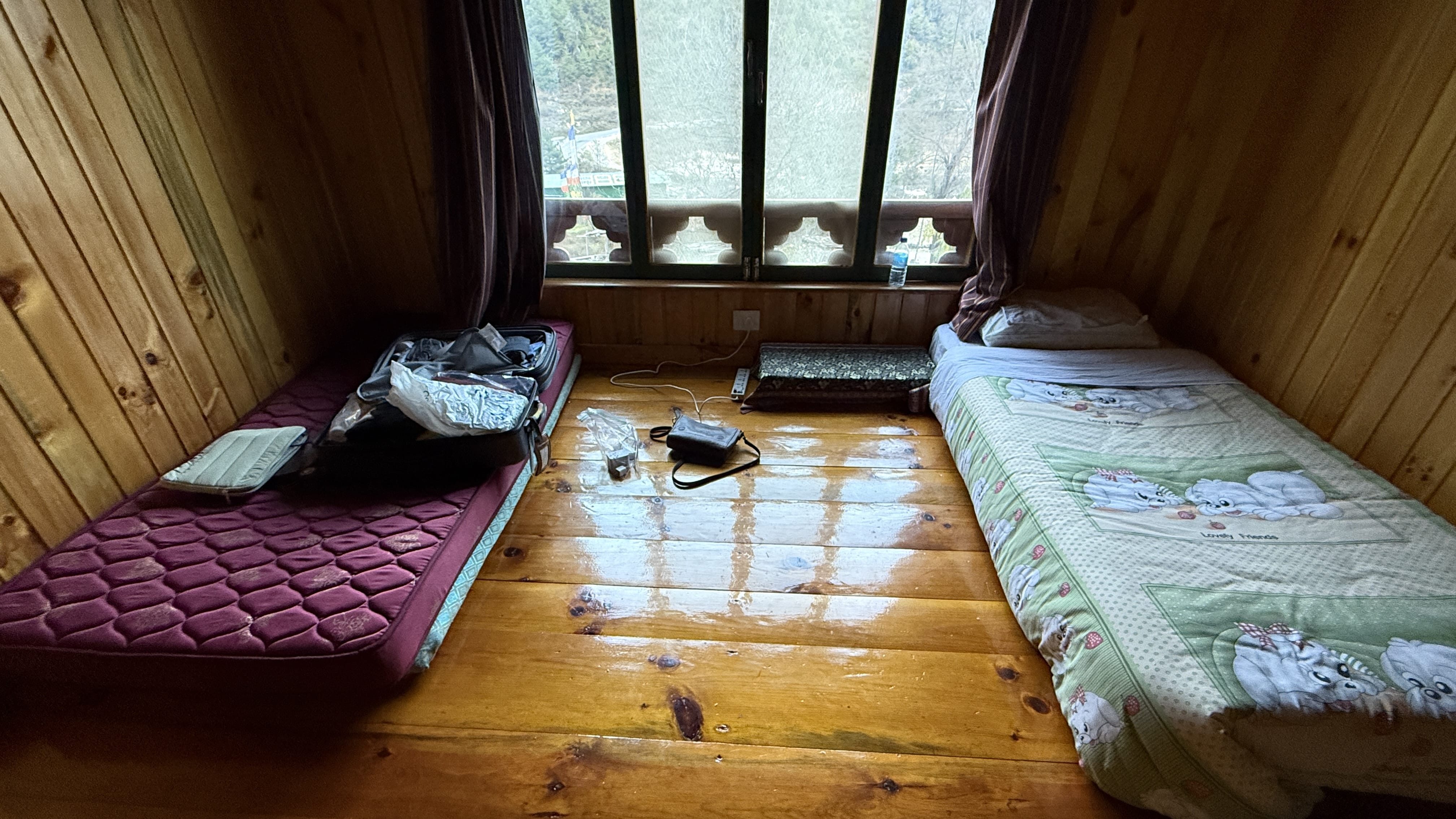
My bedroom was simple: two mattresses on the floor, an electric heater, and a mirror. Most importantly, it was warm—but also clean and surprisingly comfortable. Since it was only for one night, it worked perfectly. It wasn’t fancy, but it felt authentic.
Ugyen and Doley also offered hot-stone baths, but I planned to save mine for after the hike to Tiger’s Nest on our last full day.
Breakfast was buckwheat pancakes (something else I’d been hoping to try) with local honey and coffee (instant, but it worked). Doley also made a pot of kewa datshi—apparently it’s an anytime dish, not just something saved for lunch or dinner.
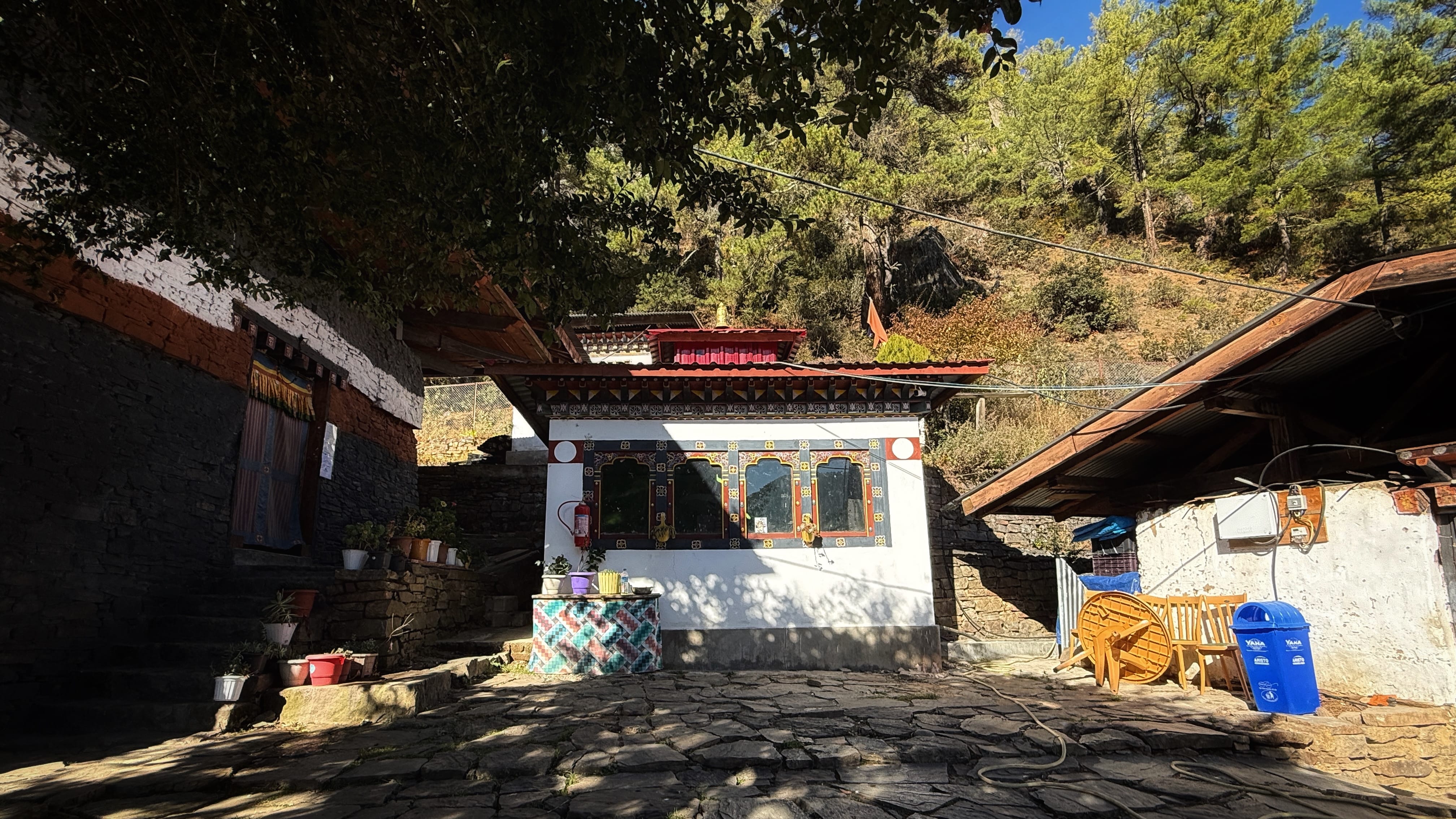
After breakfast, we walked to Lhakhang Nagpo (the Black Temple). It was much smaller than its sister temple that we’d visited the day before. Inside were statues of Guru Rinpoche, the Buddha, and the Unifier, as well as a shrine to Drakdu Tsen, a red-faced protector deity closely associated with Lhakhang Nagpo. His shrine sits beside a small trapdoor in the floor that opens to the lake beneath the temple, linked to a tshomen—a local, mermaid-like water spirit.
Parts of the gompa were undergoing restoration, but the front interior wall was original and covered with protective plastic. Even so, its surface was clearly visible—uneven and slightly wavy, shaped from traditional mud and earth materials that had settled and shifted over centuries. Knowing this wall dates back to the 7th century made its texture feel even more striking: old, imperfect, and still incredibly beautiful.
Once back from our visit to Lhakhang Nagpo, we said our goodbyes to our hosts and began the drive toward Paro.
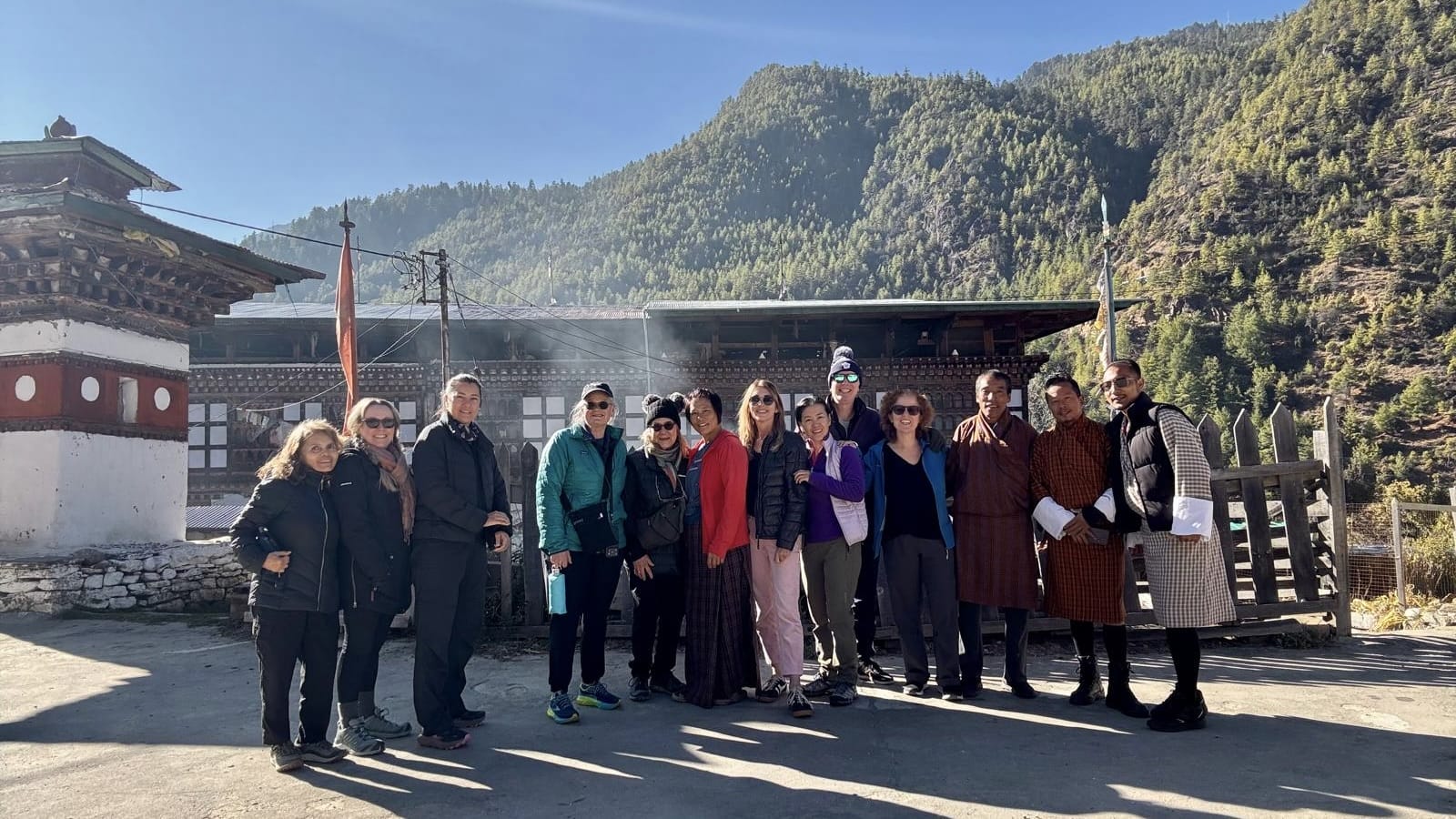
From Haa, we drove toward Paro along the Bondey–Haa Highway. The road climbed quickly out of the valley, with tight switchbacks and sheer drop-offs in places. Snow dusted the trees as we gained elevation, and within an hour we reached Chele La Pass, nearly 13,000 feet high.
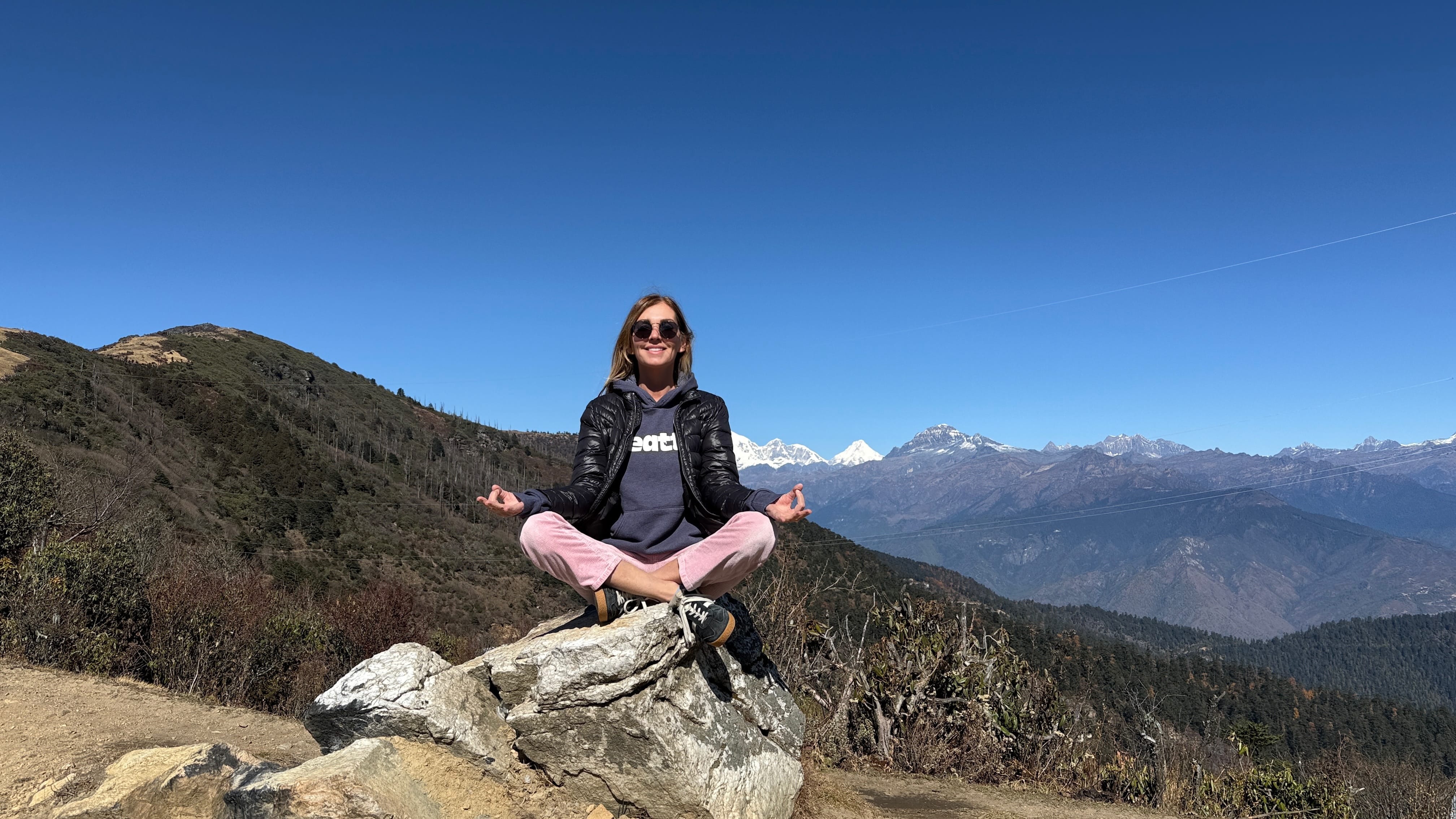
It was cold and windy at Chele La Pass, but the views were incredible—layered, snow-capped mountains with distant glimpses of Mount Jomolhari. Prayer flags lined the ridge, snapping hard in the wind, and yaks grazed in the nearby fields.
On the drive down, we stopped at a lookout above Paro International Airport. Just as we arrived, a plane took off, weaving through the valley in that precise pattern Paro is famous for.

Afterward, we had lunch in Paro, where I was thrilled to find that we were once again having momo. They weren’t buckwheat, but they were delicious nonetheless.
From lunch, we visited Kyichu Lhakhang, one of the oldest monasteries in the valley. Inside were vivid images of the Goddess of Compassion, including a circular mural of layered hands holding symbolic objects, and an enormous statue of Guru Rinpoche facing north toward Tibet.
By late afternoon, we checked into our hotel in Paro for the next two nights.
Dinner was going to be a buffet once again, and honestly, I just didn’t want it. But luckily, the restaurant also had a menu. I spotted a salad with sesame dressing, which sounded perfect—I hadn’t had any fresh greens since arriving (and, in hindsight, probably something I shouldn’t have jumped into). But I did, and it was delicious.
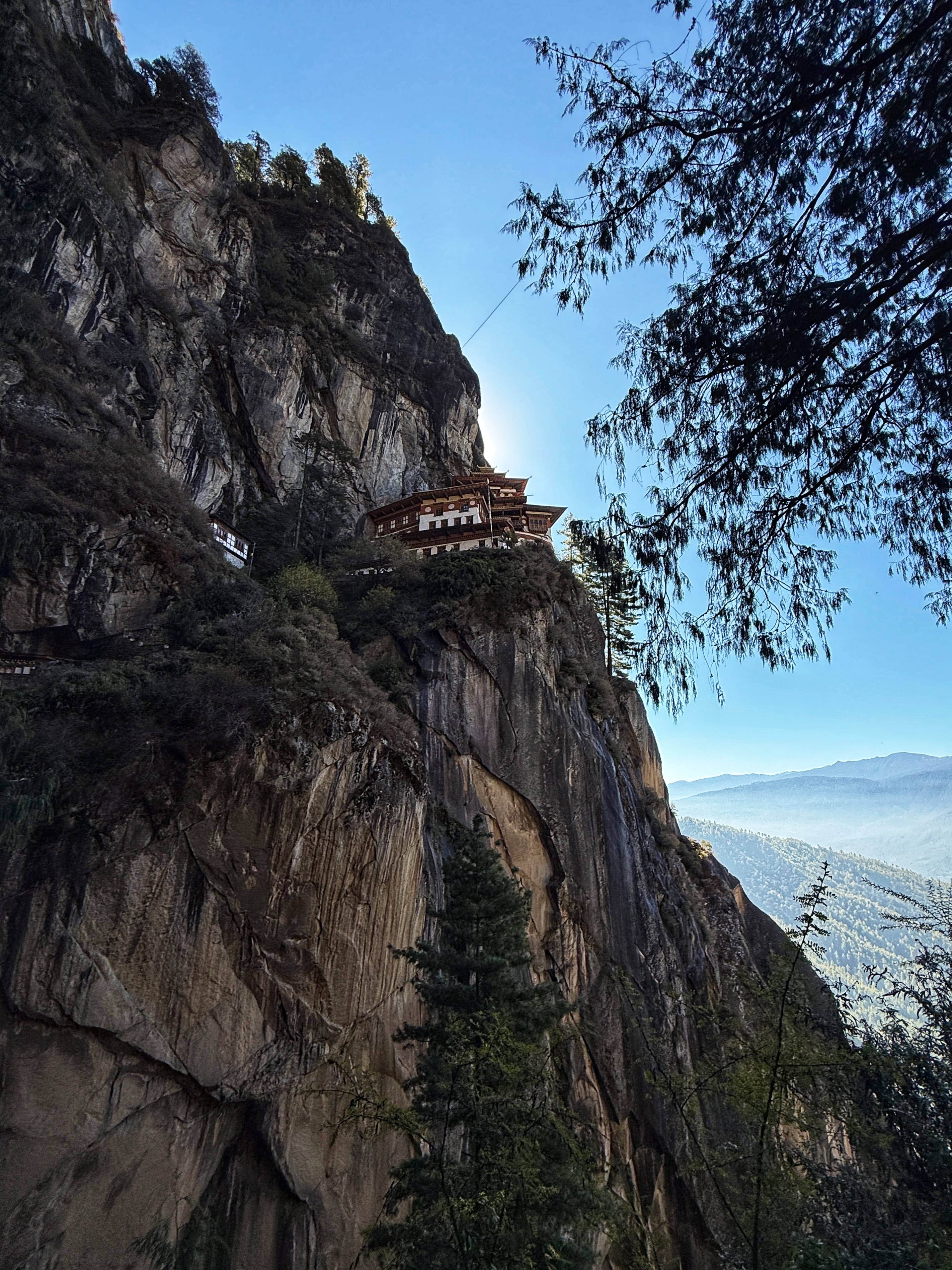
We left the hotel by 6 a.m. for the short drive to the trailhead for Tiger’s Nest Monastery (Paro Taktsang),famously built into the side of a sheer cliff and often considered the highlight of a trip to Bhutan. It was chilly when we started, so I set off in a jacket. The trail begins gently but quickly turns into the steady uphill you read about. Still, it wasn’t a big deal—you felt it, yes, but a short rest and you were good to go again.
The path winds through pine forest and switchbacks, with occasional flatter stretches that give your legs a break. Every so often, the trees opened just enough to reveal a glimpse of the monastery—tiny, distant, and impossibly perched.

By the halfway point, the jacket came off. Between the sun and the climb, I was fully warmed up. There were several spots along the trail where you could stop and really take it in. Seeing Tiger’s Nest in person—this place I’d only ever seen in photos—was truly astounding. It was hard to fathom how it was built where it was, clinging to the cliff like that.
Near the end, you descend a long set of stone steps, cross a small bridge beside a waterfall, and then climb straight back up to reach the monastery entrance. By then, your legs are already tired, and that final ascent makes it very clear just how high this place actually sits.
There are four main temples and the original meditation cave associated with Guru Rinpoche. The rooms are simple—statues, murals, butter lamps, and cool air that settles around you the moment you step inside. Before beginning my descent, I lit a butter lamp and said a quiet prayer.
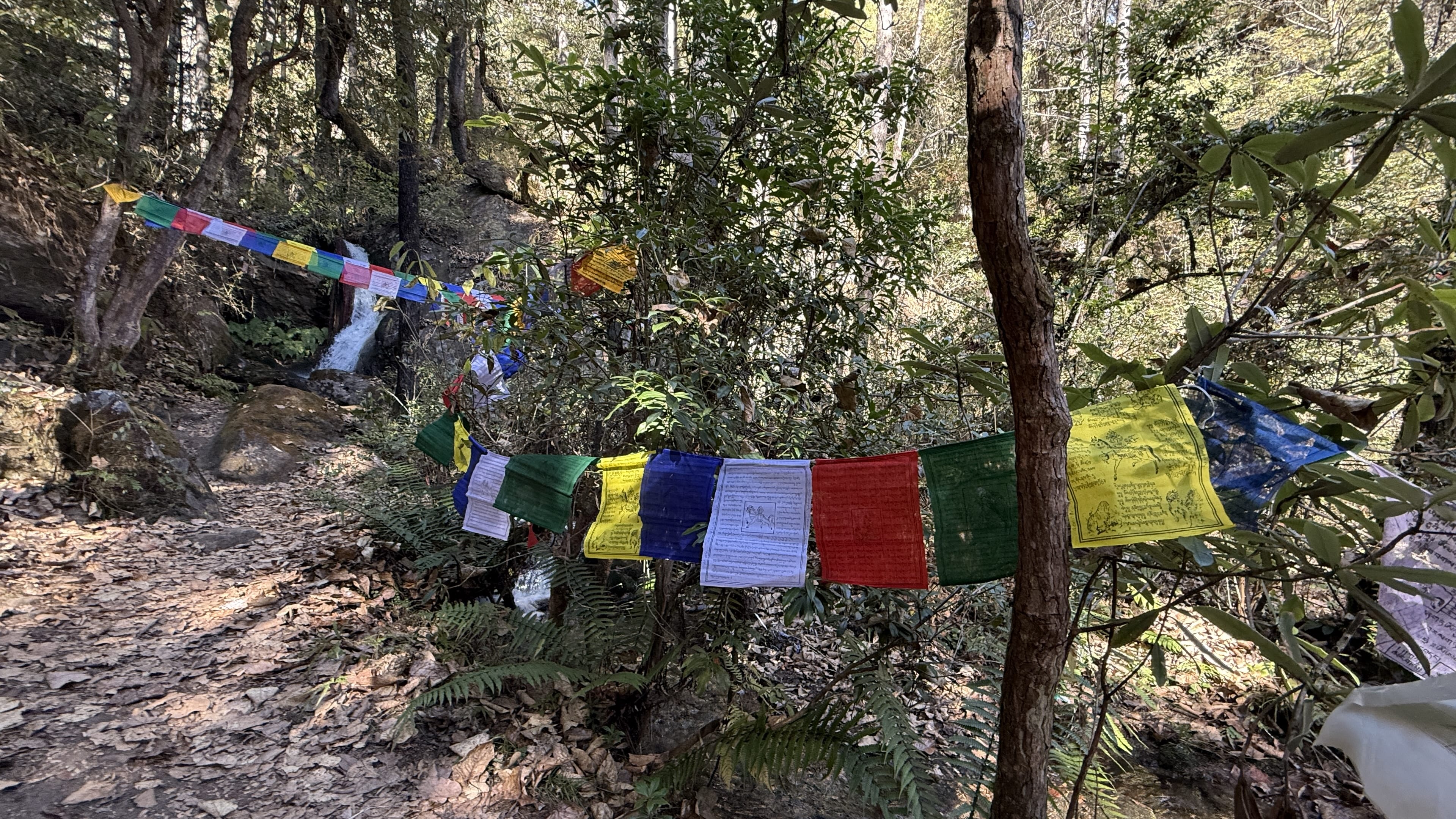
On the way down, I hung a strand of prayer flags I’d carried with me, just slightly off the trail. As I walked away, I turned back once more to watch them flutter in the wind, carrying the names of friends and loved ones I’d written on them.
At the halfway point on the trail, we regrouped at the Taktsang Cafeteria for lunch—yes, another buffet, and probably the worst one I’d had. I ended up with some kind of thukpa-style noodles, and they tasted like a salt lick.
The one redeeming thing was an excellent cappuccino, which more than made up for the lousy lunch.
We returned to the hotel around 3:30 p.m., tired in that satisfying way that only comes after a long climb. After a short rest, we headed out to Tshering Farmhouse, where we’d be having dinner—and where a couple of us had also booked hot-stone baths. I mean, what could be better than a hot-stone bath after hiking up to Tiger’s Nest?
Sinking into hot, herb-infused water after climbing nearly 2,000 feet felt like the best reward imaginable. Afterward, I met up with the rest of the group—by then very much friends—and we shared a final meal together. Dinner felt more like a home-cooked meal than anything else—Bhutanese dishes brought out family-style, well-seasoned, and genuinely delicious.
I had a 9:30 a.m. flight out of Paro, which meant leaving the hotel by seven—and skipping breakfast. The drive to Paro Airport was short, but as we went, I watched the hills and prayer flags slide past, knowing it would be the last time I’d see them for a while. The airport had a few small shops, but sadly nothing was open for breakfast, which was fine—I was starting not to feel great anyway.
The flight out was just as beautiful as the flight in. The plane lifted off, banked between mountains, and within minutes the Himalayas appeared again—layered, snow-capped, and quietly overwhelming. Then, little by little, they slipped into cloud cover.
The journey out of Bhutan was short, but the shift was immediate. Within a couple of hours, I was landing in Delhi, where I’d spend the next thirteen hours before my long flight back to the U.S.
Sitting in the airport, I scrolled through photos on my phone and couldn’t quite believe everything had happened in just ten days—Tiger’s Nest, Punakha Dzong, rafting the Mo Chhu, the stillness of Haa Valley, hot-stone baths, prayer flags, village life.
Travel compresses time in strange ways. Eleven days can feel like a month and a moment at the same time. And even before leaving the region, Bhutan already felt a little dreamlike—the kind of place that settles into you quietly and stays far longer than you expect.

Bhutan is a remarkable place, and I loved my time there. While travel—especially along the main western route—is carefully structured, that structure exists to protect what makes the country so special. What stayed with me most was the contrast: ancient traditions alongside modern pressures, preservation alongside change. Bhutan doesn’t reveal itself all at once, but it settles into you quietly, and long after you leave, it stays with you.
I didn’t spend much time writing about food in this post, partly because so many meals blended together. If you’re curious what eating in Bhutan was really like on a group trip, I wrote a separate post about it.

Hi, I’m JoAnne—writer, wanderer, and lover of places that surprise me. I’ve traveled to 60+ countries (and counting), usually with a camera in one hand and a notebook in the other. I’m drawn to mosaics, markets, and mountains, and I write to remember what moved me. When I’m not traveling, I’m working on my blog Travels Afoot, trying new creative projects, or planning my next adventure.