This post is part of my three-week journey through the Caucasus, which I’ve divided into six parts covering Azerbaijan, Georgia, and Armenia—plus a final day in Yerevan. Each section follows the trip as it unfolded, blending history, culture, and everyday moments along the way.
I arrived in Baku from the United States a little after midnight, after nearly 30 hours of travel—two flights, long layovers, and the final drive from the airport. I booked a room at the Central Park Hotel, which would also be the meeting point for my group tour through the Caucasus a few days later. The hotel was just outside the Old City walls, an easy walk to Nizami Street, Fountain Square, and the spots where I’d spend most of my time over the next couple of days.
This trip through Azerbaijan, Georgia, and Armenia was something I’d signed on for with Native Eye Travel, a small-group operator that focuses on lesser-visited regions. I hadn’t traveled with them before, but their focus on offbeat destinations felt right up my alley. Before the group tour began, I had two days in Baku to myself—a chance to get my bearings in a city I knew almost nothing about.
I didn’t know what to expect, but what I found was a modern city—wide boulevards, palm-lined parks, fountains, and dramatic new buildings. Yet turn a corner, and you’d suddenly be facing 12th-century stone walls, a mosque dome, or a Soviet apartment block.
To get a better sense of the city—both its history and how it’s laid out—I booked a private walking tour with a local guide. My contact from Native Eye arranged it for me. He met me at my hotel and suggested we start at Nizami Metro Station.
You might wonder—why a metro station? Well, my guide knew I loved mosaics. I’d seen beautiful Soviet-era stations in Kazakhstan, Kyrgyzstan, Uzbekistan, and Tajikistan. I’d heard Baku had its share too, and Nizami turned out to be one of them—huge mosaics inspired by the poetry of Nizami Ganjavi. Sadly, no photos are allowed (security has been strict here since the 1990s), but seeing it in person was worth it.
From Nizami we walked to Elmler Akademiyasi Station to see what its walls had to offer. Instead of mosaics, we found framed reproductions of European paintings—inspired by the Louvre. Unexpected and very cool. And again, no photos.
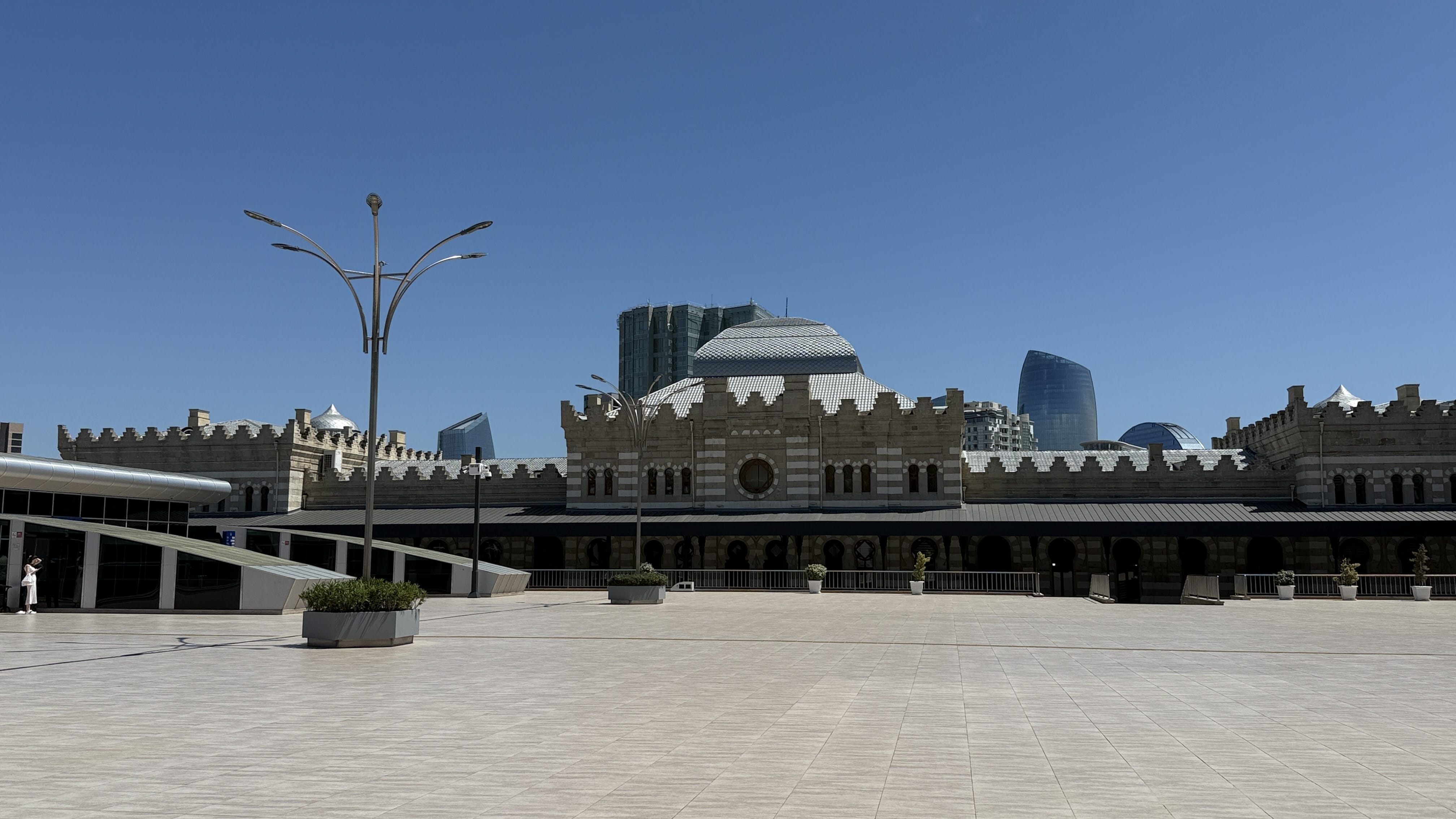
From there, we took the Green Line north to 28 May Station, one of Baku’s main interchanges where the metro connects to the city’s central railway terminal. The plaza above it looked almost like a fortress—arched walls, turrets, and a view of the Flame Towers rising behind. After a quick look around, we rode the train back to Elmler Akademiyasi Station and continued on with the tour.
We made our way toward the Caspian Sea and walked the length of Baku Boulevard—a landscaped promenade that stretches for miles along the water. The whole area buzzed with people—walking, biking, or zipping past on scooters.
Oh, and speaking of the Caspian Sea—it was my first time ever seeing it in person.
The city itself was spotless—the buildings gleamed, and there was always someone sweeping or trimming the gardens. The boulevard had wide paths, manicured parks, and beautiful fountains; you could feel the care that went into keeping it all so polished.
The boulevard runs alongside Neftchilar Avenue, a road where the traffic never really lets up. Luckily, there are underpasses at intervals, so instead of dodging cars you just go underground and come up again on the other side—right back among the palm-lined paths.
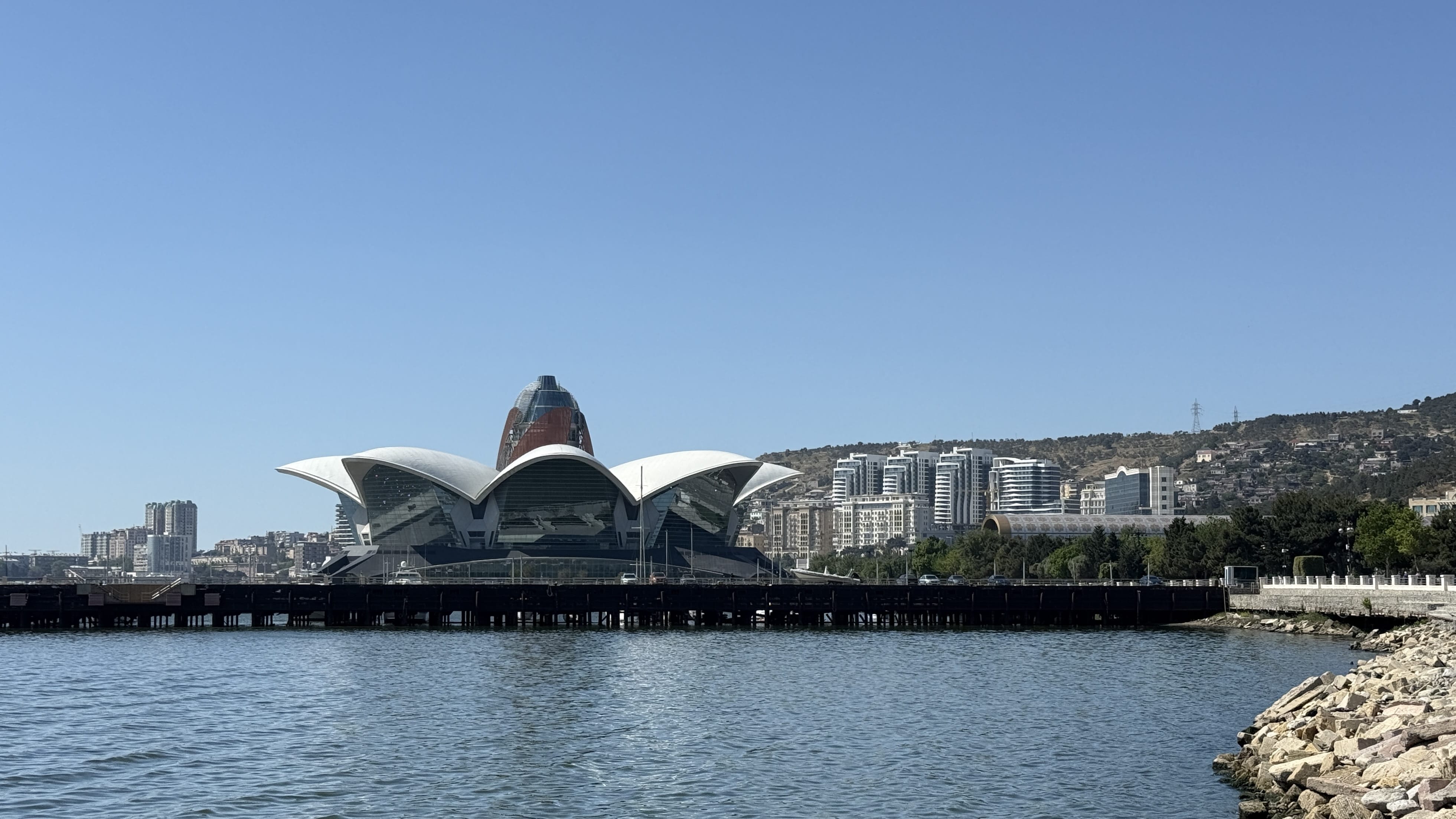
As we followed the promenade along the Caspian, one building in particular caught my eye. Deniz Mall shaped like a futuristic lotus flower at the edge of the water. From a distance, it even reminded me a little of Sydney’s Opera House.
I half-expected it to be a cultural center, but inside it turned out to be a five-story mall. We wandered through and found shops, restaurants, a cinema, and plenty of over-the-top entertainment. There was a go-kart track located on the upper level, and a giant spiral slide that carried people from the fifth floor all the way to the bottom in a matter of minutes. It felt more like a playground than a mall.
Before leaving, we stopped at Rahat Gourmet, one of the food counters inside, and grabbed a cheese peçarski.Wow, was it good—but then again, bread and cheese rarely let me down.
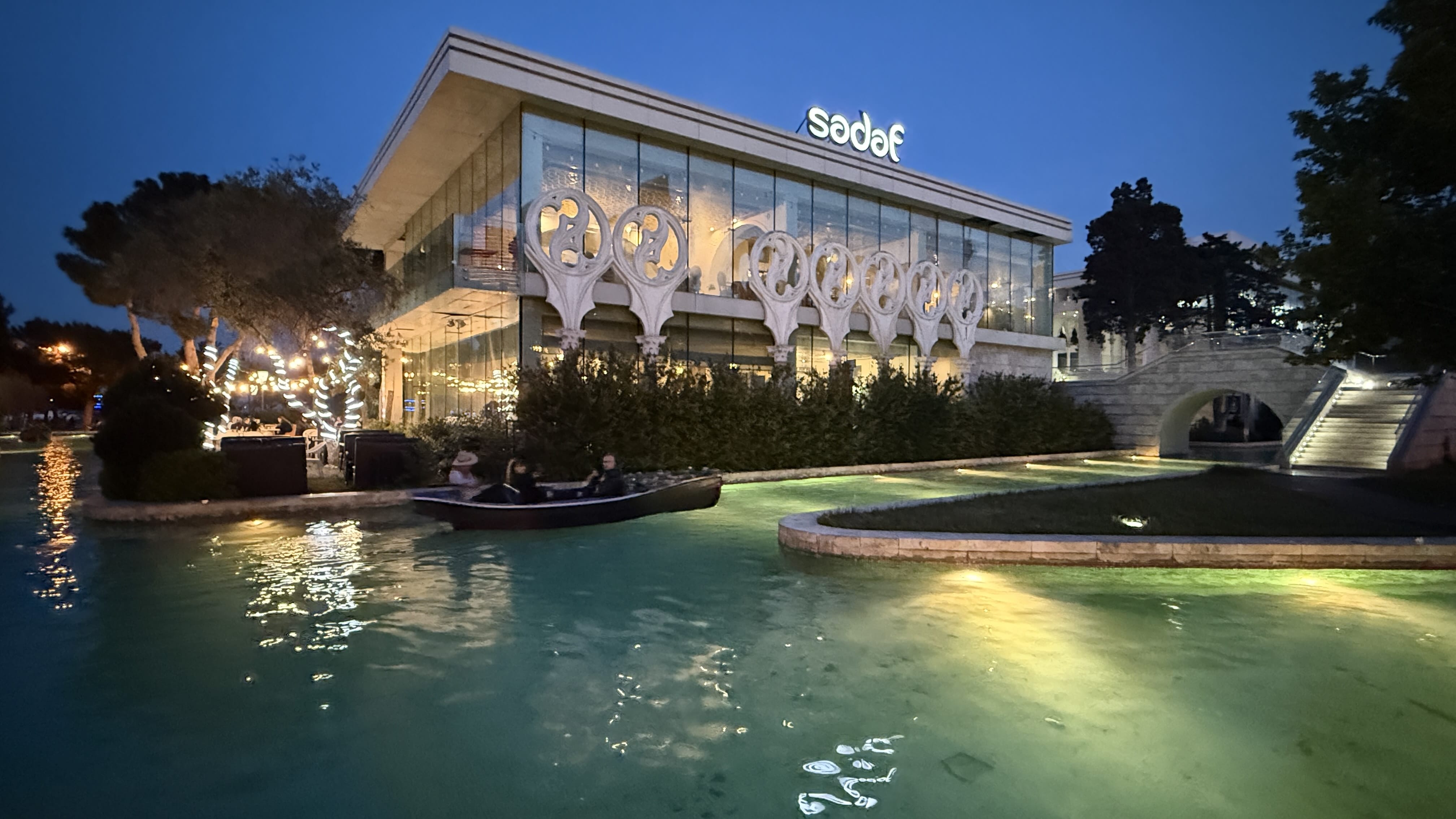
Not far from Deniz Mall, also along Baku Boulevard, is Little Venice: a network of man-made canals where gondola-style boats carry passengers slowly under little bridges. In the middle sits the Venezia Restaurant, with boats gliding around it before circling back through the park. To me, it felt more like a small amusement ride than any nod to Italy, but clearly people enjoyed it—the line was always long. I’ll admit, it did look especially pretty at night, with the lights reflecting on the water.
Nearby was the Azerbaijan Rug Museum—housed in a building shaped like a rolled-up carpet. Inside was a shop filled with traditional Azerbaijani rugs. My guide mentioned that Azerbaijani rug weaving is recognized by UNESCO as part of the country’s Intangible Cultural Heritage, known for its bold geometric patterns, natural dyes, and regional styles.
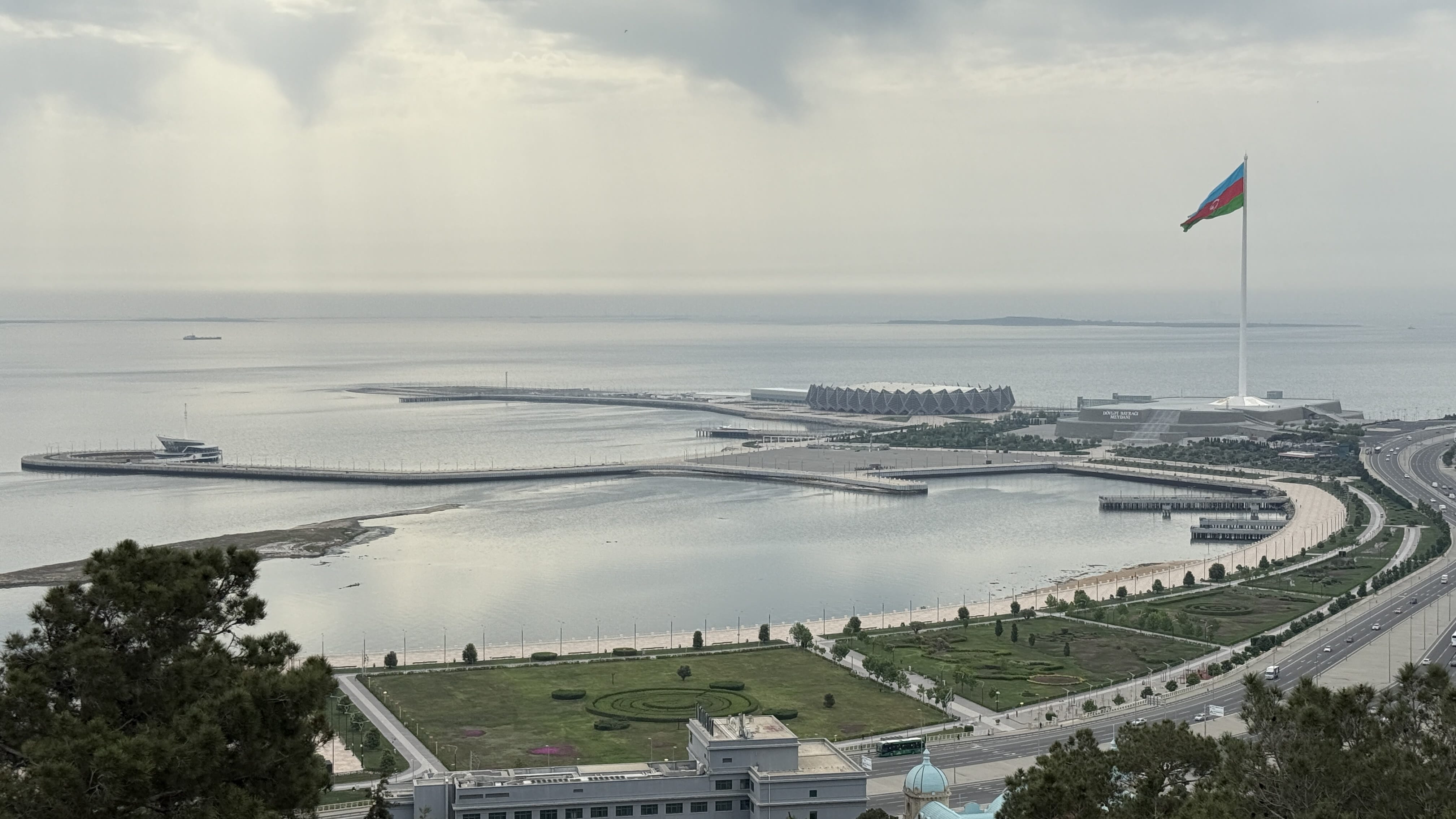
There were plenty of spots to rent scooters along the boulevard, so we each grabbed one and zipped down the wide paths by the water. We rode toward State Flag Square, where an enormous Azerbaijani flag flies over the bay.
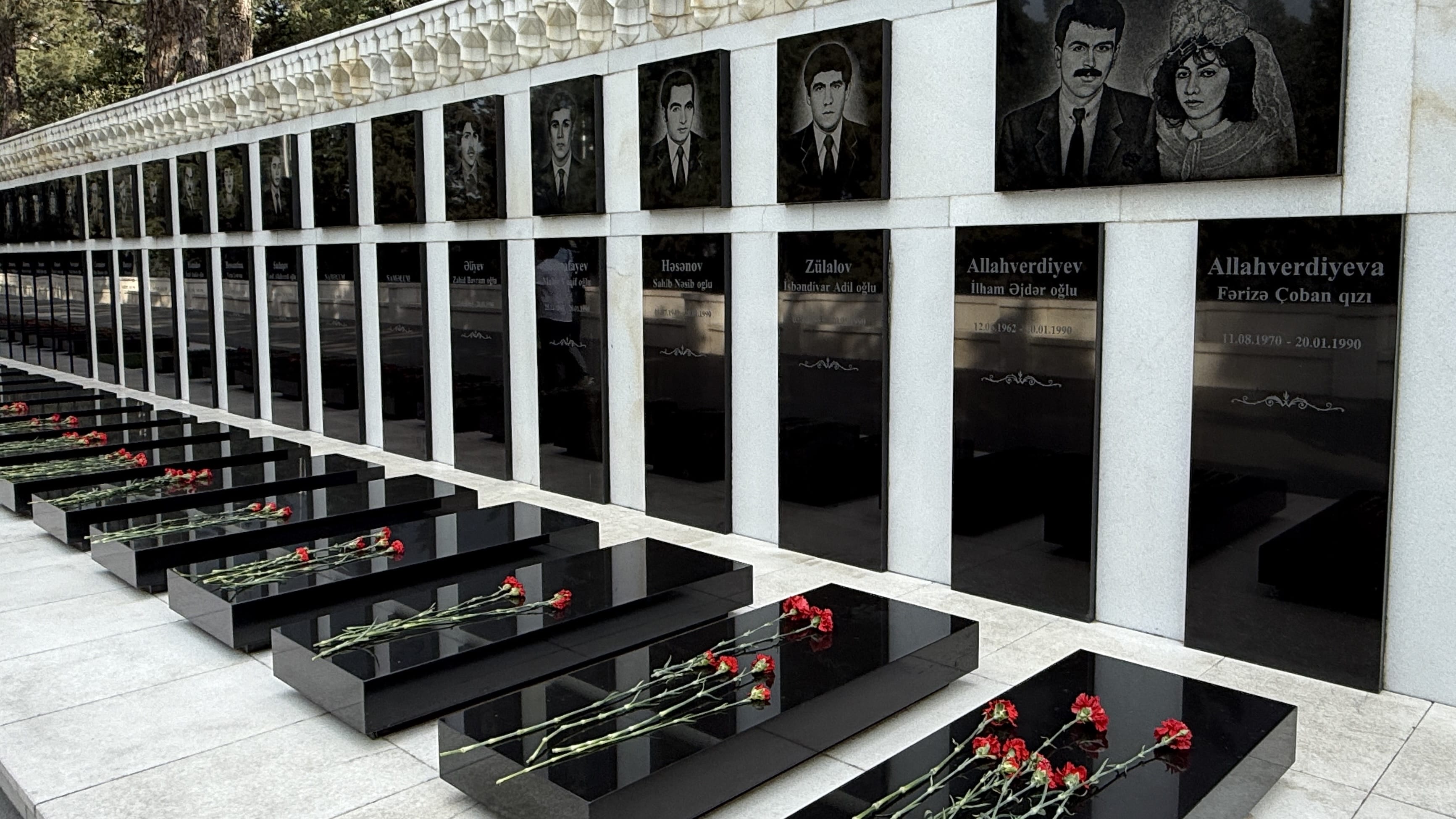
From Flag Square we rode to the base of Upland Park, left our scooters and started up the long staircase—roughly 400 steps—skipping the long line for the funicular and climbing instead. At the top we arrived at Martyrs’ Lane—a memorial honoring victims of Black January, when Soviet troops violently crushed pro-independence demonstrations in 1990, as well as those killed in the Nagorno-Karabakh conflict. Each grave had a red carnation in front of it. Some had names and etched portraits. Others were blank—because the person couldn’t be identified.
My guide shared a story about Ilham and Fariza, a young couple whose real love story has become part of Azerbaijan’s modern folklore. From what I remember, he said they were married in June 1989, but when I looked it up later, I found a few slightly different versions. What’s certain is that Ilham was killed during the Black January violence in 1990, and Fariza took her own life the next day.
They’re buried side by side now in Baku’s Alley of Martyrs. Every year on June 30, the date most often cited as their wedding day, people remember them—it’s become known as Lovers’ Day, a local celebration of love and fidelity. Around their grave—and many others—fresh red carnations are often placed, not just on that day but throughout the year.
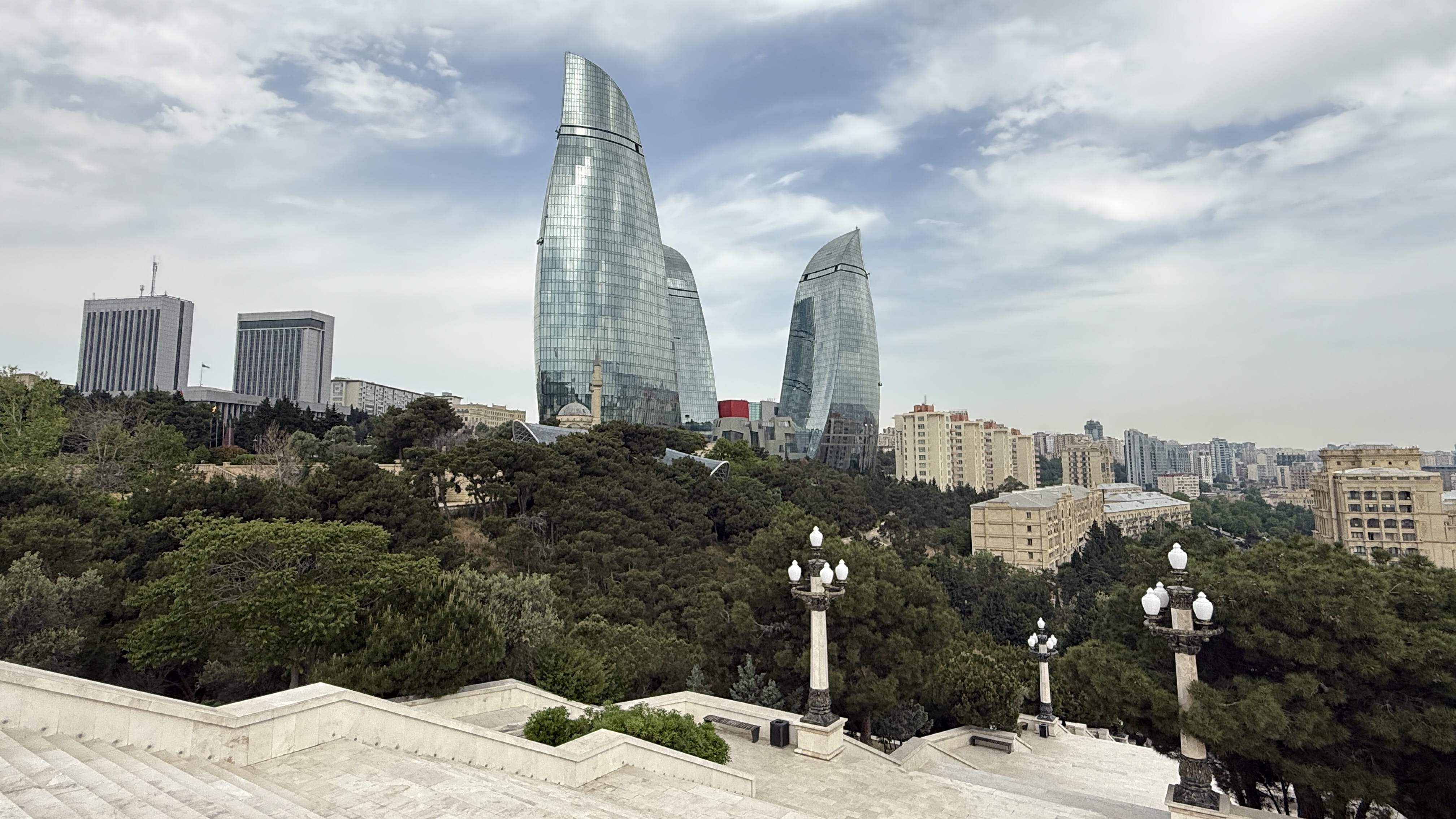
From Upland Park I could see the Flame Towers clearly. They’re one of Baku’s most recognizable landmarks—three curved skyscrapers designed to evoke flickering flames, symbolizing Azerbaijan’s nickname, the Land of Fire. At night they light up in animated color displays, shifting from red and orange flames to the colors of the national flag. Day or night, they’re impossible to miss.
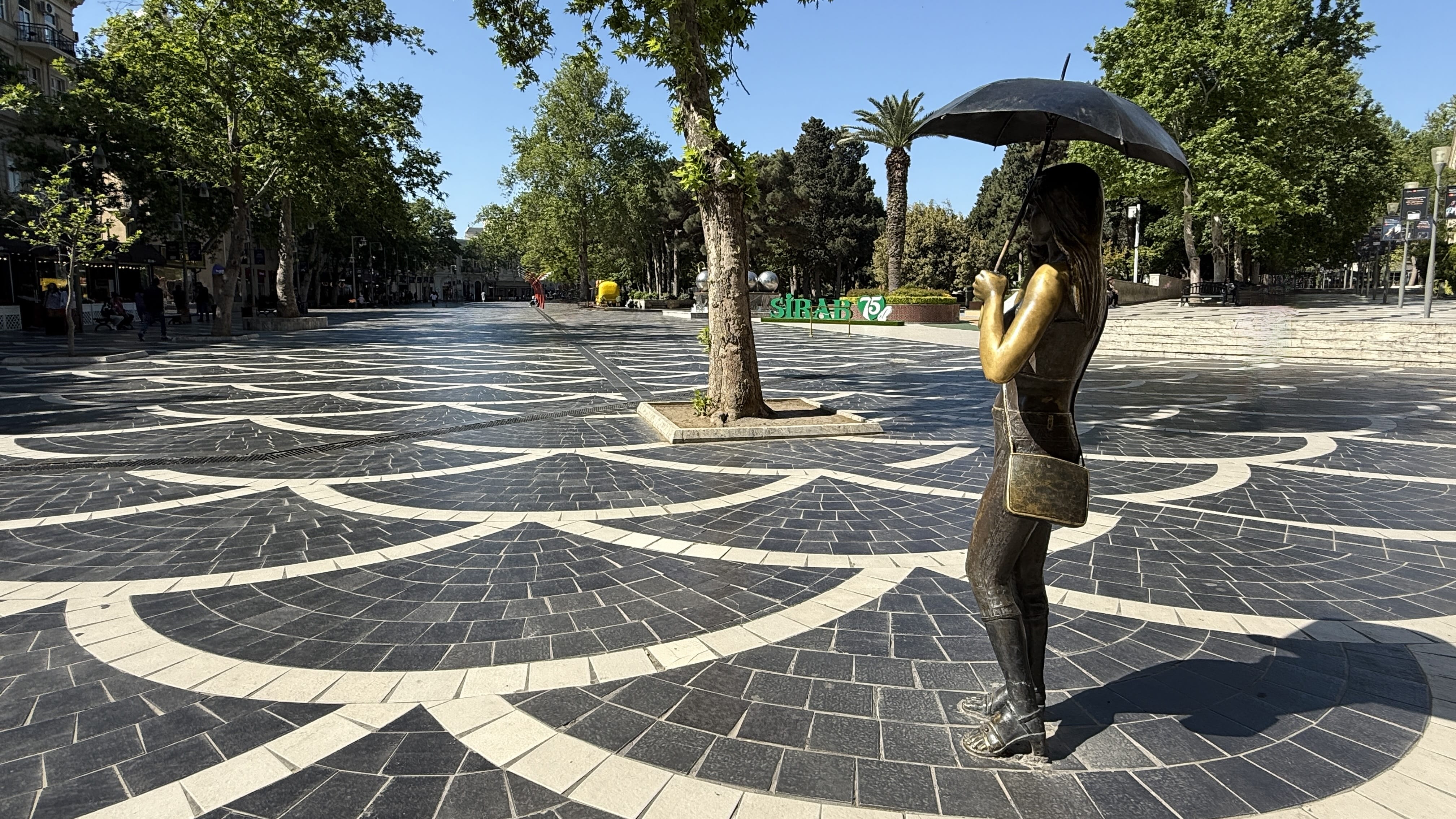
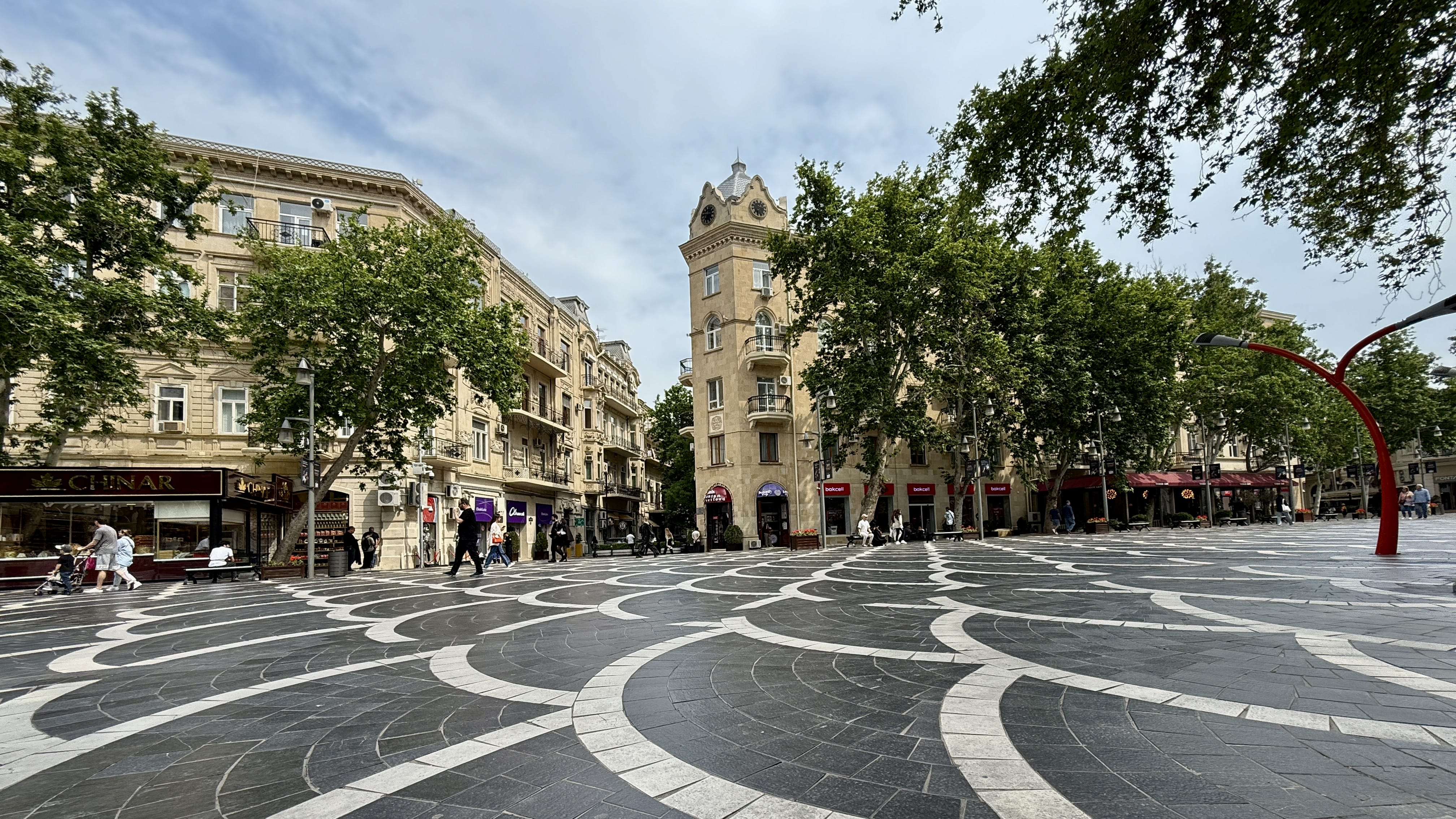
We ended the day at the Fountain Square, one of Baku’s busiest public spaces. The black-and-white tiled pavement fans out in bold geometric patterns, and shops and cafés filled the ground floors of the surrounding buildings, their façades a mix of old stone and newer glass fronts. The square takes its name from the fountains scattered around it.
By the time I got back to the hotel, my Health app said I’d walked 18.5 miles—a pretty good indication of how much of the city I’d managed to see.
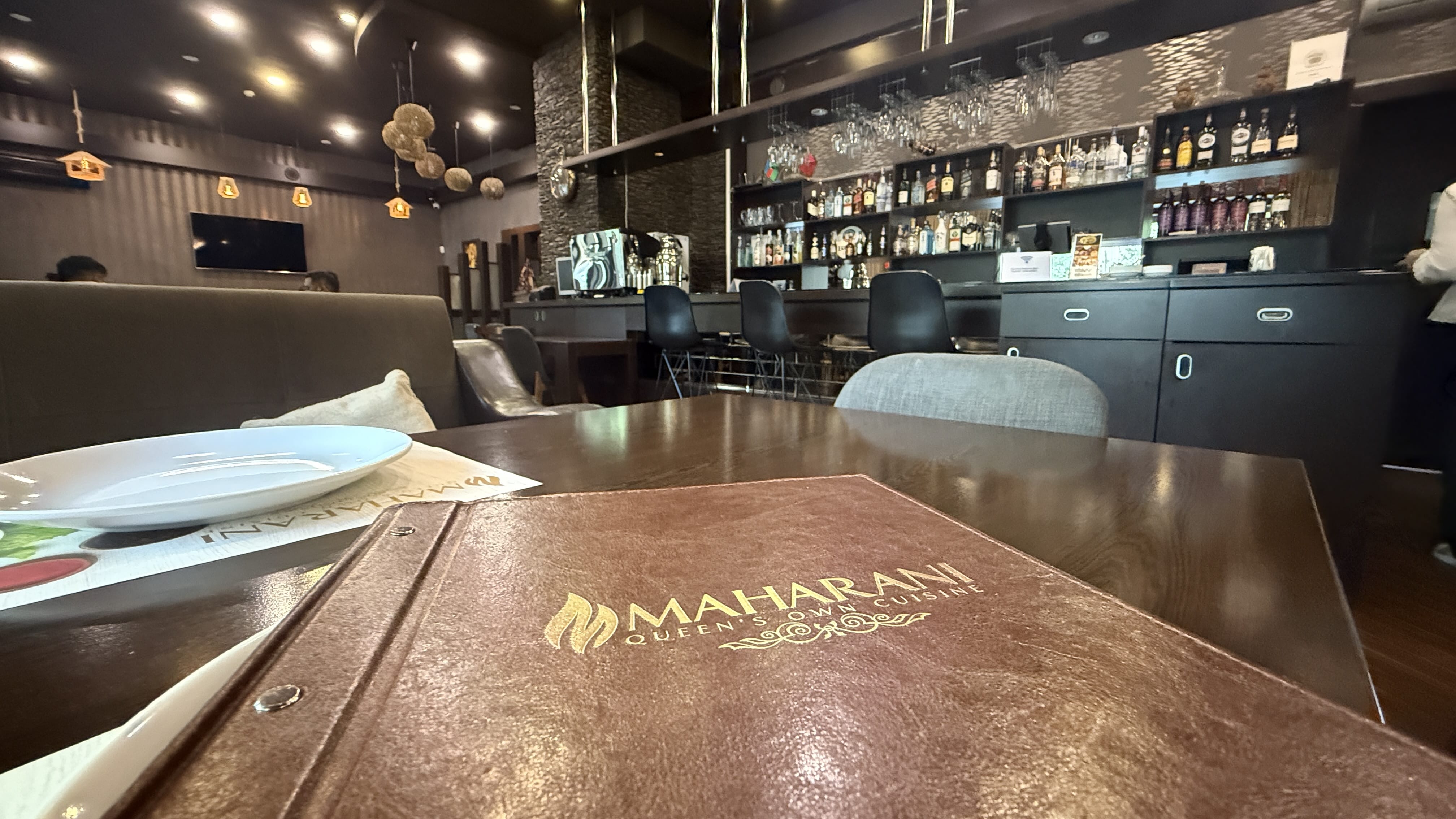
After a quick rest, I headed back out for dinner at Maharani, an Indian restaurant in town. I ordered mutter paneer and naan, then wandered a bit through the Old City before calling it a night. It’s always a treat to find an Indian restaurant while traveling—there’s usually plenty for vegetarians, and this one was a great find. The place was crowded (always a good sign), and the food was delicious.
Walking back afterward felt perfectly safe—the city was busy, well lit, and lively. By 10:00 I was back at my hotel, ready for bed. It had definitely been a full day, and I knew I was going to sleep well.
The next morning, I set off again—this time solo and pretty much unscheduled, aside from a couple of places I hoped to reach. One of the spots I’d pinned on my map was the Green Bazaar, about a half-hour walk from my hotel. The route took me into the Nasimi district—a lived-in part of the city with apartment blocks and corner shops that felt very different from the polished boulevard.
The Green Bazaar was bustling and very local. Stalls were piled high with vegetables, pomegranates, herbs, and rows of neatly arranged spices in every color. I got a few curious looks—definitely the only obvious tourist—but it felt authentic and unfussy. A small window into real daily life.
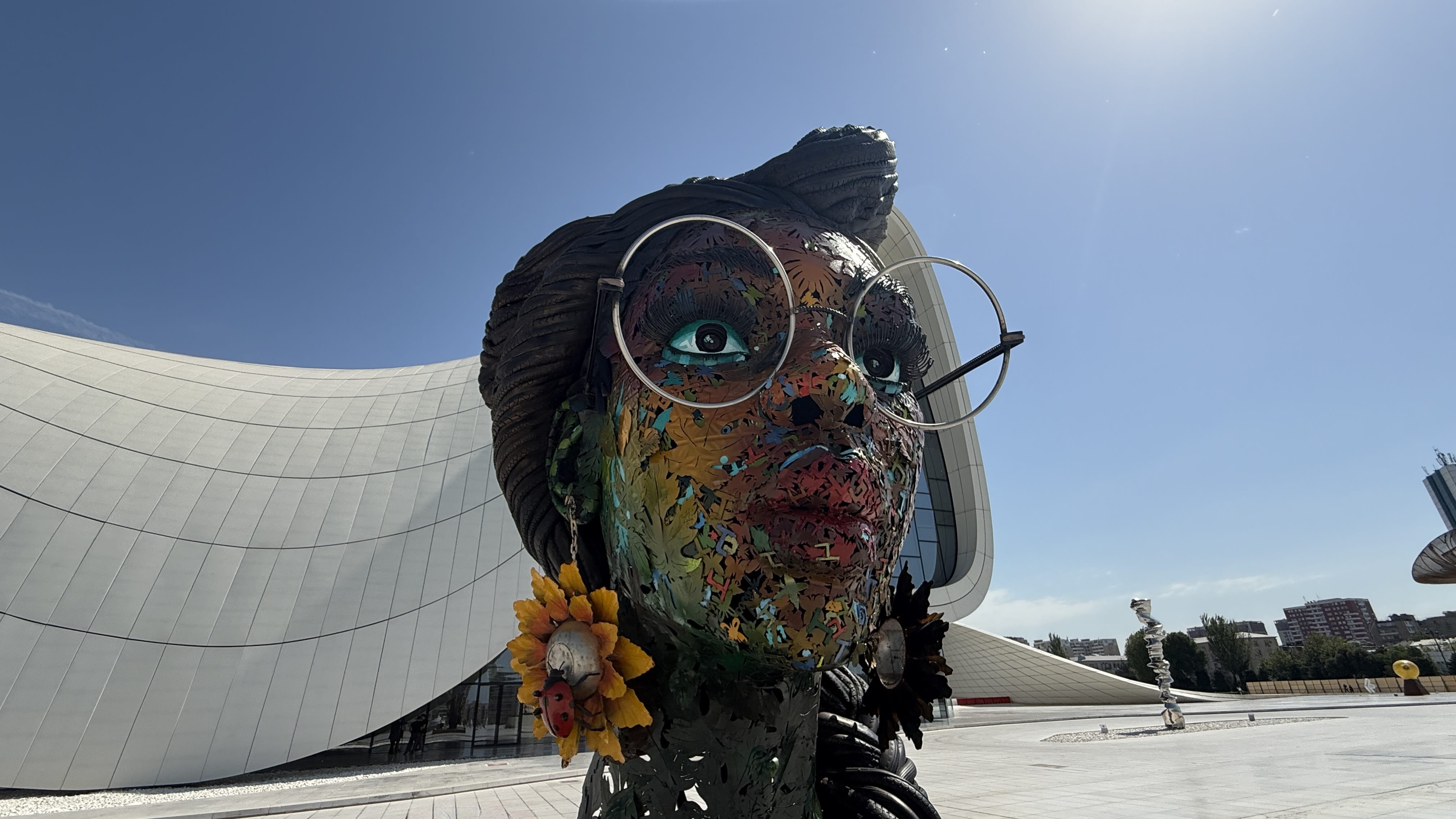
As I was walking toward the bazaar, I kept noticing what looked like a futuristic, wave-shaped building rising in the distance. After leaving the market, I continued in that direction and eventually found out what it was—the Heydar Aliyev Center. Designed by Zaha Hadid, one of the world’s most renowned female architects, its white curves seemed to flow with motion. Even from the outside, it was spectacular—sleek, bold, and unlike anything else I’d seen in Baku.
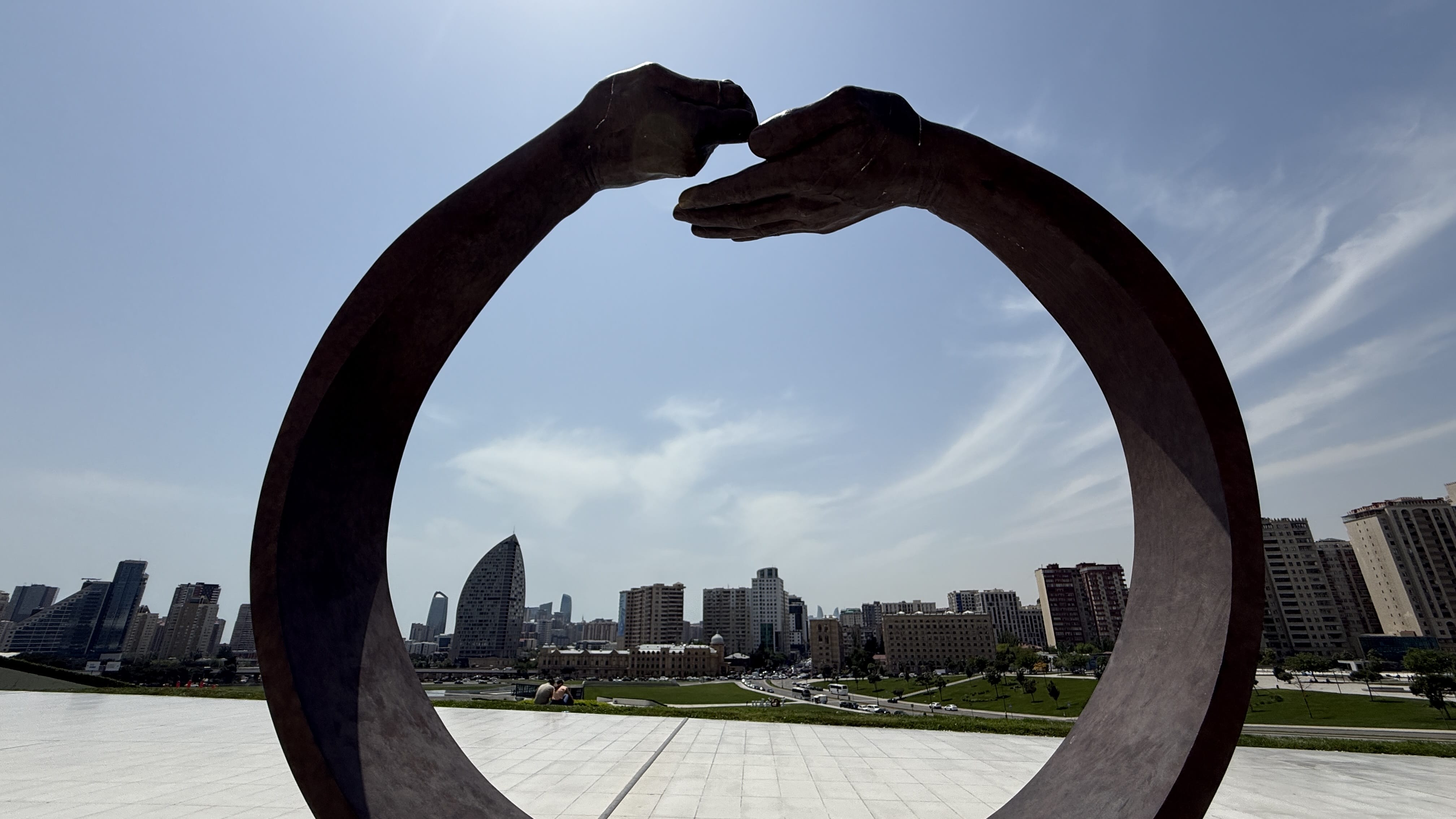
I’d arrived before it opened, so I didn’t get inside, but it was still fun wandering around the exterior and exploring the sculptures scattered across the grounds. Some were playful and modern. From the plaza, there were also wide views over central Baku— its skyline stretching toward the Caspian.
It was one of those places where architecture, art, and setting all came together perfectly.
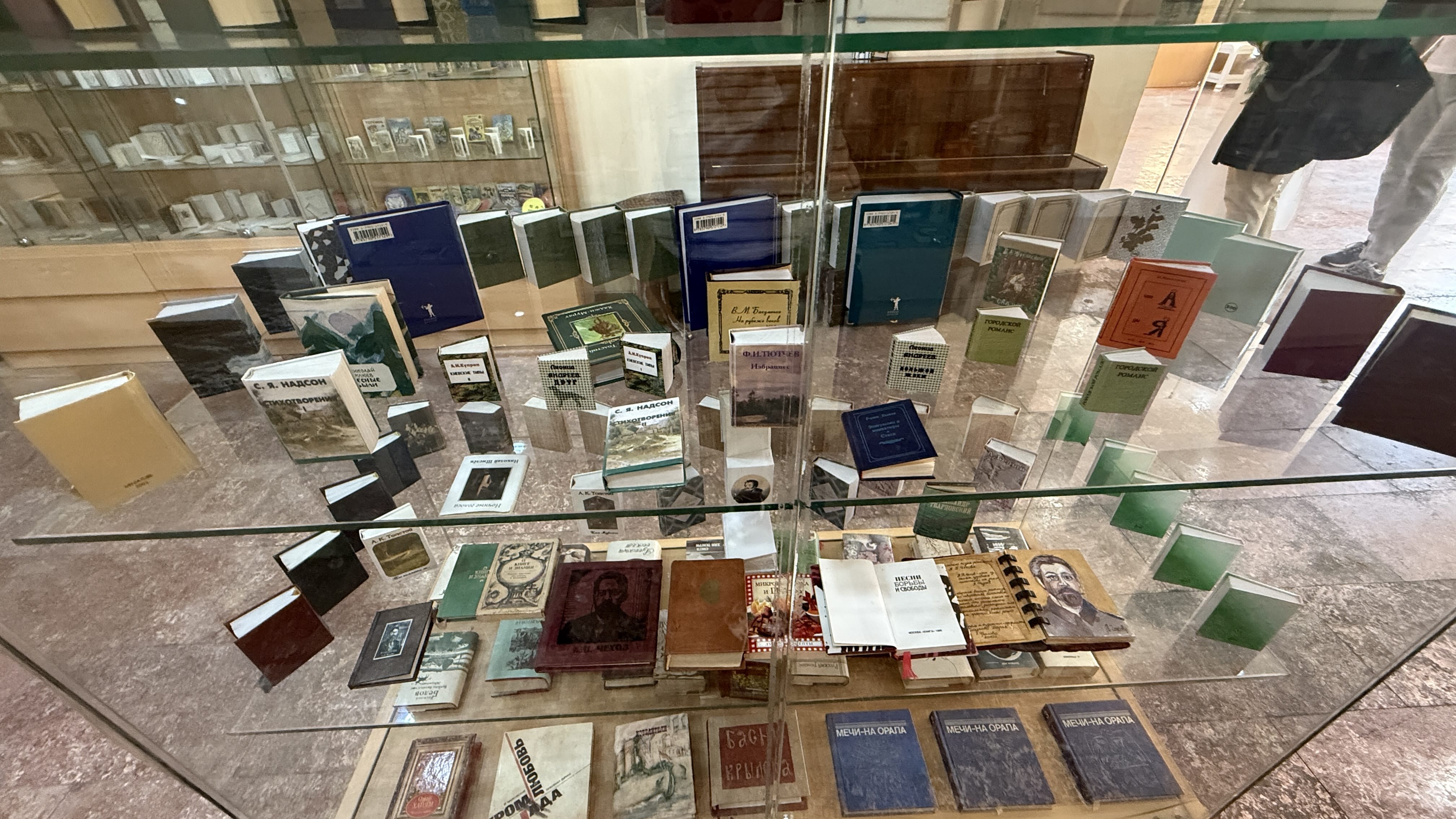
From the Heydar Aliyev Center, I set my GPS for the Baku Museum of Miniature Books, which brought me back toward the Old City. It’s exactly what it sounds like—rooms filled with thousands of tiny books, some so small you can barely make out the print without a magnifying glass. The collection is quirky and oddly impressive, spanning classics, children’s stories, and even political texts—all shrunken down to fit in the palm of your hand. Admission was free, and though the place only took a short time to walk through, it felt like one of those “only in Baku” stops.
From the museum, I went looking for a Soviet mural I’d seen the day before. It was near Rasul Rza and Uzeyir Hajibeyov Streets—a faded depiction of a soldier and child beneath the hammer and sickle, a small remnant of Baku’s Soviet past.
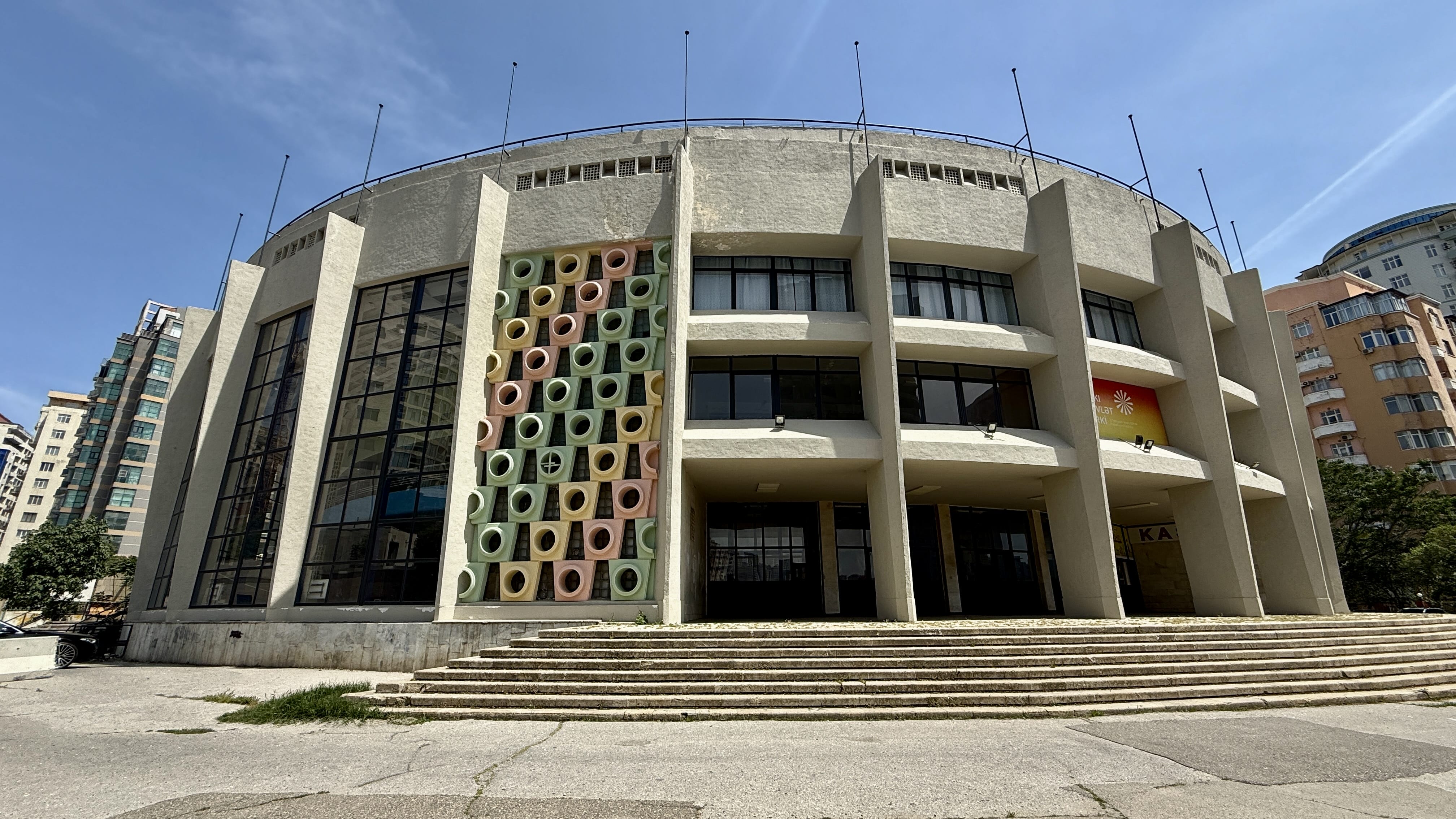
From there I headed to the old-style circus building on Samad Vurgun Street — the 1967 dome of the Baku State Circus. I hadn’t realised there was one here until I saw a street sign earlier in the day. It wasn’t far from my hotel: an aging concrete arena with faded pastel panels. The building appears closed now—through the dusty glass you can still glimpse its murals of horses and performers. The whole place felt like a Soviet-era time-capsule.
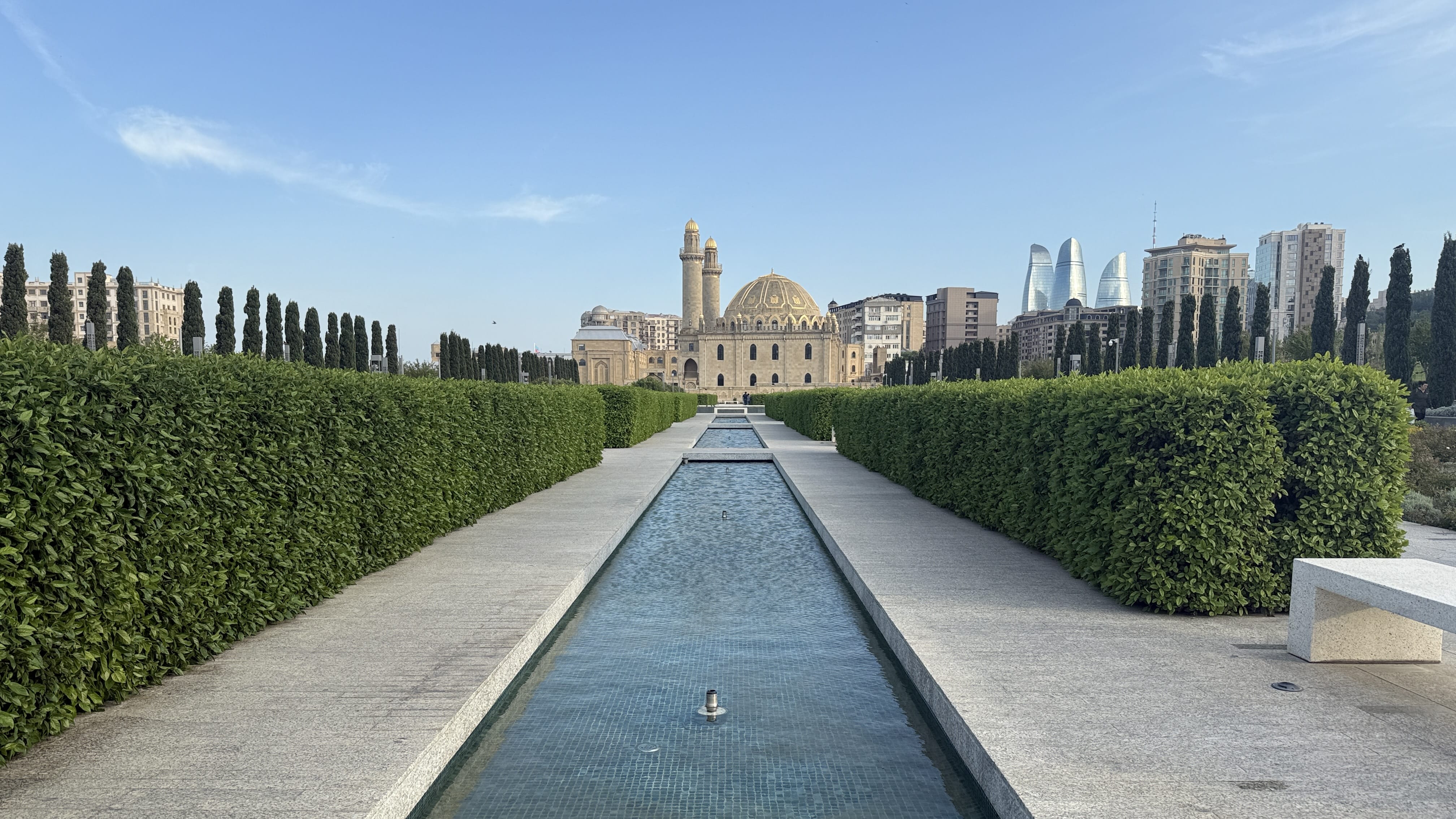
Later that afternoon, I tried to track down another mural but ended up somewhere even better: Baku’s Central Park—an elevated park system with curved paths, lush plantings, and sweeping views over the city. It’s a bit west of the city center, so getting there meant another long walk. I had no idea it existed, and it felt like one of those “happy accident” moments that travel sometimes hands you.
On the way back I passed Taza Pir Mosque, with its large golden dome and pale stone exterior. It’s one of the city’s major mosques, set on a hill where it seems to watch over the center.
It was cold walking back, with Baku’s trademark wind whipping around. By the end of the day I’d covered a lot of ground, from the Nasimi district to the Old City and out west to Central Park, and my step counter showed it.
That evening, I treated myself to dinner at Sara Bistro, a cozy spot near the hotel. I ordered bruschetta topped with pomegranate, cheese, molasses, and avocado; hummus with roasted eggplant; and two glasses of wine. It was Mother’s Day, and I toasted myself quietly—just me, my journal, and a small celebration of making it here.
These first few days were solo, but the real journey was just about to begin. As I mentioned at the start of this post, I’d signed on for a small-group tour with Native Eye Travel. I’d never traveled with them before, but the itinerary was too good to pass up—three weeks through Azerbaijan, Georgia, and Armenia, mostly overland, with stops in small towns, mountain villages, and cultural landmarks I probably wouldn’t have found on my own.
Baku gave me a first taste of Azerbaijan—but I had a feeling there was much more to discover. This country isn’t easy to define. Influenced by Europe, Asia, the Middle East, and its Soviet past, it doesn’t quite belong to any of them. You can feel that mix of identities just walking down the street.
From here, the journey continues deeper into Azerbaijan. Continue on to Azerbaijan: Part 1 — the first stop on my three-week Caucasus journey.
7 Days in Armenia: Yerevan & Southern Monasteries (Part 1)
7 Days in Armenia: Lake Sevan, Dilijan & Yerevan(Part 2)
24 Hours in Yerevan: Exploring Solo
7 Days in Georgia: Mountains, Markets & Monasteries (coming soon)
Tbilisi Sulfur Bath Experience: Soaking in History