This five-day stretch in Uganda was part of a nine-day journey through Rwanda and Uganda with Intrepid Travel. The trip began in Kigali, continued north to Musanze, and then crossed into Uganda — where the focus shifted more fully to wildlife and the experience I had been most looking forward to — gorilla trekking.
If you’d like to follow the trip from the beginning, you can read about my time in Kigali here and Musanze here.
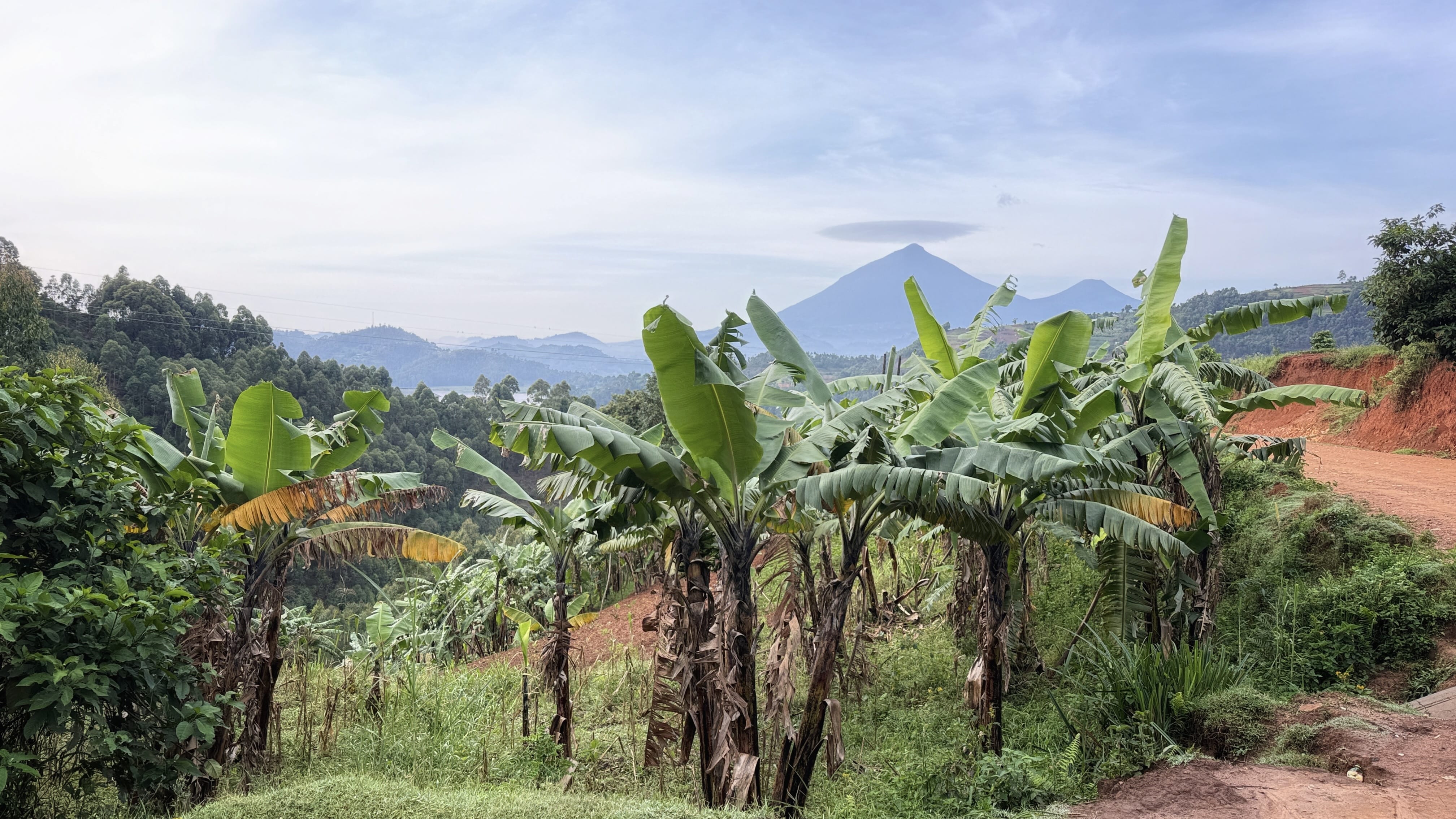
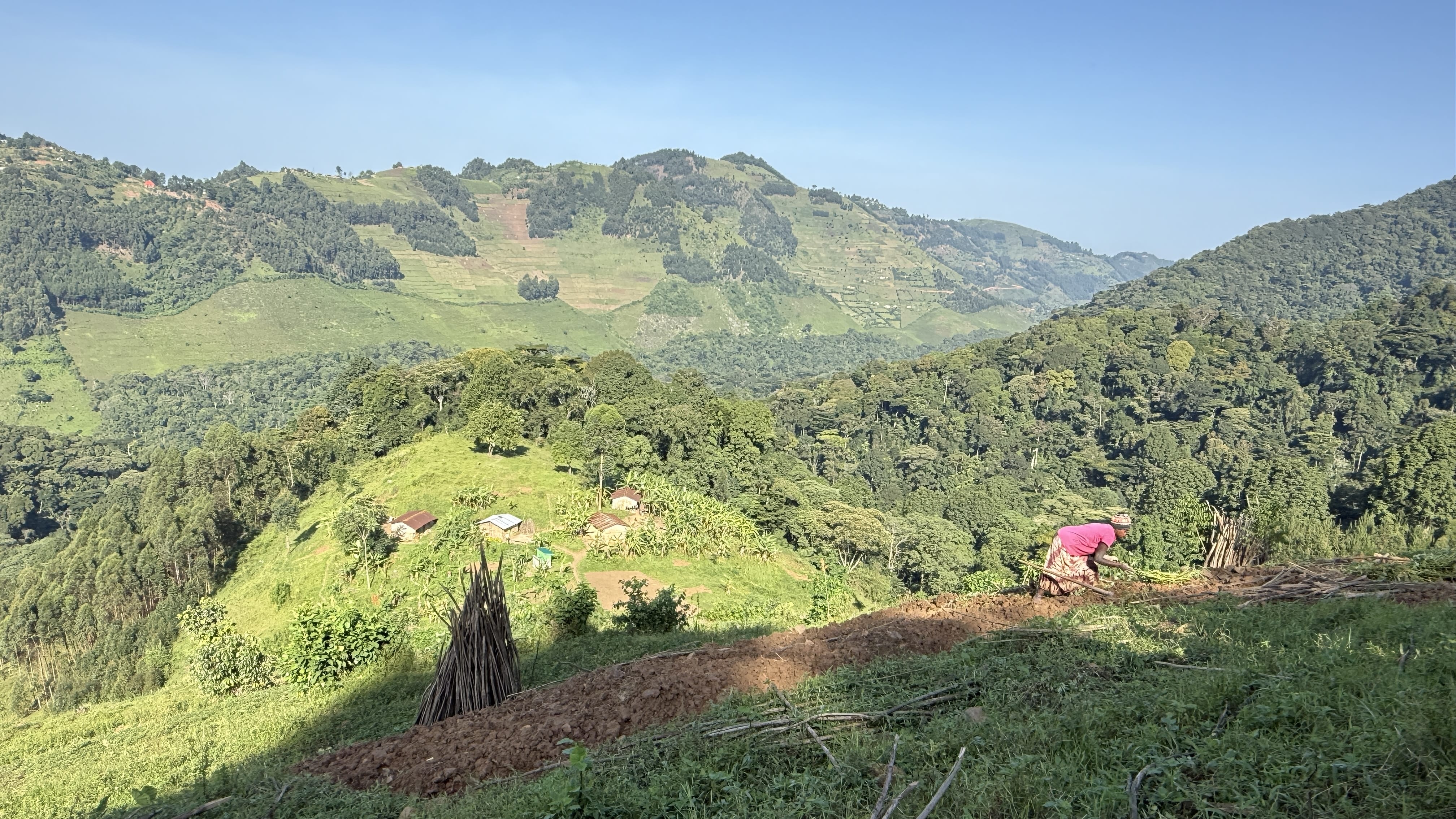
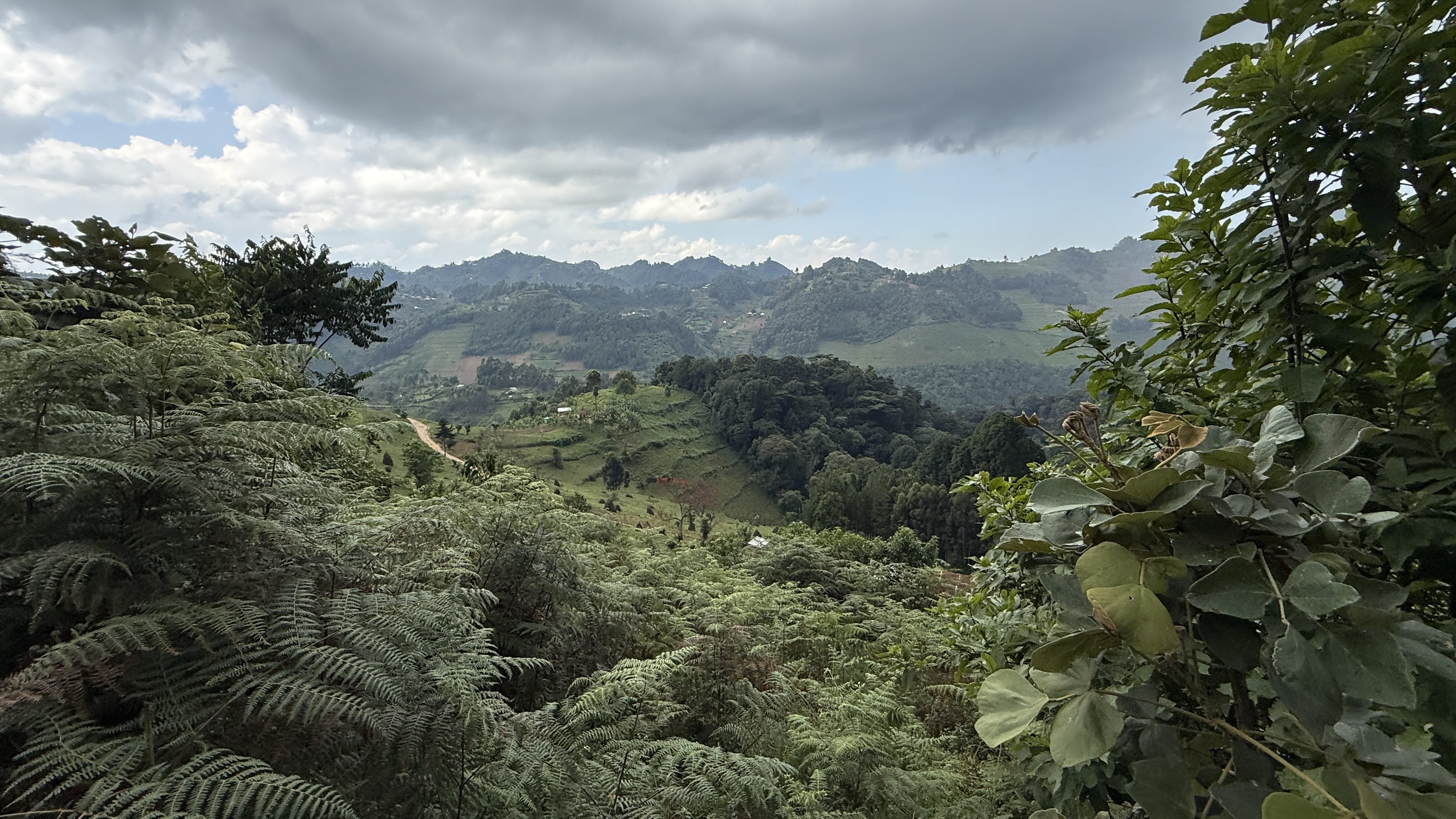
Uganda is often called the “Pearl of Africa.” Within hours of crossing the border, I understood why. Within hours of crossing the border from Rwanda, I understood why. The hills were intensely green, folding into one another, with farmland covering nearly every slope.
Wildlife was the main reason I had come — gorillas especially, but also chimpanzees, lions, and hippos. This portion of the trip focused on southwestern Uganda, moving from the Rwandan border through Queen Elizabeth National Park, down to Ishasha, and finally into the mountains around Kisoro and Bwindi Impenetrable National Park — one of the last remaining habitats of endangered mountain gorillas.
Along the way were long drives through farming villages, stretches of red dirt road, and landscapes that shifted from open savannah to dense forest.
I spent five days in Uganda exploring Queen Elizabeth National Park and Bwindi Impenetrable Forest — a mix of game drives, chimpanzee trekking, community visits, and finally, gorilla trekking. And as is often the case, the long drives, roadside scenes, and shared moments with the group shaped the experience just as much as the wildlife did.
Day 1: Cross from Rwanda into Uganda and drive through the highlands to Queen Elizabeth National Park, with wildlife sightings along the way and sunset views over the Kazinga Channel.
Day 2: Chimpanzee trekking in Kyambura Gorge, followed by a boat safari among hippos and birds, and an evening game drive across the open plains.
Day 3: A long game-drive journey south toward Ishasha, spotting elephants, buffalo, monkeys, and village life before arriving at Enjojo Lodge and visiting a nearby community project.
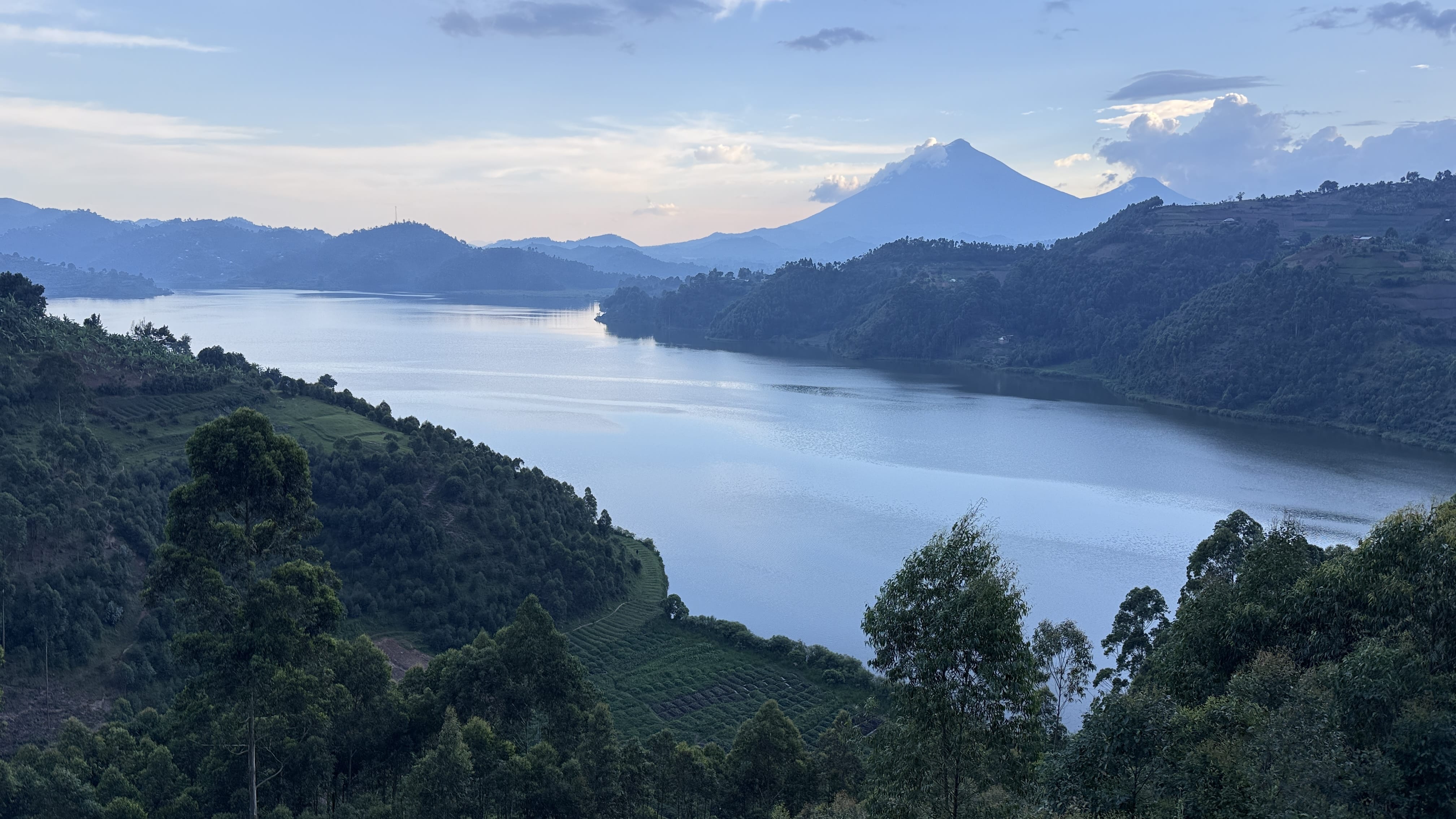
Day 4: Travel through red-dirt mountain roads and rural villages to Kisoro, ending the day with peaceful views over Lake Mulehe before the gorilla trek.
Day 5: Gorilla trekking in Bwindi Impenetrable Forest—an unforgettable hour with the Busingye family—followed by a final evening with the group before returning to Rwanda.
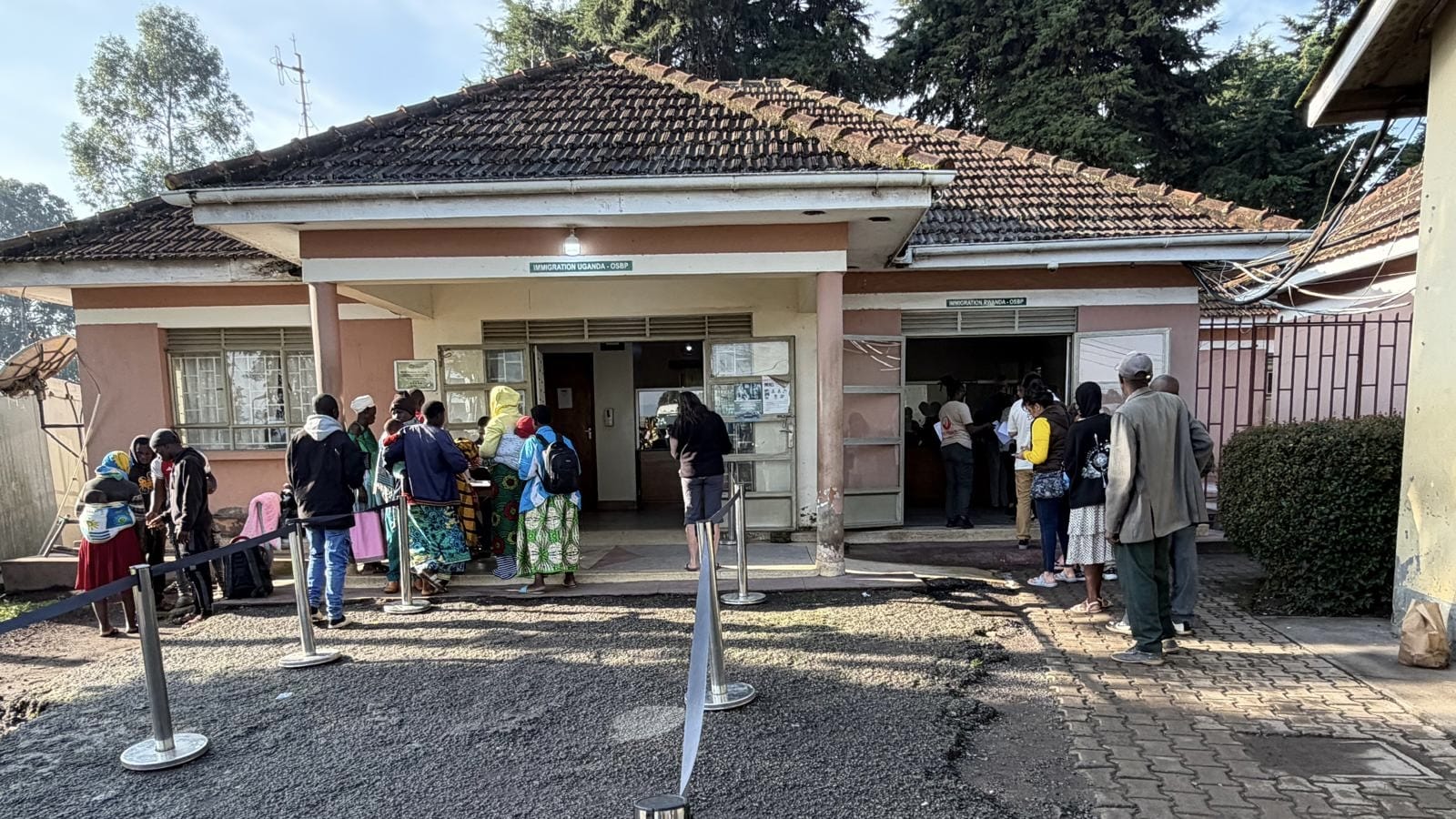
From Musanze, it was about a 40-minute drive to the border. There were no real lines — exiting Rwanda was easy and straightforward, and the two immigration offices sat roughly twenty feet from each other. Entry on the Uganda side was also simple; the only hiccup was that the computer system was down, so everything had to be done manually.
I’d been worrying about my WHO yellow fever card since I’d had to replace it and wasn’t completely sure everything was properly recorded. No one even asked to see it — though it’s officially required for entry.
Still, after about an hour, I was in Uganda.
Once across, we began the long drive north through the highlands toward Katunguru, where we would spend the next two nights near Queen Elizabeth National Park.
Rwanda — once ruled by Germany and later Belgium — drives on the right. Uganda, shaped by British colonial rule, drives on the left. Suddenly I was a front-seat passenger on the left instead of the right. It was a small but noticeable shift. Even the name Queen Elizabeth National Park carried its own trace of that British influence.
And just like that, it felt like a new chapter of the trip.
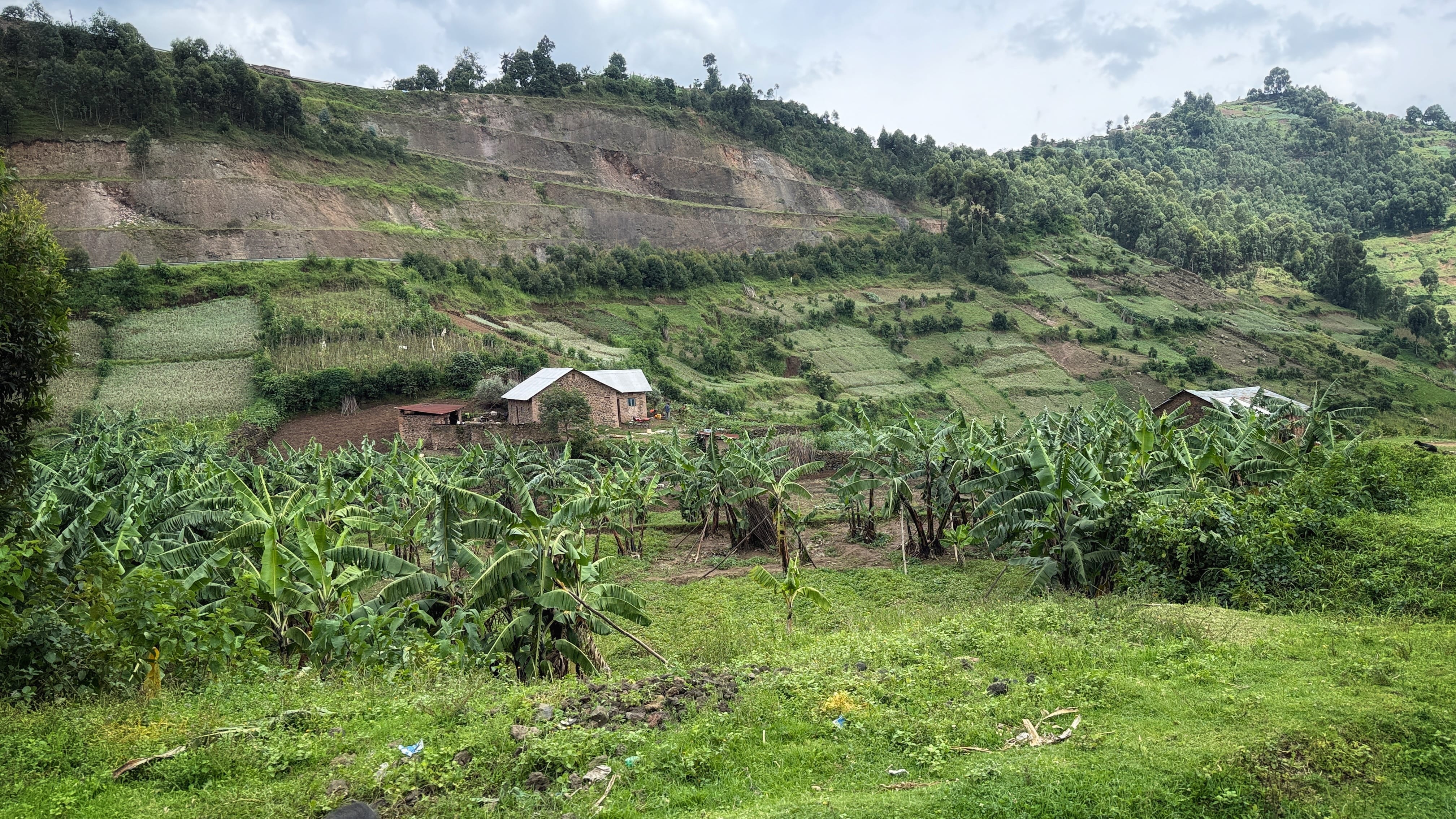
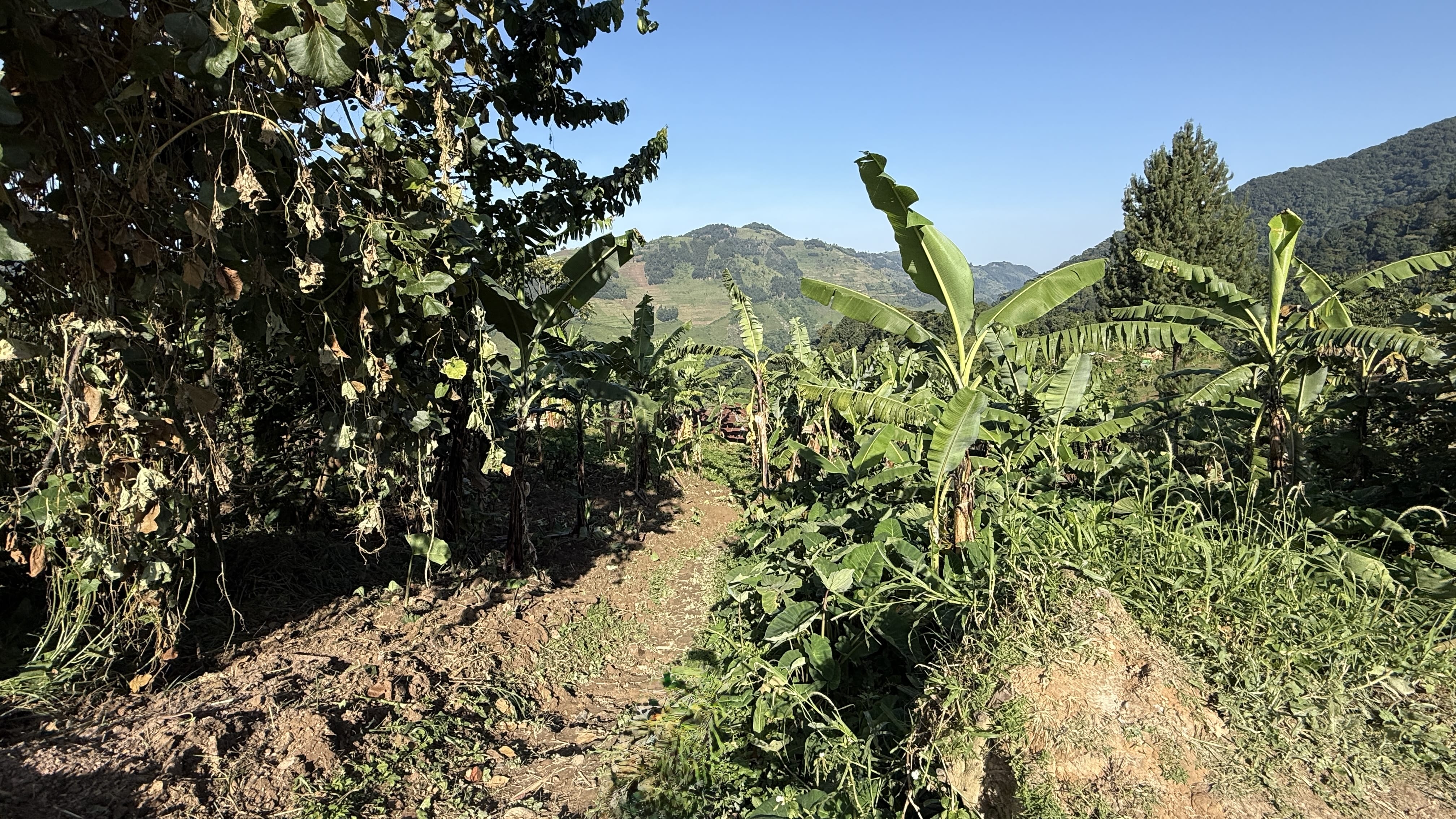
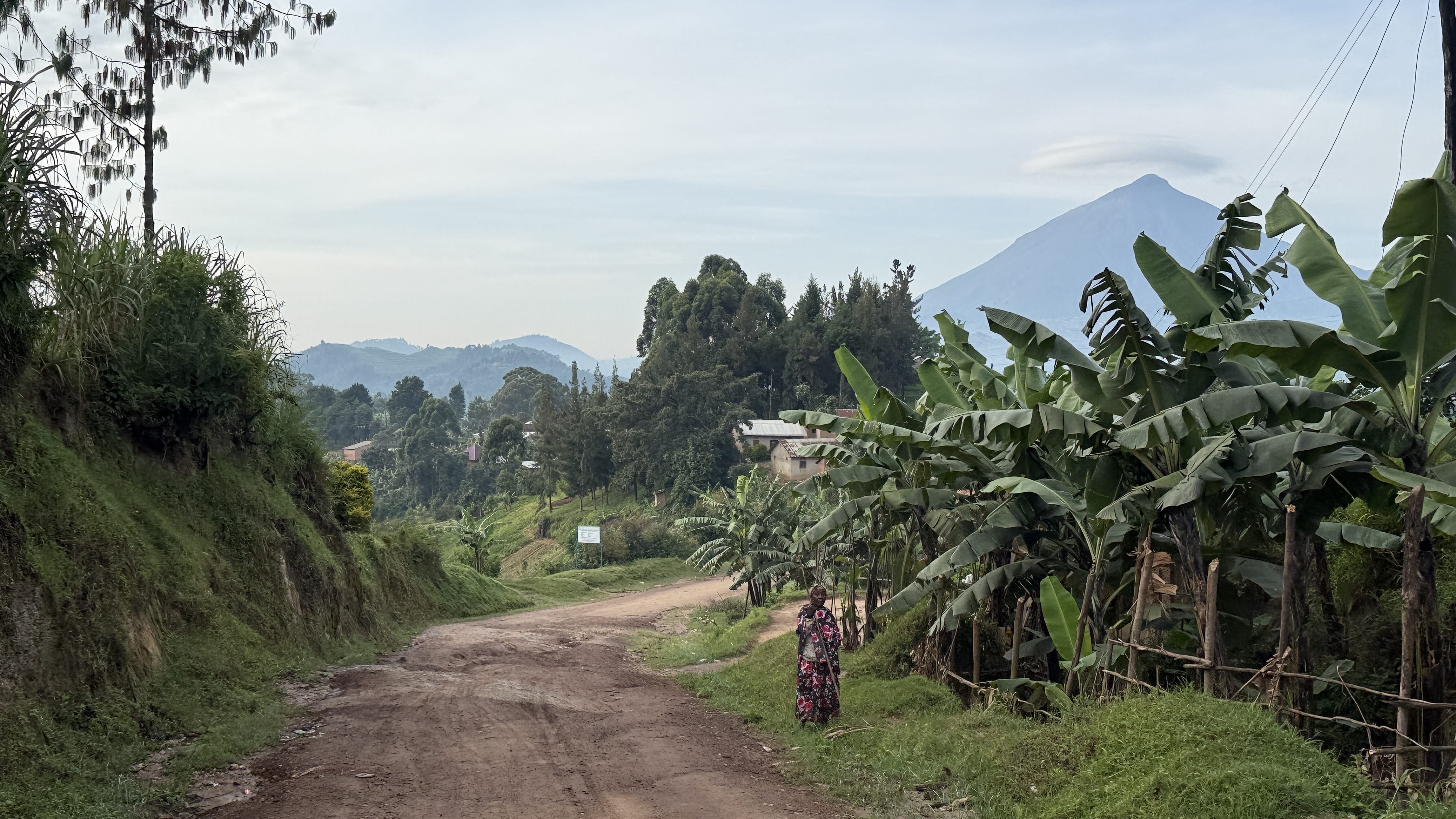
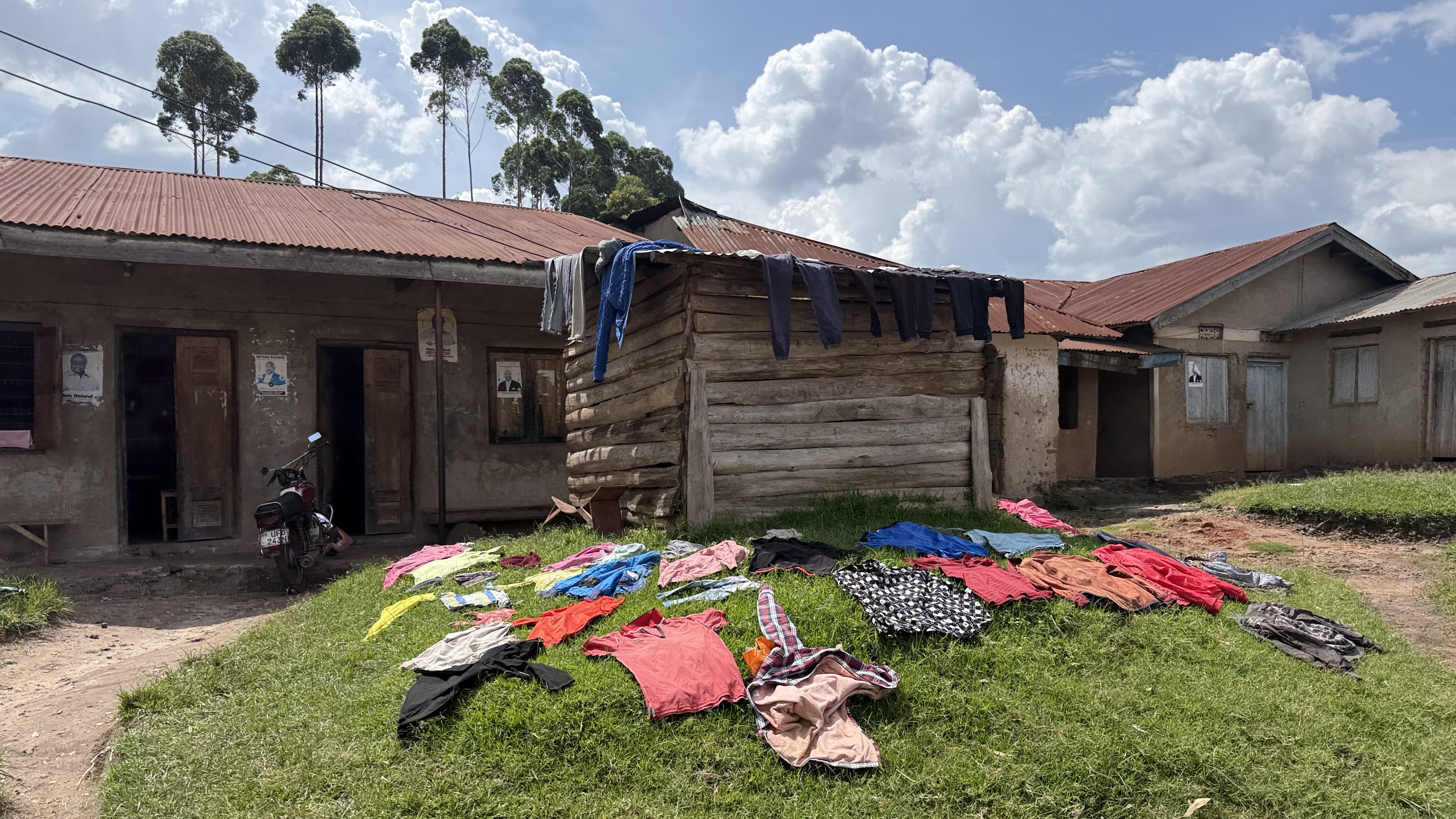
The road climbed quickly into green hills — banana trees, palms, and steep fields of potatoes, onions, and beans. Red mud-brick houses sat along narrow dirt paths cutting up the slopes.
We passed small villages miles apart, and children often stood along the roadside waving and calling out “hello.” Then I caught sight of a blue monkey — my first glimpse of wildlife outside a park.
As we continued deeper into southwestern Uganda after crossing at Cyanika, the road wound through the highlands around Kisoro. Steep valleys opened onto bamboo-covered forest stretching across the hillsides.
Along the way our driver pointed out Lake Bunyonyi, scattered with dozens of small islands. One of them — Punishment Island — was once used to abandon unmarried pregnant girls.
To reach our lodge, we passed through Kalinzu Central Forest Reserve, just outside Queen Elizabeth National Park, and had a bit of an unofficial game drive along the way. We spotted two elephants, a troop of baboons, buffalo, and more.
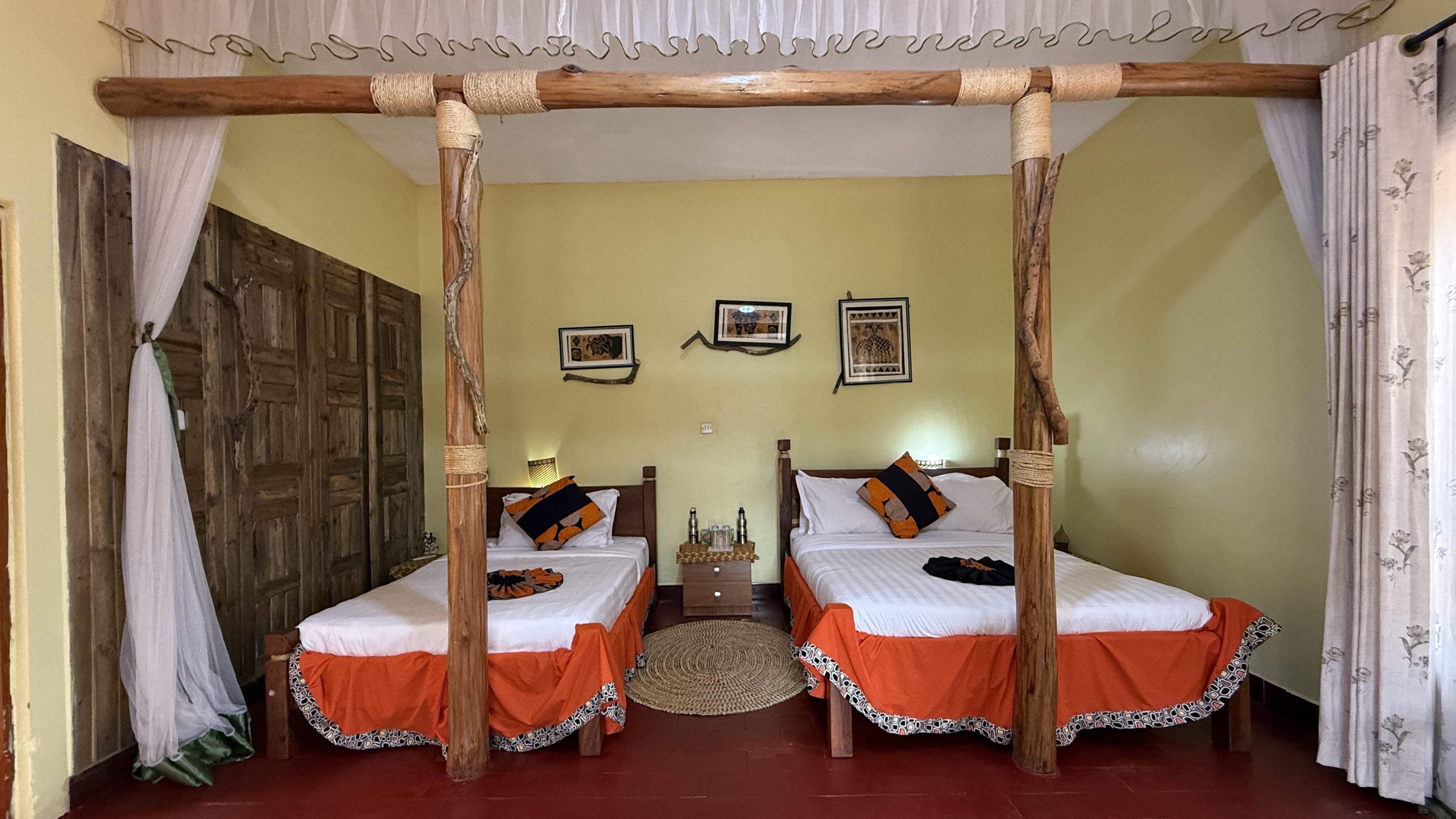
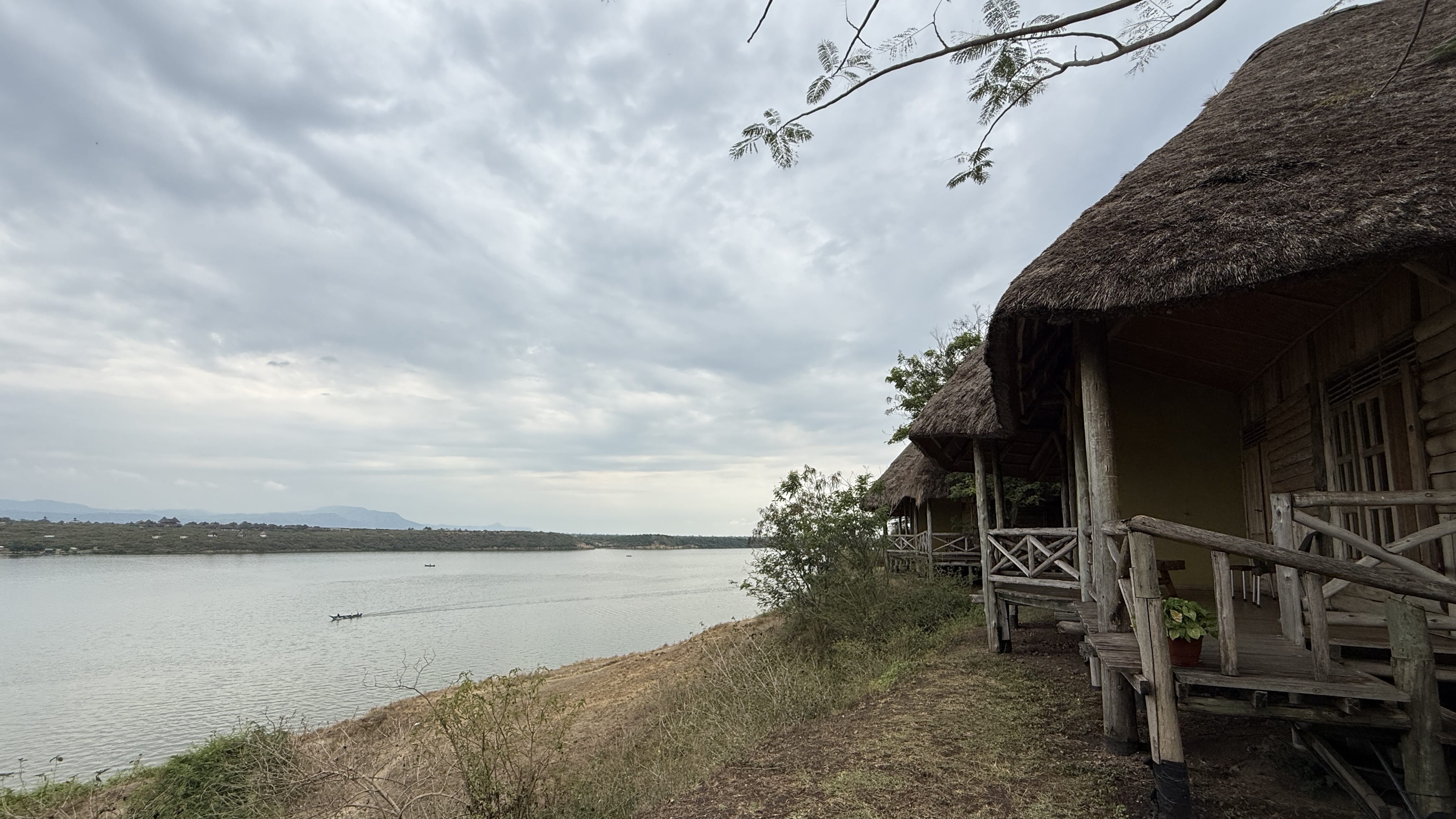
After a long day on the road — roughly six hours, plus a stop for lunch — we arrived at Tembo Safari Lodge, with wide views over the Kazinga Channel, home to one of the largest hippo populations in East Africa.
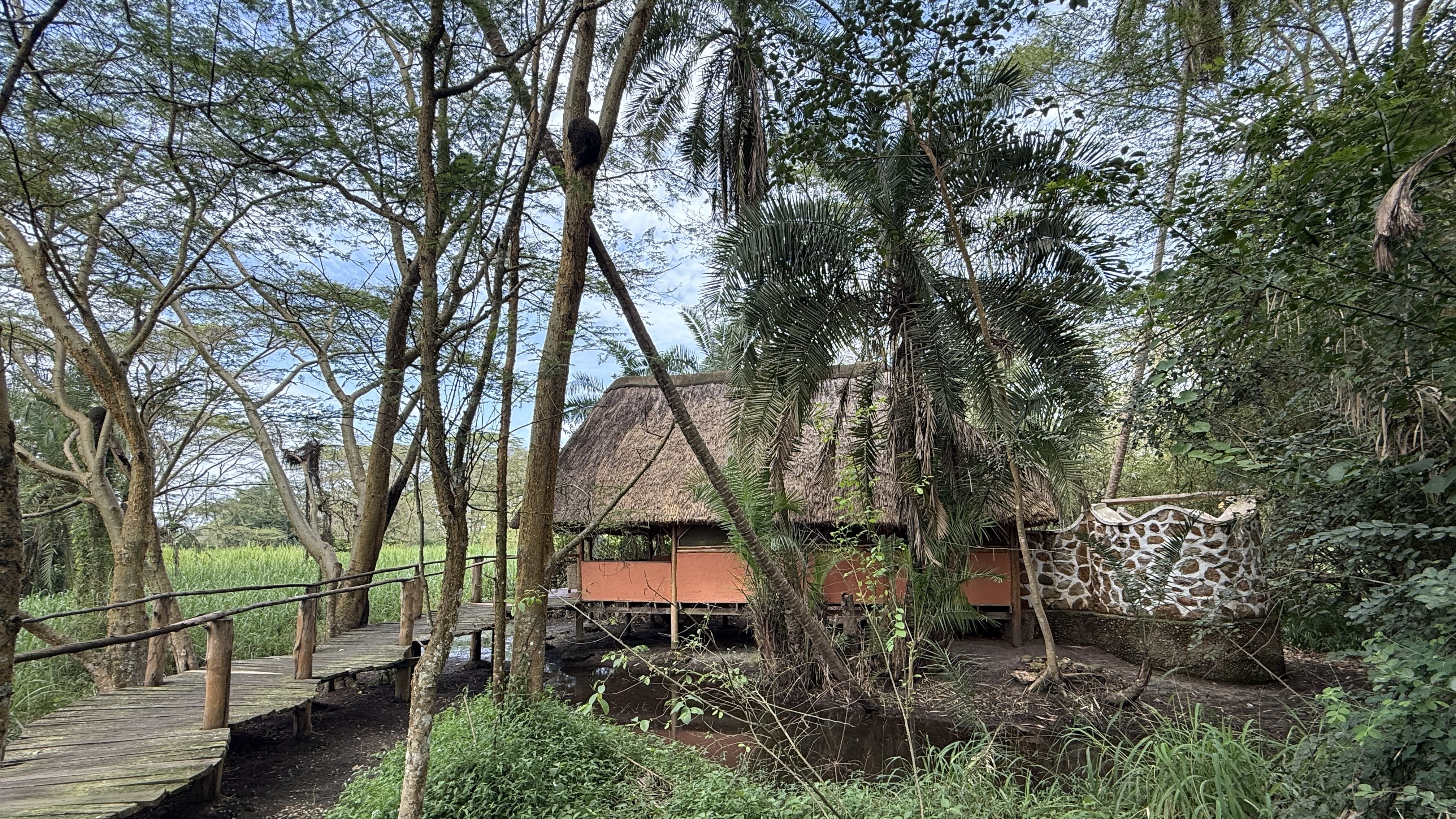
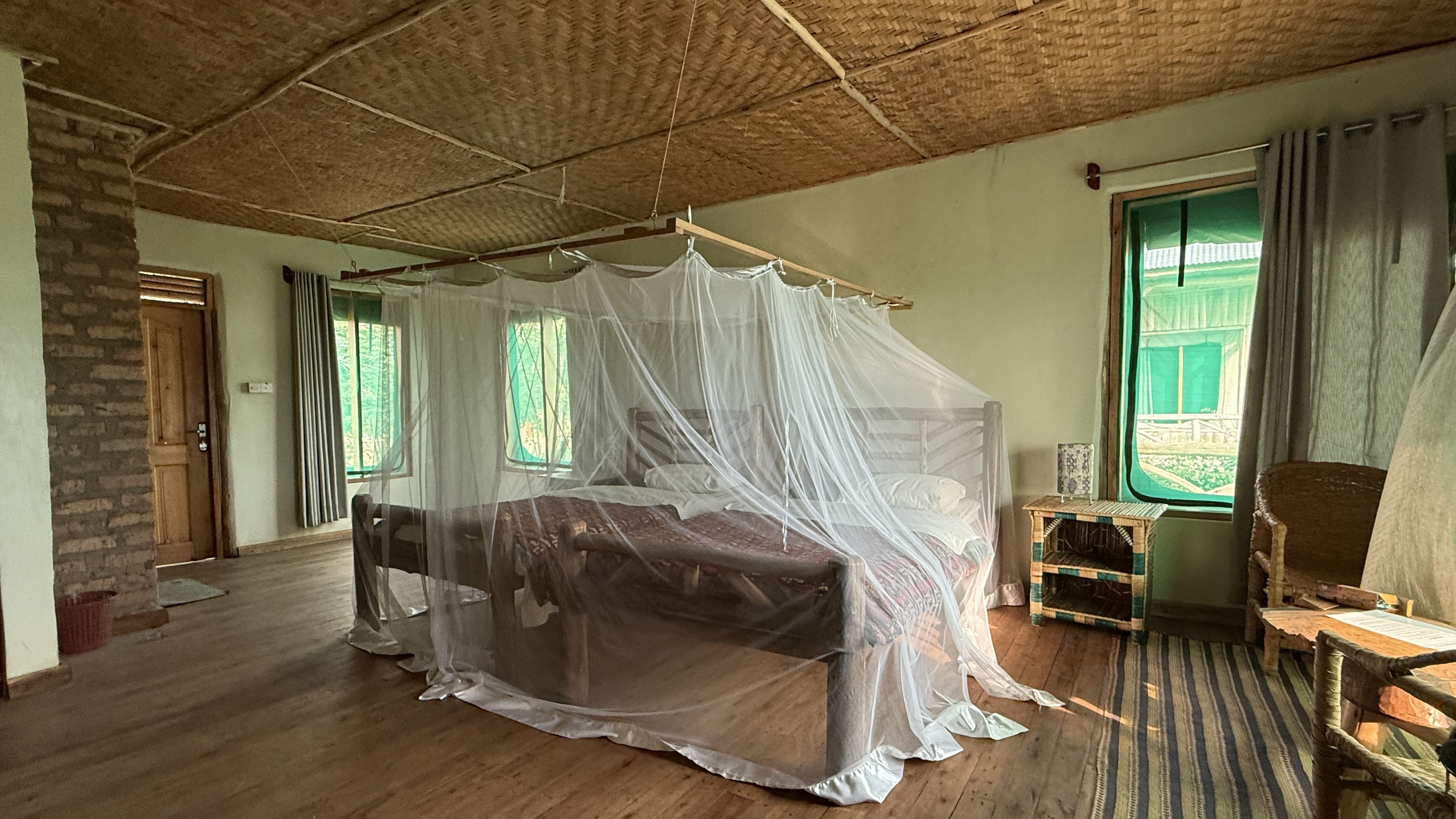
After dinner, staff was required to walked us back to our cottage. Hippos often wander onto the property at night and can be extremely aggressive. So once we were inside our rooms, we were told not to leave until morning.
After breakfast at the lodge, we drove a short distance to the Uganda Wildlife Authority briefing point for Kyambura Gorge inside Queen Elizabeth National Park. There, we registered for chimpanzee trekking and received a quick briefing — what to do if a chimp approached, how far to stay back, and the requirement to wear face masks when near them.
I hired one of the porters waiting nearby — not because I truly needed the help, but because it’s a simple way visitors can support the local community. Small choices like that feel important in places like this. Besides, he carried my backpack.
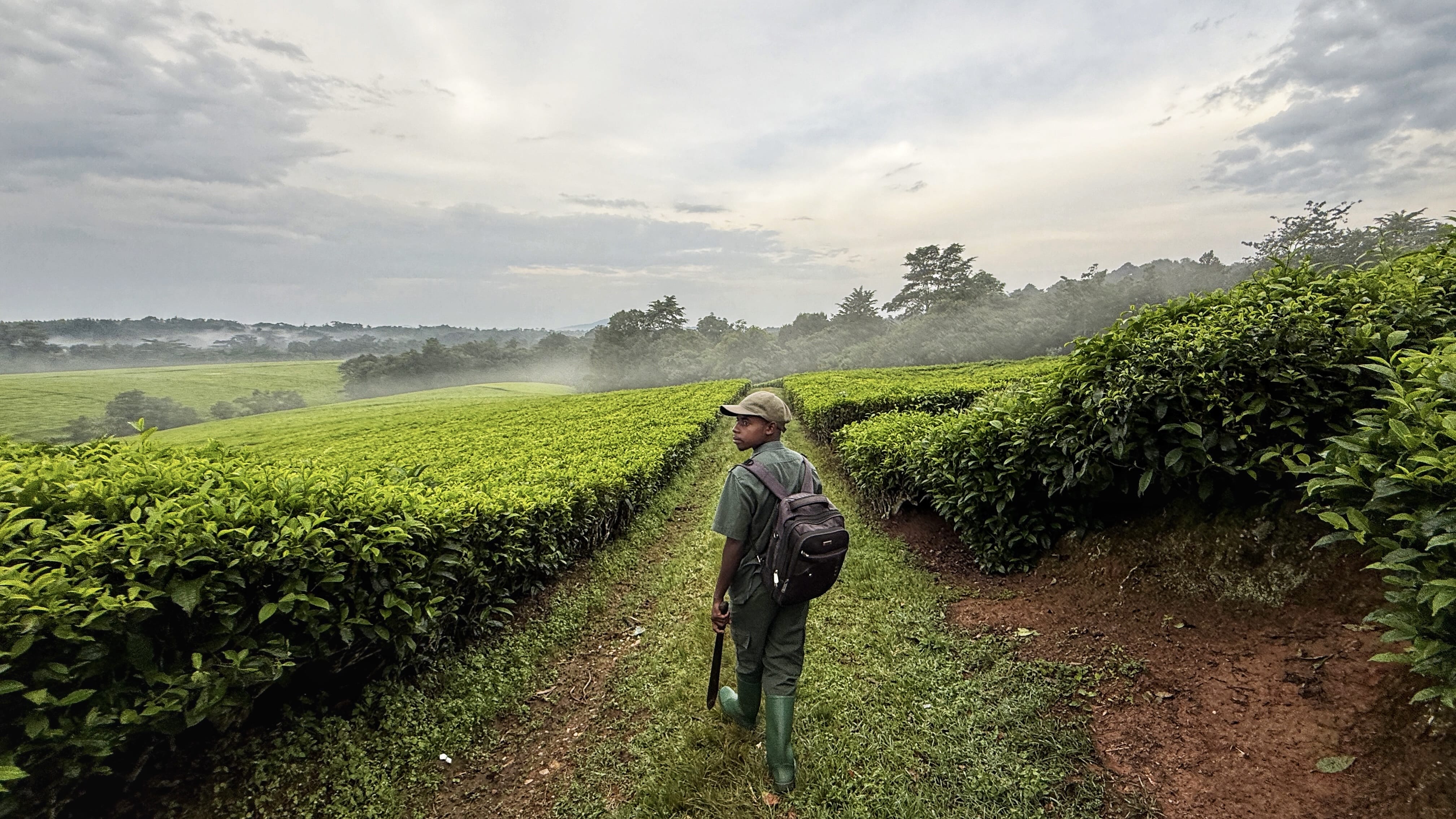
We followed our guide, Thaddeus, along the road, turning near the Ankole tea plantation. Mist rose softly from the ground, making it easy to understand how Gorillas in the Mist got its name. Behind us walked a ranger carrying a gun, there in case of trouble. If needed, he would fire a warning shot into the air.
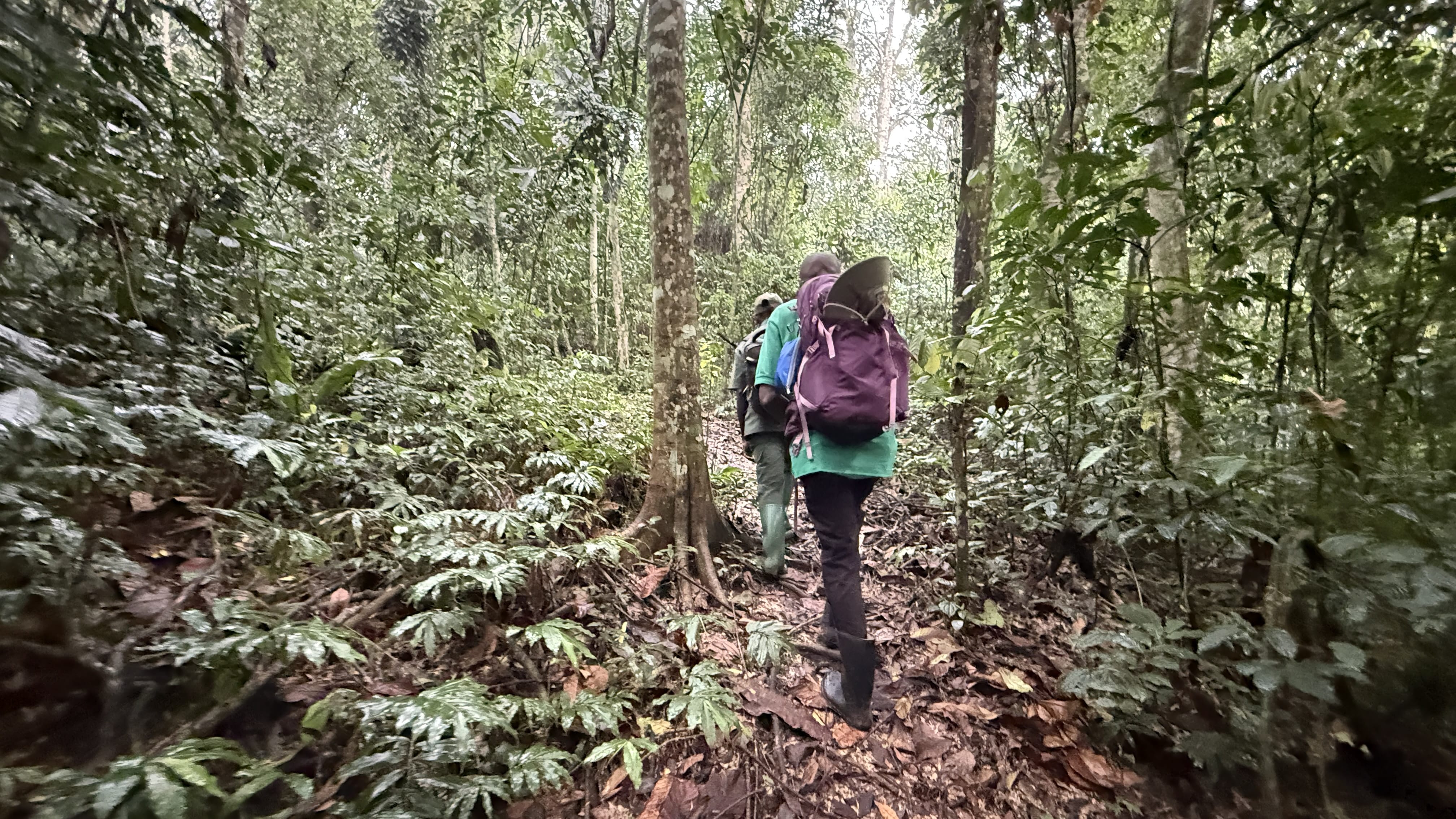
A dirt path soon left the tea fields and led us into the forest. Our guide watched carefully for signs of the chimps — first fresh droppings, then recently chewed food. Not long after, we heard crashing and movement high in the canopy. The sound came before the sight, and for a moment everything felt suspended in anticipation.
Then we saw them.
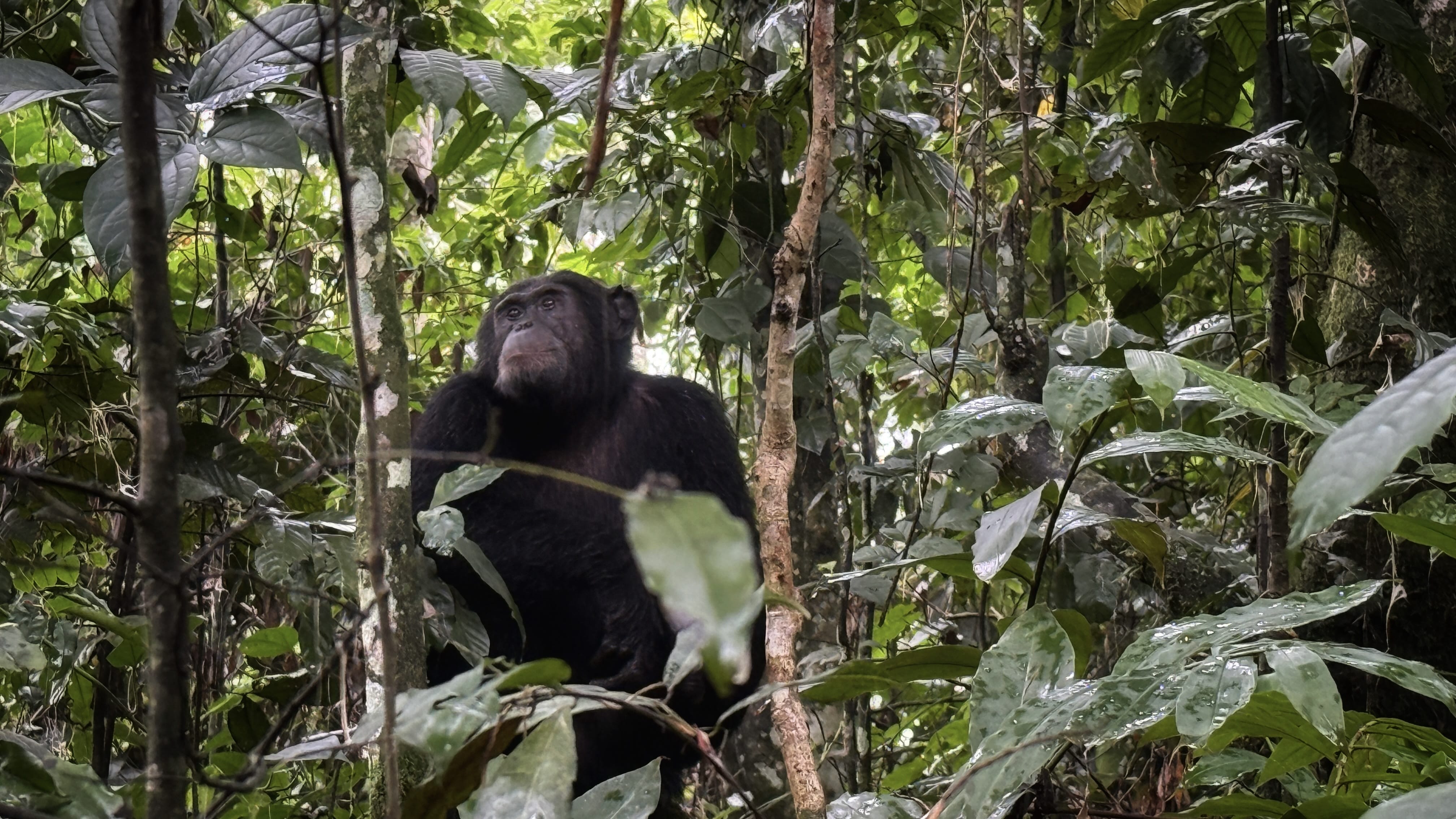
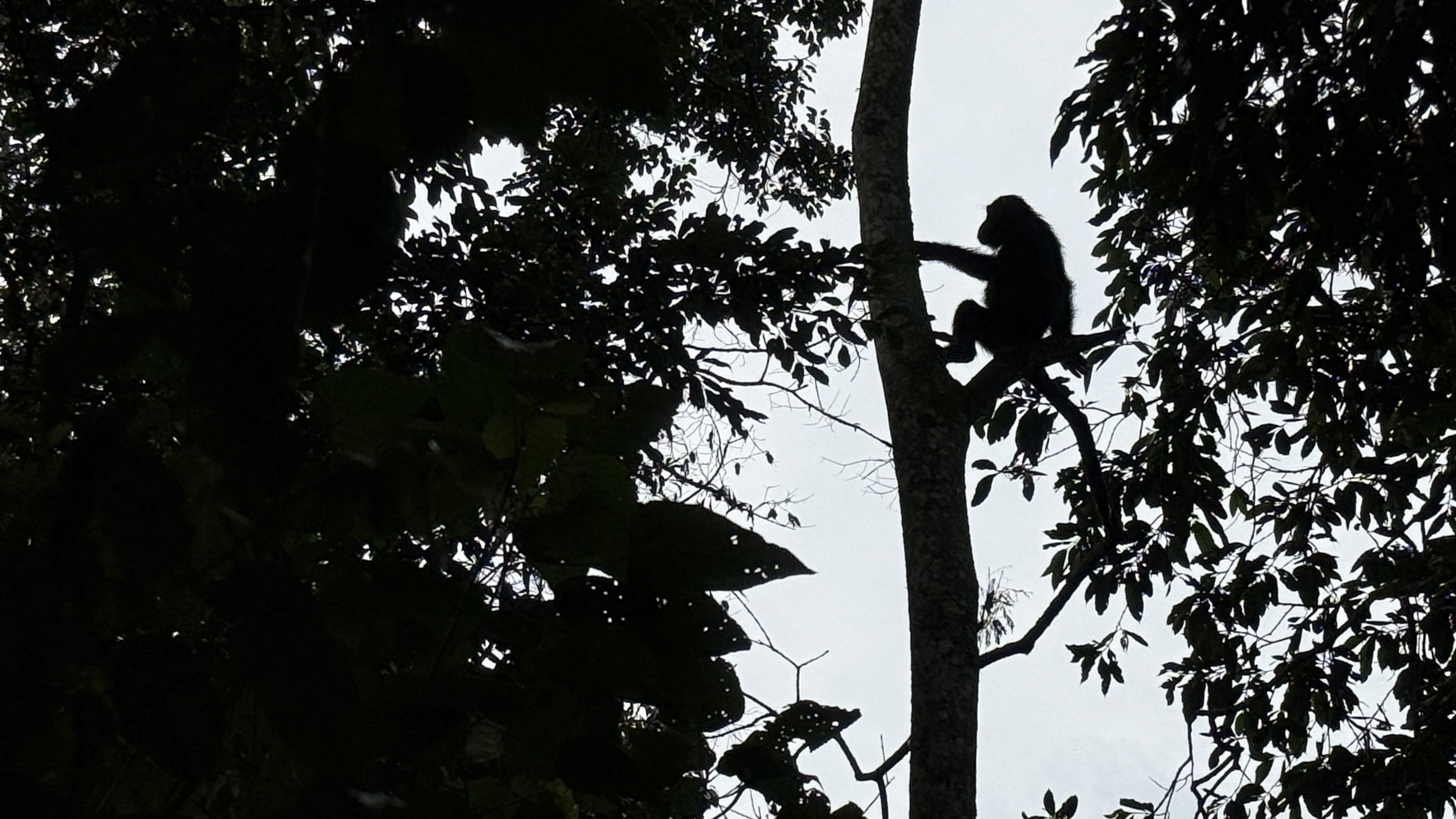
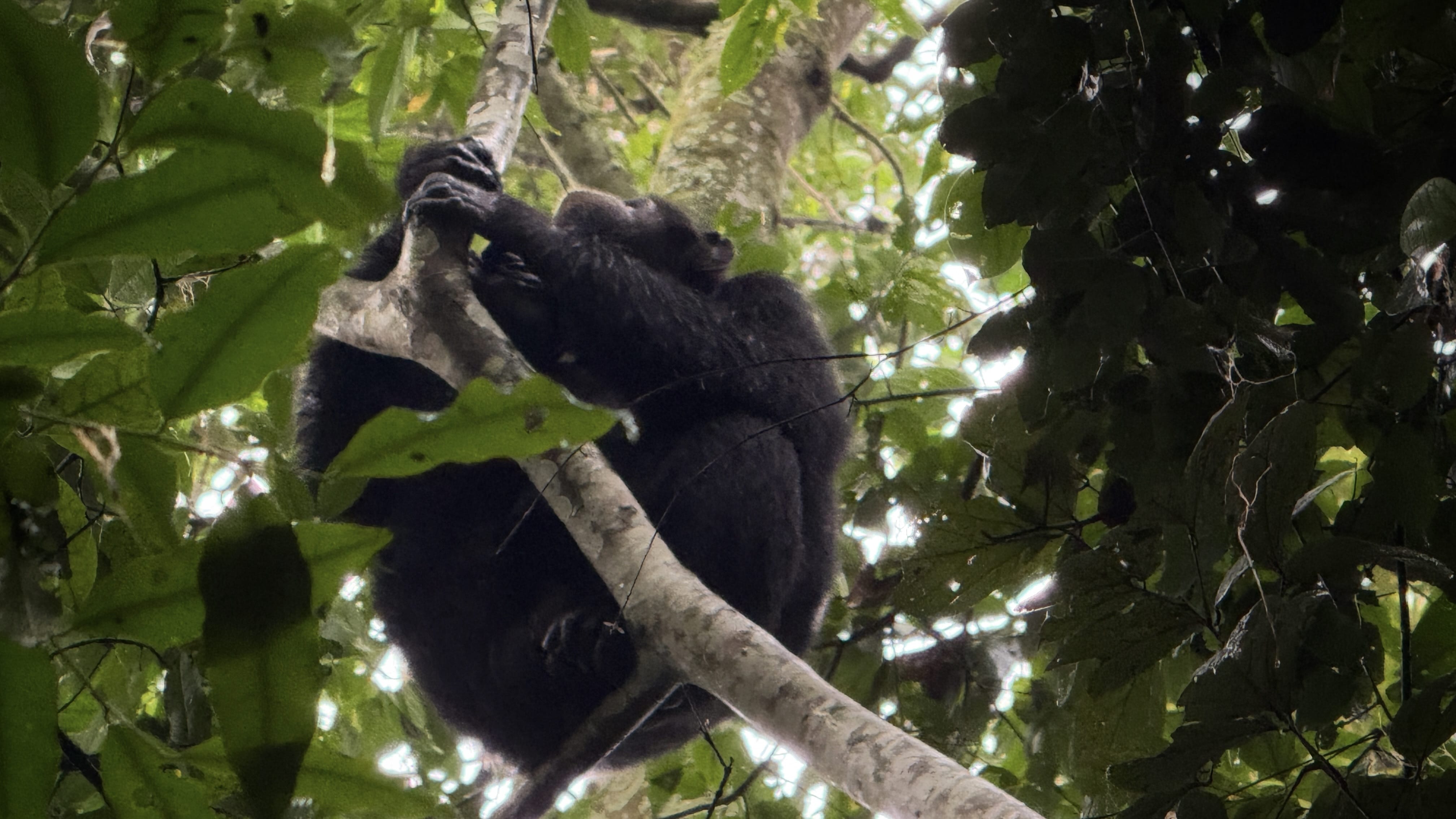
We spotted about ten of the roughly fifty chimpanzees that live here. They jumped, chewed leaves, and climbed with incredible speed, never still for long. Their loud, echoing calls carried through the forest. Watching them so close, it was impossible not to notice how familiar they seemed, even in their wildness.
The entire trek lasted around three hours, including the hike and our time with the chimpanzees — and it was completely worth it.
The total time can be longer or shorter depending on where the chimps are that day. Once you find them, you’re given about an hour to observe — and that hour goes by far too quickly.
We headed back toward the lodge, spotting another elephant along the way — always a highlight for me. I’m a bit of a freak for elephants.
After lunch, we set out again, this time for a two-hour cruise along the Kazinga Channel, which links Lake George and Lake Edward before eventually feeding into the Nile system.
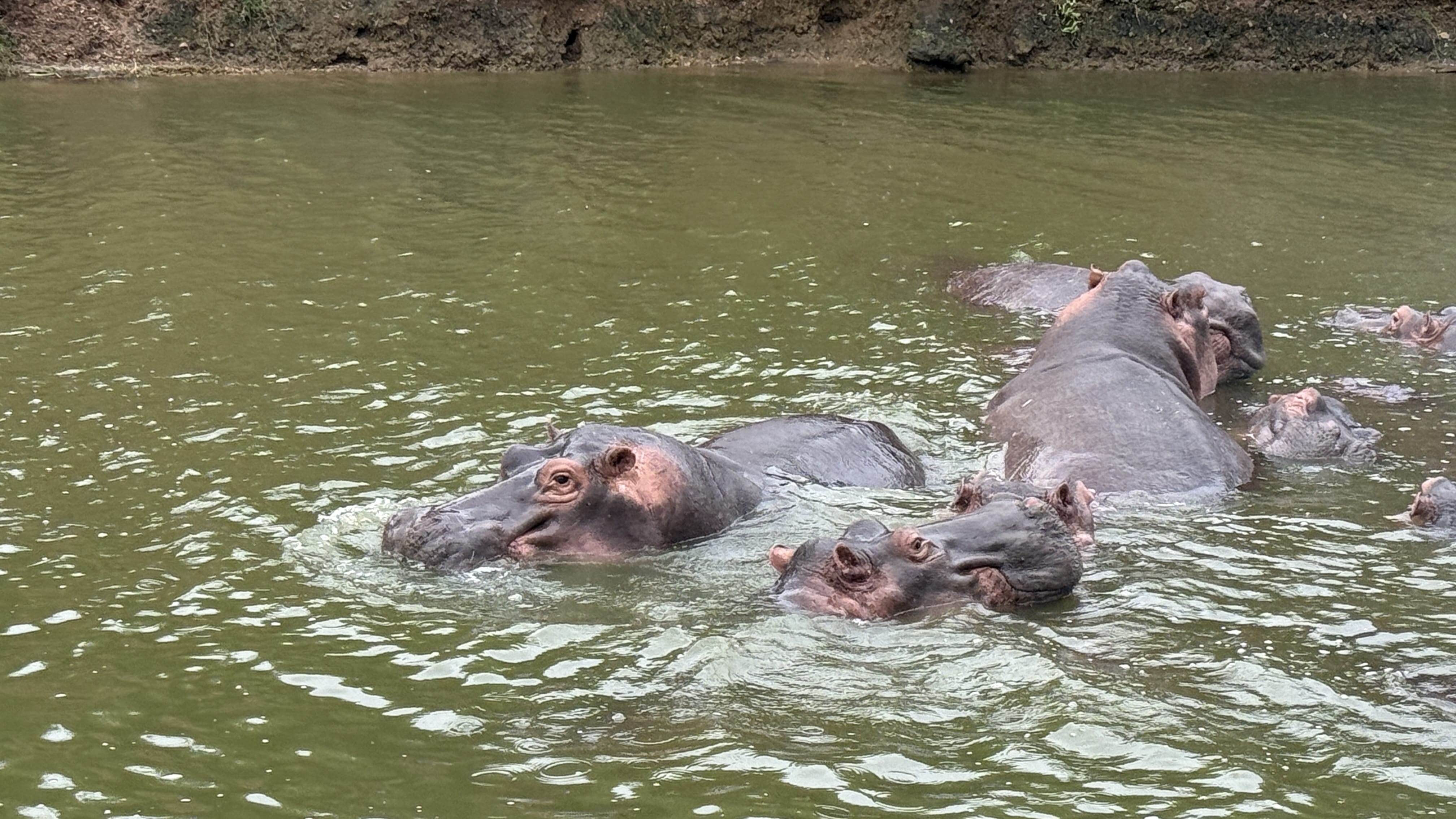
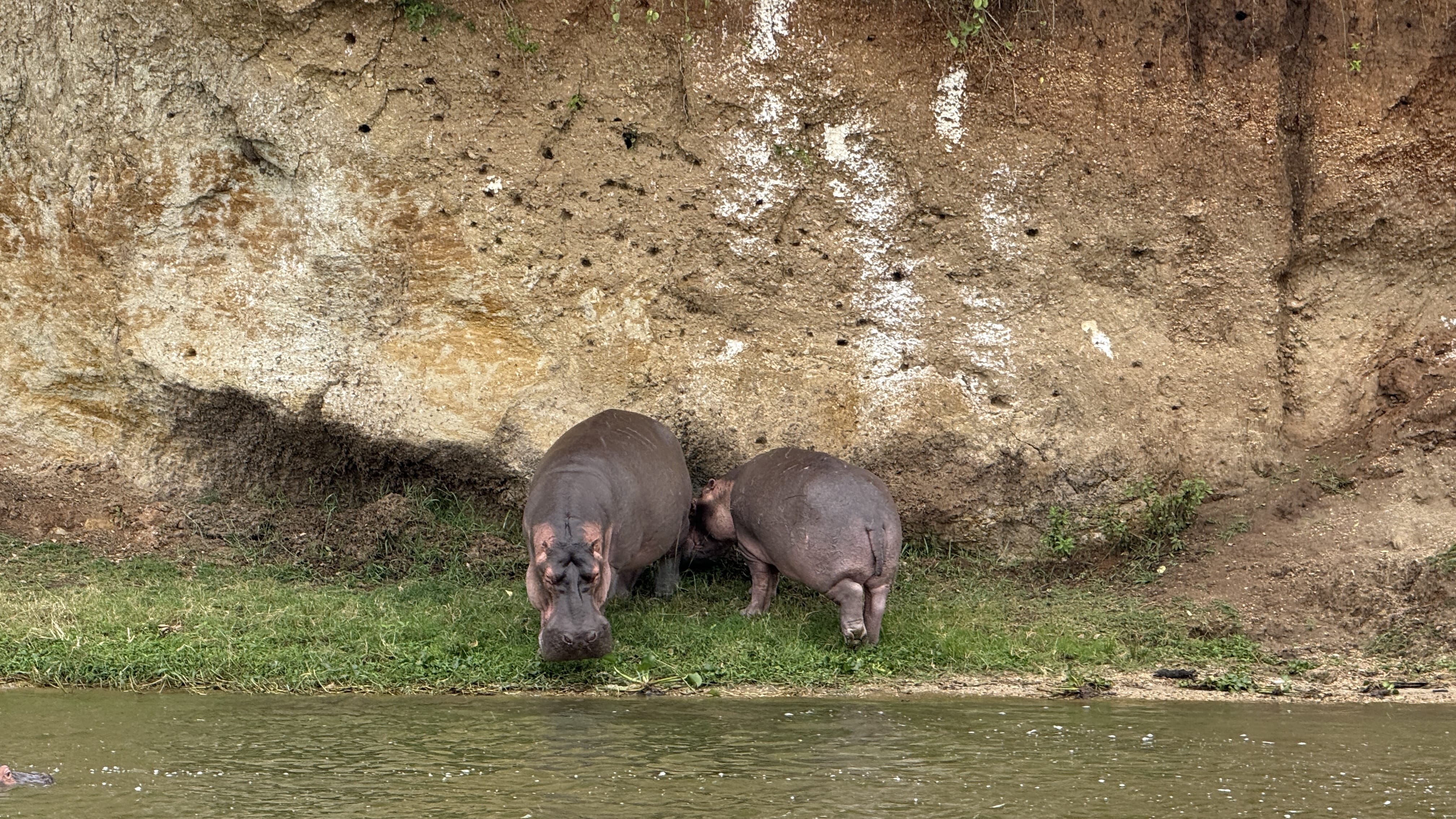
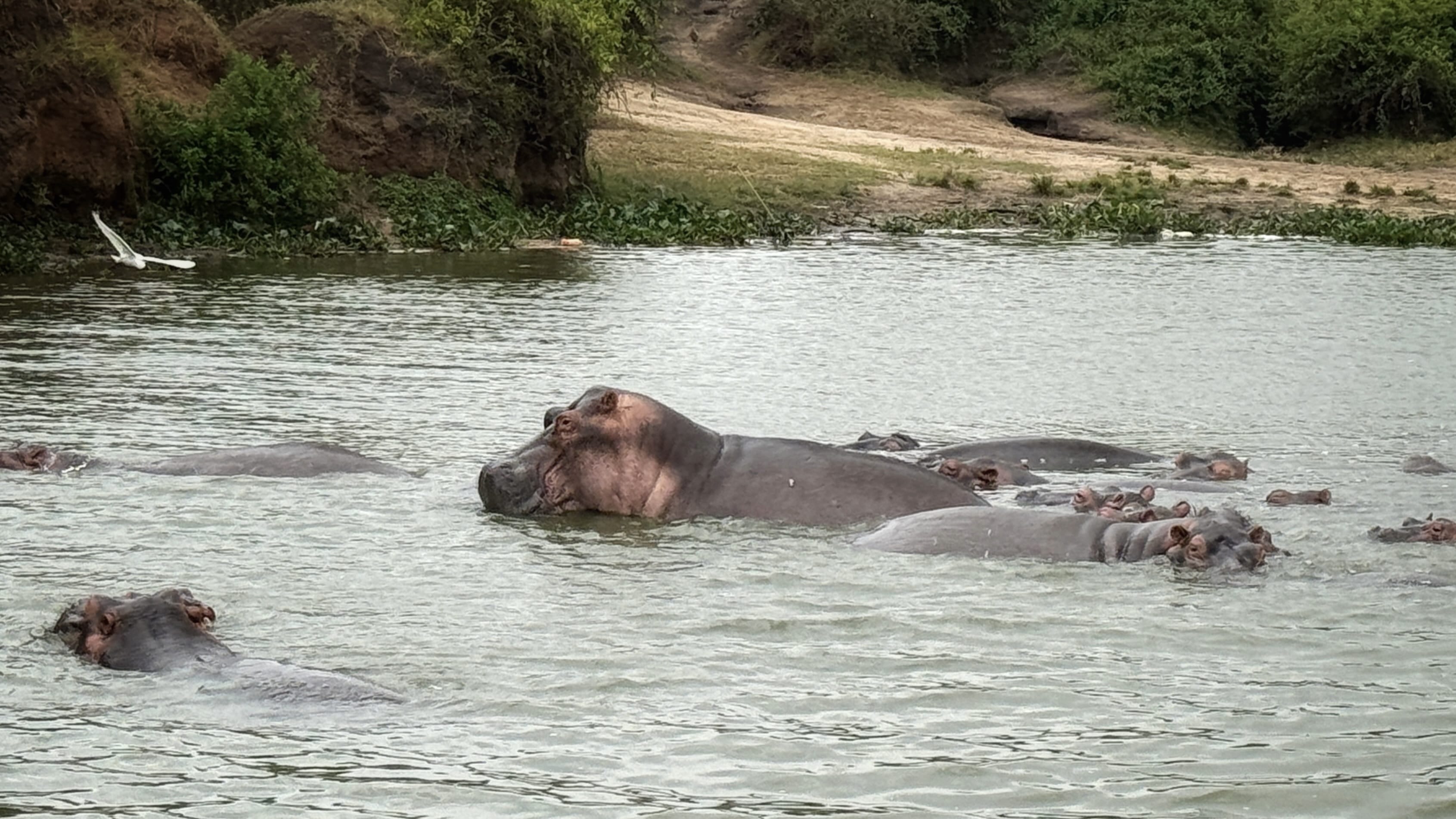
There were birds everywhere, and the captain was excellent at pointing them out. But the main attraction was the hippos — and there were plenty. We passed pod after pod, some with fifteen or twenty hippos gathered together. Most simply floated with only their nostrils and the tops of their heads visible above the water.
At one point, two waddled onto a narrow stretch of shoreline to relieve themselves before slipping back into the channel. In another pod, the captain pointed out a rare sight — a pink-headed hippo. We also saw two Nile crocodiles. Elephants sometimes appear along the lakeshore as well, but the afternoon heat kept them away that day.
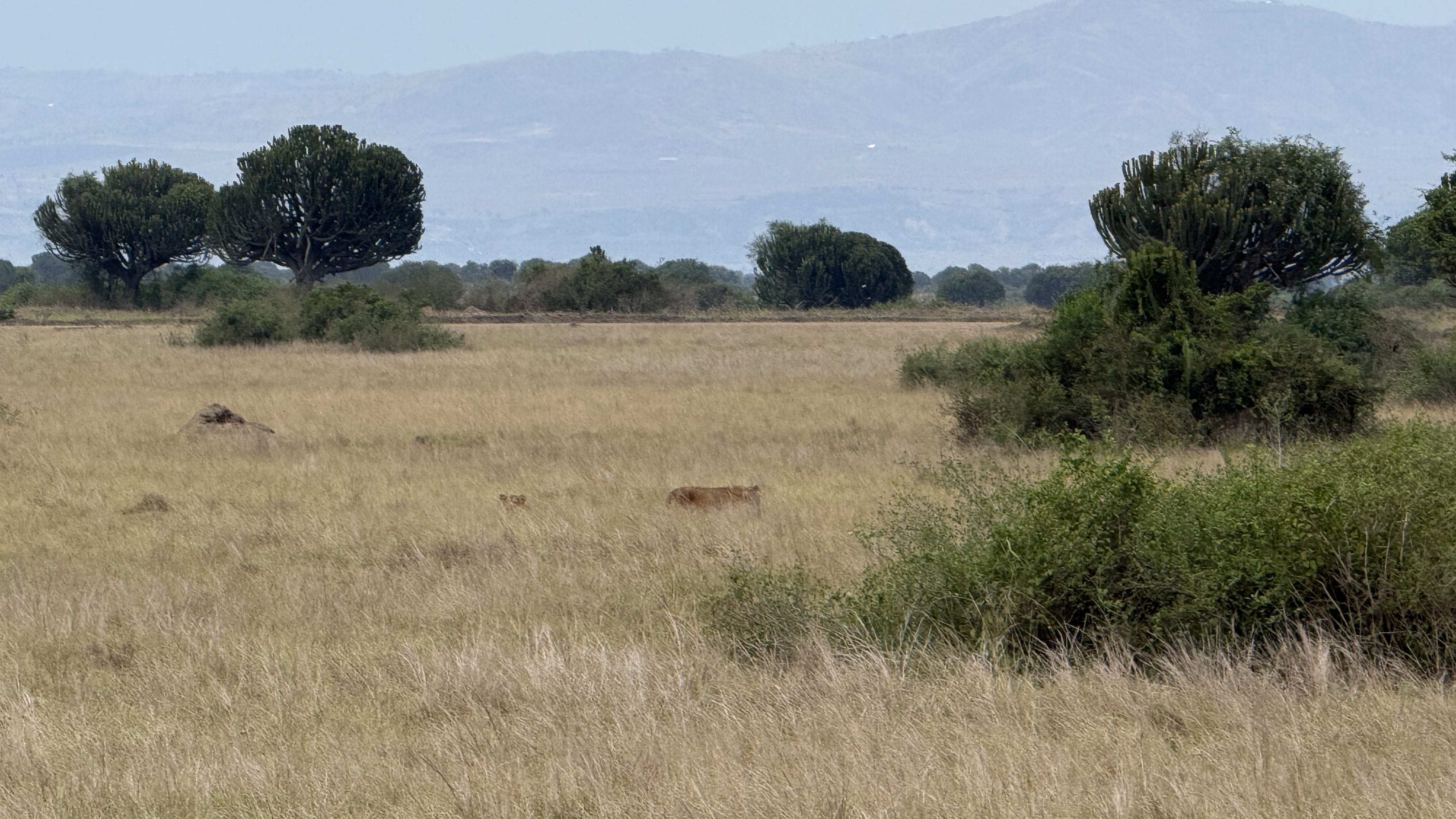
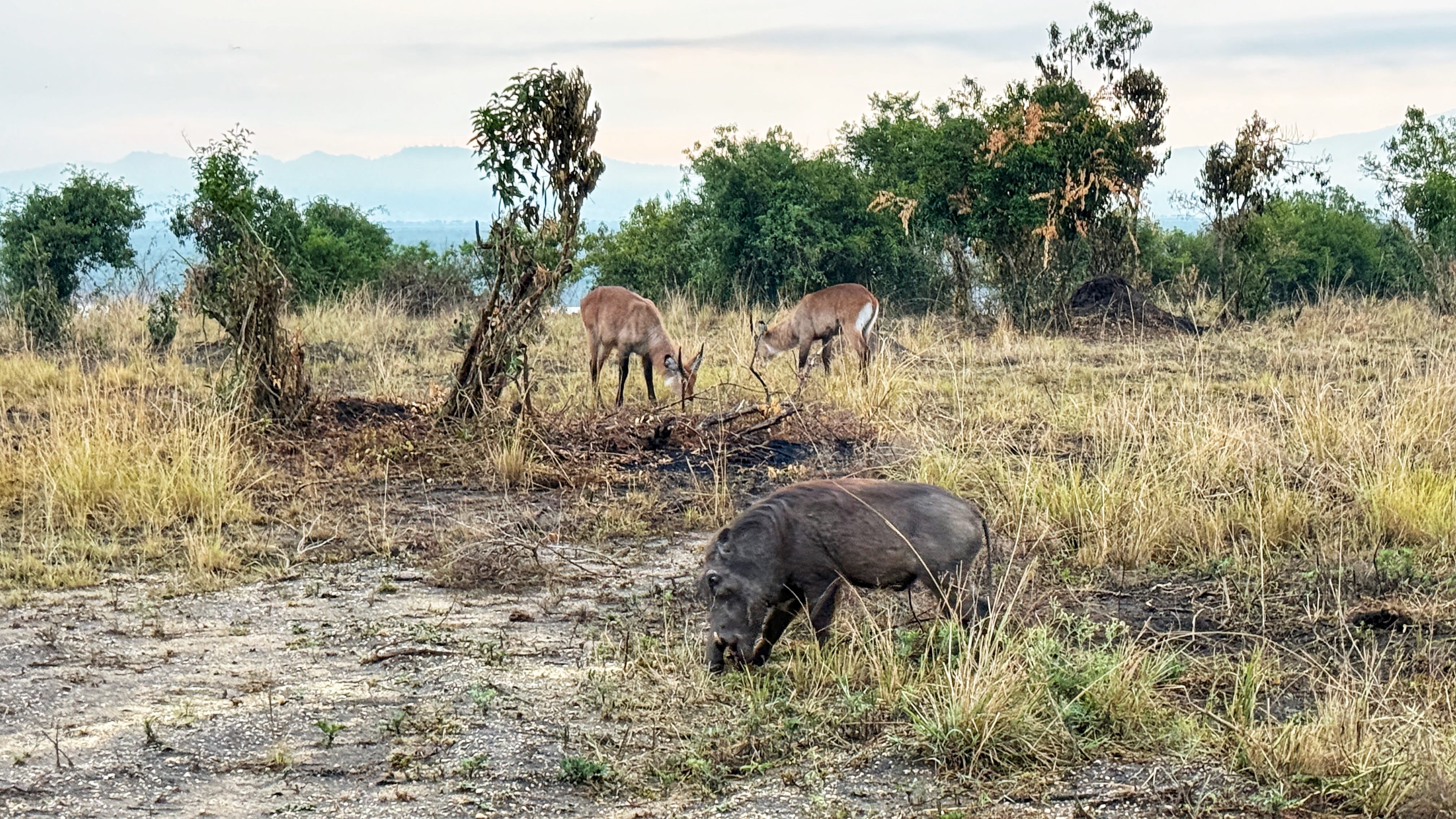
After the boat ride, we drove into the Acacia sector of Queen Elizabeth National Park. Along a stretch of road crowded with safari vehicles — a small cluster of jeeps — we spotted two lions, at first visible only by their heads rising above the grass. Farther along we saw African buffalo, Uganda kob, warthogs, waterbuck, and baboons scattered across wide plains dotted with acacia trees.
By evening we returned to the lodge for dinner.
It had been a full day — chimps in the morning, hippos in the afternoon, and a final game drive across the plains to close it out.
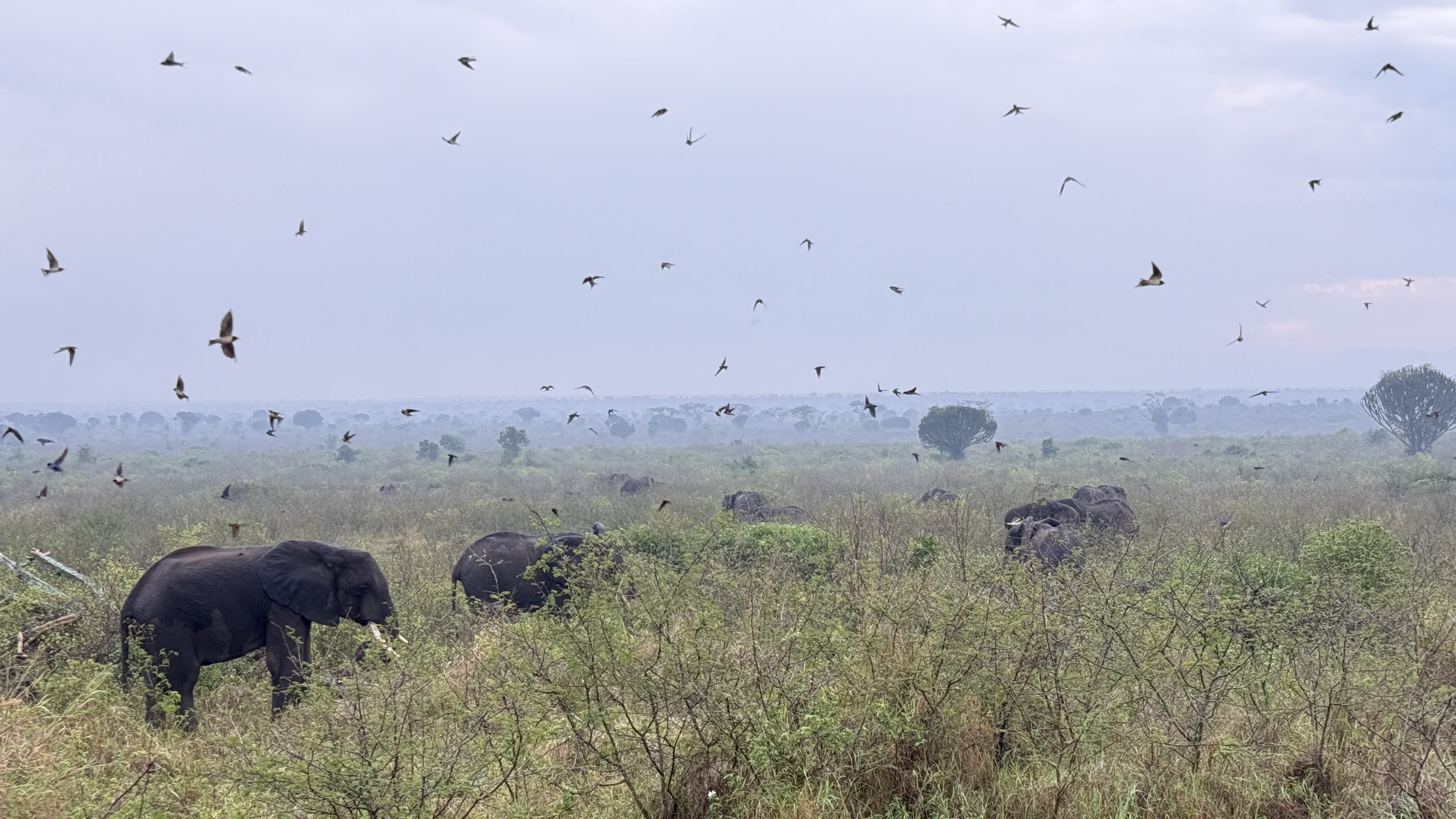
We left Tembo Safari Lodge and made our way south toward Ishasha and our lodging for the night, turning the drive itself into a game drive along the way. We saw a lot—especially, you guessed it, elephants, including a herd of them with swallows flying all around them.
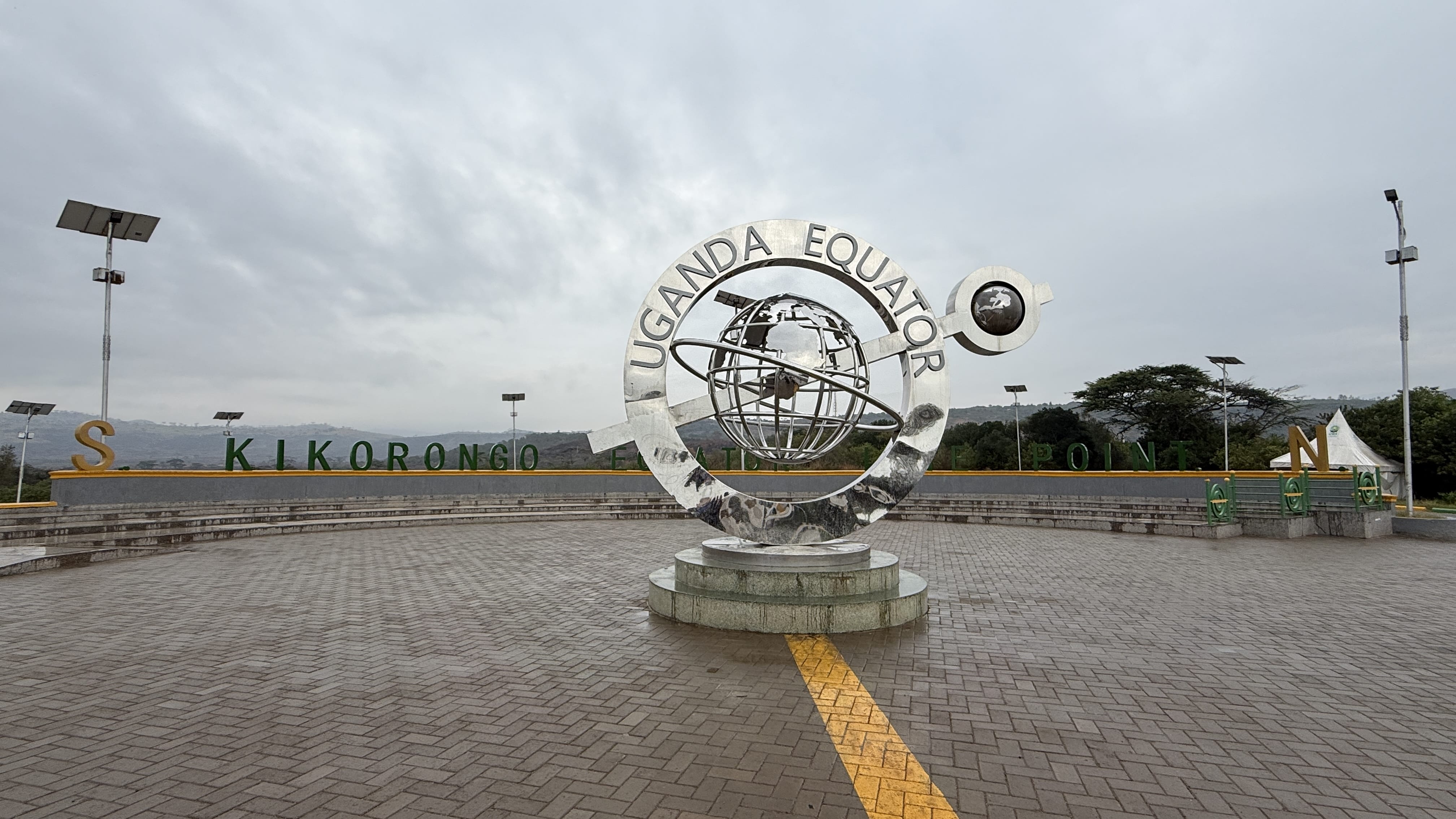
About an hour and a half into the drive, we passed the Uganda Equator near Lake Katwe, where we stopped briefly for a photo before continuing in search of more wildlife.
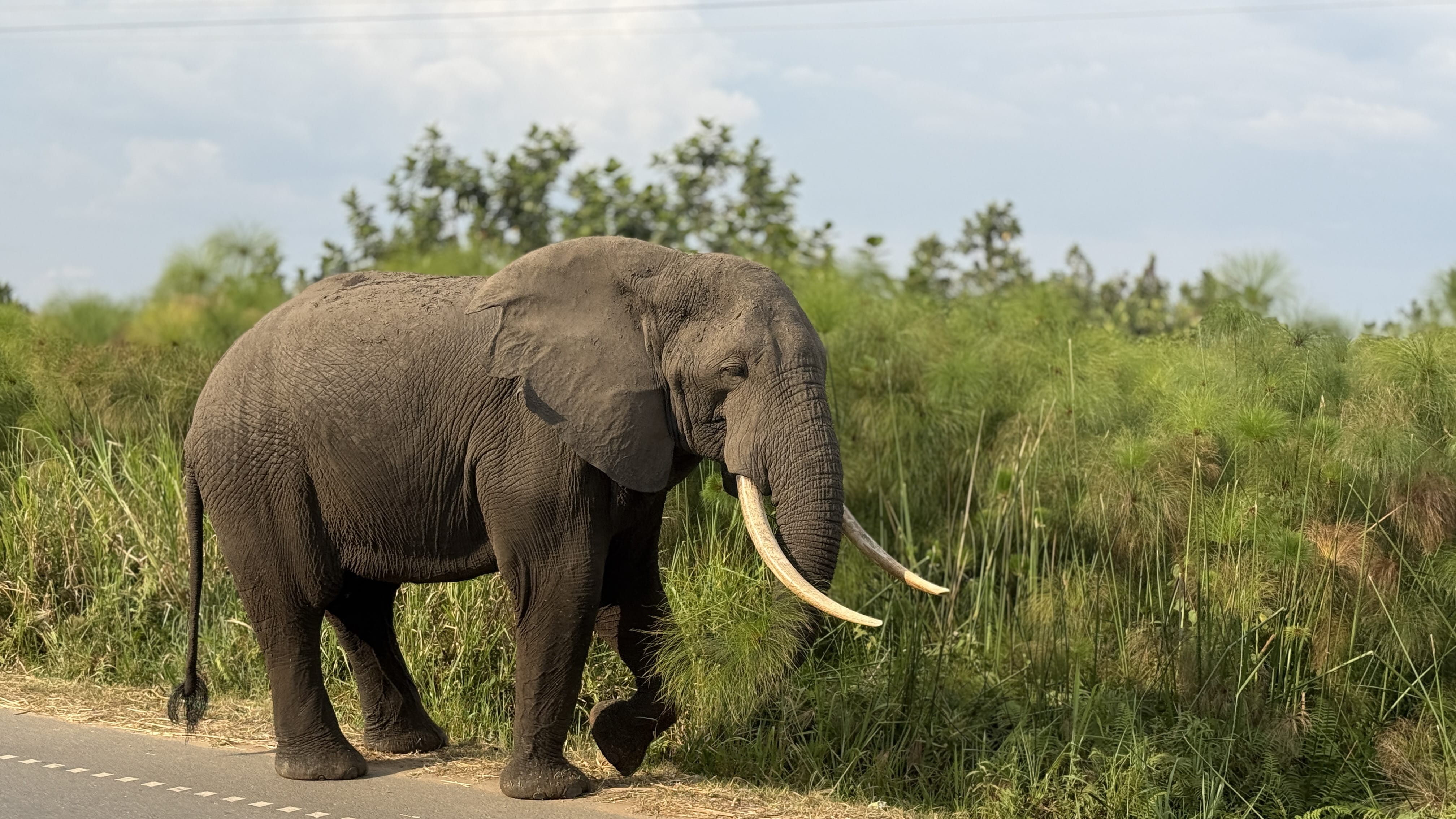
Not long after, we came across roughly fifty buffalo moving slowly across the plains, a few babies among them—though it was impossible to count precisely while driving. Around eleven o’clock, we spotted a huge elephant feeding on papyrus.
There, for a moment, I thought it was a statue.
We soon lost count of the buffalo, passing another massive herd — seventy or more — spread across the landscape. High in a tree, movement in the leaves revealed five black-and-white colobus monkeys, easy to miss if you weren’t looking carefully.
Farther along, we saw defassa waterbuck, a vervet monkey crossing the road and climbing into a tree, and a distant hippo floating quietly in a stream with birds riding on its back. Fresh elephant dung appeared along the road for quite a while before we finally spotted the elephant responsible, standing alone out in a field.
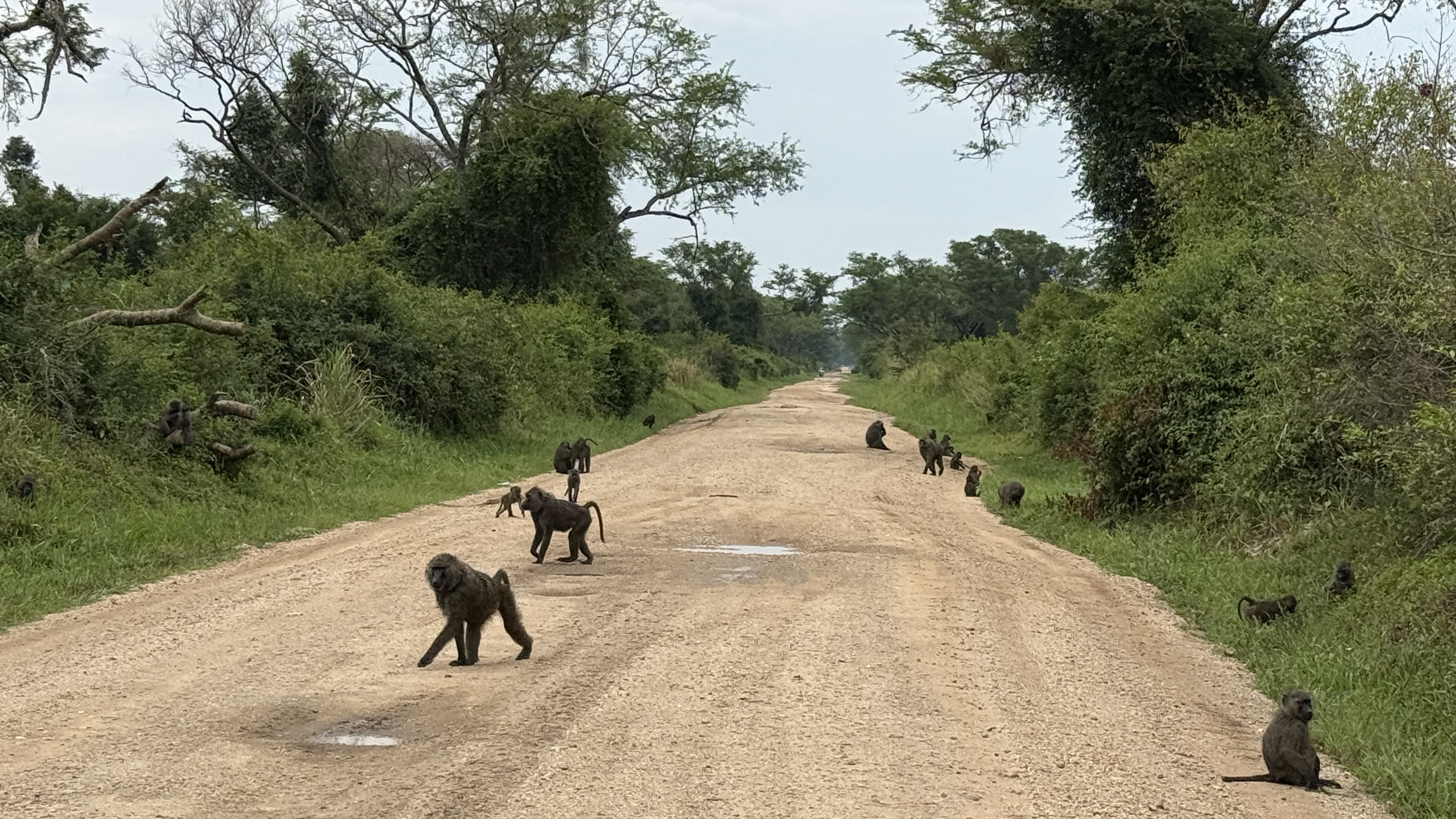
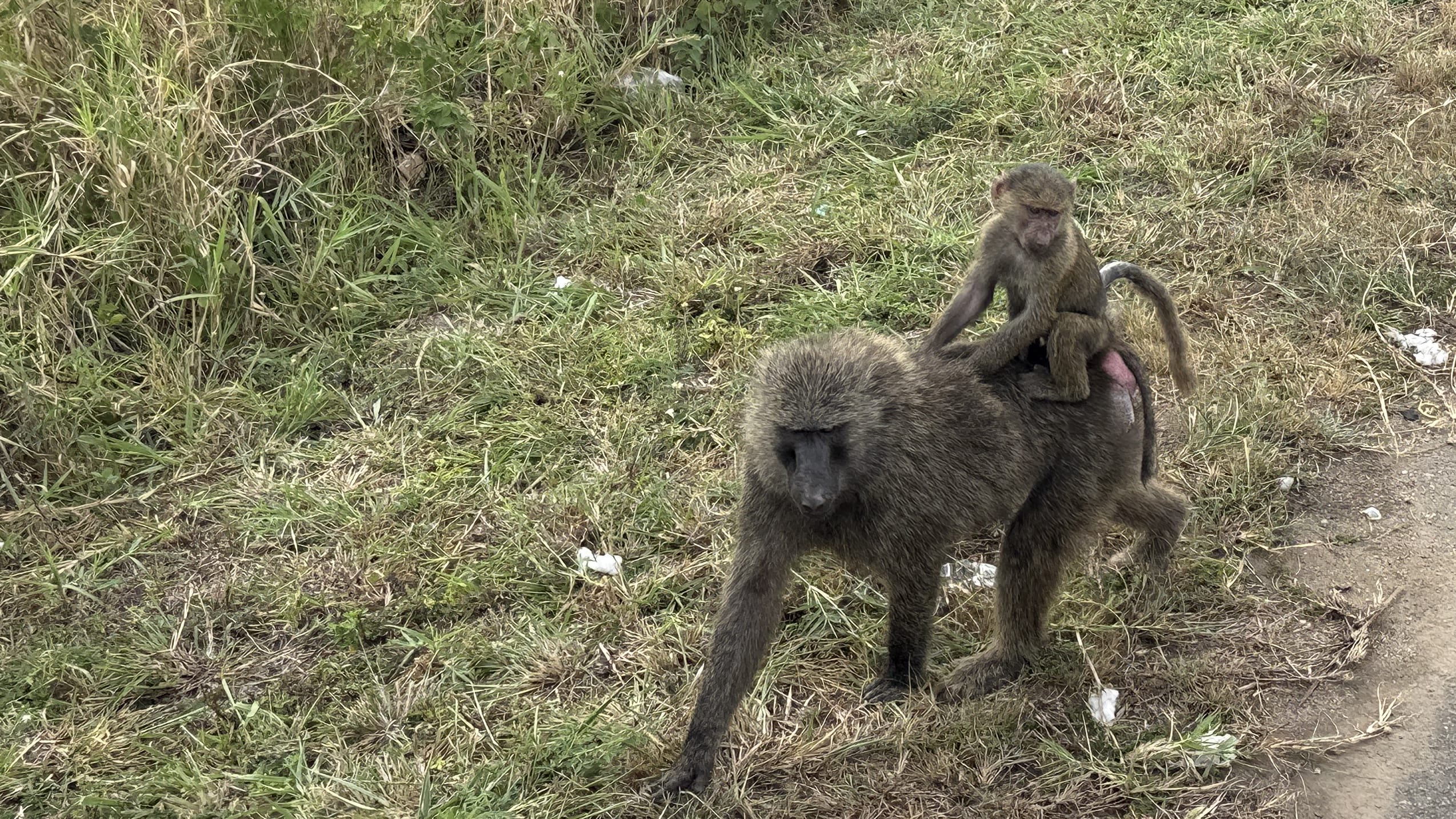
Later, a huge troop of baboons — perhaps forty or fifty, with babies among them — spread across the road, the roadside, and the nearby trees. Some were eating, while others simply sat and watched us pass.
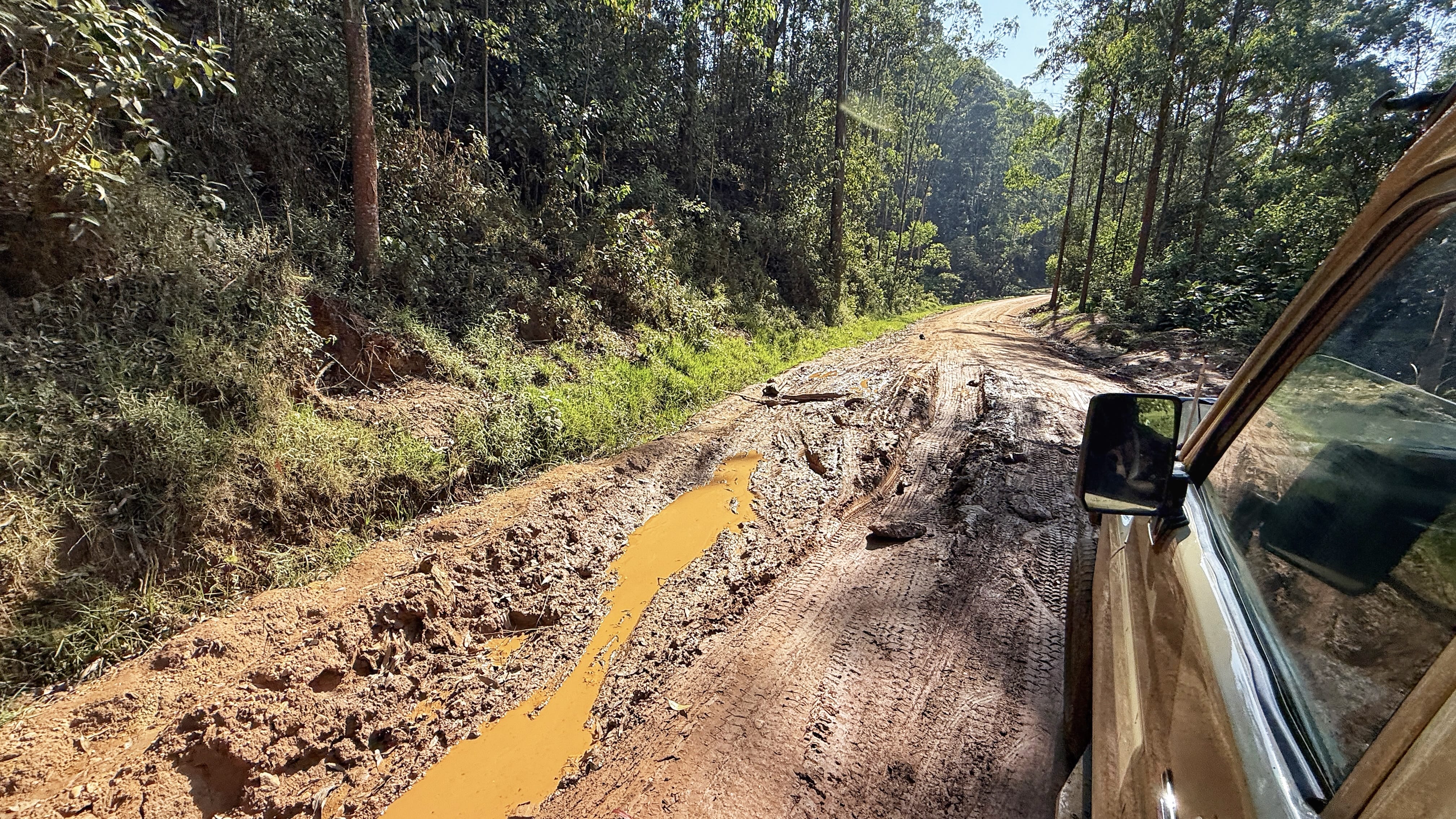
And that two-and-a-half-hour drive became an adventure of its own. The dirt road was incredibly rough — deeply rutted, full of potholes, and so bumpy that I was thrown from side to side and up and down the entire way, often needing to hold on just to stay steady. Our driver seemed to read the road the way a kayaker reads a river, constantly choosing the best path through the uneven ground.
By noon we arrived at our night’s stay — Enjojo Lodge, with views toward Lake Edward. Like at Tembo Safari Lodge, we were told we needed to be walked back to our rooms — this time not because of hippos, but because of elephants.
After a quick lunch, we headed to a nearby village. That afternoon we visited a community tourism project in the Kinkiizi area, where the goal is to help visitors understand daily village life while also supporting wildlife conservation.
We were shown how women create woven items by hand, providing income for families, and how practical solutions — like trenches and watchtowers — are used to keep animals out of crops and reduce conflict between people and wildlife. Much of the visit focused on education, with local leaders working to help the community see conservation not as a burden, but as something connected to their future.
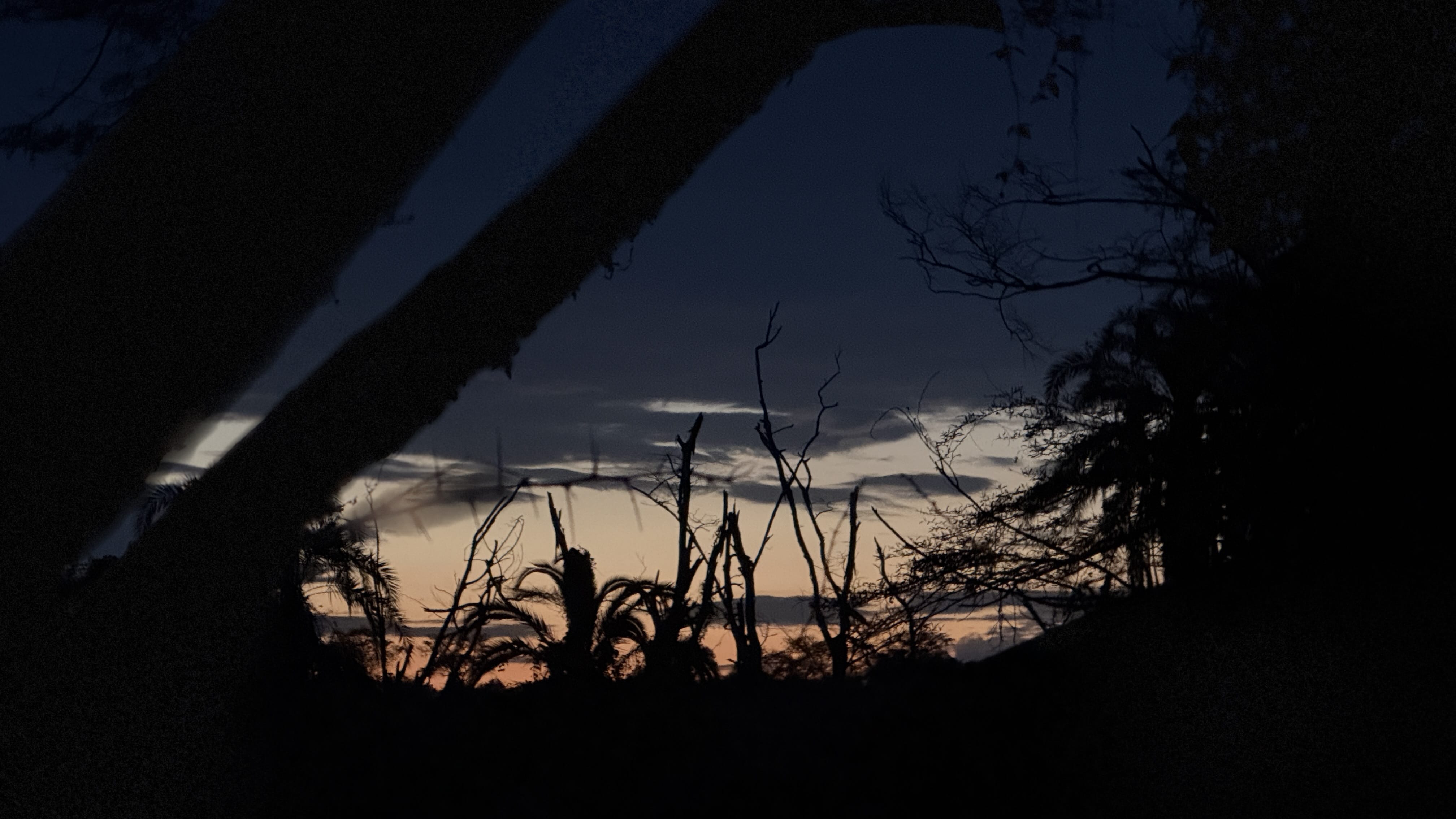
And then more wildlife spotting as we made our way back to the lodge, the afternoon slowly settling into evening.
We left Ishasha for the six-hour drive to the southwest tip of Uganda. Six hours on the map feels different when every mile is red dirt, switchbacks, and potholes.
The first half followed the same bouncy, uneven road, curving through small villages, tea plantations, banana groves, and steep green hills that looked like a patchwork quilt. Everything was red dirt and bright green.
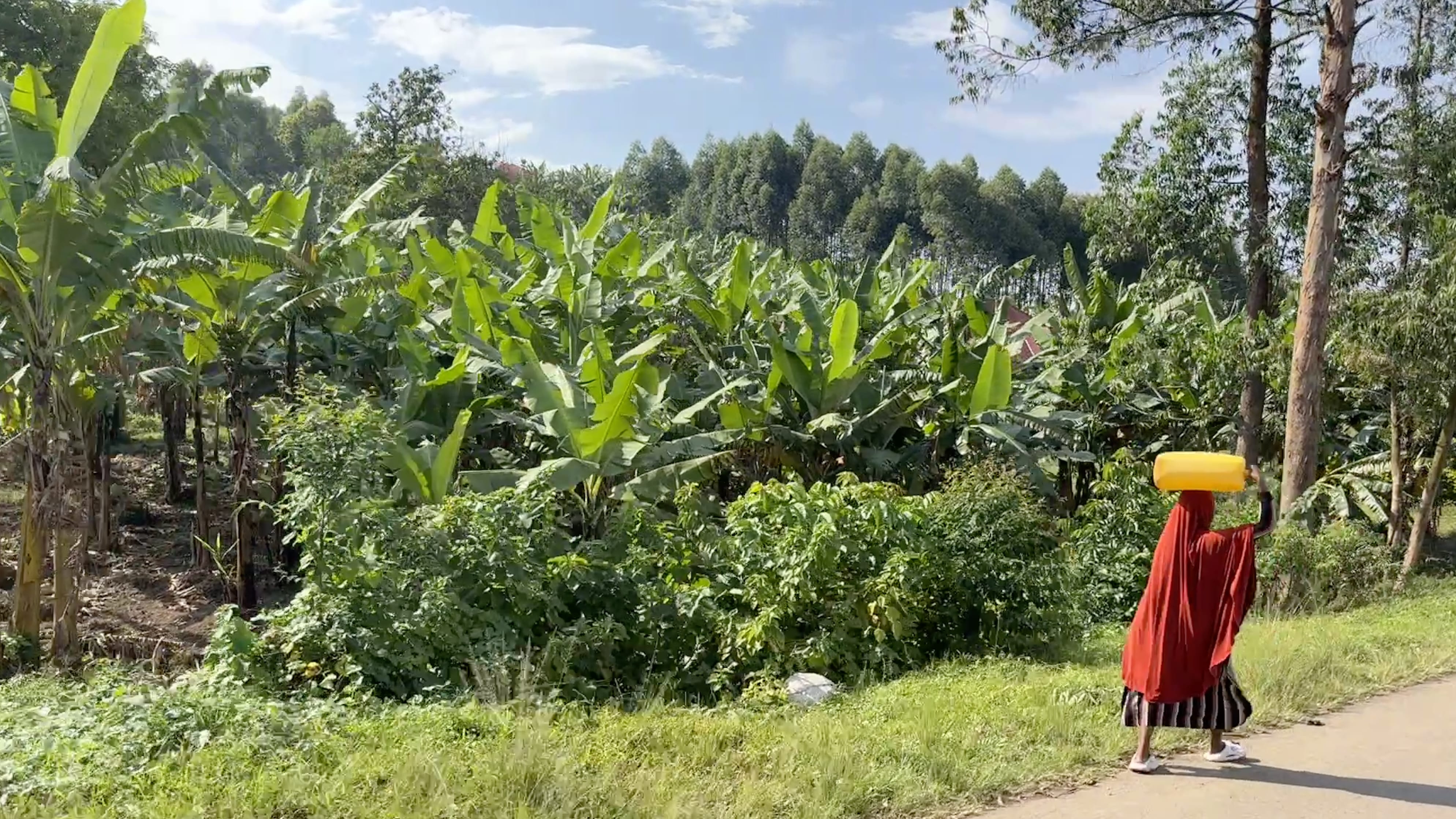
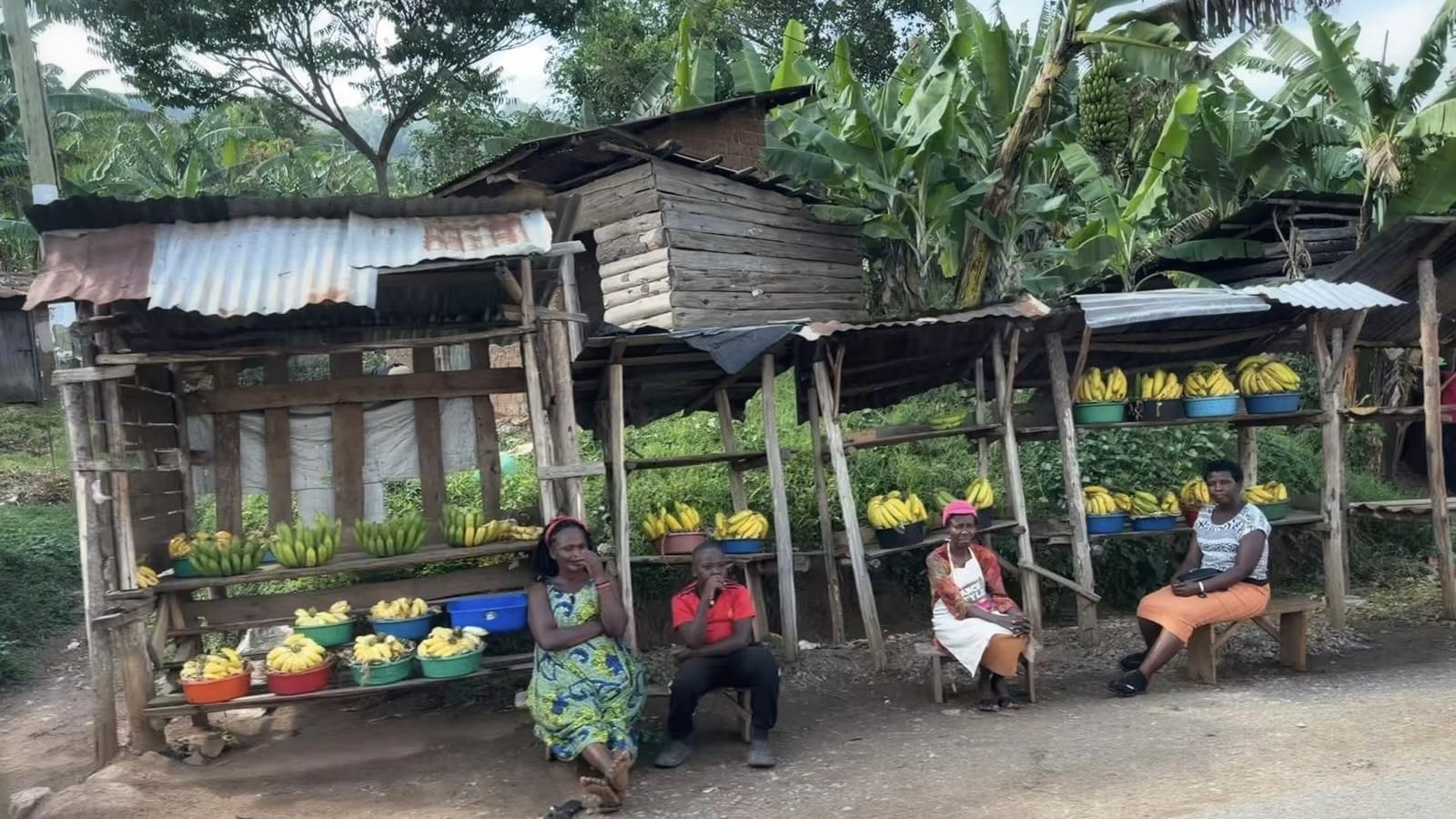
There were constant snapshots of daily life — kids in school uniforms walking along the roadside, women balancing heavy bundles on their heads, coffee beans spread out to dry in the sun, roadside produce stands, and boda-bodas weaving carefully around the worst of the potholes. And of course, little children standing by the road, waving, smiling, and yelling “Hi!” as we passed.
As we climbed higher into the mountains, the air felt cooler and the scenery grew quieter. Eventually we reached Kisoro, a small but important gateway for gorilla trekking near both Mgahinga Gorilla National Park and Bwindi Impenetrable Forest.
From there it was just a short drive to Lake Mulehe Gorilla Lodge. One night earlier we had been surrounded by jungle; tonight there were open views across Lake Mulehe, and layered hills rising beyond it.
It felt like arriving at the edge of something remote and peaceful — the perfect place to pause before the gorilla trek ahead.
Like all the staff we had encountered at lodges throughout Uganda, the welcome here was warm and genuine — an easy kindness that had quietly followed us from place to place.
The day started early, with a 5:30 a.m. breakfast at the lodge before leaving for the hour-and-a-half drive to Bwindi Impenetrable National Park headquarters. Bwindi is one of the last remaining habitats of endangered mountain gorillas — a dense, ancient forest spread across steep hills in southwestern Uganda.
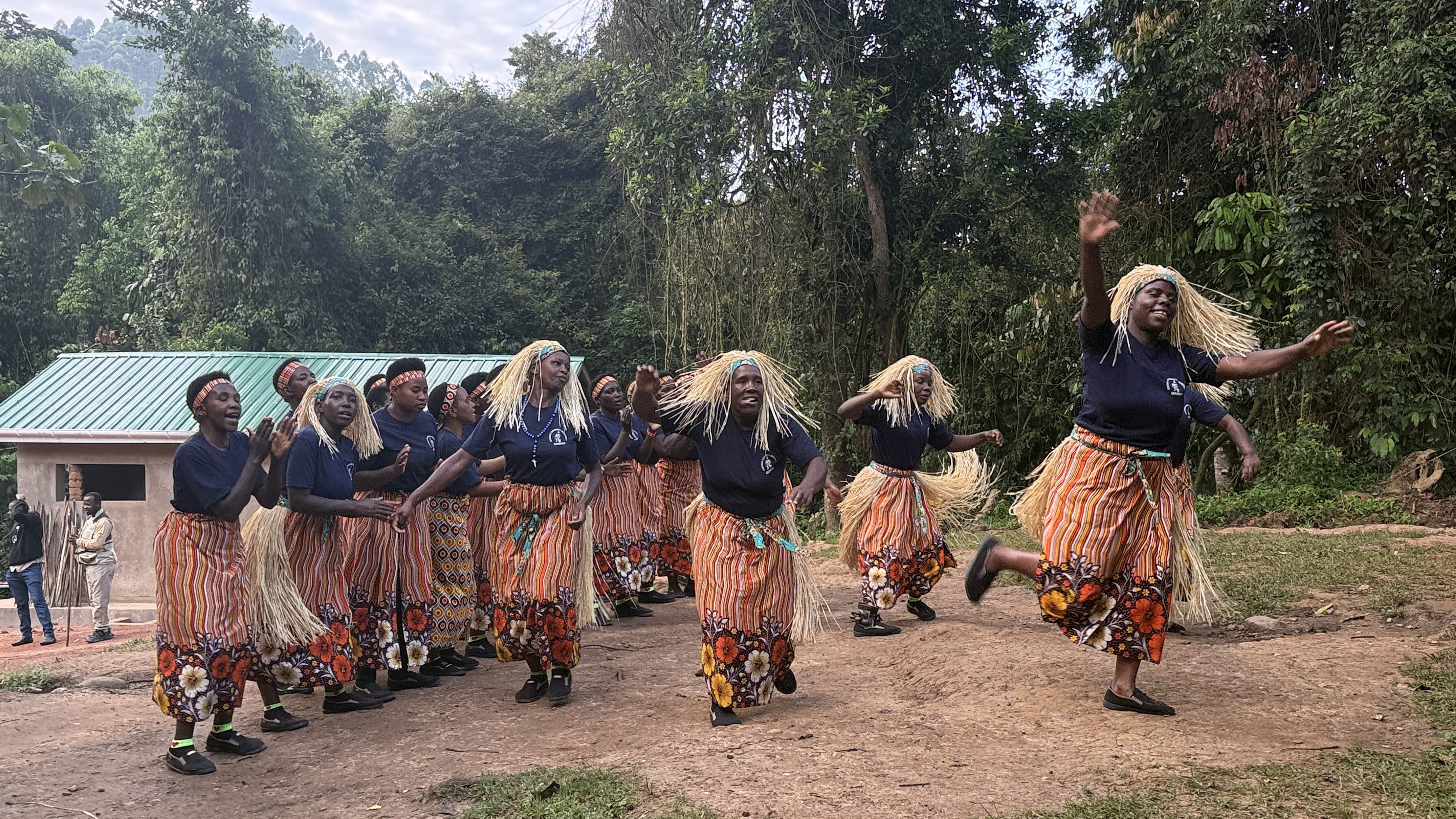
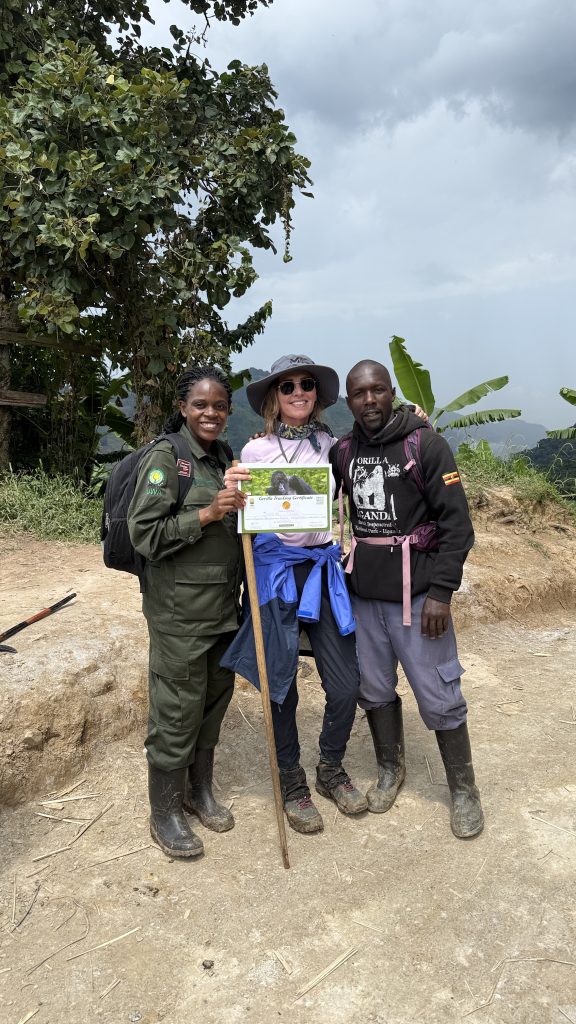
Once there, we checked in, went through the required ranger briefing, and watched a short dance performance by local women meant to bring luck before heading into the forest. Normally trekking groups are limited to eight visitors, but because the eleven of us were traveling together, we were allowed to remain as one group. We were assigned to track the Busingye gorilla family, one of the habituated groups in Bwindi’s Rushaga sector.
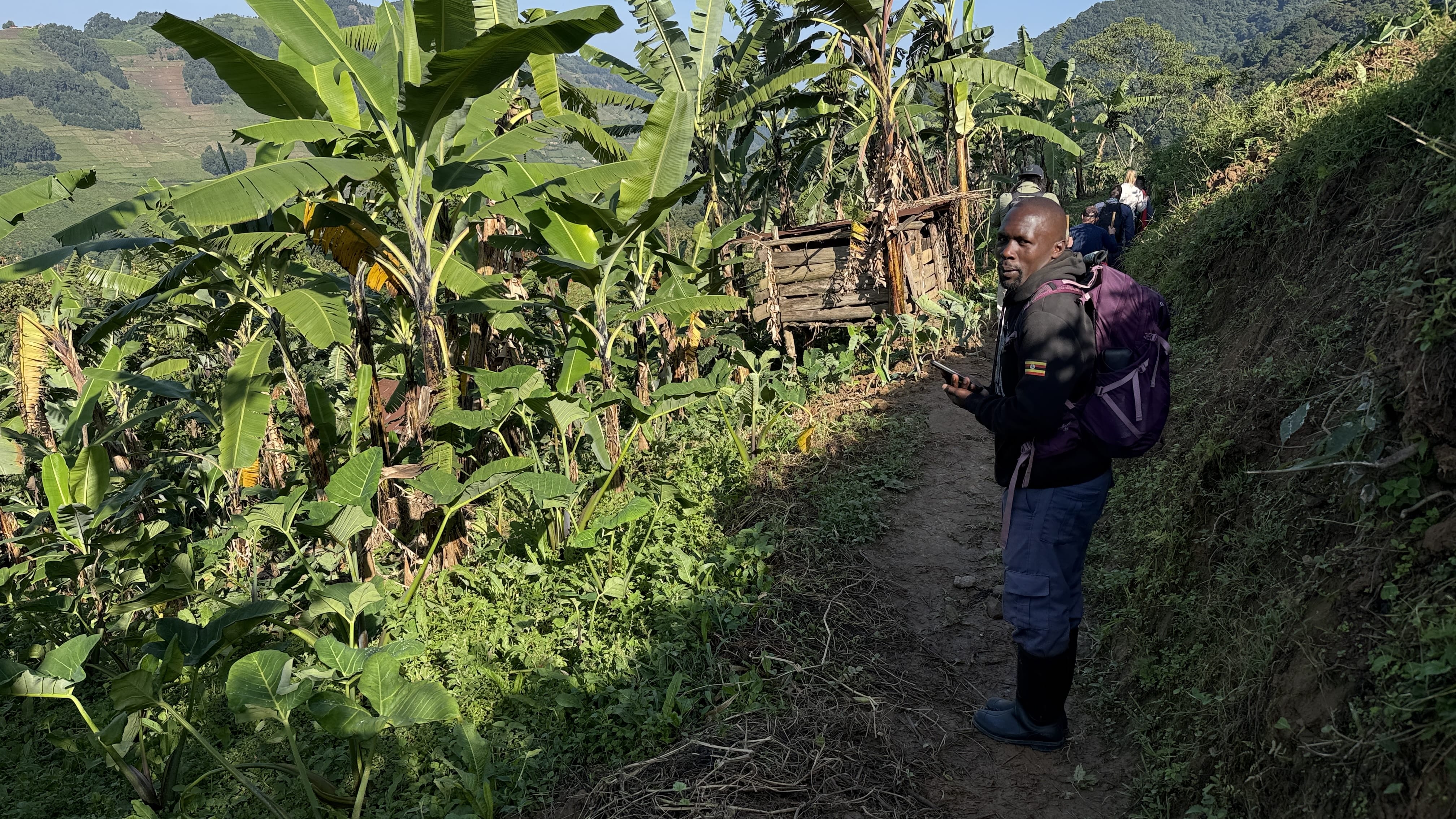
After the briefing, we climbed back into our 4×4 and drove about an hour to the village of Rubuguri, a small farming community near the park boundary. Waiting for us were local porters available to assist anyone who wanted help. Parts of the trail are steep and slippery, and the porters not only guide you through the tougher sections but also carry your backpack.
There are so many people in the village hoping for porter work that opportunities are rotated, and many individuals may only get the chance to porter once or twice a month. The cost was $25 USD — well worth it for the help on the trail and the chance to support the local community.
I was paired with a porter named Richard. The porters had been lined up waiting, and somehow Richard and I made eye contact. He walked over, lifted my backpack onto his shoulders, and just like that we were a team.
Richard stayed close, offering a hand through some of the trickier sections of the hike. Once everyone was ready, we began walking above the village, re-entering the national park and following a narrow forest path that climbed steadily through the lush woods.
The trail narrowed in places and grew steeper, roots and slick mud making each step something to think about. In spots, the path had been worn into deep grooves by years of trekkers and rain. It wasn’t technical — just uneven enough to keep you focused on every step. More than once, Richard reached back without even looking, steadying me over slippery ground. Hiring a porter had been a very good decision.
About forty minutes later, trackers signaled to our guide that we were very close—and within minutes we saw our first gorilla.
Then suddenly they were everywhere.
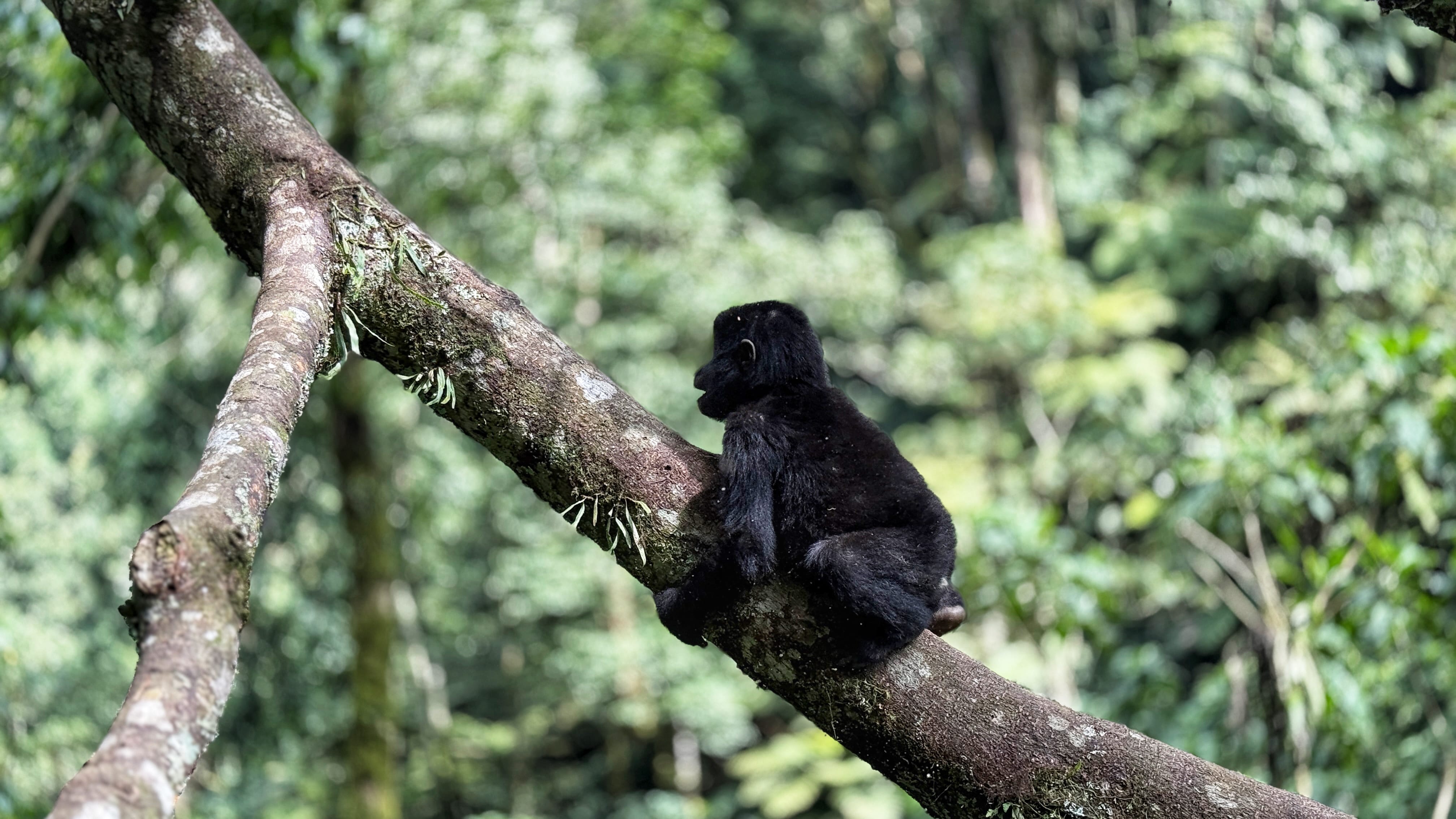
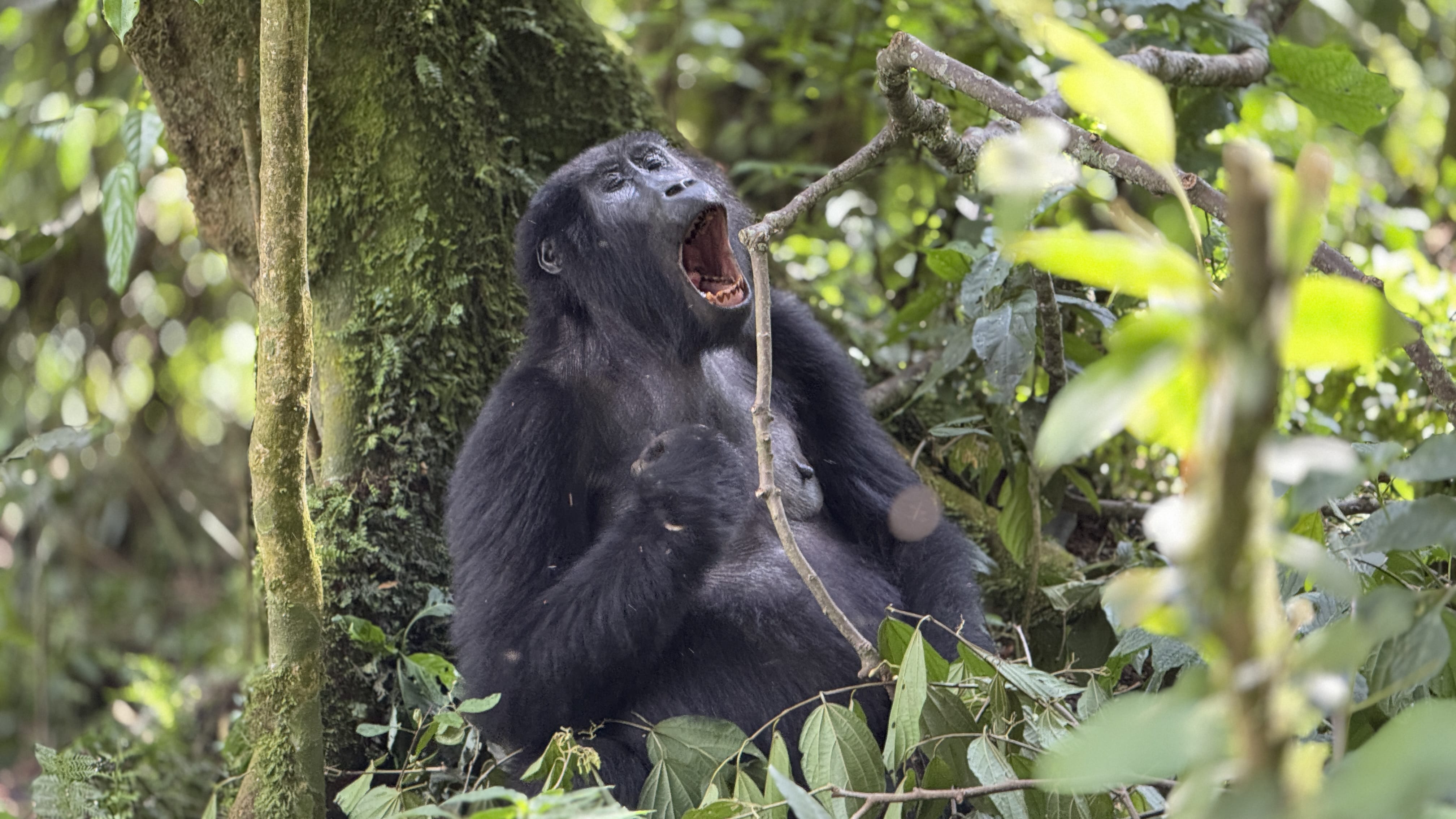
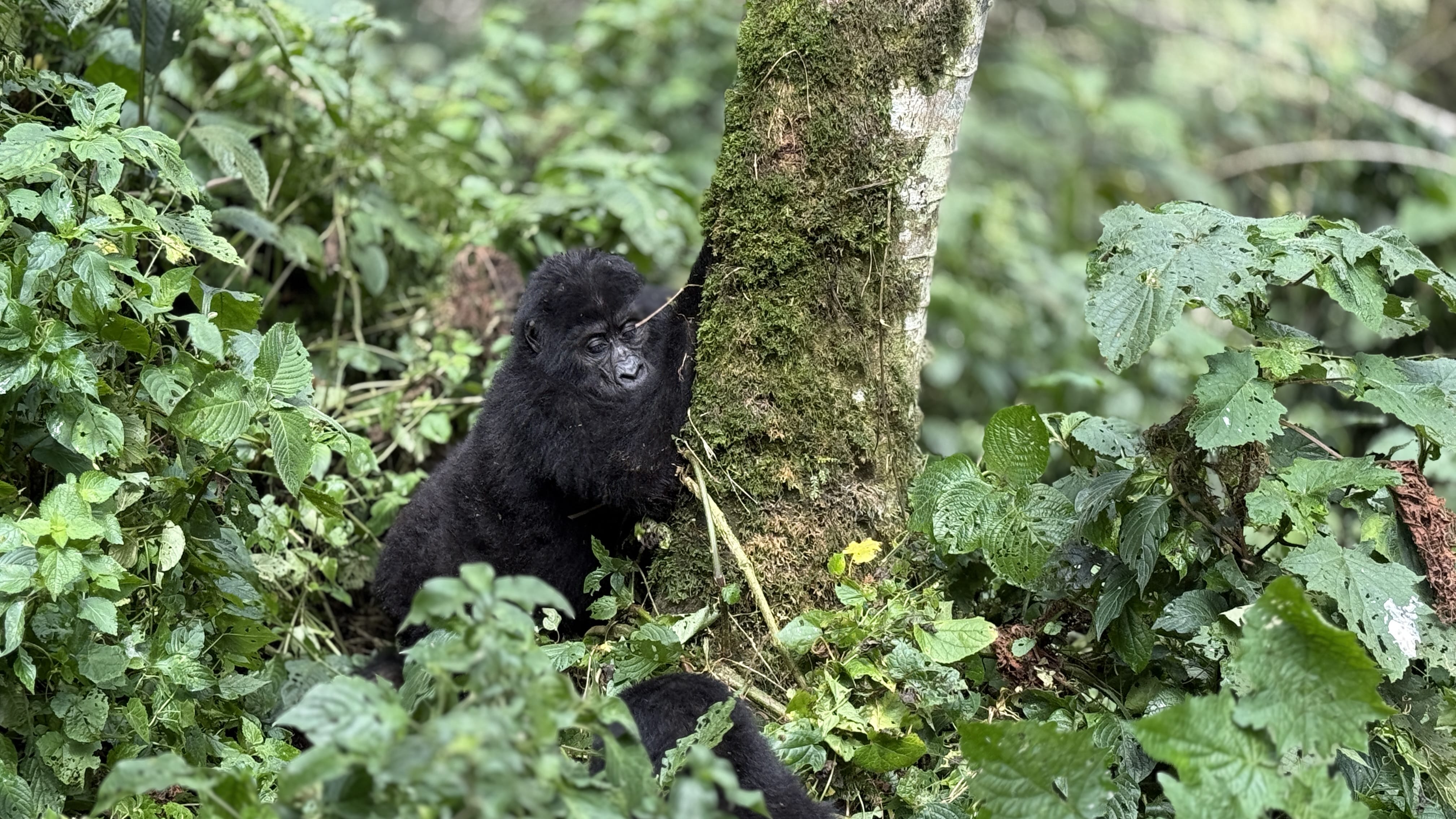
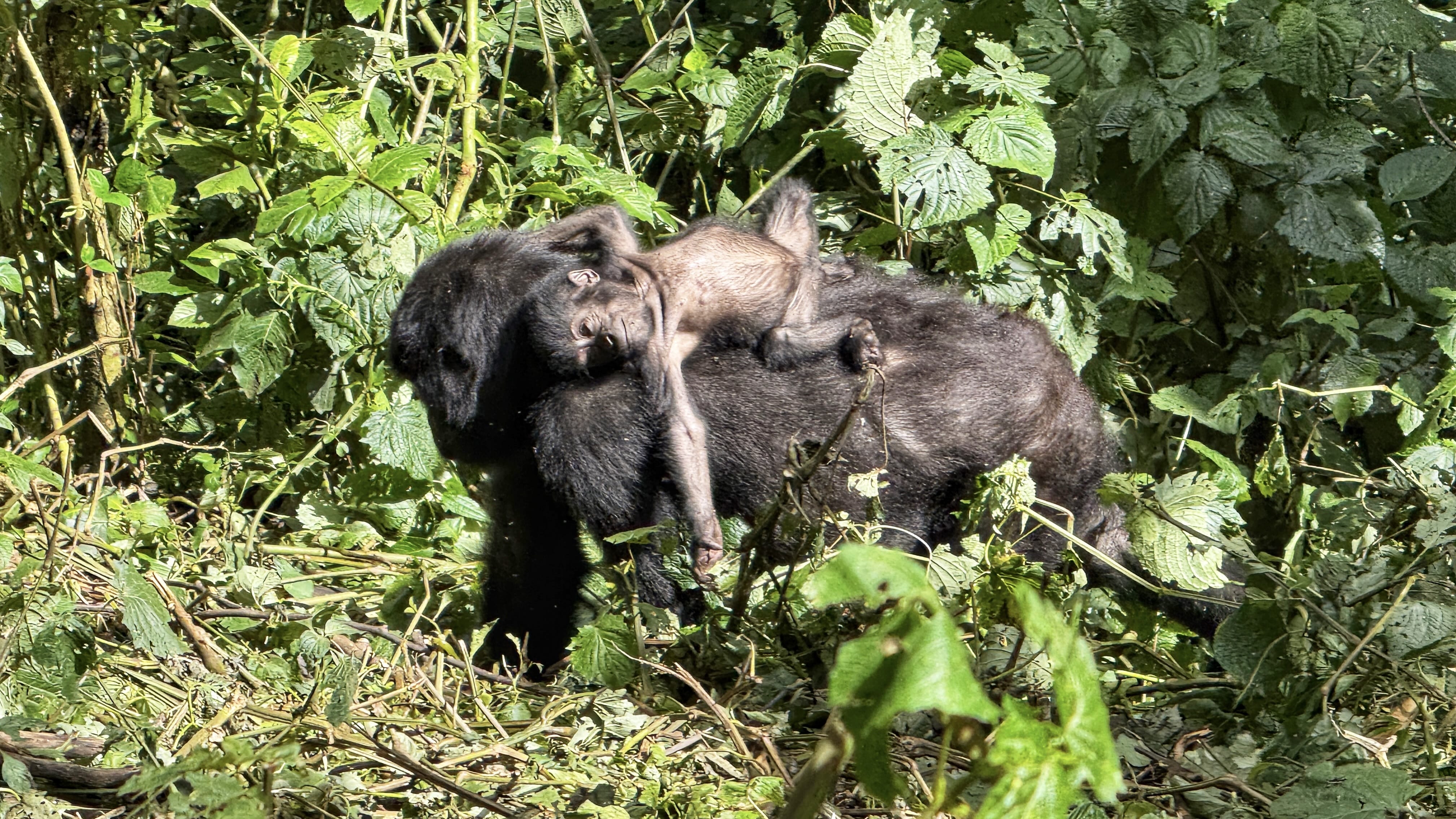
Climbing trees, swinging from vines, wrestling with each other — one gentle mother carrying a tiny baby on her back.
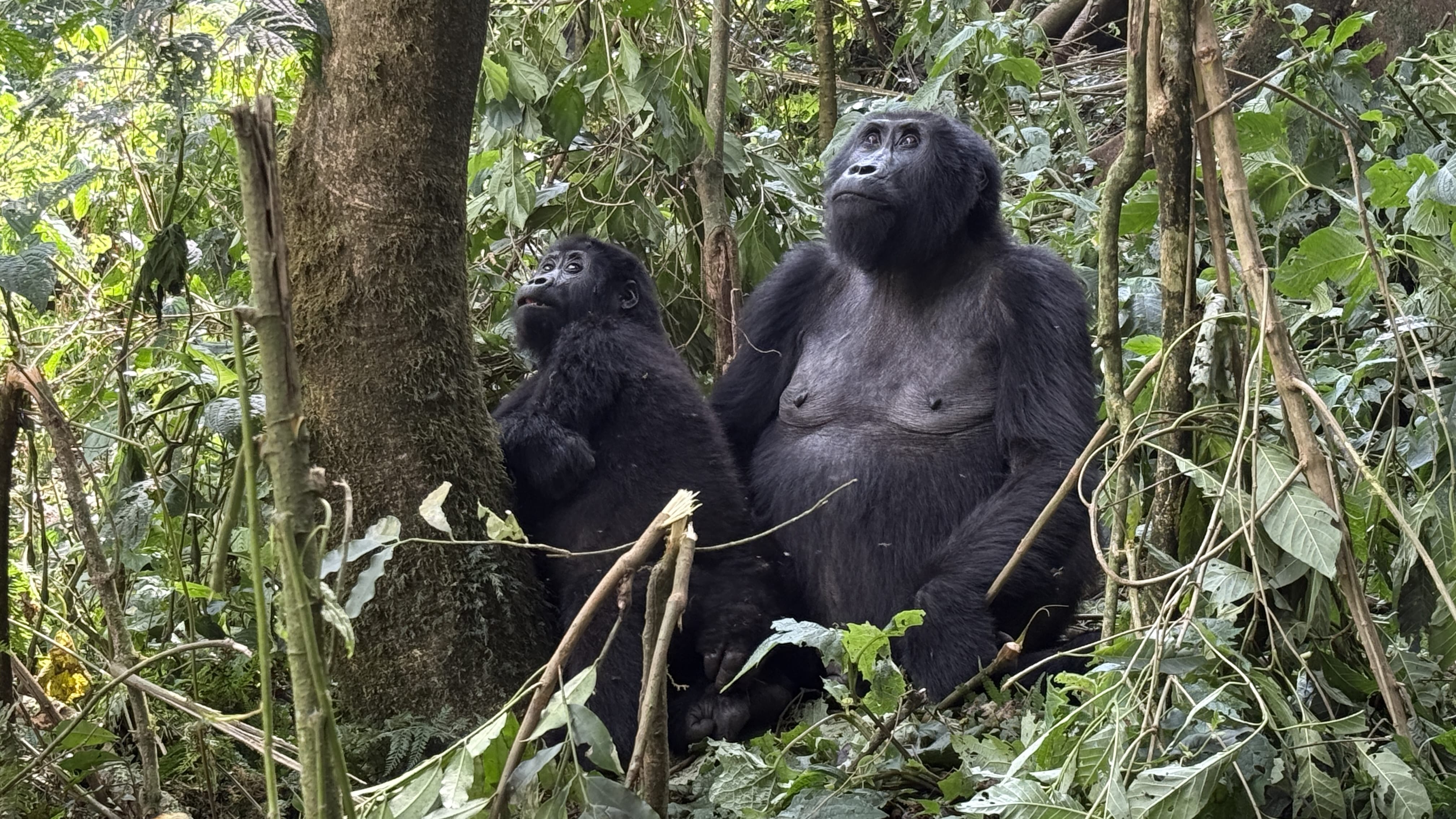
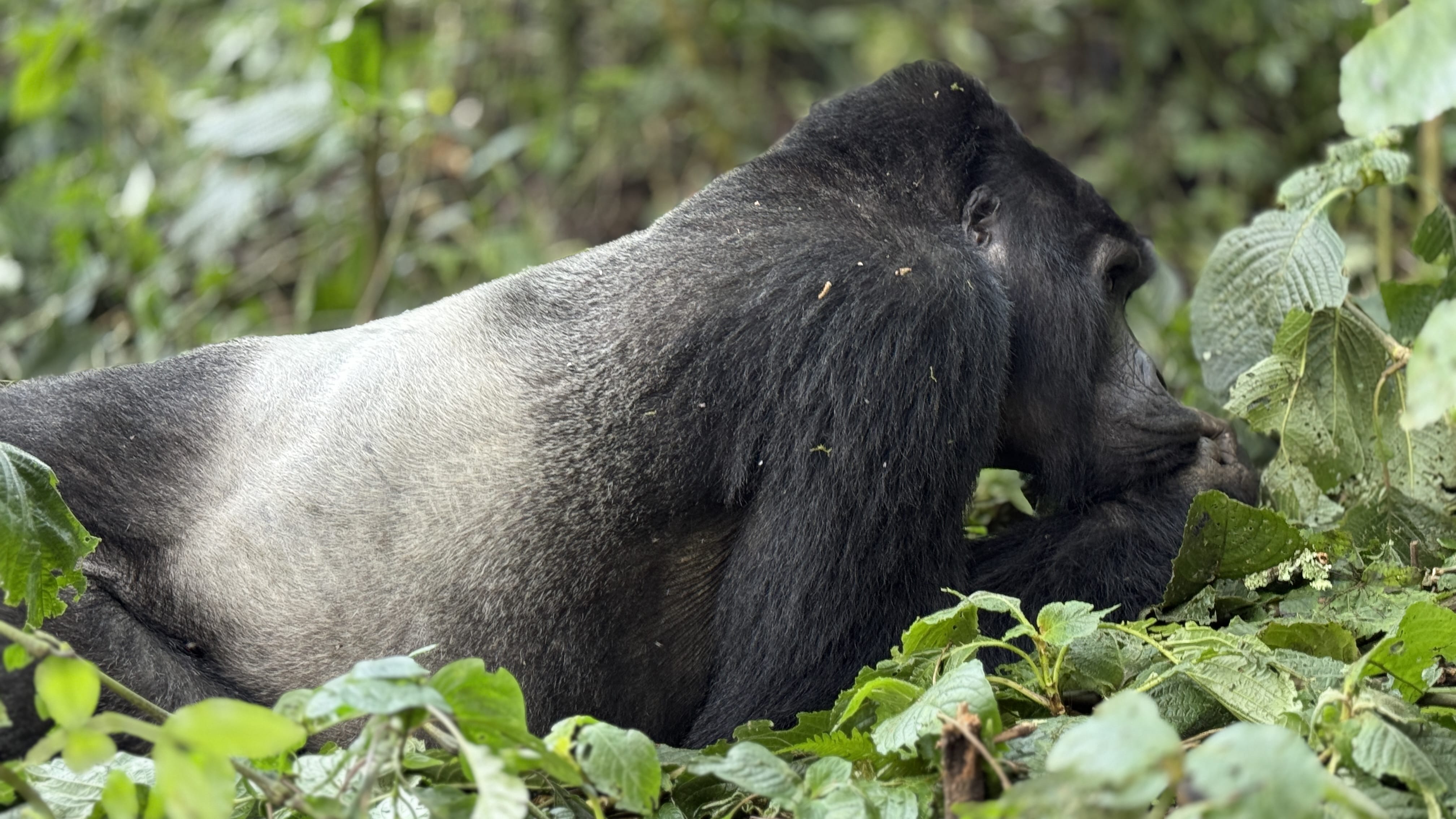
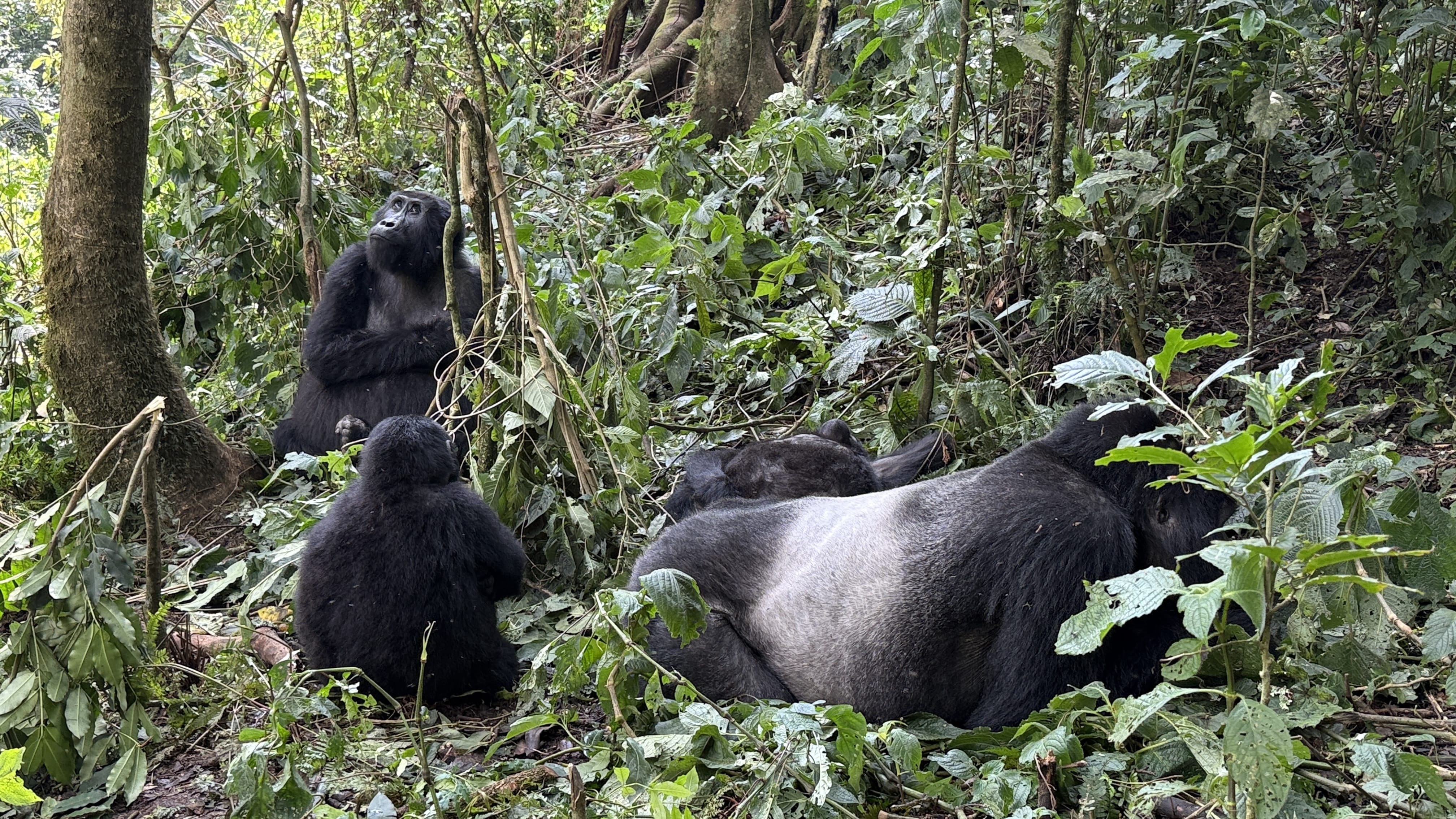
We spent about an hour quietly observing them. The first gorilla we saw sat beside a tree. Before long, two others joined nearby. Farther up the slope, a silverback lay resting with his head down. After a while, he slowly lifted his head, scratched his chin as if deep in thought, and settled back down again.
Near him, a female and two juveniles wrestled noisily, while above us young gorillas climbed trees, swung from vines, and leapt from branch to branch.
One of my favorite moments was hearing a gorilla beat its chest — a deep, hollow sound that carried through the forest. Chest-beating is a form of communication: sometimes a display of strength or excitement, sometimes simply an expression of energy within the group. Hearing it in the wild was unforgettable.
Watching them move through the forest, completely absorbed in their own world, felt extraordinary. The group included around 10-12 members — a dominant silverback, a few blackbacks, several adult females, juveniles, and a few tiny babies — just one of about 25–27 habituated gorilla groups in Bwindi Impenetrable National Park.
I’ve seen wildlife before, but this felt different. I’m already wishing I had booked another trek.
You couldn’t have asked for better weather: around 68°F, blue sky with scattered clouds, and the forest a deep, rich green. But as we headed back, rain was already visible in the distance.
We said our goodbyes to our porters and guide, then climbed back into the 4×4 for the winding, bumpy hour-and-a-half drive to the lodge. I have to admit, I’ll miss these crazy drives — the bumps, the villages, and those incredible views. We were supposed to stop for a picnic, but with the clouds getting darker, we headed straight back instead.
By the time we arrived, we were starving. Not long after lunch, the rain came — hard and steady — for the next four hours. We had been incredibly lucky with the weather that morning.
That evening we shared a final dinner with the group I’d been traveling with. I celebrated the day with a margarita.
Tomorrow we would return to Rwanda, where I’d spend five days on my own while the rest of the group began their journey home.
It felt like the kind of ending that doesn’t really feel like an ending at all — just a pause before the journey continues somewhere else.
Five days in Uganda felt both full and fleeting — dense with wildlife, long drives, and moments I’ll replay for a long time. If gorilla trekking is on your list, it’s worth the early wake-up, the muddy boots, and every step of the climb.
This Uganda chapter was part of a longer trip that began in Rwanda with Intrepid Travel. If you missed that beginning, you can read it here: 2 Days in Kigali: Motorbikes, Markets & Memory.
Start early: Expect a 5:30 a.m. breakfast and a long, bumpy drive before the trek begins.
Hire a porter ($25 USD): Worth it for stability on steep, muddy sections — and it directly supports local income.
Wear long pants and good traction: The trail isn’t technical, but it’s uneven, slick, and sometimes deeply rutted.
Bring layers and a rain jacket: Weather can shift quickly, even if the morning starts clear.
Pack light: Water, a small snack, sunscreen, and anything you want easily accessible.
Your visit lasts one hour: Put your camera down at least once and just watch.
Follow lodge rules at night: Wildlife sometimes wanders onto lodge property after dark.