7 Days in Azerbaijan: Baku and Beyond (Part 1)

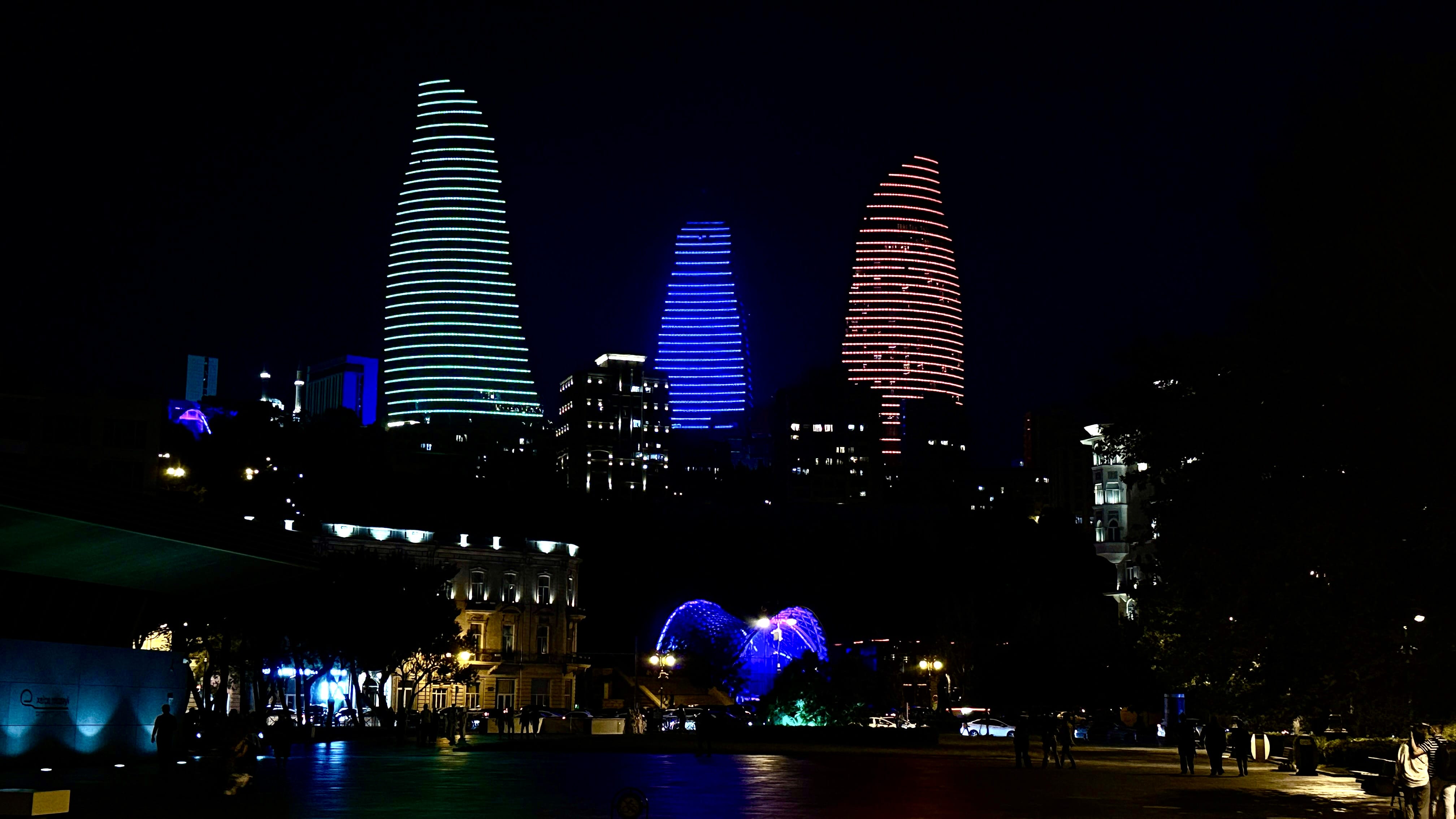
Baku Flame Towers illuminated in red, blue, and green lights at night — 7 Days in Azerbaijan city skyline photo.
Flame Towers Night View

This post marks the start of my three-week journey through the Caucasus—Azerbaijan, Georgia, and Armenia. I’d never been to any of them before, and to be honest, I couldn’t even pronounce “Azerbaijan” when I first booked the trip (though I had it down by the time I left).

All three countries were once part of the Soviet Union. They share borders, but that hasn’t meant harmony. Armenia and Azerbaijan have fought wars over Nagorno-Karabakh, a disputed region that remains a source of tension even today. Armenia’s border with Turkey is still closed because of their long and bitter history. Georgia has its own unresolved struggles with Russian-backed regions, and Azerbaijan’s southern border with Iran is another point of strain.

I wasn’t even sure how to categorize the Caucasus as a whole. Are they Europe? Asia? Technically, both. Russia sits to the north, Iran to the south, the Black Sea to the west, and the Caspian Sea forms Azerbaijan’s eastern edge. It’s a complicated corner of the world, and that was part of what drew me in.

So why go somewhere I knew so little about? Honestly, that felt like the best reason. I love discovering places I don’t already have a mental picture of. And if I’m not writing about a trip I’ve just taken, I’m usually daydreaming about the next one—scrolling for inspiration and imagining myself somewhere new. 

That’s how I stumbled across this itinerary with Native Eye Travel: Azerbaijan, Georgia, and Armenia—The Edge of Europe. I’d never traveled with them before, but the small group size (twelve or fewer) and the promise of local guides in each country sealed it for me.

Whenever I told people where I was headed, I usually got the glazed-over look—clearly not knowing where I was talking about, let alone where it was on a map.

This post begins the first leg of that journey—my seven days in Azerbaijan. Independent since 1991, the country still shows traces of the Soviet era, but Baku—its capital—looks like a city out of the future. Oil and gas wealth have funded landmarks like the Flame Towers and the swooping Heydar Aliyev Center. Yet not far outside the city you’ll find mud volcanoes, fire temples, and villages that feel centuries away from Baku’s sleek skyline.

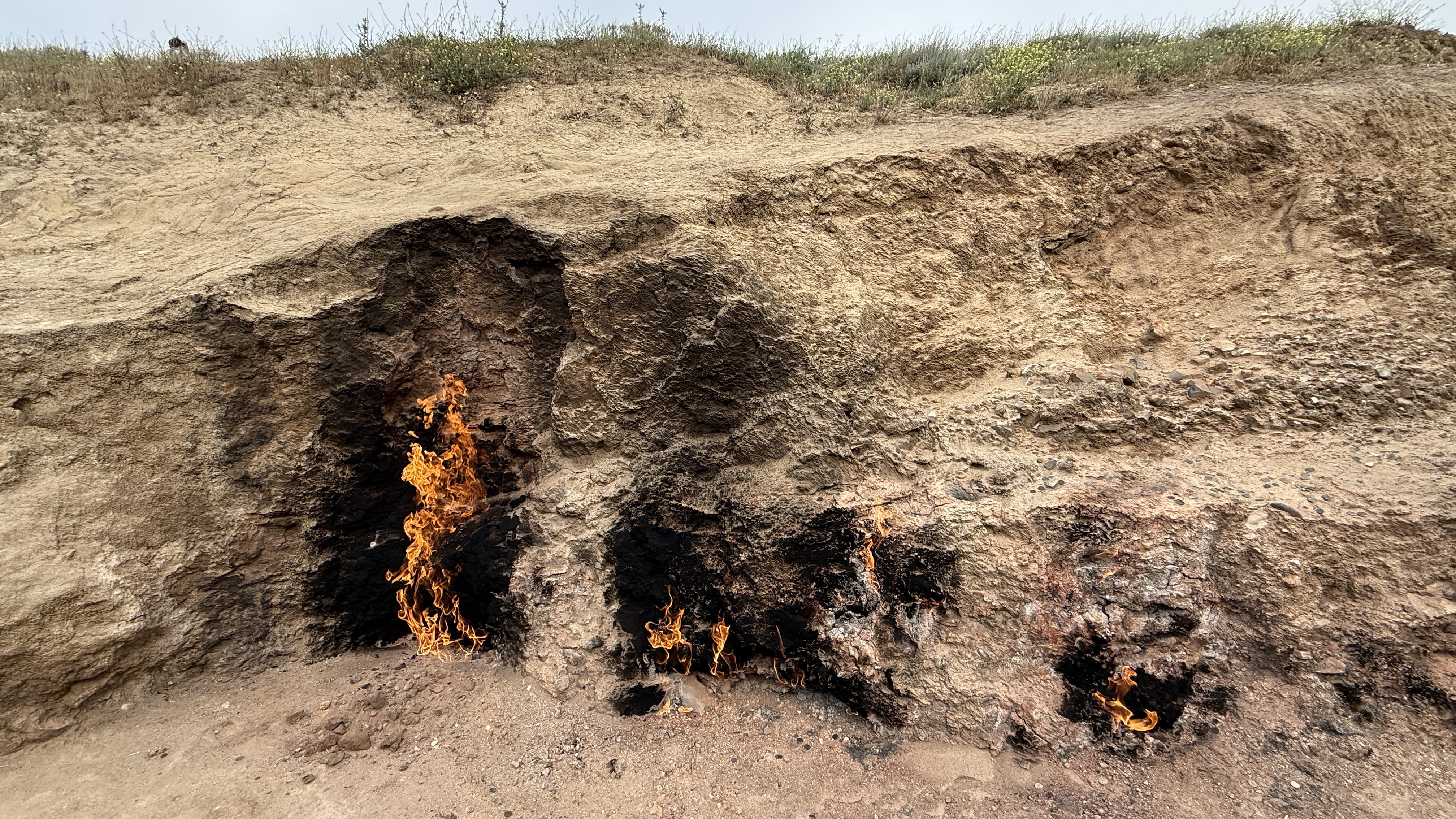
Azerbaijan calls itself the “Land of Fire.” For thousands of years, natural gas leaking from the ground has caught fire and burned on the hillsides—sometimes for decades at a time. Those flames became part of the country’s identity, woven into local stories and traditions. 

Natural gas flames burning from the hillside at Yanardag, also known as Burning Mountain, near Baku, Azerbaijan — 7 Days in Azerbaijan travel blog.
The eternal flames of Yanardag have been burning for centuries, fueled by natural gas seeping through the earth.

Today Azerbaijan is majority Muslim (mostly Shi’a), but it’s also proudly secular, and daily life is shaped less by religion and more by traditions like tea, music, and food. And the food—honestly, it’s unforgettable: saffron-rich pilafs, flatbreads pulled hot from the oven, heaps of fresh herbs, and endless tea poured alongside jam or preserved fruit.

Day 1: First Impressions of Baku

Our trip officially began in Baku, Azerbaijan’s capital—though I’d already spent two days here on my own before meeting up with the group (I wrote about that in a separate post: 2 Days in Baku). So while the others were just getting their first glimpse, I was retracing familiar streets, this time hearing them through our guide’s stories.

Baku had already surprised me. I’d pictured something a little gray, maybe worn down at the edges. Instead, it turned out to be clean and modern, with wide boulevards, palm-lined parks, fountains, and dramatic new architecture that wouldn’t look out of place in Dubai. But it wasn’t all shine—turn a corner and you’d find 12th-century stone walls, a mosque dome, or a Soviet-era apartment block.

I stayed at the Central Park Hotel — the location was excellent: a quiet side street, just a short walk from Nizami Street and Fountain Square, with a park right across the road where locals gathered in the evenings. Everyone in the group arrived at different times, and even though this was technically Day 1, we didn’t really get started until Day 2.

Day 2: Gobustan, Mud Volcanoes, and Fire Temples

After breakfast, I finally met the group I’d be spending the next three weeks with—and our Azerbaijani guide, Elvin. There were twelve of us in total: me and one other person from the States, a German woman, and the rest from the UK. With introductions out of the way, we set off on our first full day together.

Gobustan National Park

We drove about an hour southwest to Gobustan National Park, home to one of the largest collections of petroglyphs in the world. Some of the carvings are more than 10,000 years old.

Close-up view of human-shaped petroglyphs at Gobustan National Park, showing ancient carvings of people and animals on sandstone rock.
Carvings depict scenes of dancing and hunting.

We followed a trail along a rocky cliffside, and there they were—etched into the sandstone: people dancing, long-horned animals, boats with curved bows. It was surprisingly easy to make them out, even after all that time. Standing there, I thought about how even then, people wanted to leave something behind. I guess that’s what I’m doing too, in a way.

Faint prehistoric carvings of animals and hunters on a large rock face at Gobustan National Park in Azerbaijan.
Some of Gobustan’s oldest petroglyphs are barely visible under centuries of weathering.

Mud Volcanoes

After Gobustan, we swapped our comfortable van for a pair of banged-up local taxis and headed down a bumpy dirt road into the hills. I don’t know how those cars didn’t fall apart en route, but they got us where we were going: the mud volcanoes. We were off-roading in little cars—crazy, but fun.

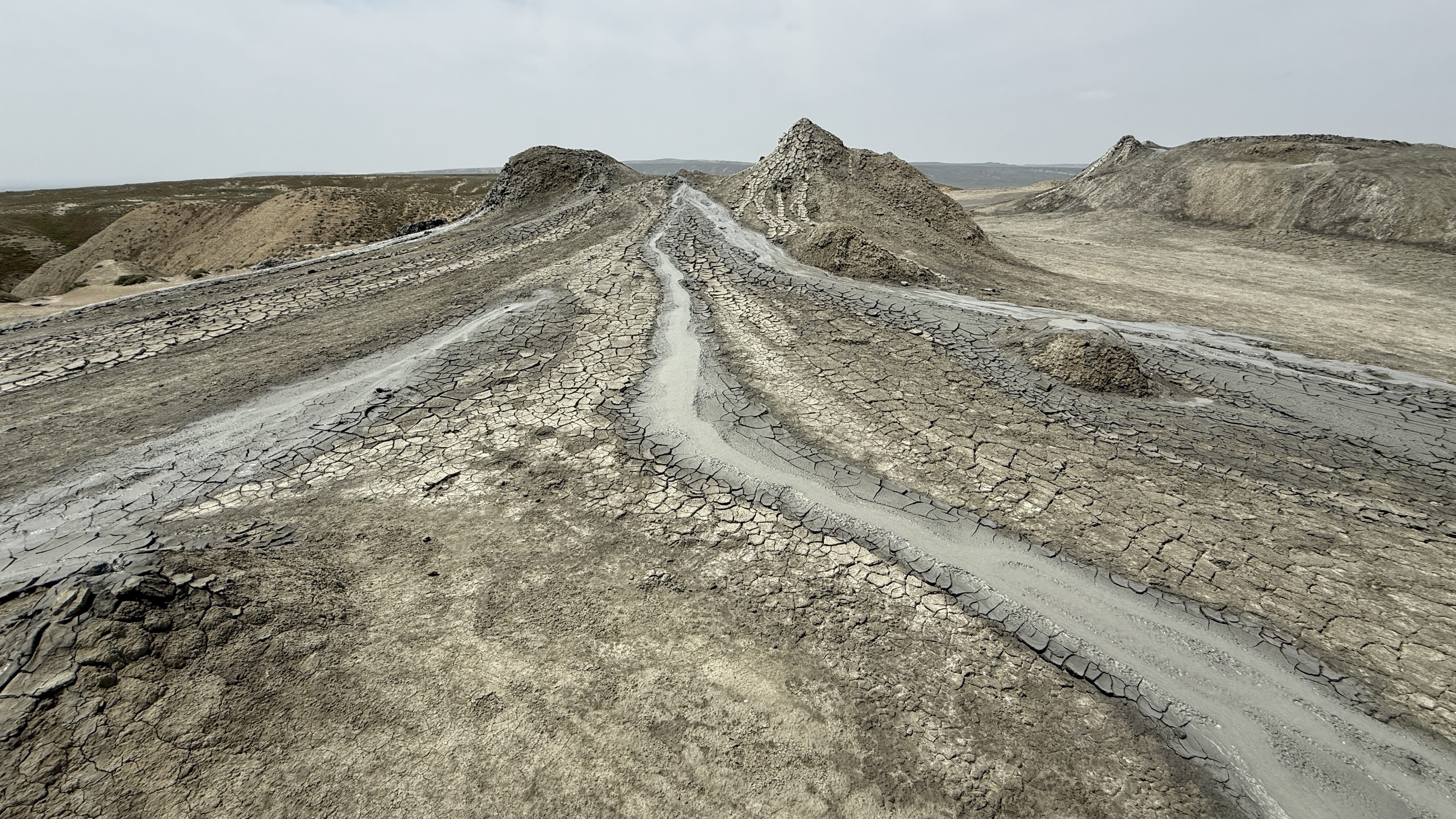
Cracked gray earth and small mud cones at the Gobustan mud volcanoes in Azerbaijan, one of the world’s most active mud volcano regions.
The lunar-like landscape near Gobustan.

The cracked landscape looked like a dried-up lunar field, with little gray mounds scattered in every direction. Some were crusted over, but others were bubbling with cool, thick mud. I reached out and touched one (with our guide Elvin’s okay). It was cool to the touch—smooth, dense, almost like wet clay. If there had been a bathhouse nearby (which of course there wasn’t), I would have happily lathered the mud all over my face.

Traveler touching the bubbling surface of a mud volcano near Gobustan, Azerbaijan, surrounded by dry hills and barren terrain.
Testing the texture—it’s surprisingly cool to the touch!

At one of the larger mounds, someone from our group stepped near a vent and the ground visibly rippled. It wasn’t dramatic, just enough to see it shift—as if the earth was breathing just beneath us. No steam. No sound. Just quiet pressure building below. Surreal and very cool.

Bubbling mud pool inside a small cone at the Gobustan mud volcanoes, surrounded by dry, cracked earth.
Mud slowly gurgles to the surface, releasing gas from the depths of the Earth
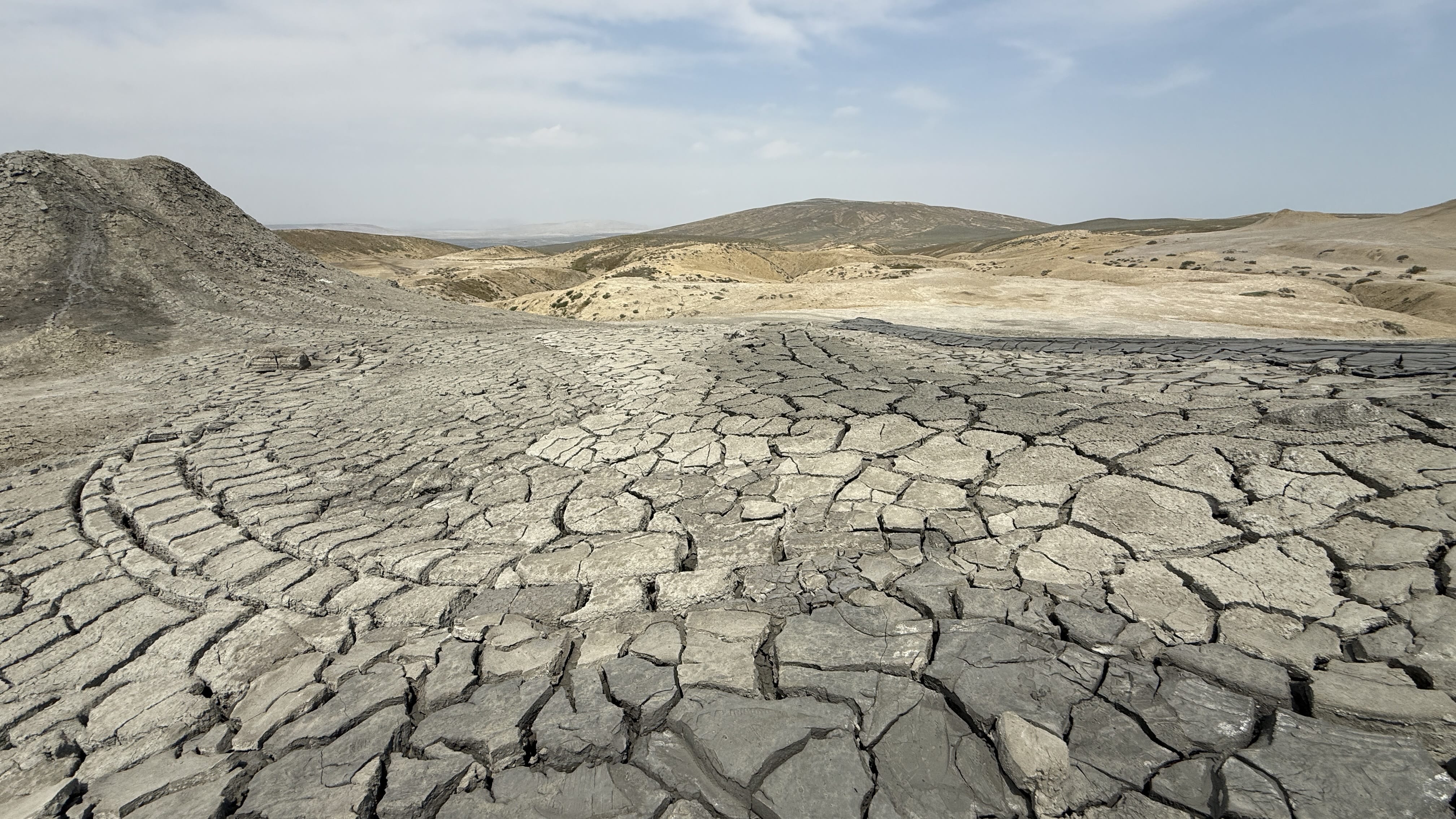
Expansive view of the cracked gray surface and rolling hills of the Gobustan mud volcano area in Azerbaijan.
A final look at the surreal Gobustan terrain.

Back in Baku we took about an hour break to scatter for lunch. I found a little place near Fountain Square with roasted vegetables, hummus drizzled with olive oil, and some incredible bread.

Yanar Dağ: The Burning Hillside

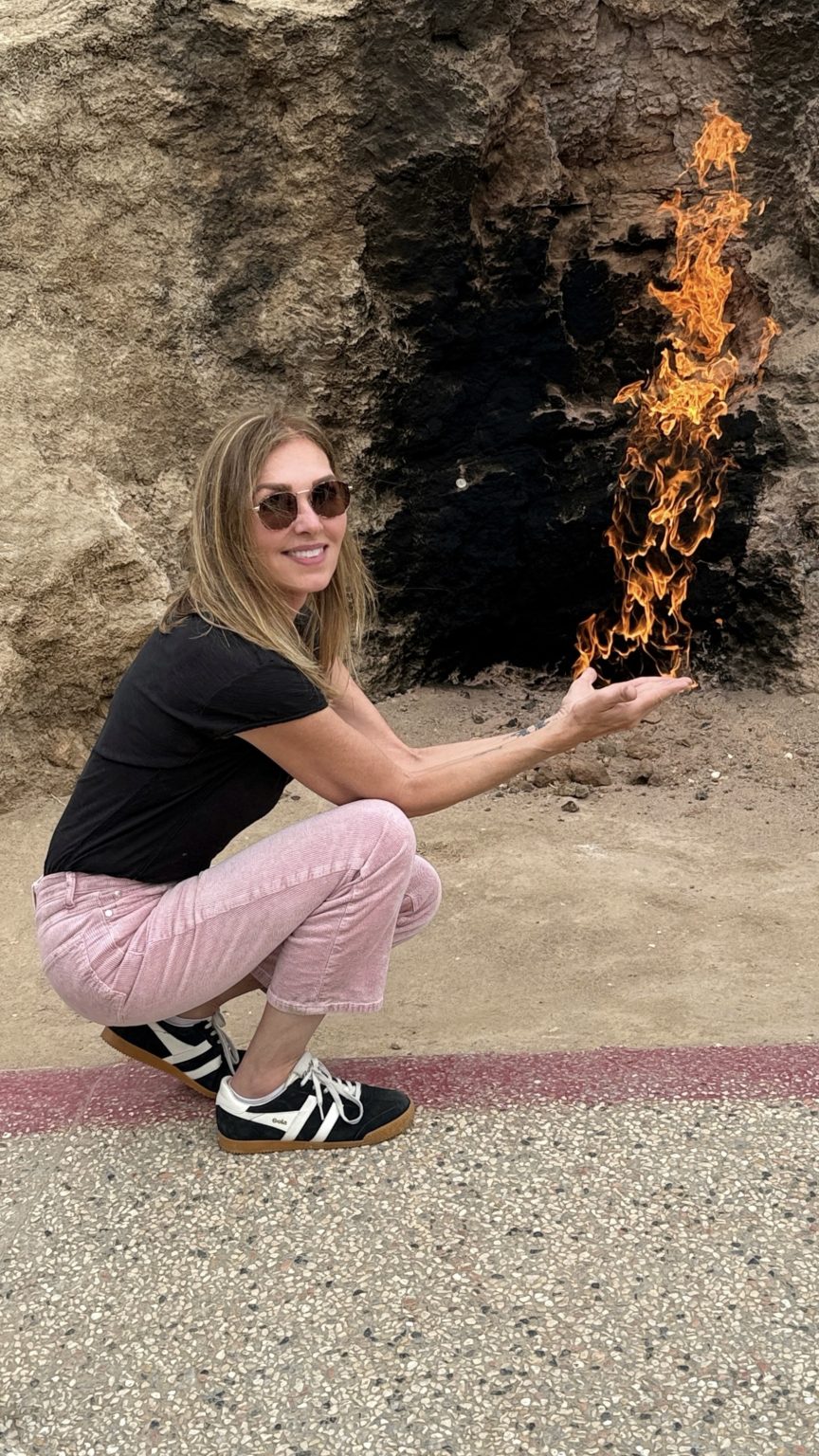
Our next stop was Yanar Dağ, or “Burning Mountain,” where natural gas seeps through a hillside and fuels a flame that never goes out. It’s a long horizontal line of fire stretching across the base of the hill—low and flickering, but steady.

raveler posing near the natural gas flames of Yanardag, the Burning Mountain of Azerbaijan, part of 7 Days in Azerbaijan itinerary.
The flames look staged, but they’re entirely natural.

Elvin had me sit in front of the flames and told me to hold my hand just right—so it looked like I was holding fire in the photo. Totally cheesy. Totally worth it.

Ateshgah Fire Temple

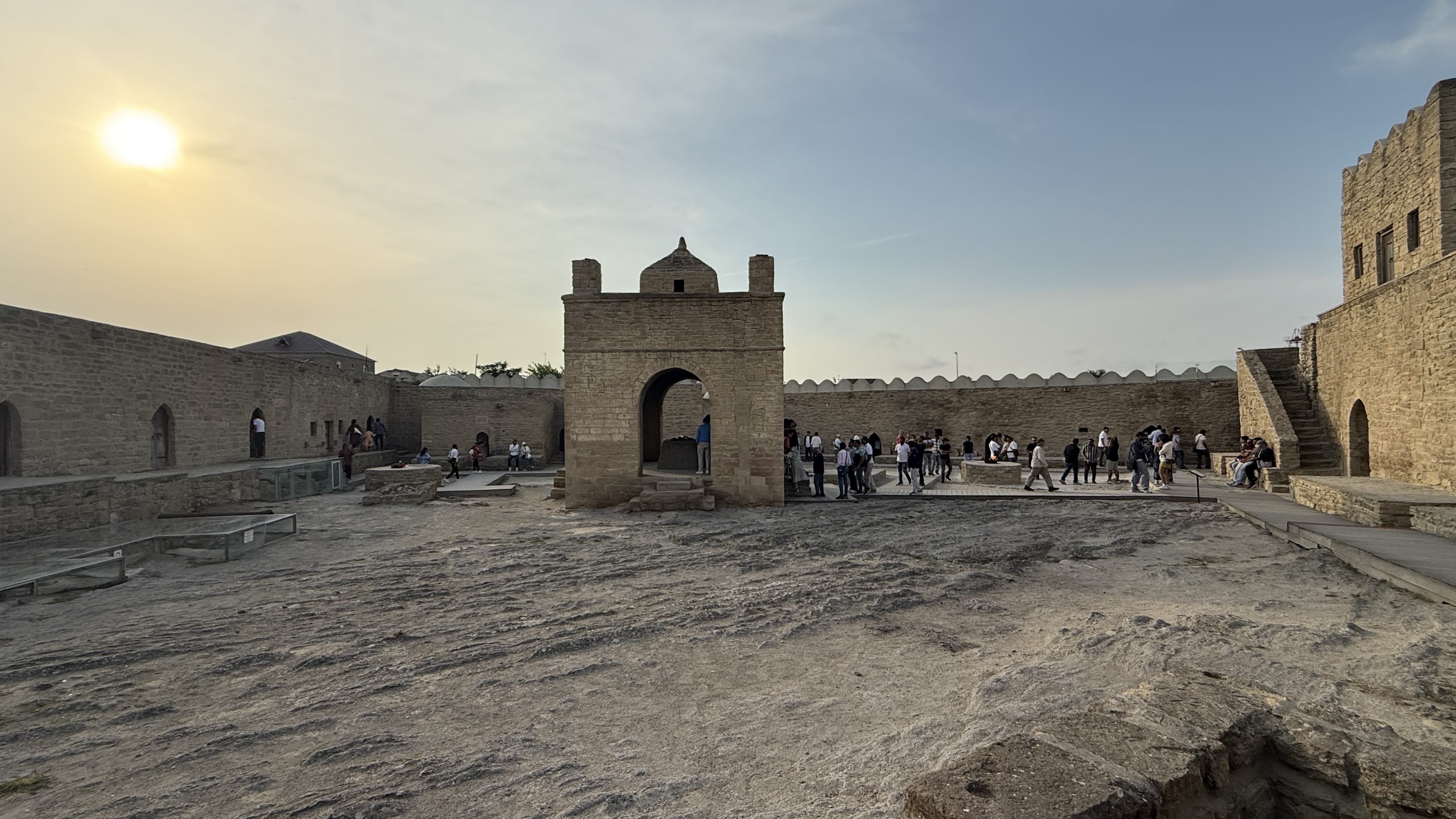
Our final stop of the day was the Ateshgah Fire Temple, a Zoroastrian site where pilgrims once gathered to worship at a naturally burning flame. The fire today is piped in, but the layout of the temple—arched stone cells surrounding a central altar—is original.

Zoroastrianism is one of the world’s oldest religions, and fire is central to it—not destructive fire, but fire as purity, wisdom, and light. Walking through the quiet stone courtyards, it was easy to see how sacred that element must have felt. Especially in a land where fire just rises out of the earth uninvited.

Ateshgah Fire Temple in Surakhani near Baku, Azerbaijan, with visitors exploring the stone courtyard at sunset — 7 Days in Azerbaijan travel blog.
The ancient Zoroastrian fire temple.

Back in Baku, I finished the day with a late dinner at Manipura Vegan and Ethnic Café, joined by a couple of fellow travelers. It had caught my eye earlier in the week, and thank goodness it did—the food was fantastic.

Day 3: Baku's Martyrs’ Lane, Flag Square & the Heydar Aliyev Center

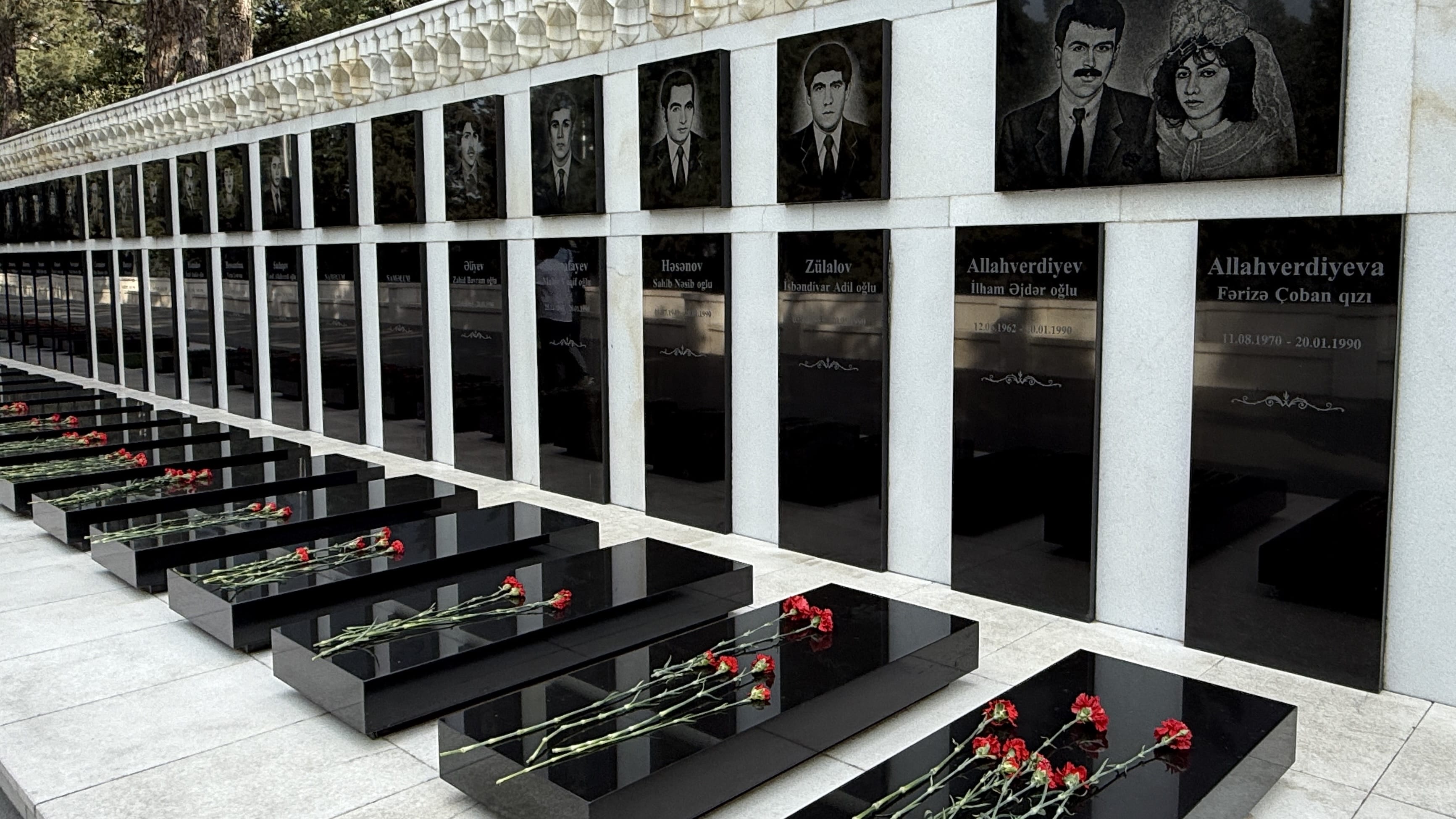
This morning we headed to Martyrs’ Lane. I’d already been there briefly on my own earlier in the trip (I wrote about that here: 2 Days in Baku), but it was good to return with more time and context. The hillside cemetery honors those killed in Black January (1990) and the Nagorno-Karabakh wars. Most of the gravestones are etched with the person’s photograph, and everyone was marked with a red carnation. At the top, the Eternal Flame burns inside a stone pavilion.

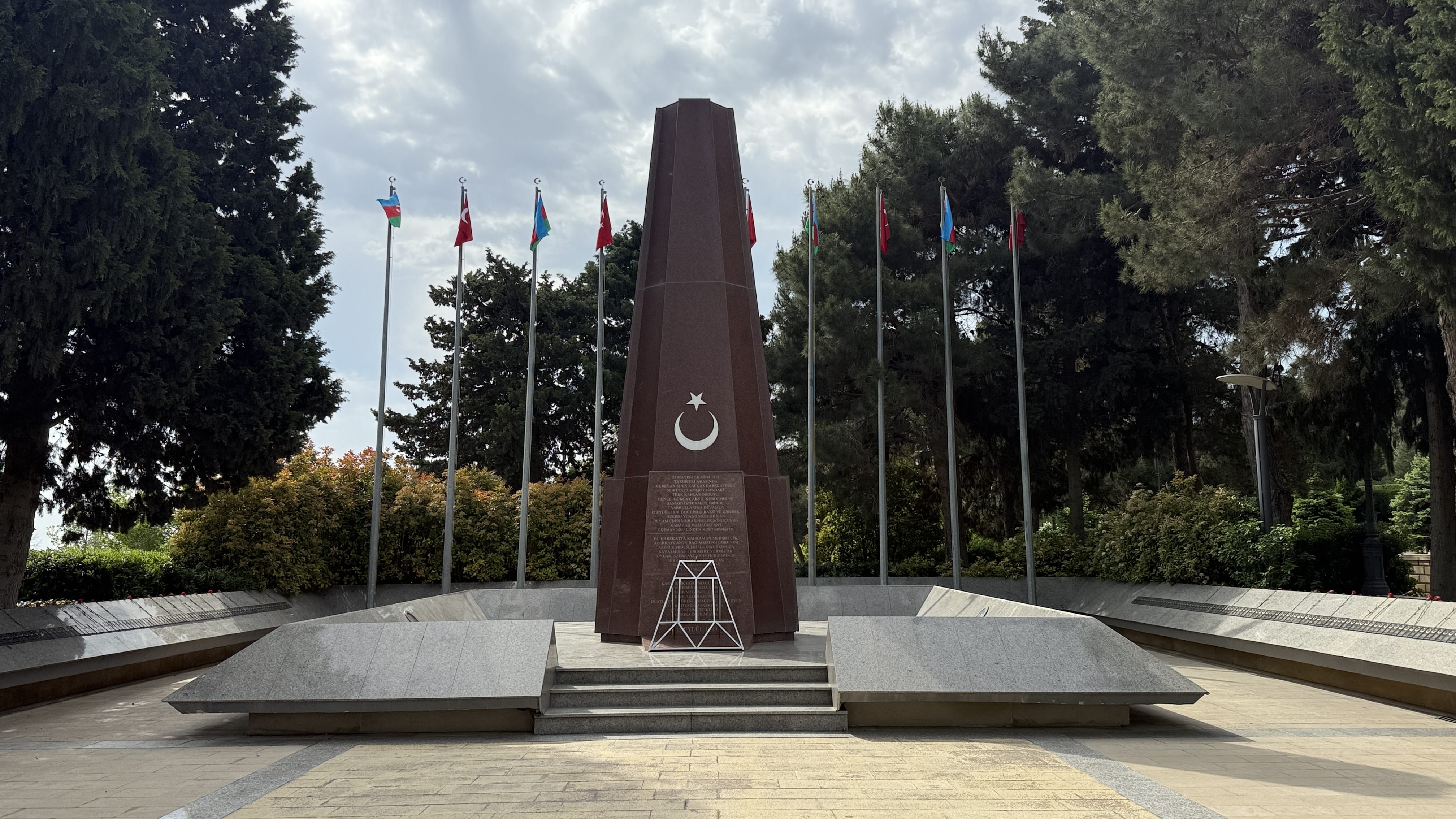
Nearby is the Turkish Martyrs’ Memorial, which honors Ottoman soldiers who died during the 1918 Battle of Baku.

Black marble graves with red carnations at Martyrs’ Lane in Baku, Azerbaijan — 7 Days in Azerbaijan memorial photo.

Rows of black marble and red carnations line Martyrs’ Lane—a tribute to those who lost their lives for Azerbaijan’s independence.
Turkish Martyrs’ Memorial in Baku, Azerbaijan honoring Ottoman soldiers — 7 Days in Azerbaijan travel photo.
Turkish Martyrs’ Memorial

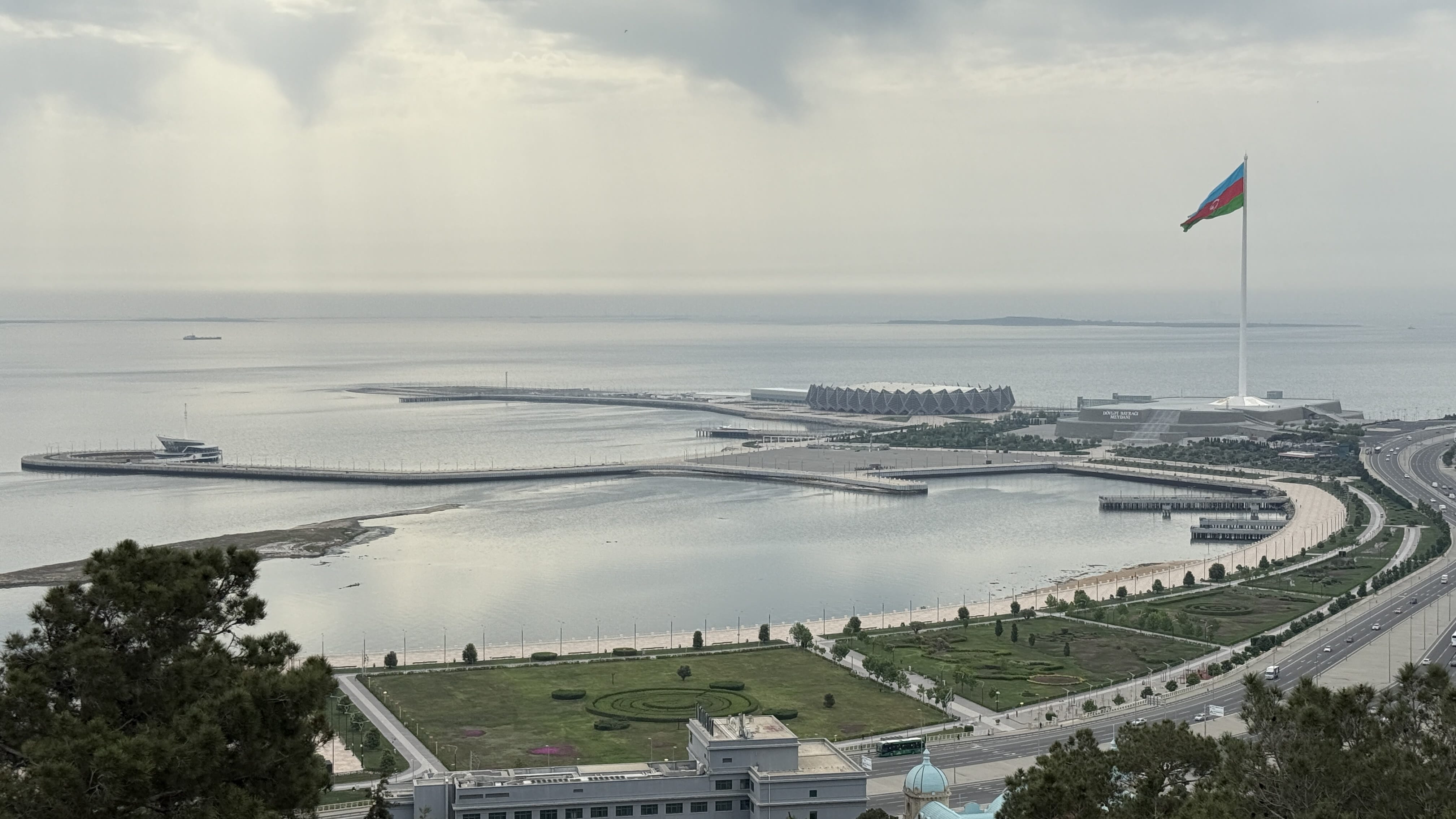
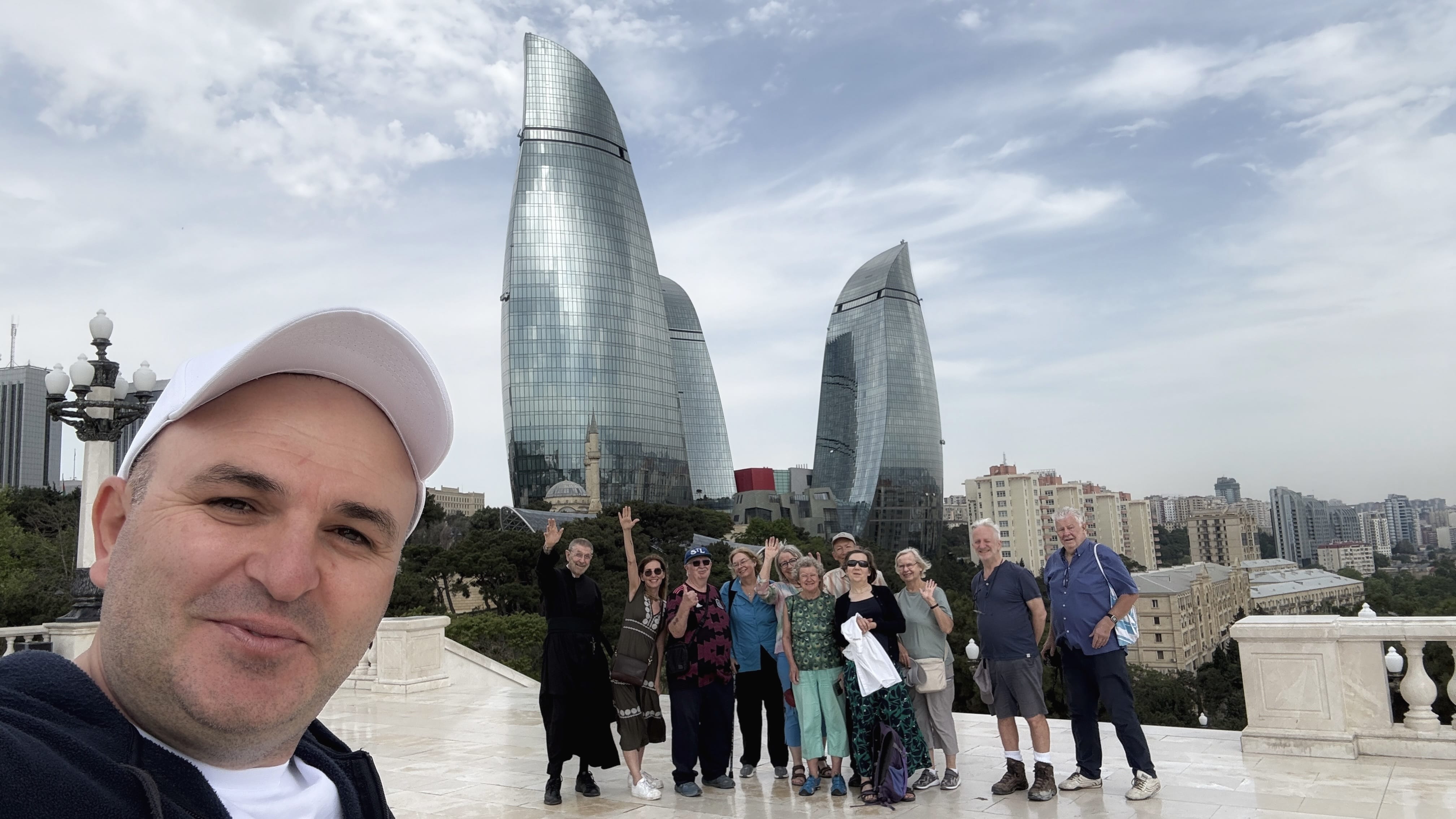
From here you see the Caspian on one side and Baku’s skyline on the other. The massive Azerbaijani flag flying over Flag Square was impossible to miss—at 36 by 72 meters and weighing more than 500 kilograms, it holds the record as the largest regularly flown flag in the world. We even paused for a group photo with the Flame Towers in the background, the kind of proof shot every guide makes sure to get.

Panoramic view of Baku Bay with National Flag Square and the Caspian Sea promenade — 7 Days in Azerbaijan itinerary photo.
State Flag Square.
Group of travelers posing with a local guide in front of Baku’s Flame Towers, Azerbaijan — 7 Days in Azerbaijan tour group.
Our group at the Flame Towers

Passing Baku’s Landmarks

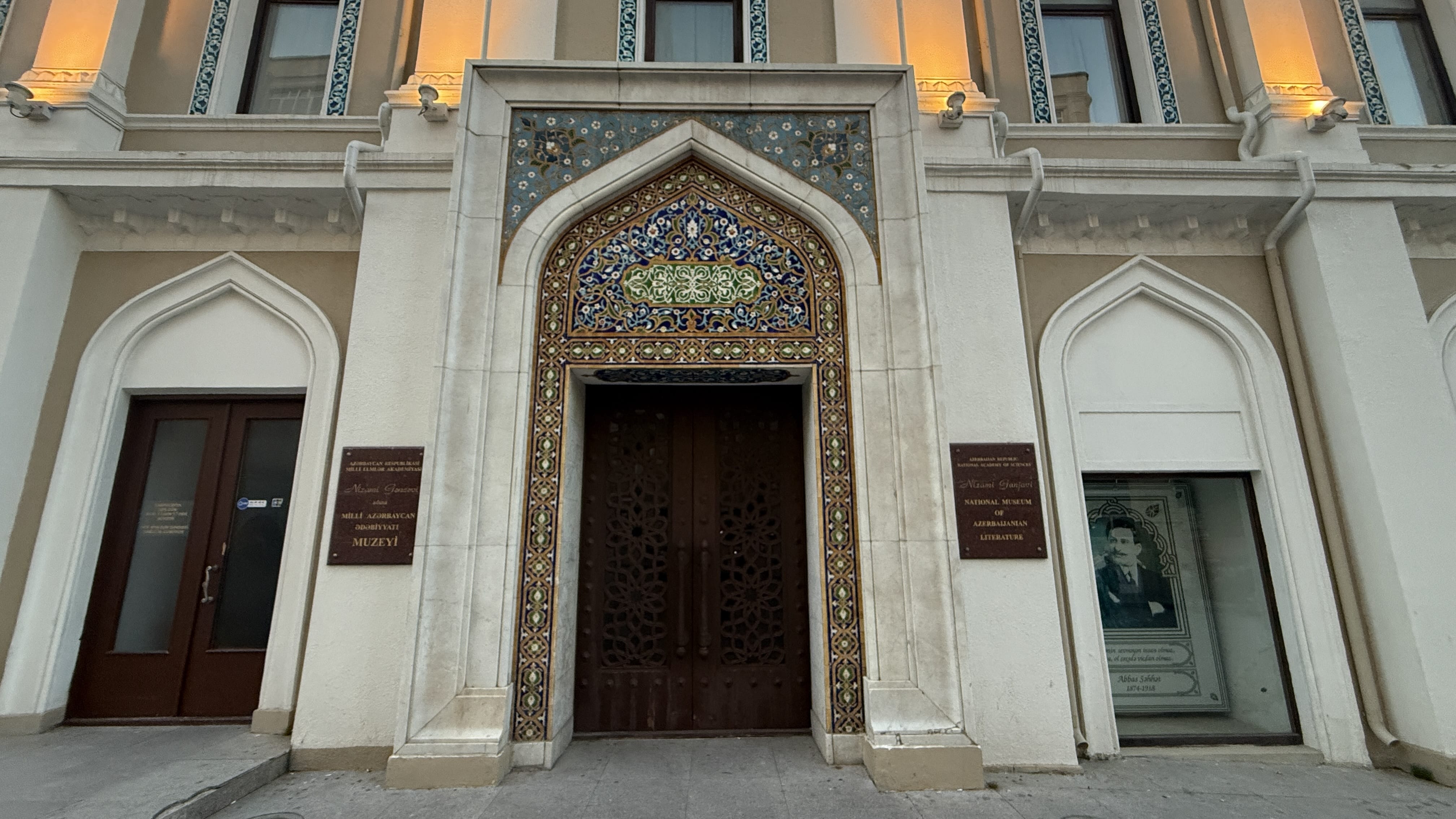
As we continued our walking tour through central Baku, we passed some of the city’s most striking landmarks along Istiglaliyyat Street. The Nizami Museum of Azerbaijani Literature stood out first, its tiled entrance framed by carved arches and calligraphy honoring the great poet Nizami Ganjavi.

Exterior of the Nizami Museum of Azerbaijani Literature in central Baku, featuring mosaic tilework, arched windows, and statues honoring poet Nizami Ganjavi.
The Nizami Museum of Azerbaijani Literature

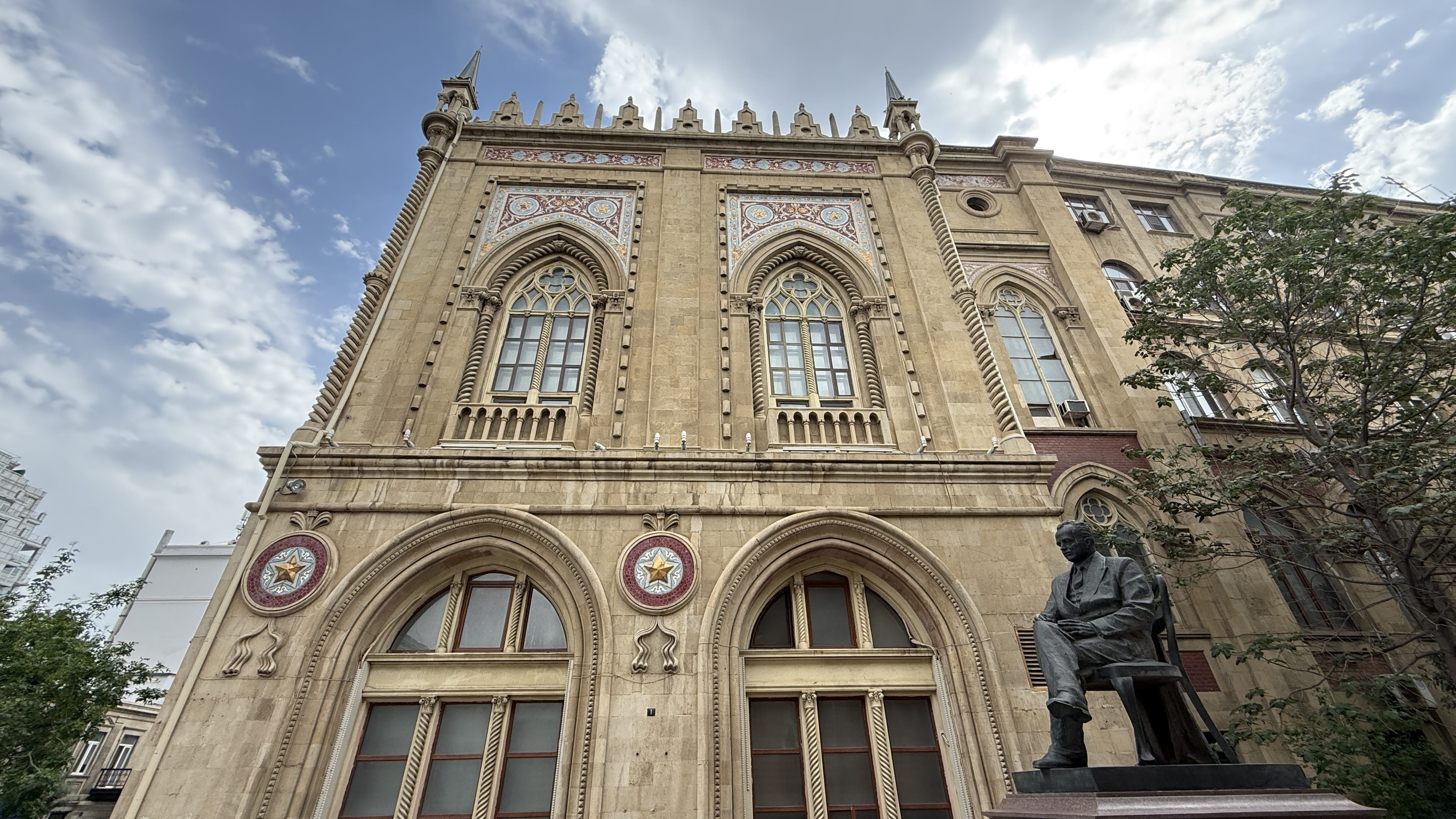
Nearby was the Ismailiyya Palace, a Venetian-Gothic masterpiece built in 1913 by oil baron Musa Naghiyev in memory of his son Ismail, who had died of tuberculosis—a tragic story behind one of the city’s most beautiful buildings.

Ismailiyya Palace in Baku, Azerbaijan, built by oil baron Musa Naghiyev in memory of his son — 7 Days in Azerbaijan architecture and history.
Ismailiyya Palace in Baku was built by oil baron Musa Naghiyev in memory of his son

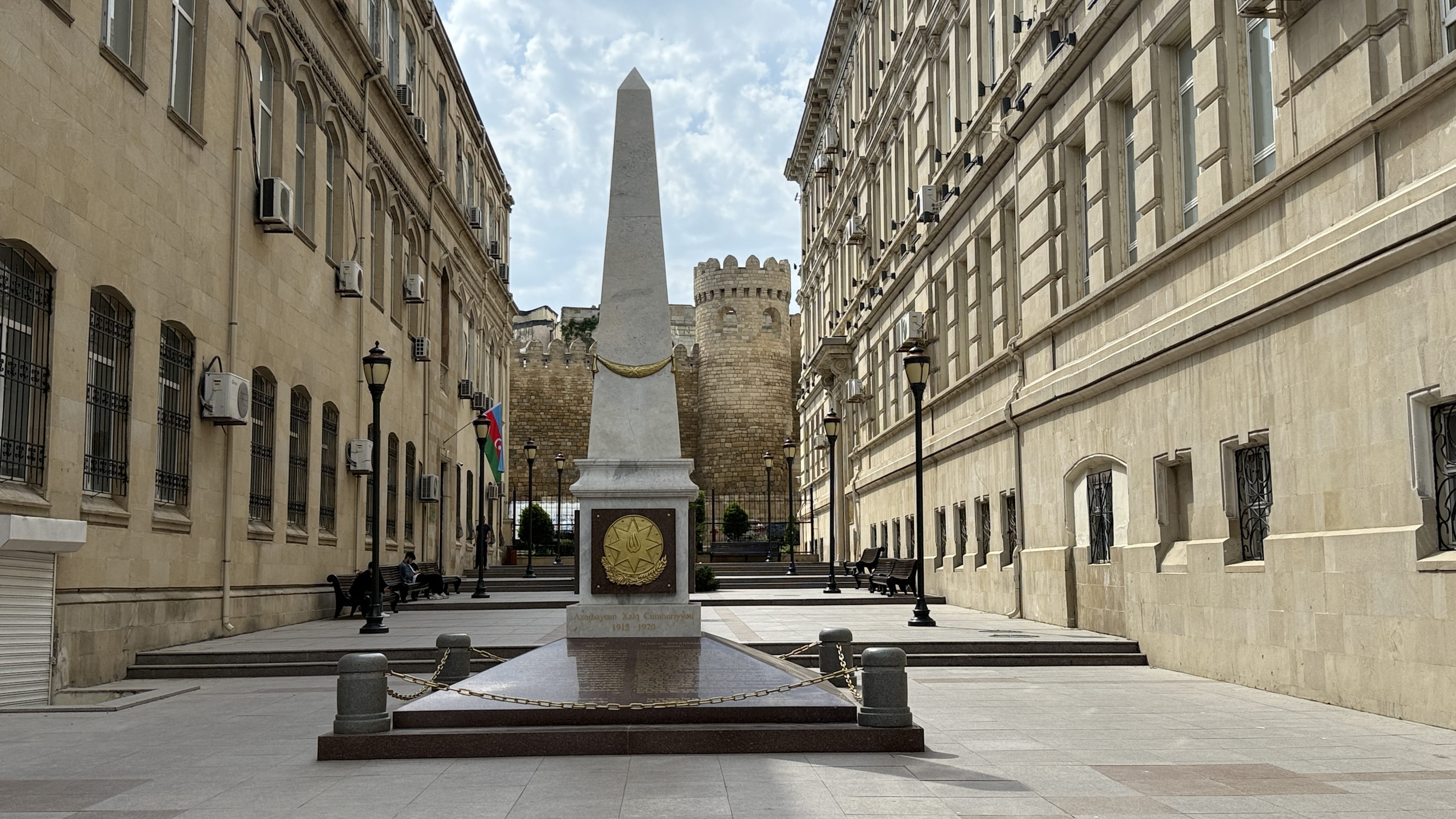
Just ahead, the Declaration of Independence Monument marked the founding of the Azerbaijan Democratic Republic in 1918, standing between stately facades and within sight of the Old City walls. 

Declaration of Independence Monument on Istiglaliyyat Street in Baku, commemorating the 1918 founding of the Azerbaijan Democratic Republic.
The Declaration of Independence Monument marks the birth of the Azerbaijan Democratic Republic in 1918

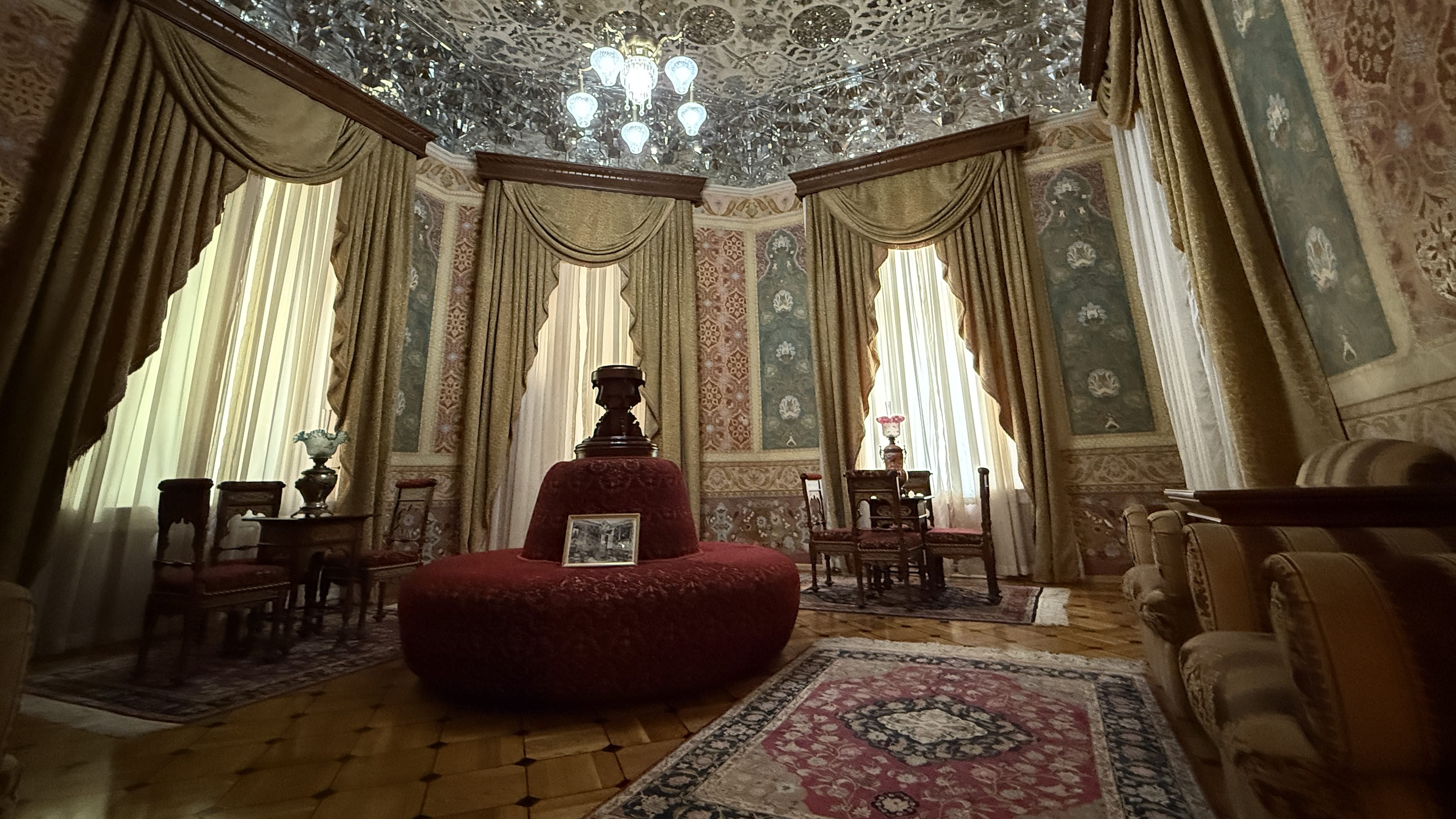
Our last stop on this stretch was the National Museum of History, once the lavish mansion of philanthropist Haji Zeynalabdin Taghiyev. Even from the outside, its grandeur hinted at the wealth of Baku’s first oil boom—an era that shaped so much of what the city is today.

National Museum of History of Azerbaijan in Baku, formerly the neoclassical mansion of philanthropist Haji Zeynalabdin Taghiyev, built during the oil boom.
Once the mansion of oil baron Haji Zeynalabdin Taghiyev, today the National Museum of History of Azerbaijan

The Heydar Aliyev Center

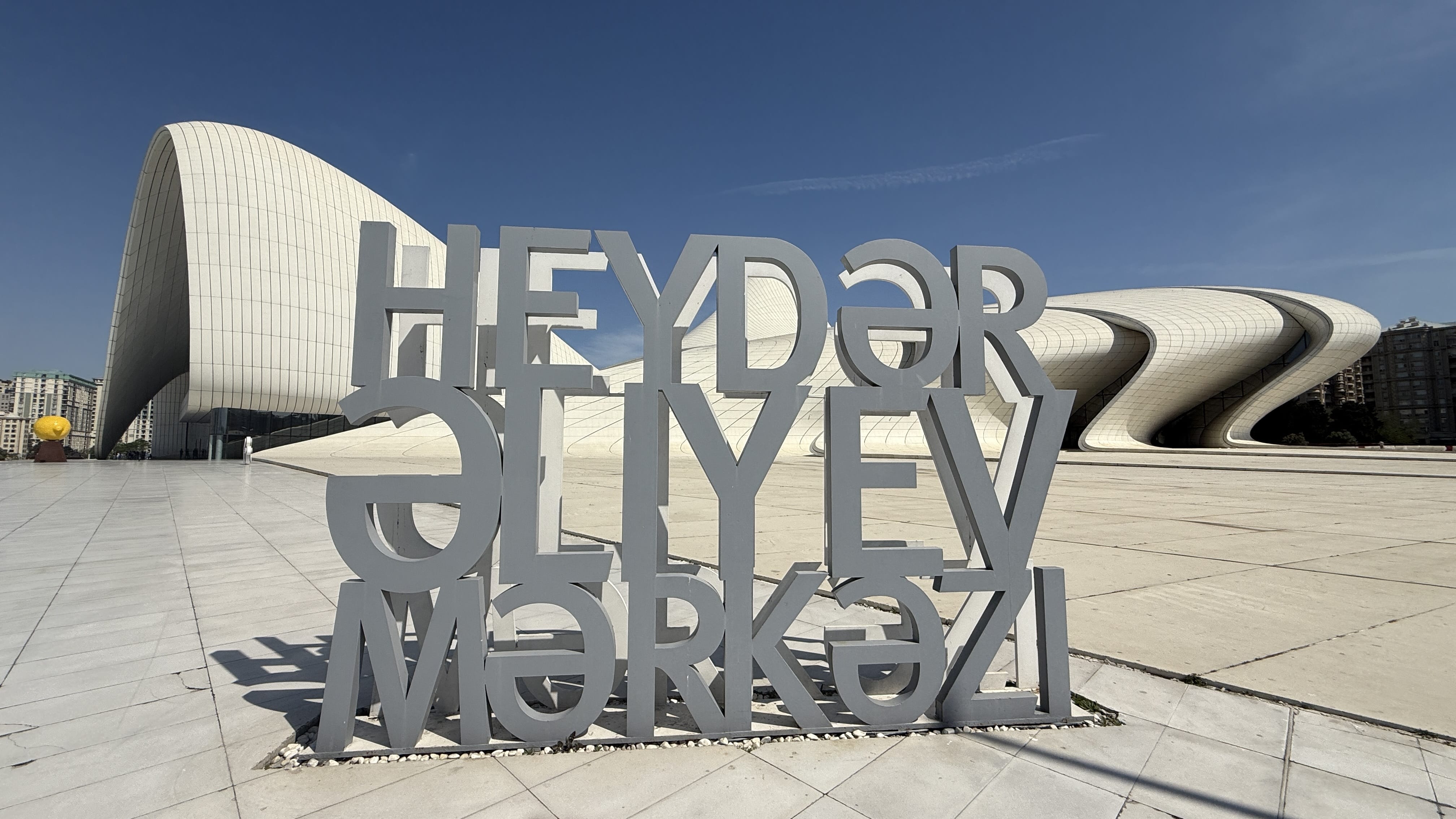
The highlight of the afternoon was finally getting inside the Heydar Aliyev Center. Two days earlier I’d walked out to see it, but the museum was closed. This time, I could step inside. Designed by the late Zaha Hadid, the center has no sharp edges—just sweeping white curves that seem to flow like a wave. Inside, the exhibitions ranged from traditional dress and musical instruments to entire galleries of vintage cars, all displayed with real care and attention.

raveler posing with the I Love Baku sign in front of Heydar Aliyev Center, Azerbaijan — 7 Days in Azerbaijan travel photo.
It's true —I ❤️ Baku

A funny side note: when I posted a photo of the Heydar Aliyev Center, a librarian friend of mine recognized it immediately. She hadn’t been to Azerbaijan, but she had at one point shared The World Is Not a Rectangle by Jeanette Winter, a children’s book about Zaha Hadid, with her students in Princeton, New Jersey. That little connection made me smile—proof that Hadid’s work resonates far beyond Baku.

Modern architectural design of Heydar Aliyev Center with sculptural lettering in Baku, Azerbaijan — 7 Days in Azerbaijan sightseeing.
Heydar Aliyev Center
ronze sculpture of a figure in a hand outside the Heydar Aliyev Center in Baku, Azerbaijan — 7 Days in Azerbaijan modern art.
One of the many modern art installations on the grounds of the Heydar Aliyev Center.

What stayed with me was the sheer scale of the building—those endless white curves, inside and out. It didn’t look like anything else I’d seen.

Heydar Aliyev Center in Baku, Azerbaijan with a yellow lemon sculpture outside — 7 Days in Azerbaijan modern architecture.
Exterior view of the Heydar Aliyev Center in Baku.

Back in the Old City

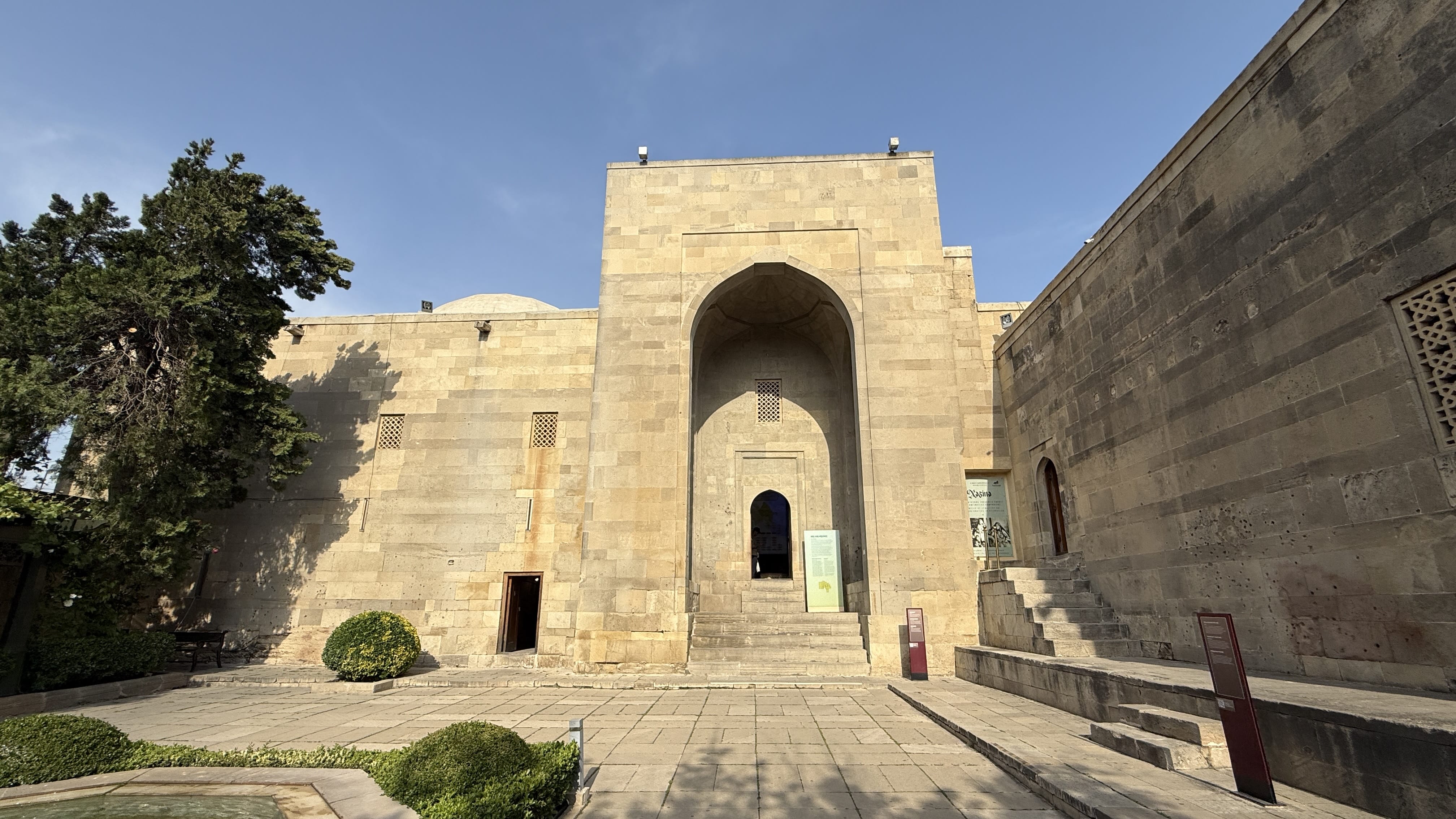
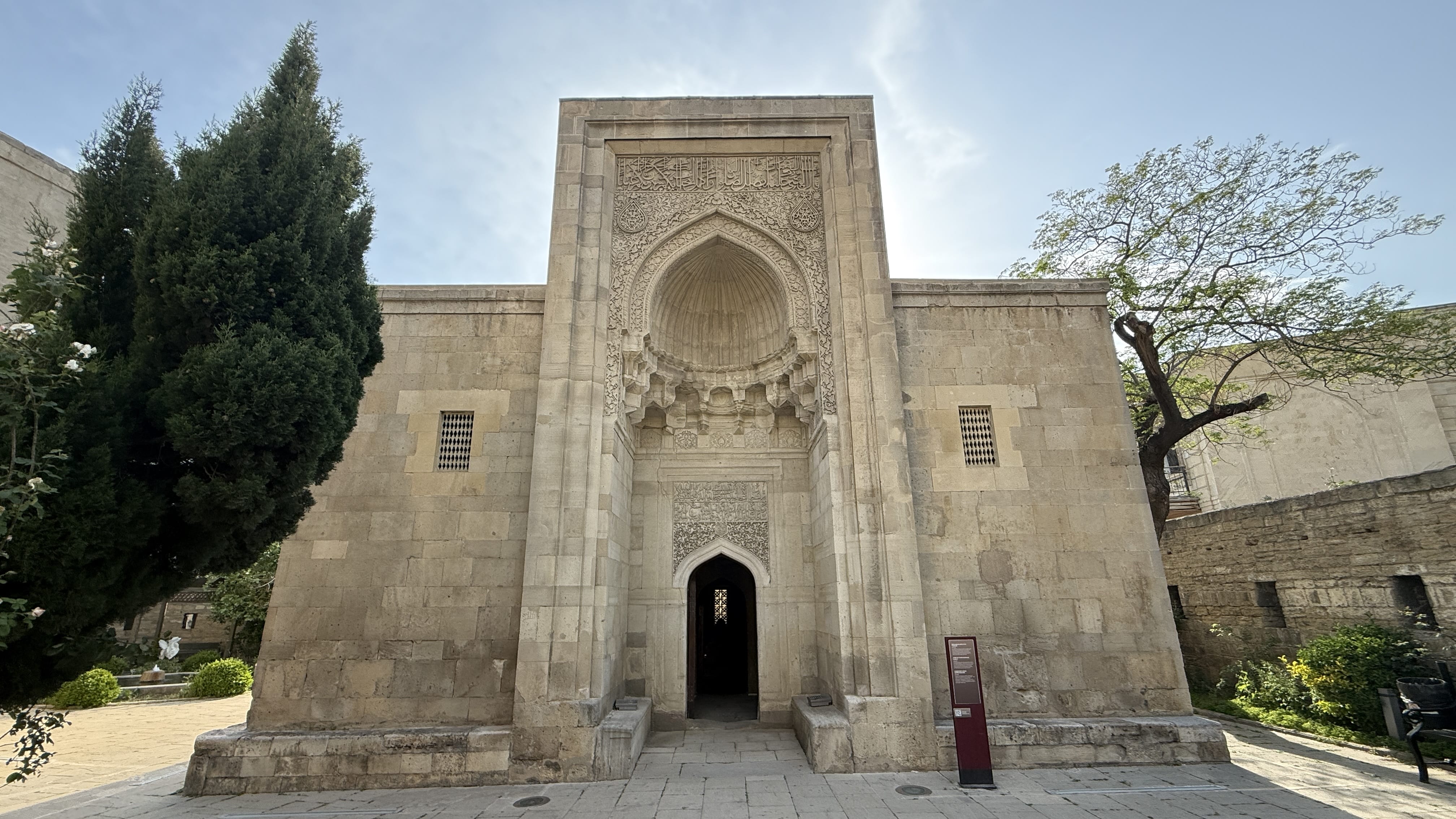
We ended the day back in the Old City, visiting the Palace of the Shirvanshahs, once home to medieval rulers. Our guide pointed out traces of shooting still visible on the stone walls—bullet holes from the violence of the March Days in 1918. We also saw the small Chin Mosque, also known as the Keygubad Mosque, which is part of the same palace complex and dates back to the 14th century.

Stone entrance of the Palace of the Shirvanshahs in Baku’s Old City, Azerbaijan — 7 Days in Azerbaijan historic site.
The Palace of the Shirvanshahs, built in the 15th century.
Wall of the Shirvanshahs Palace showing traces of bullet holes and damage from past conflicts in Baku, Azerbaijan — 7 Days in Azerbaijan history.
Traces of shooting on the palace walls.
Chin Mosque (Keygubad Mosque) in Baku’s Old City, Azerbaijan — 7 Days in Azerbaijan.
The Chin Mosque.

As we continued walking, Elvin mentioned that the Formula One race runs right through these streets. They were already putting up some of the roofed grandstands when I visited in May, even though the race wasn’t until September. It was strange to picture racecars flying past souvenir shops and cafés. Alvin explained how disruptive it can be for locals—streets closed, buses rerouted, even residents near the track asked to leave.

The Maiden Tower and Small Surprises

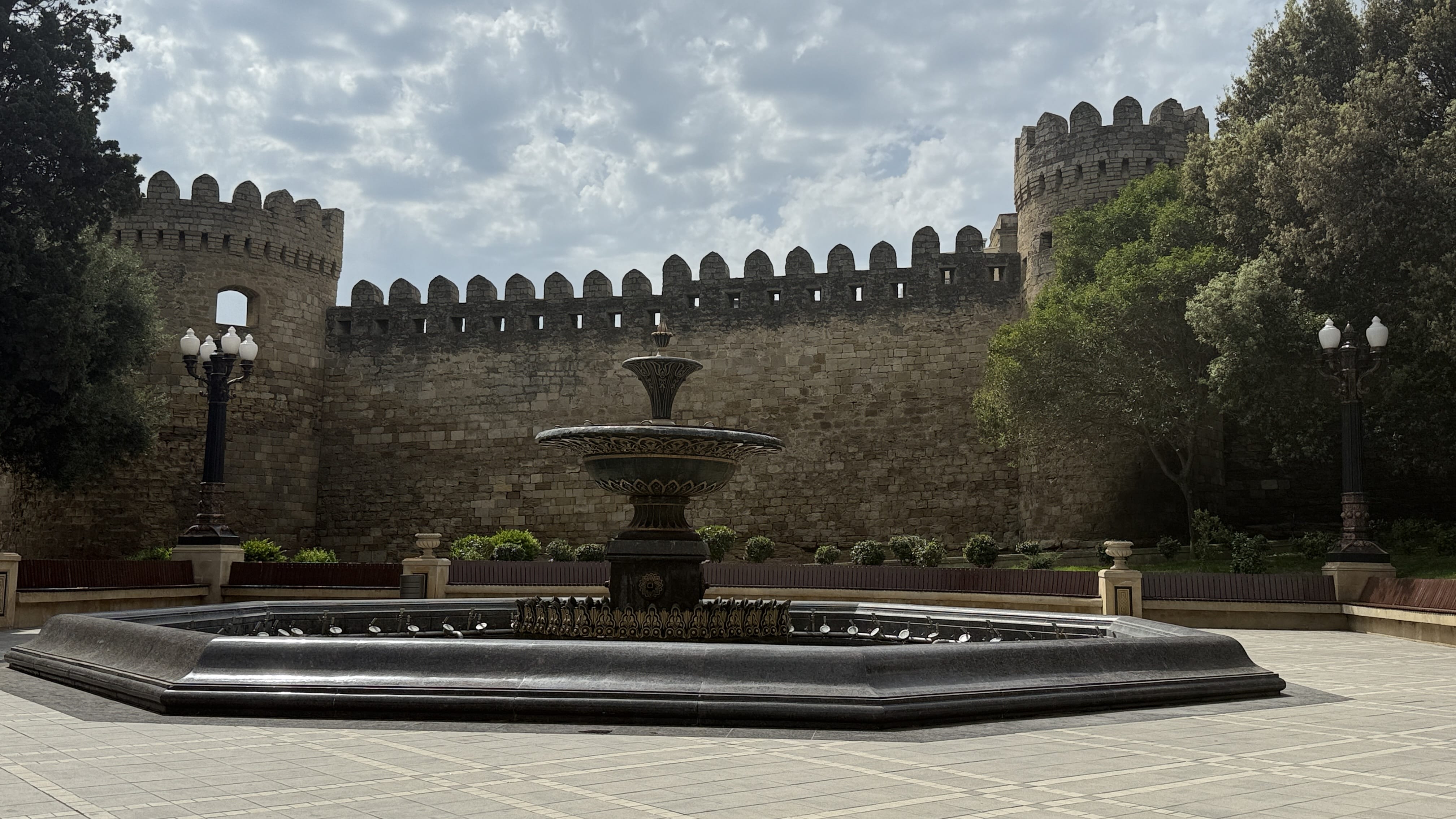
From there we continued to the Maiden Tower, the Old City’s most famous landmark. Parts of it date back to the 12th century, though some sections are older, built at different times. The tower has been a fortress, a watchtower, and a lighthouse. Around it, the Old City walls still stand, with gates leading into streets now filled with restaurants, souvenir shops, and tourists. 

Stone walls of Baku’s Old City (Icherisheher) with a decorative fountain in the foreground — 7 Days in Azerbaijan.
Fountain and fortress walls inside Baku’s Old City.
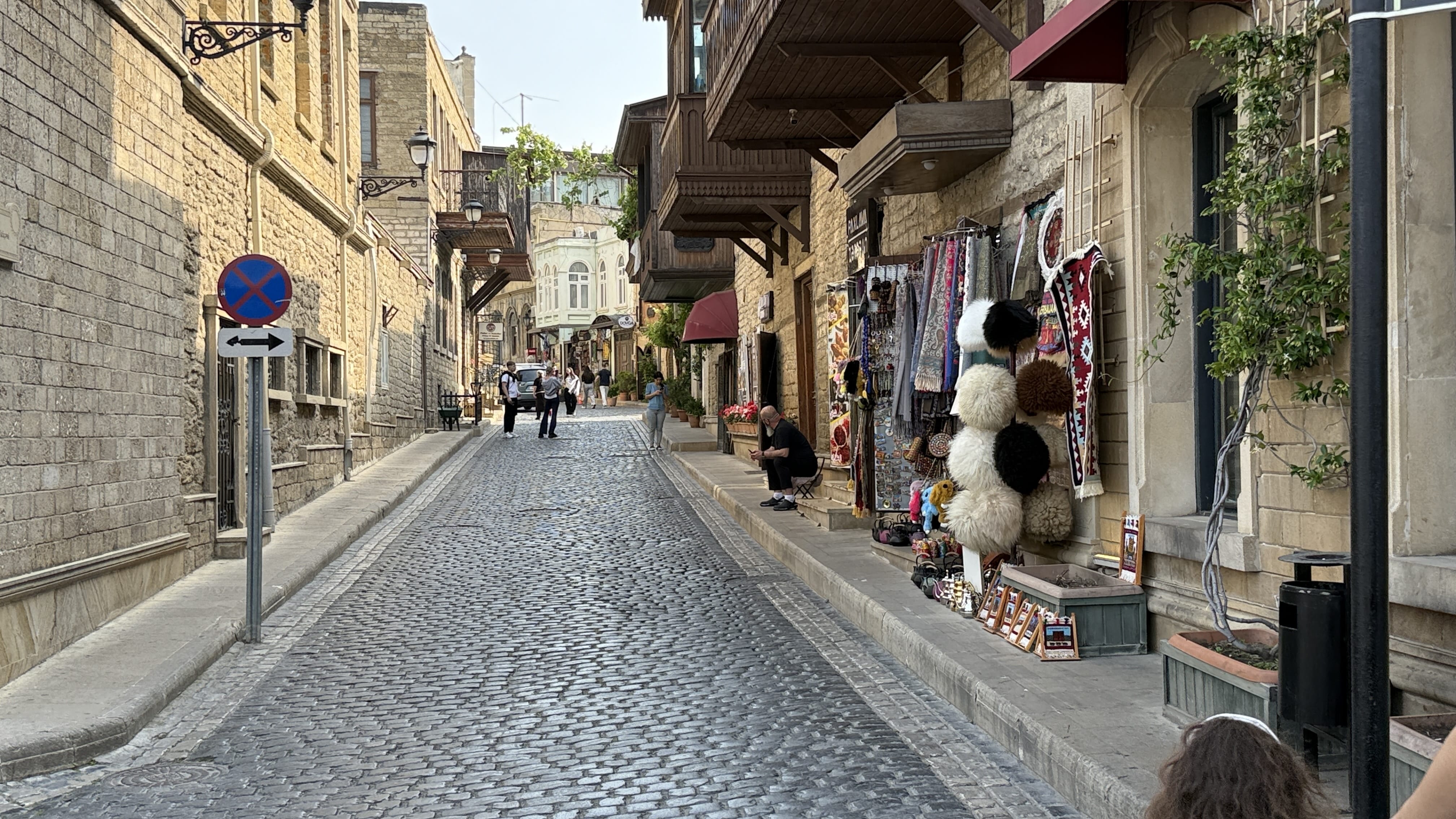
Narrow cobblestone street in Baku’s Old City lined with shops and local crafts — 7 Days in Azerbaijan Old Town photo.
A cobbled street in Baku’s Old City.
Stone fortress walls and tower in Baku’s Icherisheher (Old City), Azerbaijan — 7 Days in Azerbaijan historic architecture.
The Maiden Tower.

Just outside the tower, a man was singing on a park bench. His voice carried through the square—unexpected and beautiful.

On our way back through the Old Town, my guide pointed out something I would have walked right past—the Cat House sculptures, with three stone cats peeking out from an alcove. A quirky little surprise tucked in among centuries of history.

Quirky cat sculptures peeking from a stone window in Baku’s Old City, Azerbaijan — 7 Days in Azerbaijan city details.
Quirky statues in Old Town.

Evening in Baku

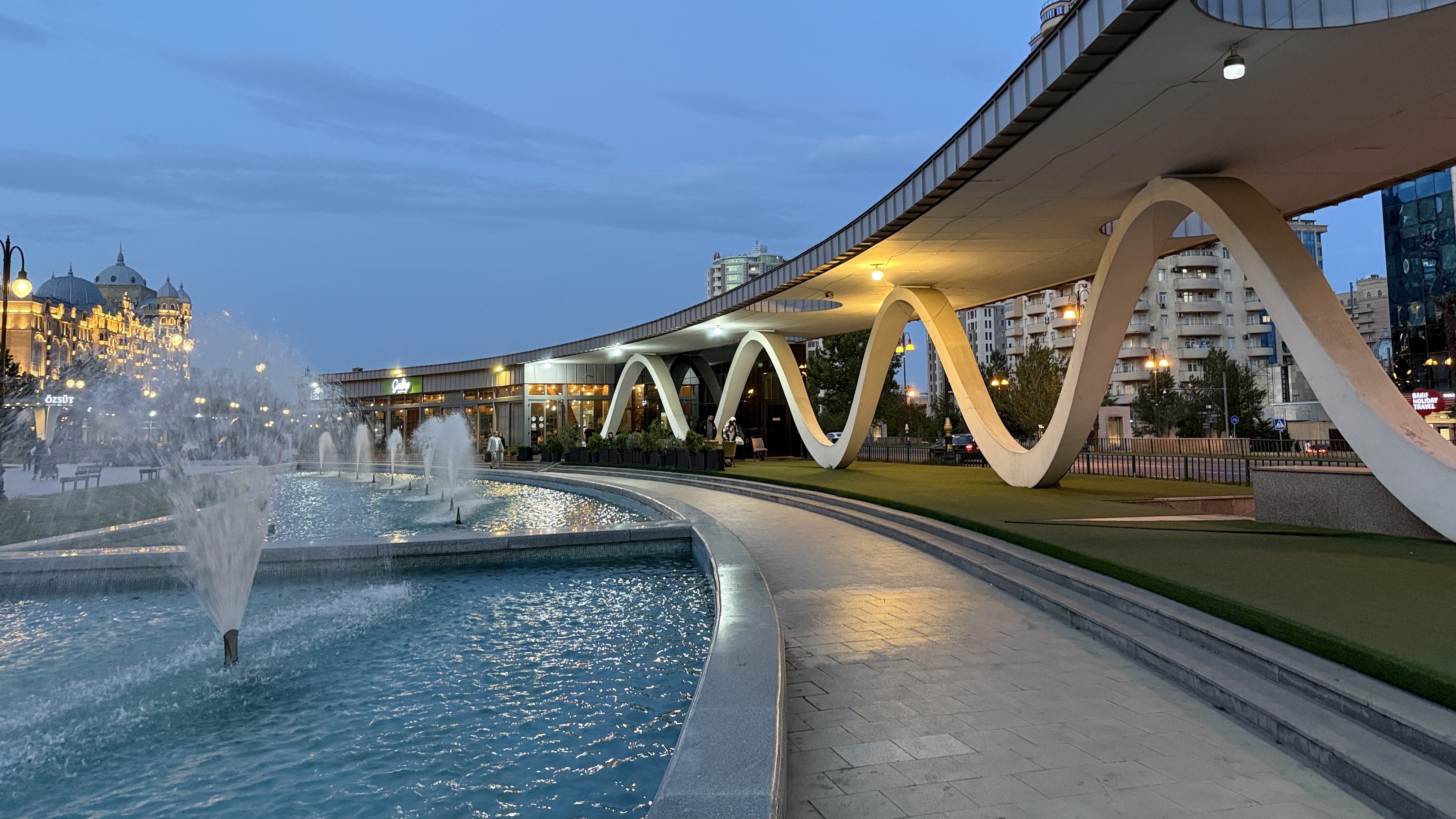
Later, after regrouping at the hotel, I wandered out on my own again. I walked through Winter Park, taking in the view of another wave-shaped pavilion that reminded me of how much Baku invests in its public spaces. 

Winter Park Fountain and Walkway Alt text: Evening view of fountains and modern architecture in Winter Park, Baku,
Evening view of a modern wave-shaped pavilion and fountains in Winter Park.

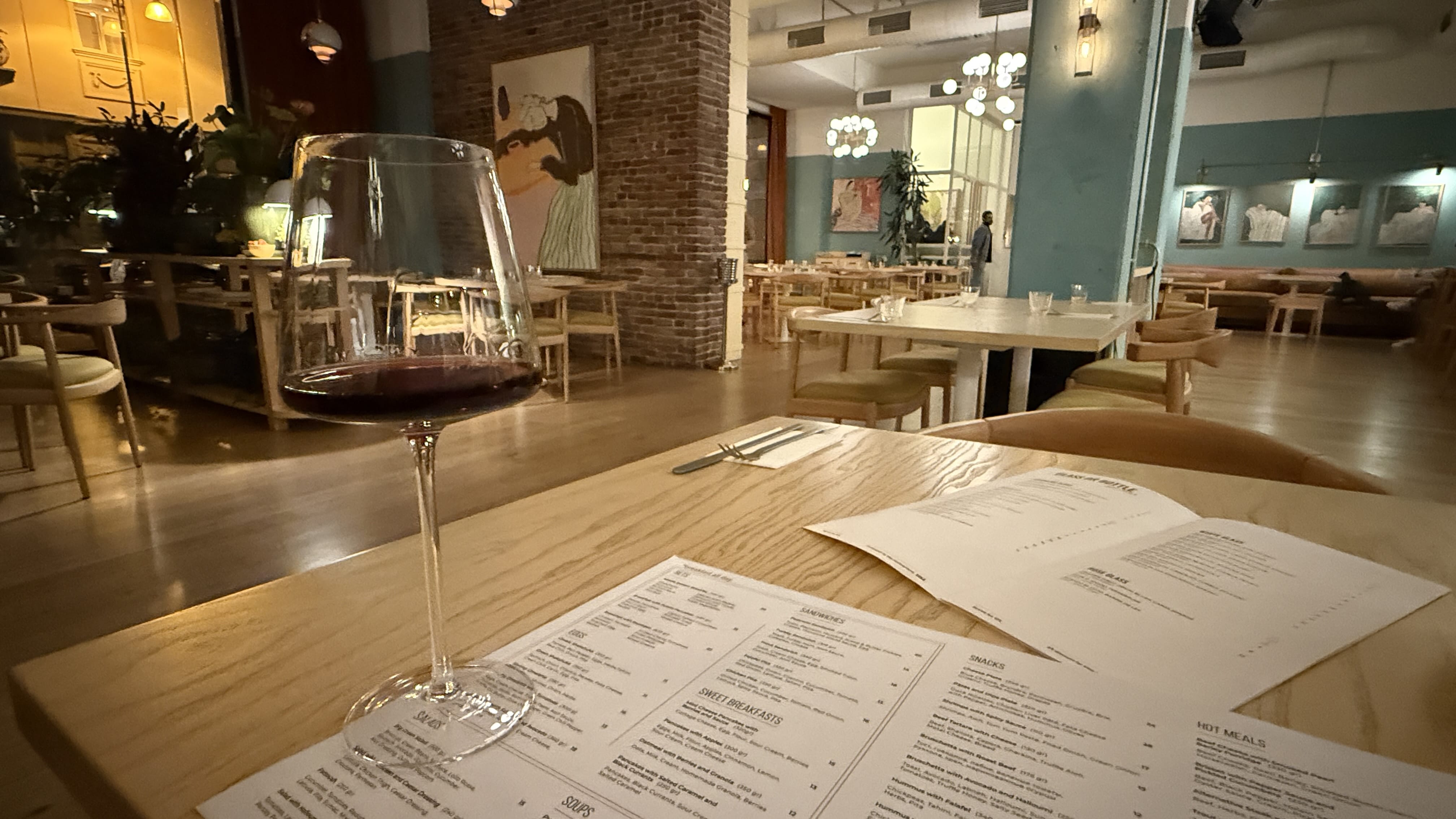
From there I headed to a café that had caught my eye earlier—Sara Café. It had a warm, open vibe with brick walls and interesting artwork. I had hummus, falafel, warm bread, and—breaking from my usual—two glasses of wine. A simple but fitting end to a full day in and around Baku.

Quirky cat sculptures peeking from a stone window in Baku’s Old City, Azerbaijan — 7 Days in Azerbaijan city details.
Dinner at Sara Café

Related Blogs

Tomorrow we leave Baku and head north toward Quba—a quieter, more rural side of Azerbaijan filled with mountain villages and old caravanserais.

Continue the journey in 7 Days in Azerbaijan: Quba to Sheki (Part 2). 

JoAnne Cross headshot

About the Author

Hi, I’m JoAnne—writer, wanderer, and lover of places that surprise me. I’ve traveled to 60+ countries (and counting), usually with a camera in one hand and a notebook in the other. I’m drawn to mosaics, markets, and mountains, and I write to remember what moved me. When I’m not traveling, I’m working on my blog Travels Afoot, trying new creative projects, or planning my next adventure. 📍 More about me | ✈️ Explore destinations