7 Days in Azerbaijan: Quba to Qabala to Sheki -Part 2
This is the second half of my journey through 7 Days in Azerbaijan, following my first three days exploring Baku and the surrounding area. If you haven’t read Part 1 yet, start there before jumping in.
Day 4: Quba Region
We woke to rain this morning, which meant our original plan—driving to the remote mountain village of Xinaliq—wasn’t happening. The road can get treacherous when wet, and between the fog and slippery switchbacks, it just didn’t make sense.
Instead, we detoured to Laza, a Lezgin village located in northern Azerbaijan, surrounded by steep cliffs, winding rivers, and wide-open valleys near the foot of Mount Shahdag. The closer we got, the narrower and rougher the road became. Visibility was almost nonexistent—thick white fog. The road cut right along the edge of cliffs with real drop-offs, and while I’m not usually nervous on mountain roads, I definitely had a few white-knuckle moments.
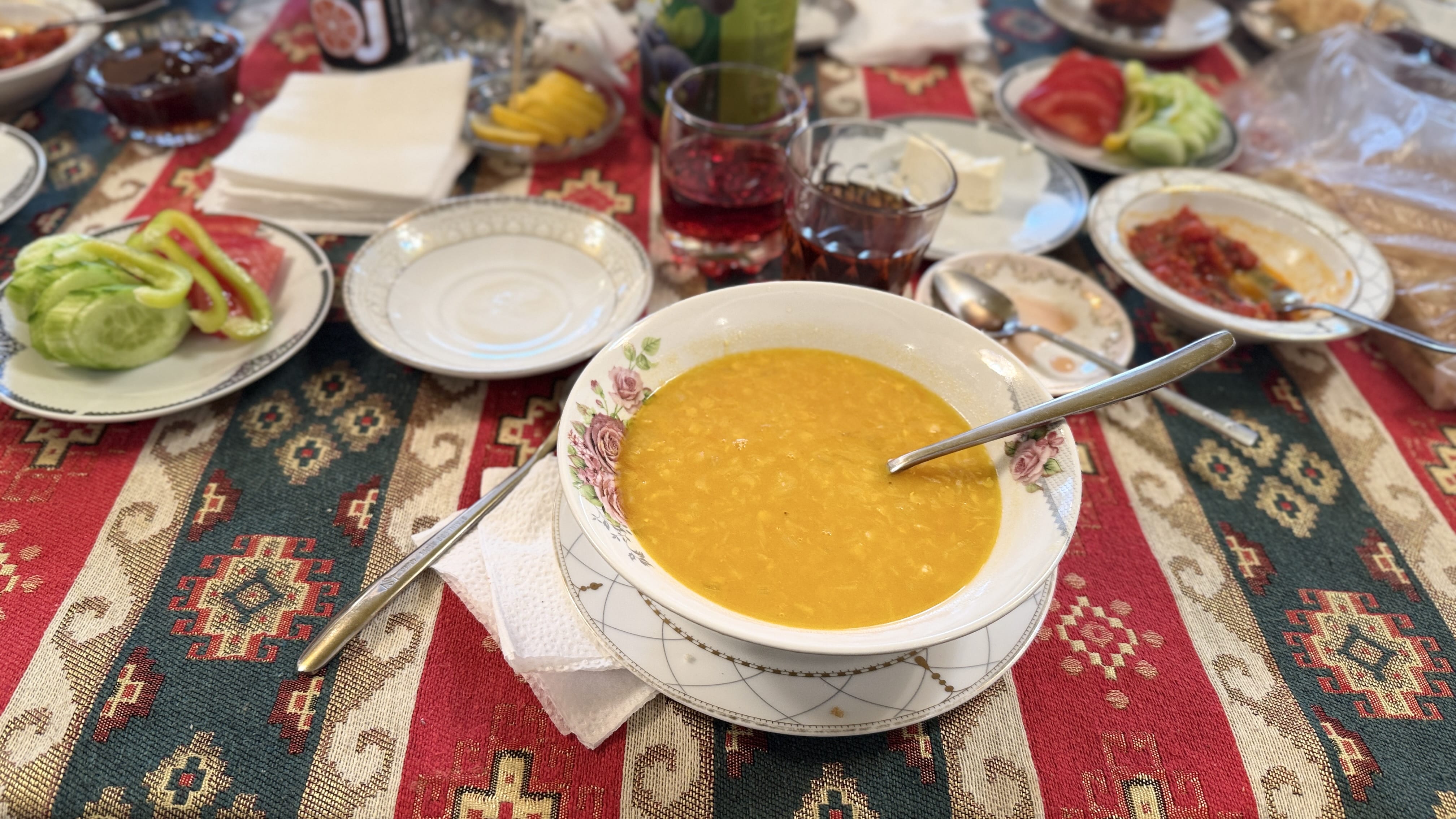
We had lunch at the home of a local family, who served flatbreads, lentil and rice soup, tomato-cucumber salad, and a sweet chicken dish with dried fruits. We finished with tea and homemade plum and quince preserves. It was simple, genuine, and such a nice experience.
The guesthouse in mountain village of Laza, where we had lunch.
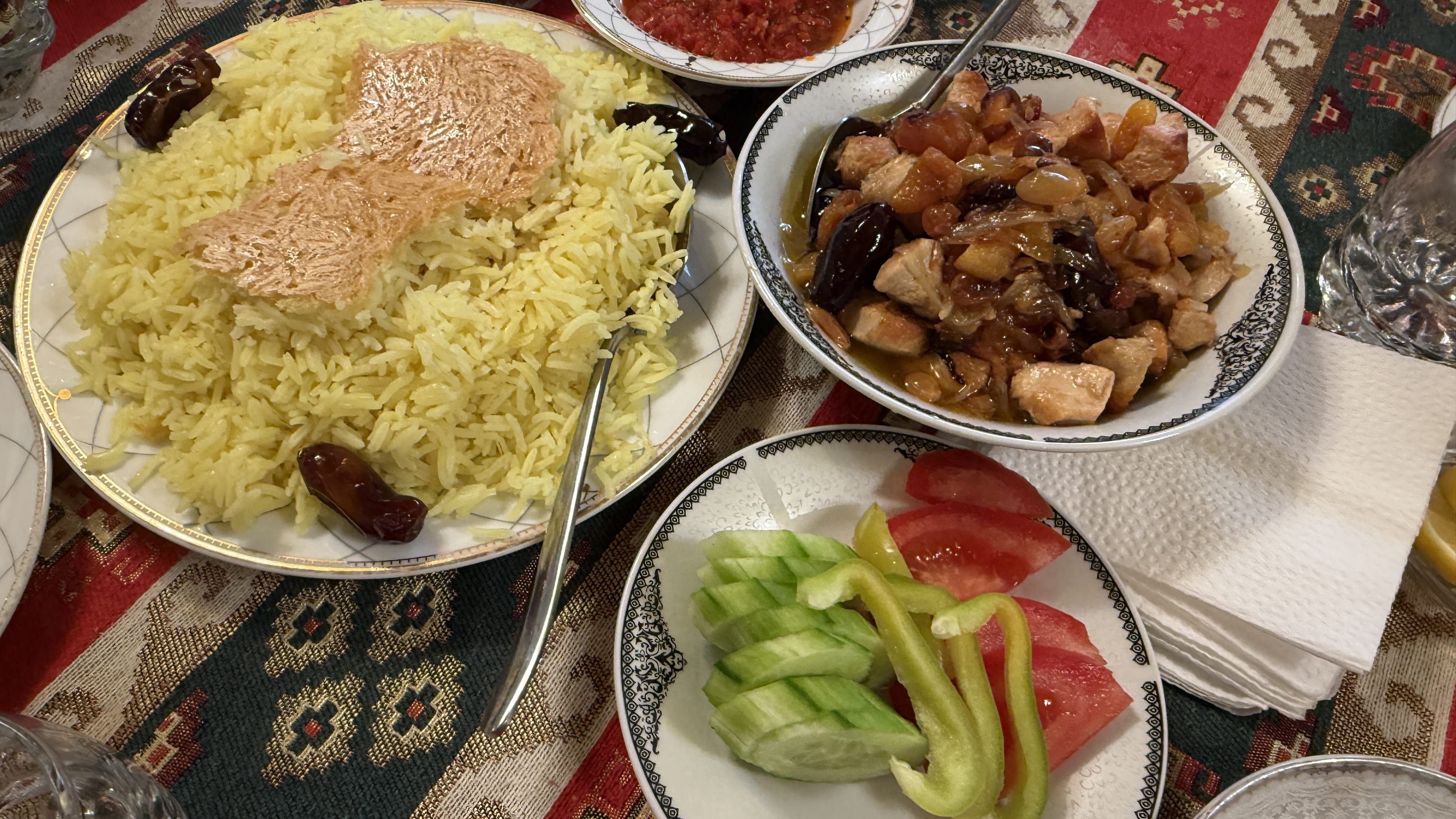
The standout was şah plov—saffron rice baked with a golden crust (gazmaq) made from yogurt and lavash. The rice inside was mixed with dates and bits of torn bread and served alongside a fruit-and-meat stew. It was a perfect example of the sweet-and-savory balance that defines Azerbaijani cooking.
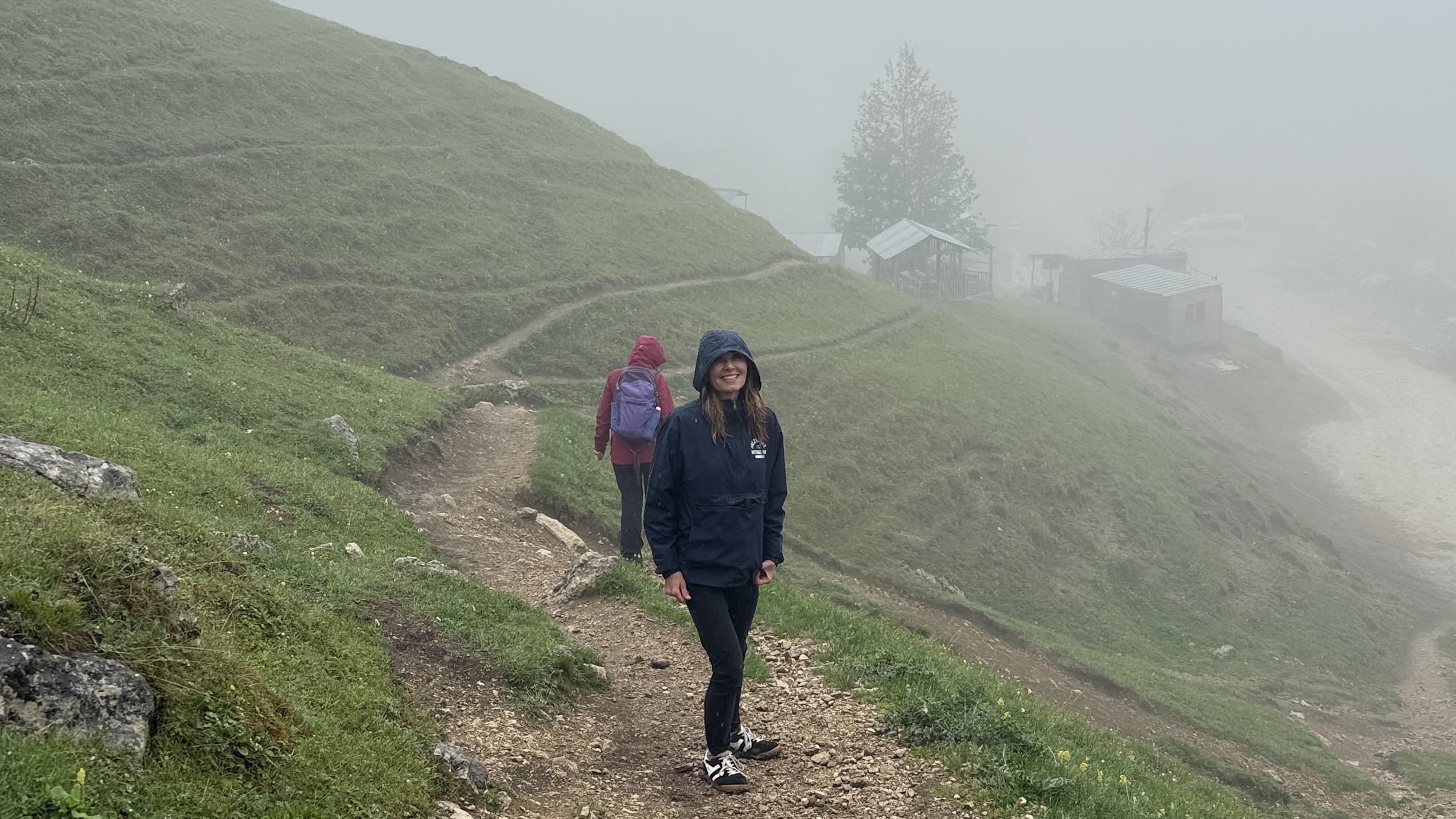
After lunch, we hiked up to Afurja Waterfall in Quba,one of the most beautiful waterfalls in Azerbaijan—a double cascade that drops in two stages down the cliffs outside the village. The trail was slick from the rain, and I was in sneakers without poles, so we only made it to the lower viewpoint. Even so, it was worth it—the roar of the water echoed through the fog, and mist rose all around us.
Fog, rain, and muddy trails — hiking toward Afurja Waterfall.
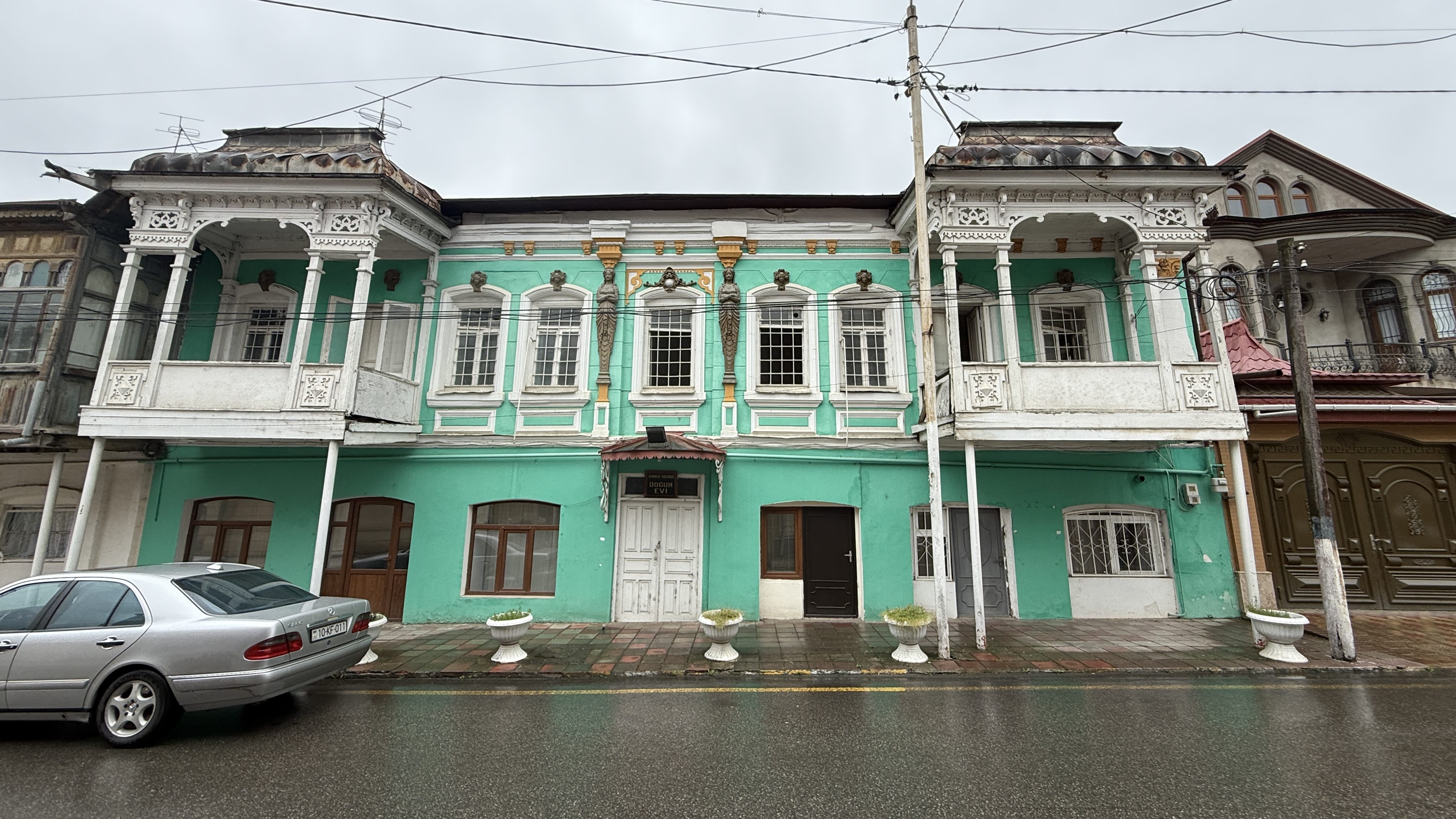
Before heading back to Quba and our hotel for the night, we made one last stop: Krasnaya Sloboda, or Qırmızı Qəsəbə—the Red Village. Sitting along the Kudyal River, it’s home to the Mountain Jews, or Juhuro, a unique community that has lived in the Caucasus for more than 2,000 years. At its peak, it was considered the largest all-Jewish town outside of Israel and the U.S. The village is linked to Quba by a 19th-century brick bridge that still carries cars and pedestrians across the river—a quiet reminder of the connection between the two communities.
The name of the town comes from the red-tiled roofs and brick houses that once made the village stand out. Walking the quiet streets, I noticed how many buildings looked like they were no longer lived in—not destroyed, just slowly crumbling. I was told that many families moved abroad—mostly to Israel, the U.S., and Russia—after the fall of the Soviet Union.
Some still own property here, and many send money back or return for holidays, but the homes often sit empty. It’s not that they’re abandoned—there’s still money in the community, and even signs of wealth—but not many people actually living here year-round.
It felt like a place suspended between past and present. Some houses were being restored or rebuilt, while others were slowly being reclaimed by time. The whole town had this strange quiet to it—like it was holding on, even as much of it had moved on. And you can picture how beautiful it must have been in its day, with all the brickwork, the elaborate trim on the facades, and those homes with oriel and wraparound balconies.
After exploring the village, it was just a ten-minute drive back across the river to our hotel in Quba. The Gold Hotel sits on the quieter edge of town, near residential streets, a few shops, and only two or three nearby restaurants. After checking in, I decided to try one of them—Sərin Restaurani—about a 10–15 minute walk from the hotel.
At first, I wasn’t even sure the restaurant was open. The outdoor tables were still wet from the rain, the lights inside looked dim, and only a couple of men were standing out front. But when I asked, one of them smiled and said, “Yes,” and led me in.
Dinner at Sərin — one of the few restaurants near the hotel.
The main dining room had plenty of empty tables, but instead of seating me there, the waiter led me into a private room with a long table fully set for eight. So there I was, sitting alone at the head of this giant banquet table, looking like I was about to host a dinner party for… absolutely no one. Awkward, yes—but so absurd I had to laugh. And to make it even funnier, the room had a door he kept closing every time he left, as if I needed privacy for my imaginary guests.
My private dining room at Sərin Restaurant in Quba — a full table for eight, just for me.
Then came the wine adventure. He asked if I’d like wine. I asked if they had red. He said yes, so I said, “Great, I’ll have a glass of red?” He shook his head: “No, only bottle.” So I said, “No thanks.”
Then he asked if I wanted white. I said, “A glass?” and again he shook his head: “No, only bottle.” I declined again.
He left, and when he came back I changed my mind. “You know what,” I said, “I’ll take a bottle of red.” He disappeared, then returned a few minutes later with the news: “No red.”
I laughed and said, “Okay, no problem, I’ll just have water.”
He left once more, but a moment later the door creaked open and his head appeared again. “You want red?” he asked. I said yes. He grinned. “Okay. Ten minutes. We go to store.”
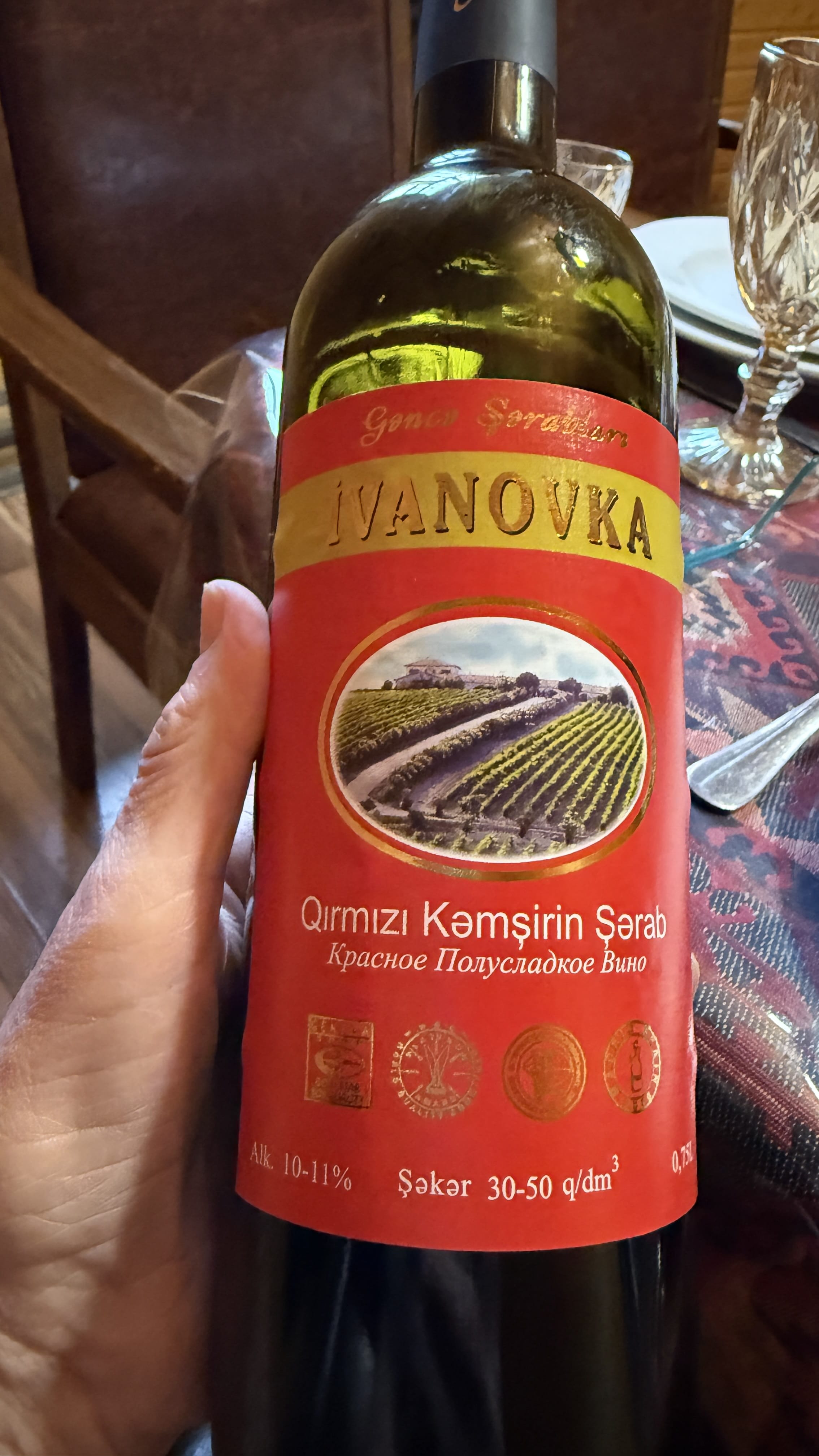
Sure enough, ten minutes later he reappeared—triumphant—holding a bottle of Ivanovka, a local red wine fresh from down the road. He poured me a taste as if I needed to sample a bottle he’d just bought at the local market. I couldn’t help laughing—what if I’d said no, I didn’t like it? Then what? But I told him it was good (and honestly, it was).
Dinner itself was simple: a basket of warm təndir çörəyi (flatbread) and six roasted vegetables—two eggplants, two peppers, two tomatoes—served whole on a plate. It wasn’t fancy, but it was hearty, and I was perfectly happy with my bread, wine, and vegetables.
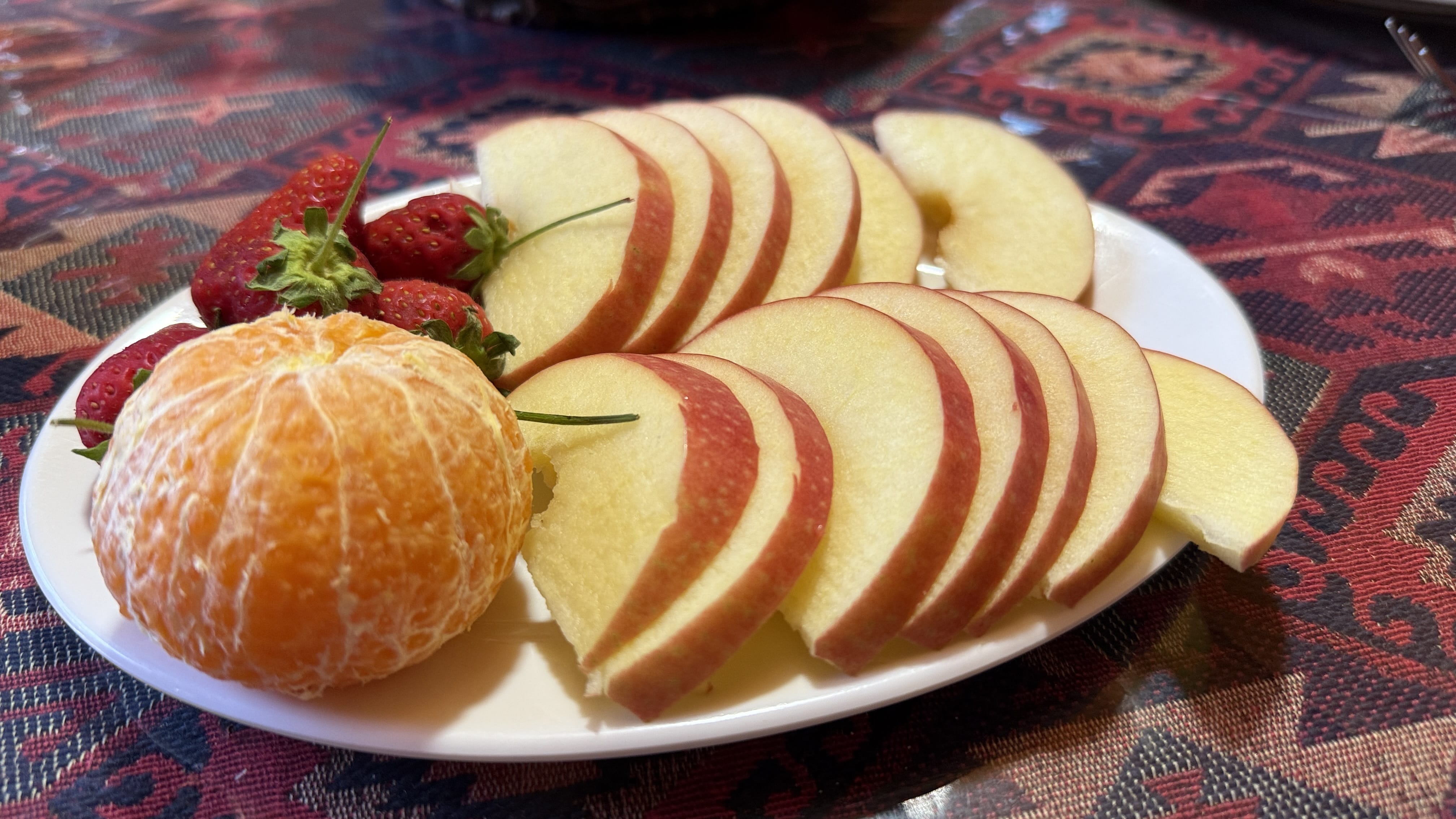
Just as I was finishing, the waiter reappeared with a small plate of sliced fruit—apples, a tangerine, a few strawberries. “English not good… but gift. Gift from restaurant,” he said with a smile. And really, how could you not be charmed by that?
I wasn’t sure how my evening in Quba would unfold, but this is what I’ll remember: foggy mountains, a detour that turned out better than expected, and the kindness of a host over a plate of roasted vegetables and a bottle of wine.
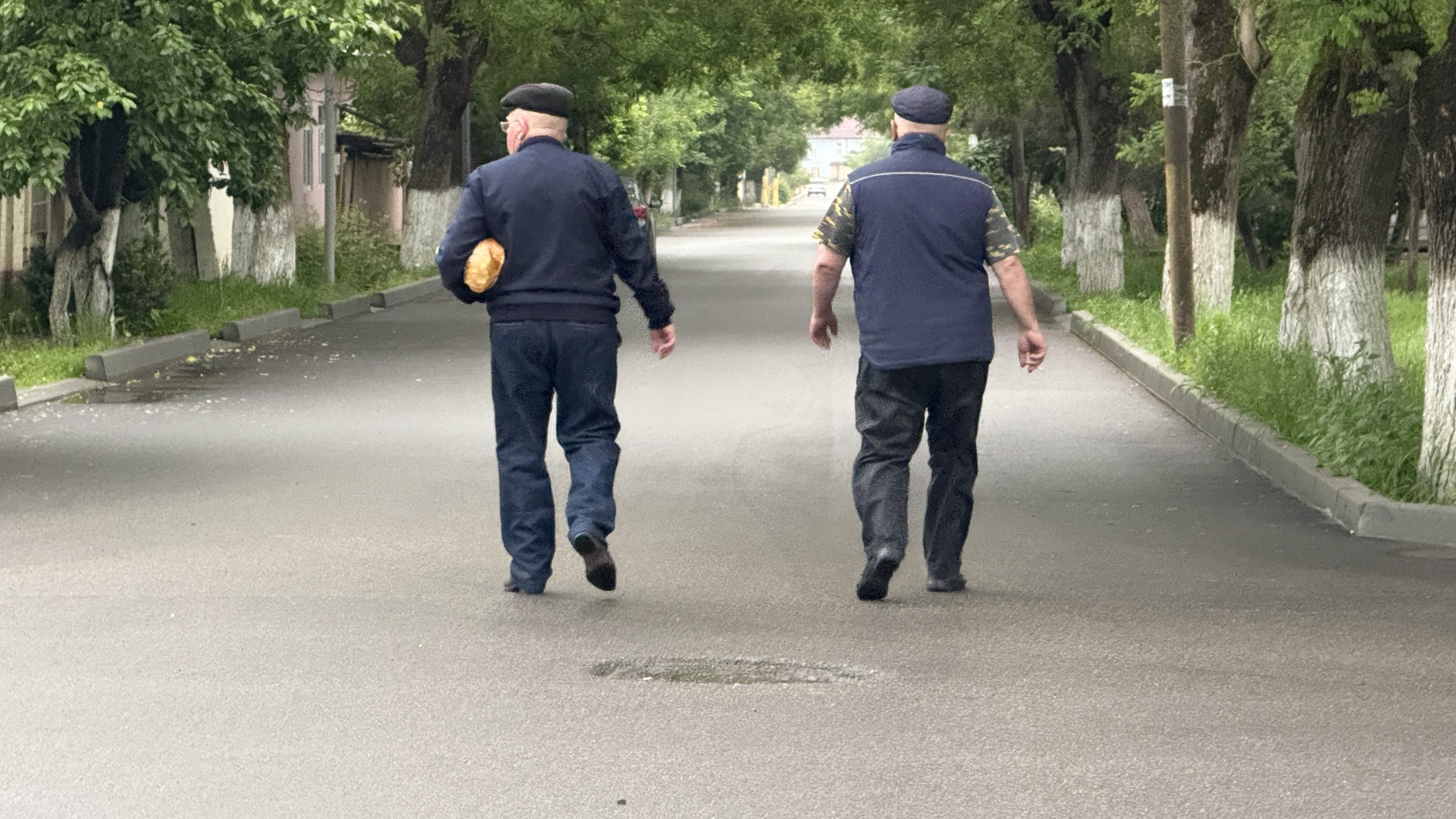
On my walk back to the hotel, I ended up behind two older men who had clearly just come from a local bakery—one carrying a fresh loaf of bread under his arm as they talked. For some reason, the image made me smile.
A small, everyday moment that made me smile on my walk back to the hotel.
Tomorrow, we head toward Gabala.
Day 5: Quba to Qabala
We left Quba this morning and began the long drive toward Shamakhi and Qabala, where we’d be spending the night. The route was scenic—rolling hills, shepherds guiding livestock along the roadside, and wide skies stretching between steppe and mountain.
To break up the drive, we stopped at a few places along the way—each with its own quiet kind of magic.
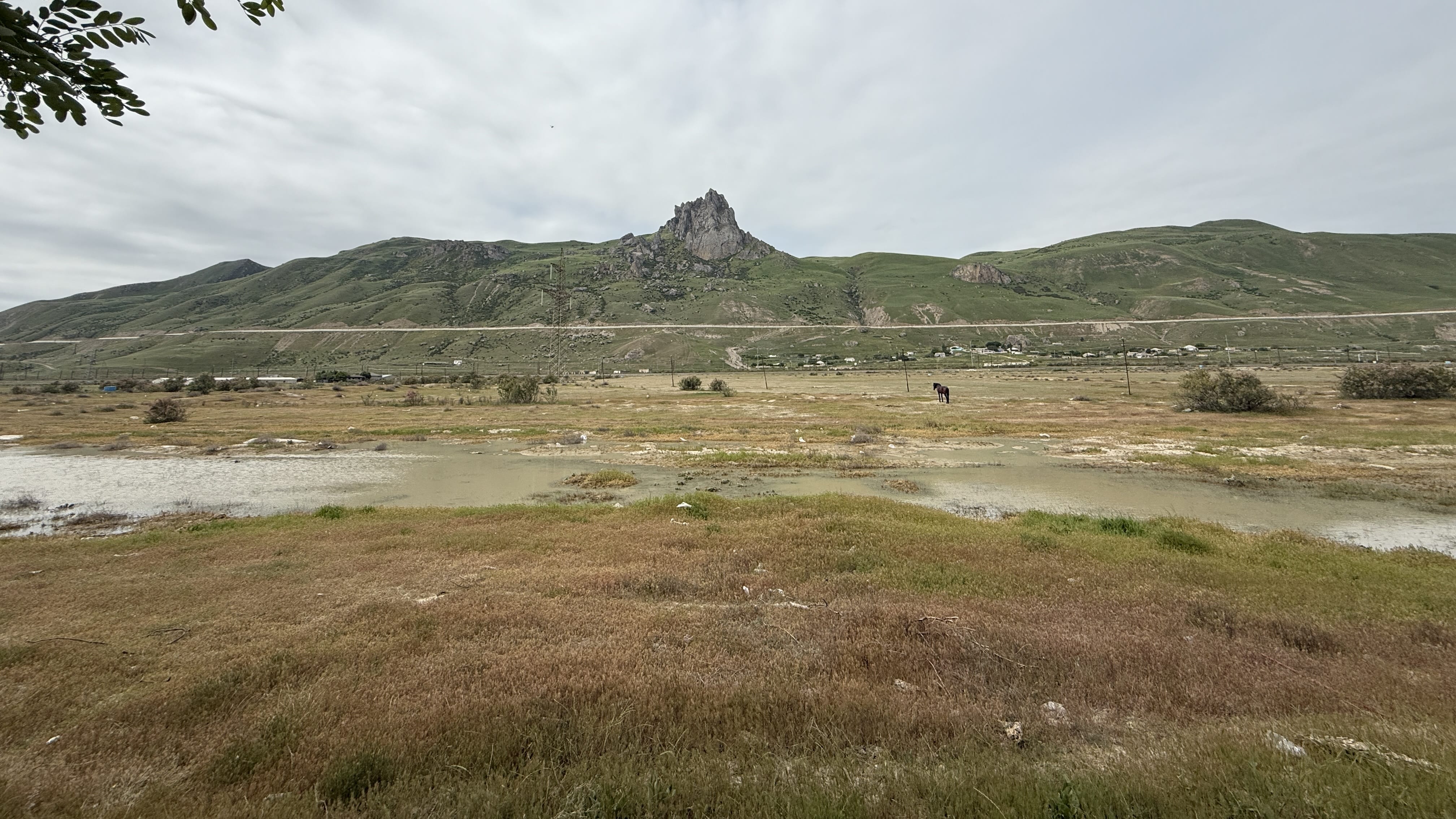
Driving from Baku to Quba with views of Besh Barmag —‘Five Finger Mountain'.
Diri Baba Mausoleum – Maraza
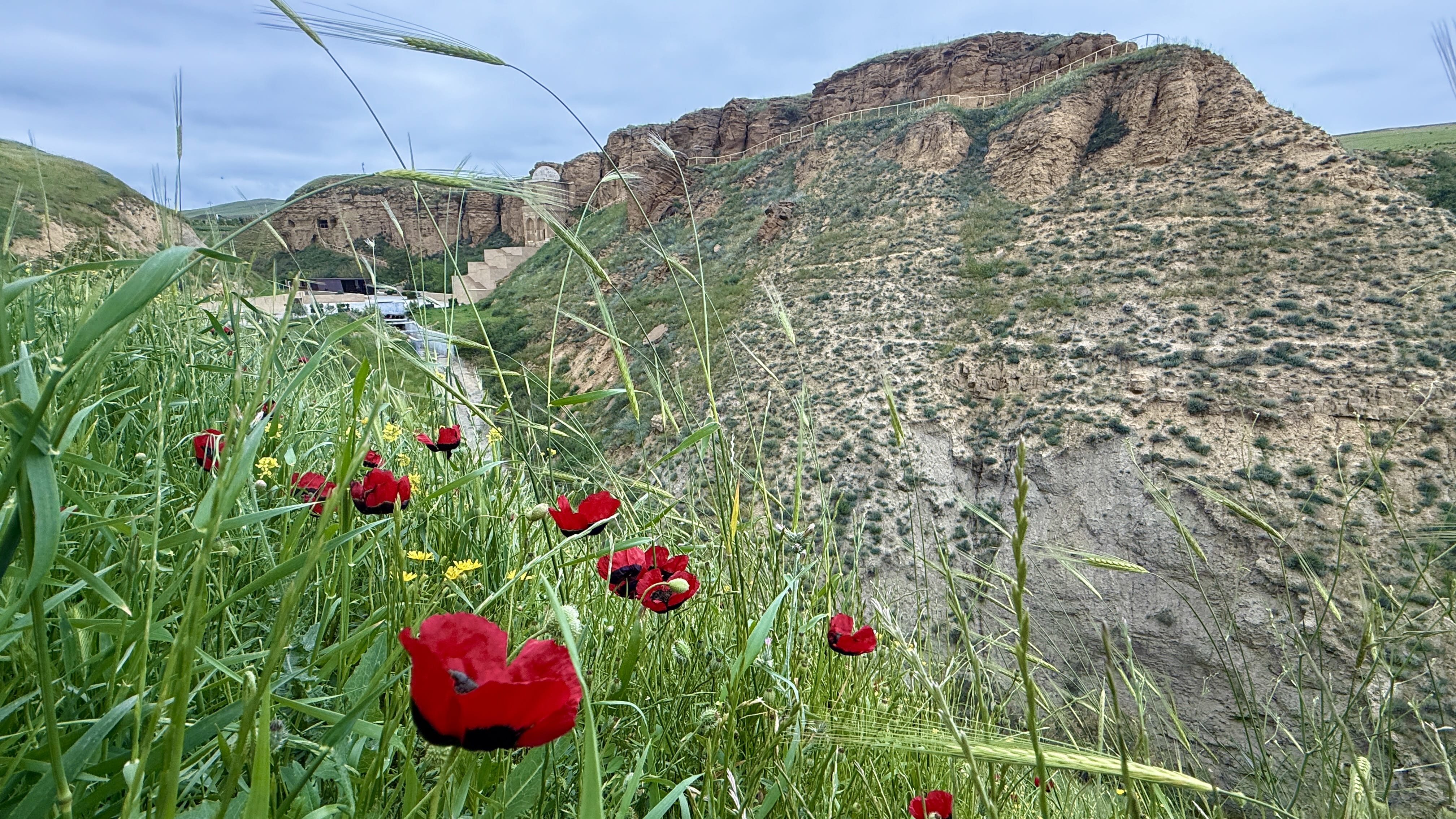
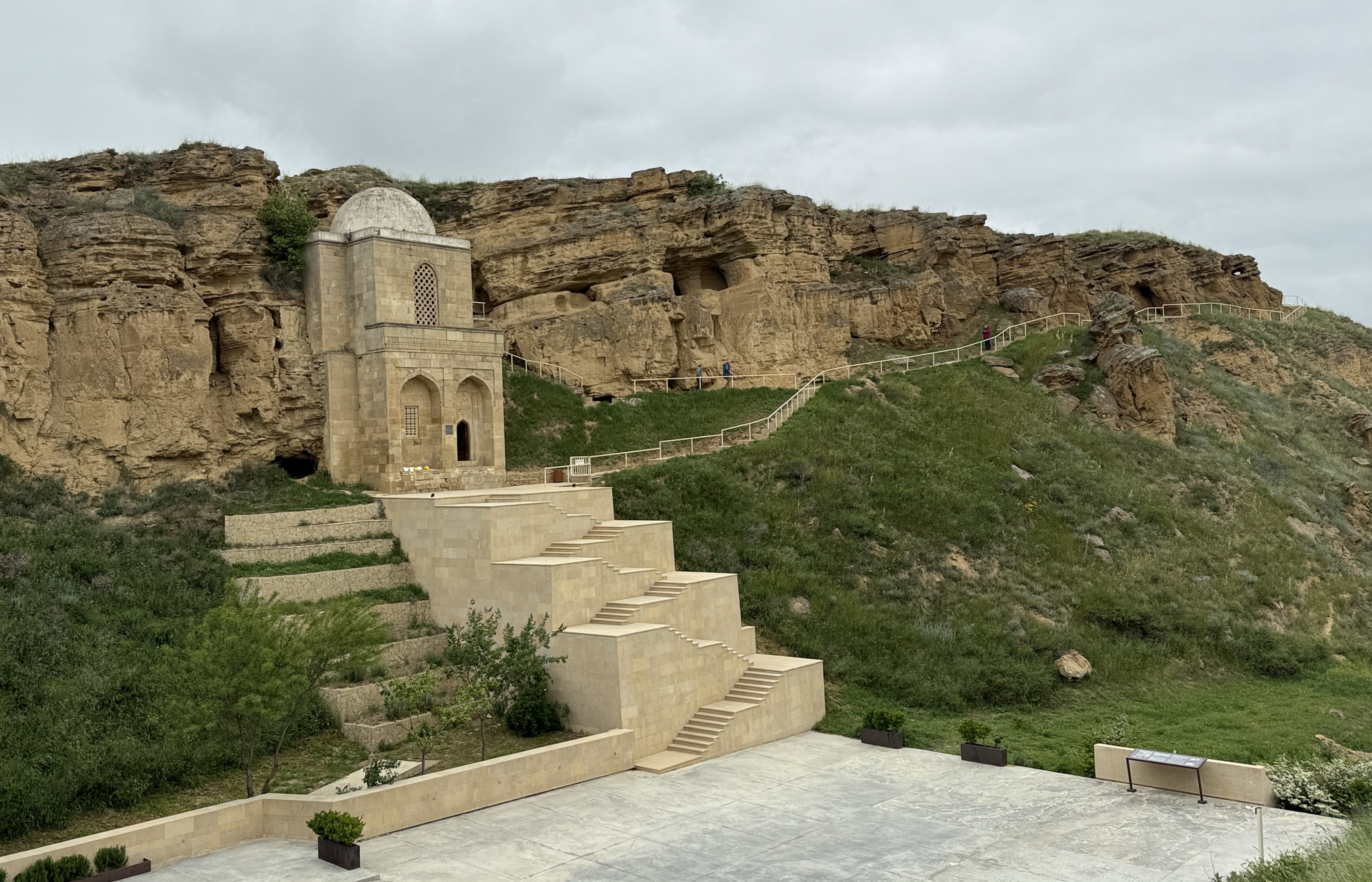
Our first stop was in Maraza (also spelled Meysəri), a small village perched on a ridge that felt like a natural pause between two landscapes. The main sight here is the 13th-century Diri Baba Mausoleum in Azerbaijan, built directly into the rocky cliff. In the drizzle, the grass and flowers looked extra bright against the stone. “Diri Baba” means “Living Father,” and legend says his body never decayed—turning the mausoleum into a pilgrimage site, especially for Sufi followers and anyone interested in historic sites in Azerbaijan.
Wild poppies and soft spring grass frame the cliffs around Diri Baba Mausoleum.
The structure has two levels: a prayer hall below and a tomb chamber above, reached by a staircase climbing the hillside. A pathway winds along the cliff with railings for safety, and here and there, shallow caves open up to explore. The cliff, the greenery, and the mausoleum all fold together into one striking setting. Even with a few tour groups passing through, it still felt quiet and apart.
Another view of Diri Baba Mausoleum.
Yeddi Gumbaz – The Seven Domes
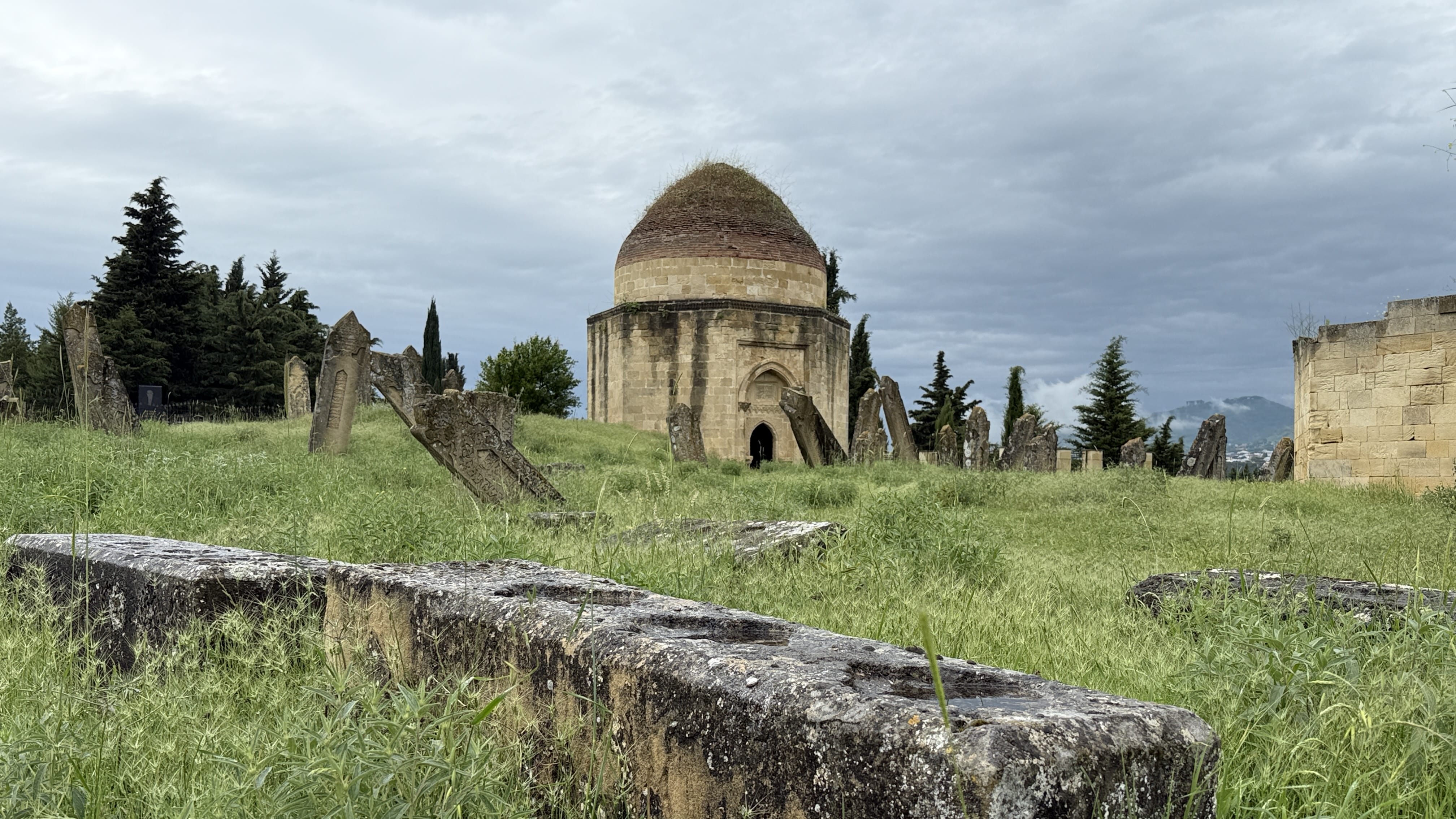
Just outside Shamakhi, we stopped at Yeddi Gumbaz, a mausoleum complex named for its once-seven domes—though only a few remain standing today. Inside the main dome, we found a cluster of tall, narrow gravestones. Some still held faint traces of painted decoration, remarkably intact after centuries, while others were carved with motifs and inscriptions, weathered by time.
Yeddi Gumbaz Mausoleum, resting place of the 18th-century Shirvan Khan rulers.
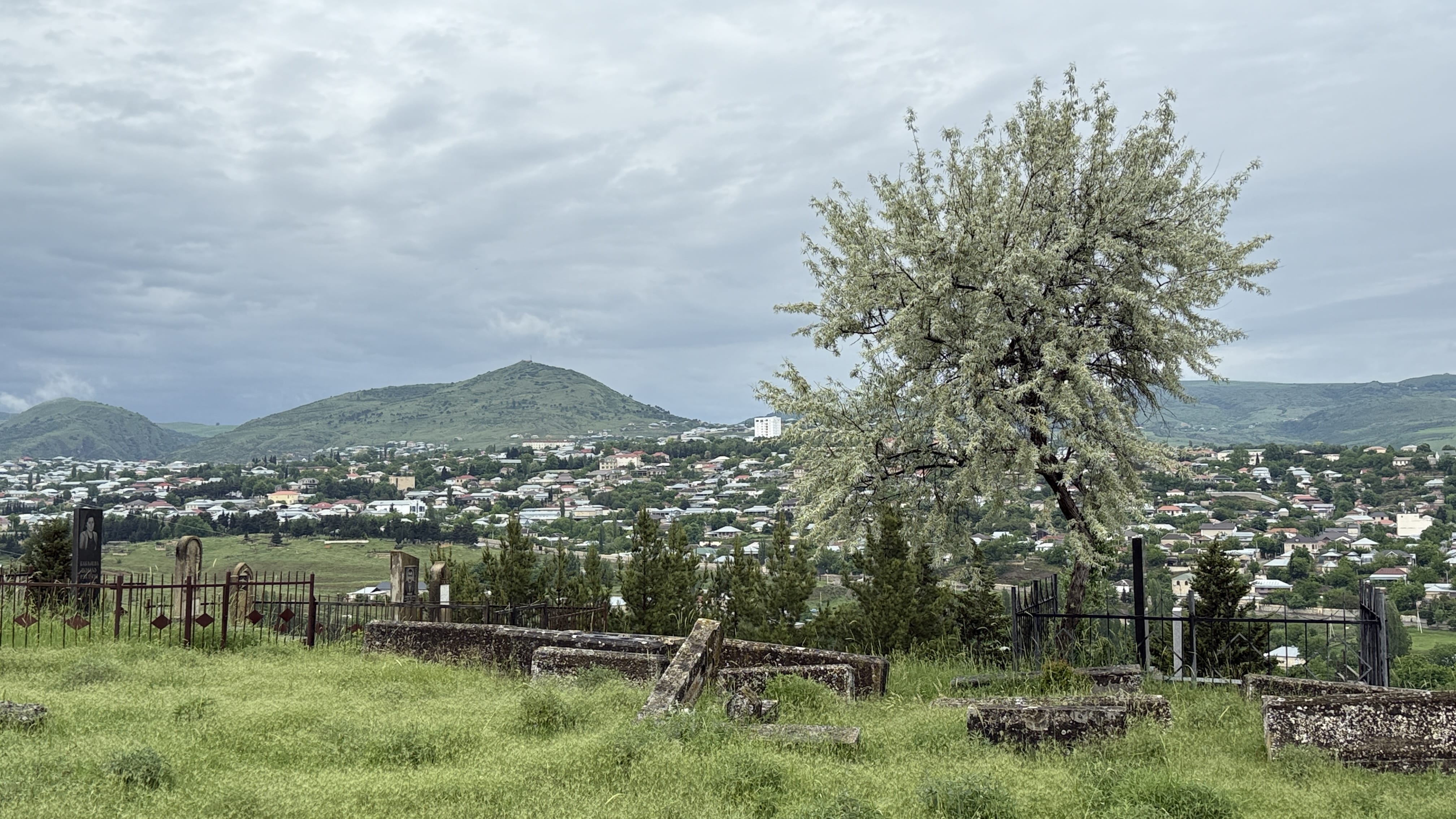
Below the domes, a small cemetery spread across the hillside, the stones scattered among grass and wildflowers. From here, the view stretched over valleys and farmland—another spot that felt timeless, quiet.
From the hilltop cemetery at Yeddi Gumbaz.
Juma Mosque – Shamakhi
Next, we visited Juma Mosque in Shamakhi, thought to be the oldest mosque in Azerbaijan. It has been damaged and rebuilt many times—by earthquakes, invasions, and age—but parts of the original structure still stand.
The Juma Mosque of Shamakhi — one of the oldest mosques in the Caucasus.
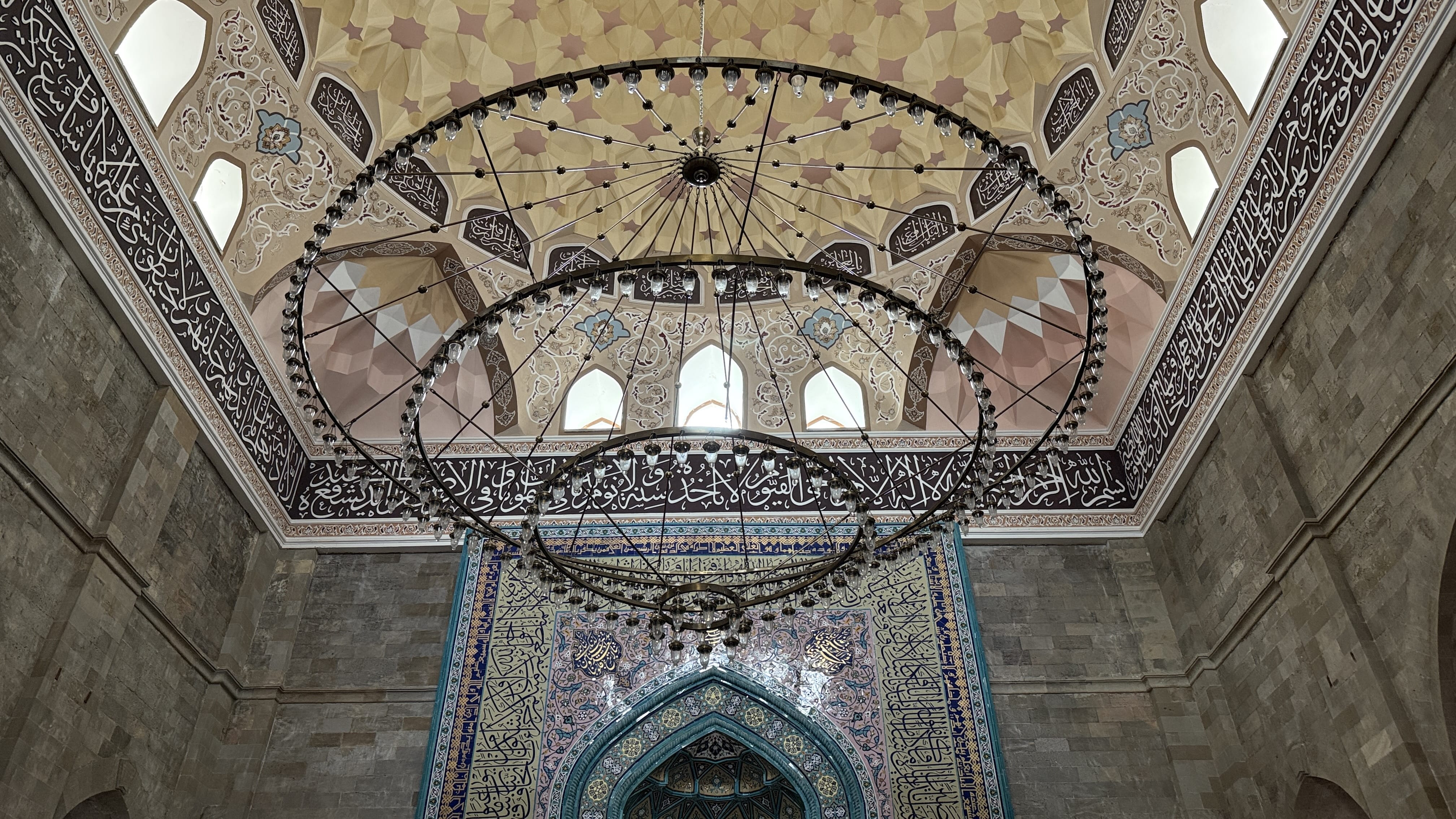
Outside, a few old metal spires from earlier domes are displayed. Our guide pointed out details of its early Islamic design: modest domes, open symmetry, simple lines. Inside, the prayer hall was quiet and airy.
The painted ceiling of Juma Mosque in Shamakhi.
Lahıc – A Village of Copper and Clouds
Our final stop before reaching Qabala was Lahıc, a mountain village known for its cobblestone streets, stone houses, and centuries-old copper craftsmanship. The road up was narrow and winding, with panoramic views and sheer drops to the canyons below.
Lahic — a mountain village known for its cobblestone lanes and copper workshops.
The village was misty and still when we arrived. We wandered through lanes lined with traditional homes and stepped into workshops where coppersmiths still hammer patterns by hand—just as their ancestors did. A few locals nodded as we passed.
A Lahic craftsman working in his tiny shop.
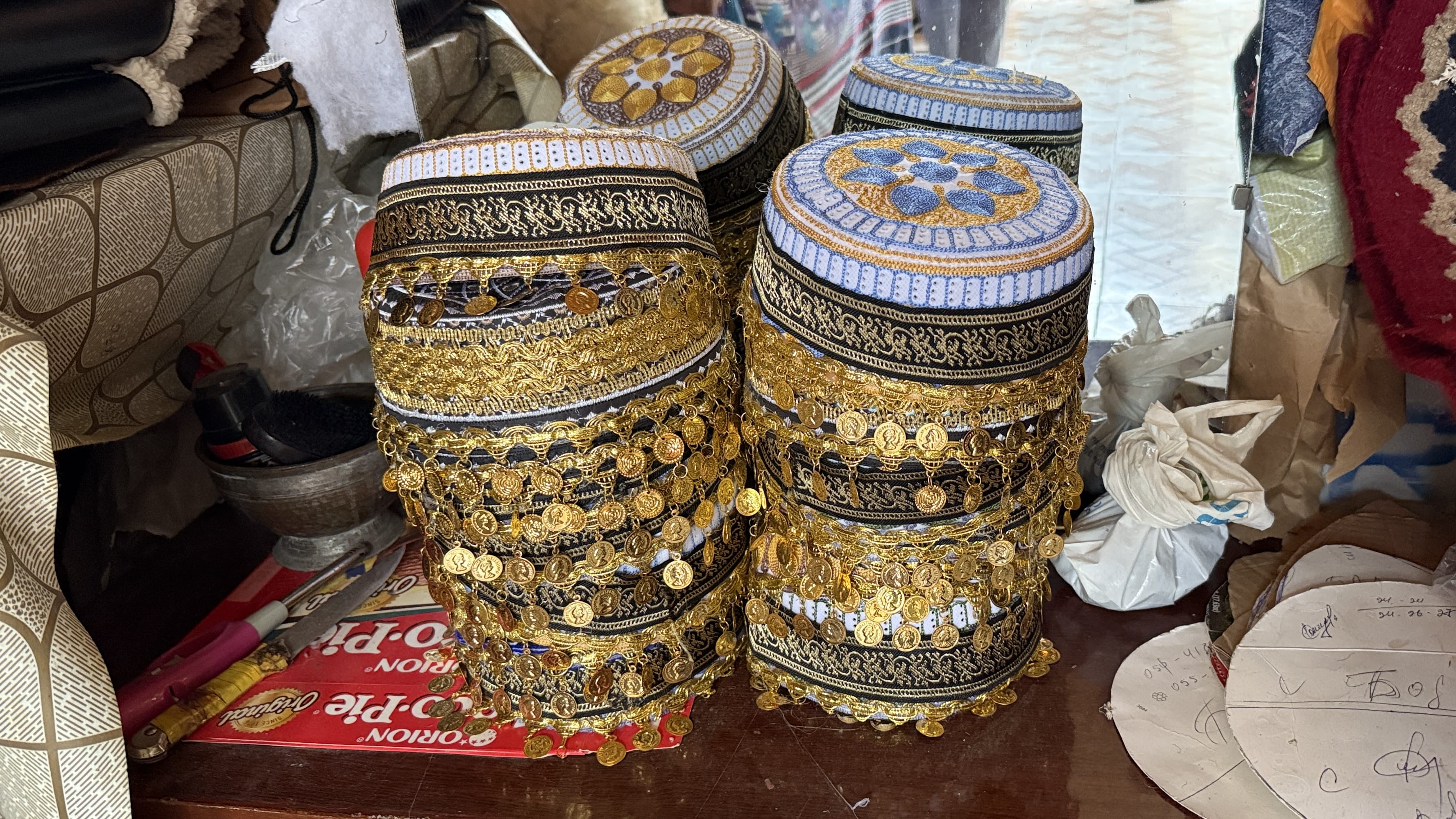
Along one lane, I noticed several Soviet-era cars parked in a row—a reminder of another layer of history. Small shops sold hand-knit mittens and “sheep hats,” copper plates with intricate designs, old tools, brass bells, and embroidered textiles. By this point in the trip, my group and I had also developed a taste for churchkhela—strings of walnuts dipped in thickened grape juice and dried into chewy sweets that look like colorful candles hanging in rows—so a bunch of us bought some to take home.
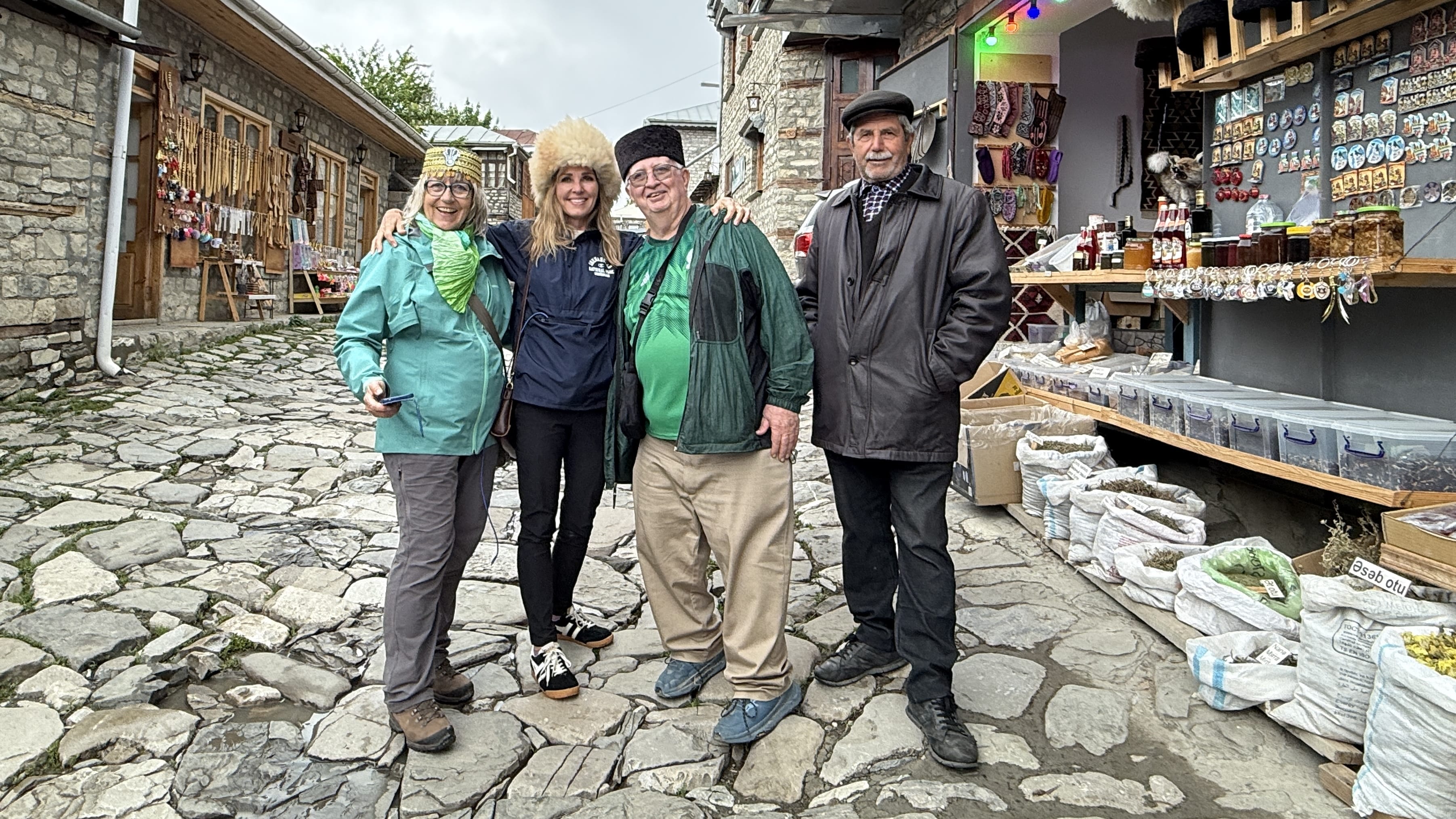
Truthfully, I knew my churchkhela would never make it that far. I also bought a wool hat, which I ended up wearing the second we stepped back outside—it was colder than I’d expected. That’s when one of my fellow travelers looked over and laughed, saying I looked like Laura from Dr. Zhivago.
My fellow travelers and me in our newly purchased hats posing wiht the shop owner.
There’s something about Lahıc that feels like it’s moving at its own rhythm.
After lingering in the village for a while, we headed to Asgard Restaurant for dinner before continuing on to our night’s stay at the Gabala Garden Hotel.
Day 6: Lahıc to Sheki
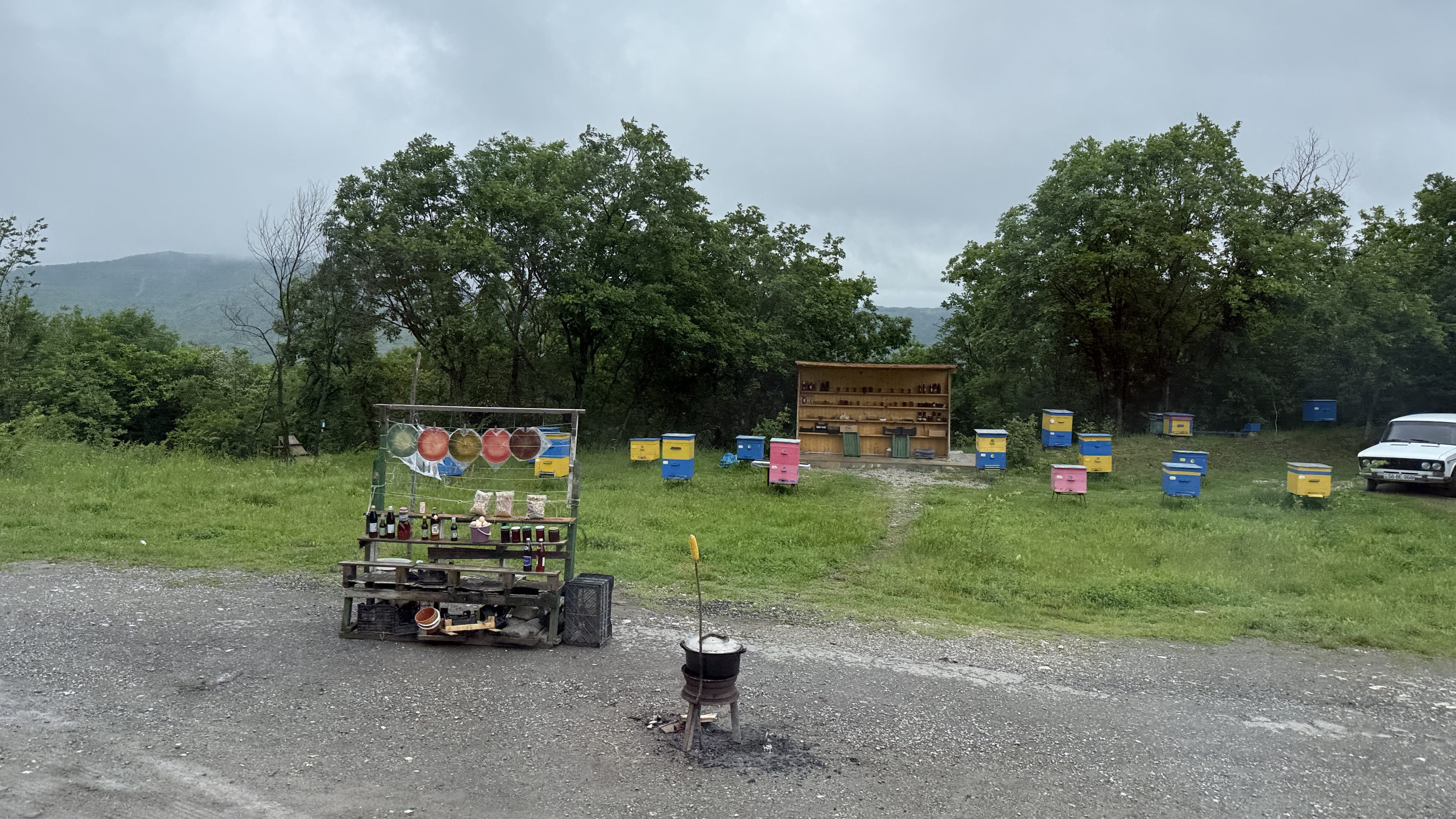
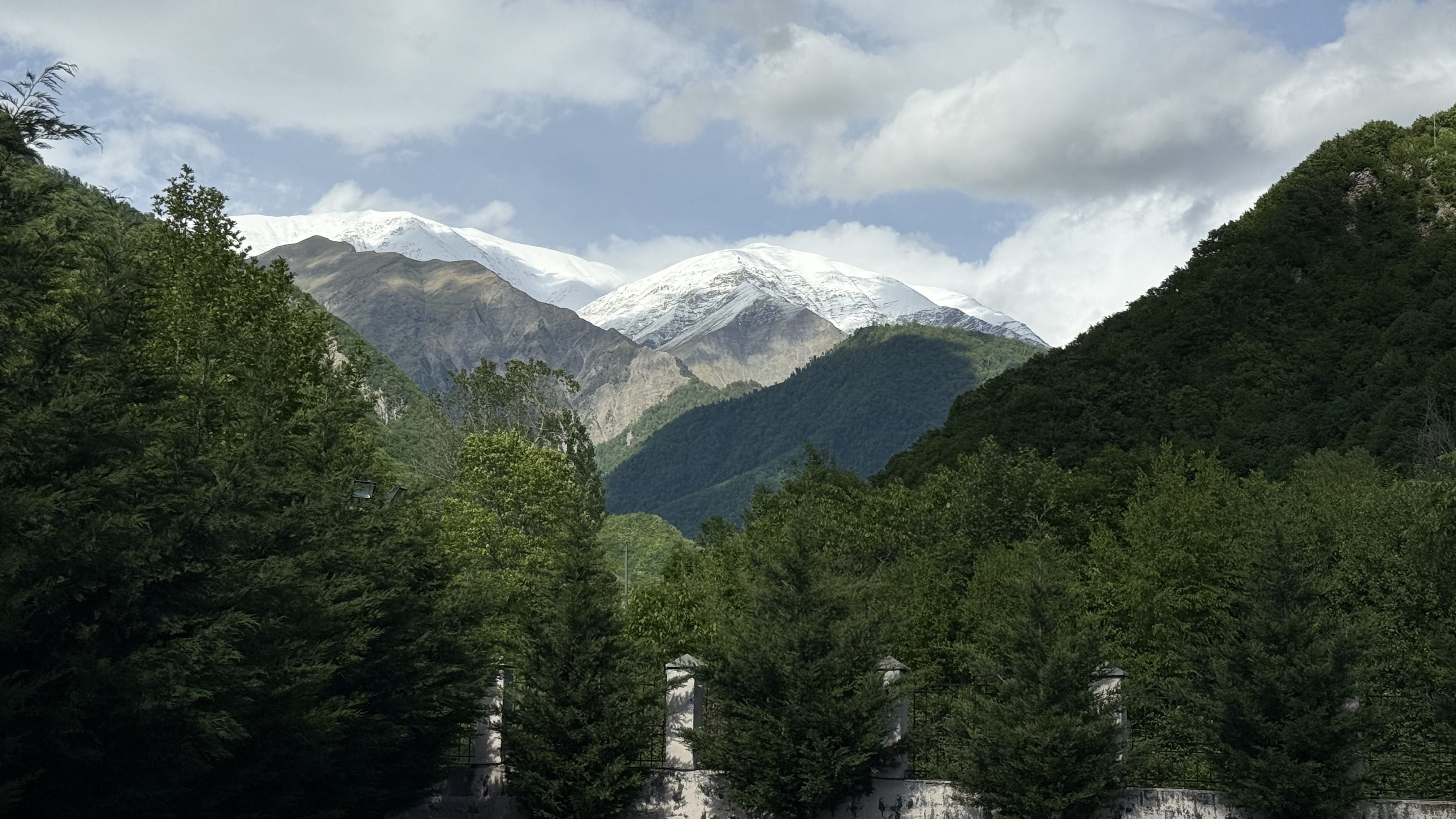
The next morning we enjoyed a huge assortment of items at Gabala Gardens’ breakfast buffet before setting out. We left Lahıc and drove west toward Sheki—about three and a half hours of winding mountain roads and wide green valleys. The scenery was some of the best I’d seen so far: sheep grazing in pastures, cows casually standing in the road, snowy peaks in the distance, and makeshift stands selling dried fruit and jars of honey along the way. At times, it felt like one long, slow-moving postcard.
A little roadside honey stand we passed on the way to Sheki.
Along the way, our guide pointed out the many newly planted trees—part of a national initiative to green the landscape. You could see it taking root everywhere. We passed village after village where men gathered on benches or outside shops. You rarely saw women. Like parts of Albania and other places I’ve traveled, public space here still seems to belong largely to men.
Palace of the Sheki Khans
Our first stop was the Palace of the Sheki Khans, built in the late 1700s as a summer residence for the ruling family. It was stunning. The façade is painted in fresco patterns and decorated with raised plasterwork—flowers, vines, even peacocks—in soft reds, greens, blues, and black. Just under the eaves is a band of colorful geometric designs.
The stunning façade of Shaki Palace.
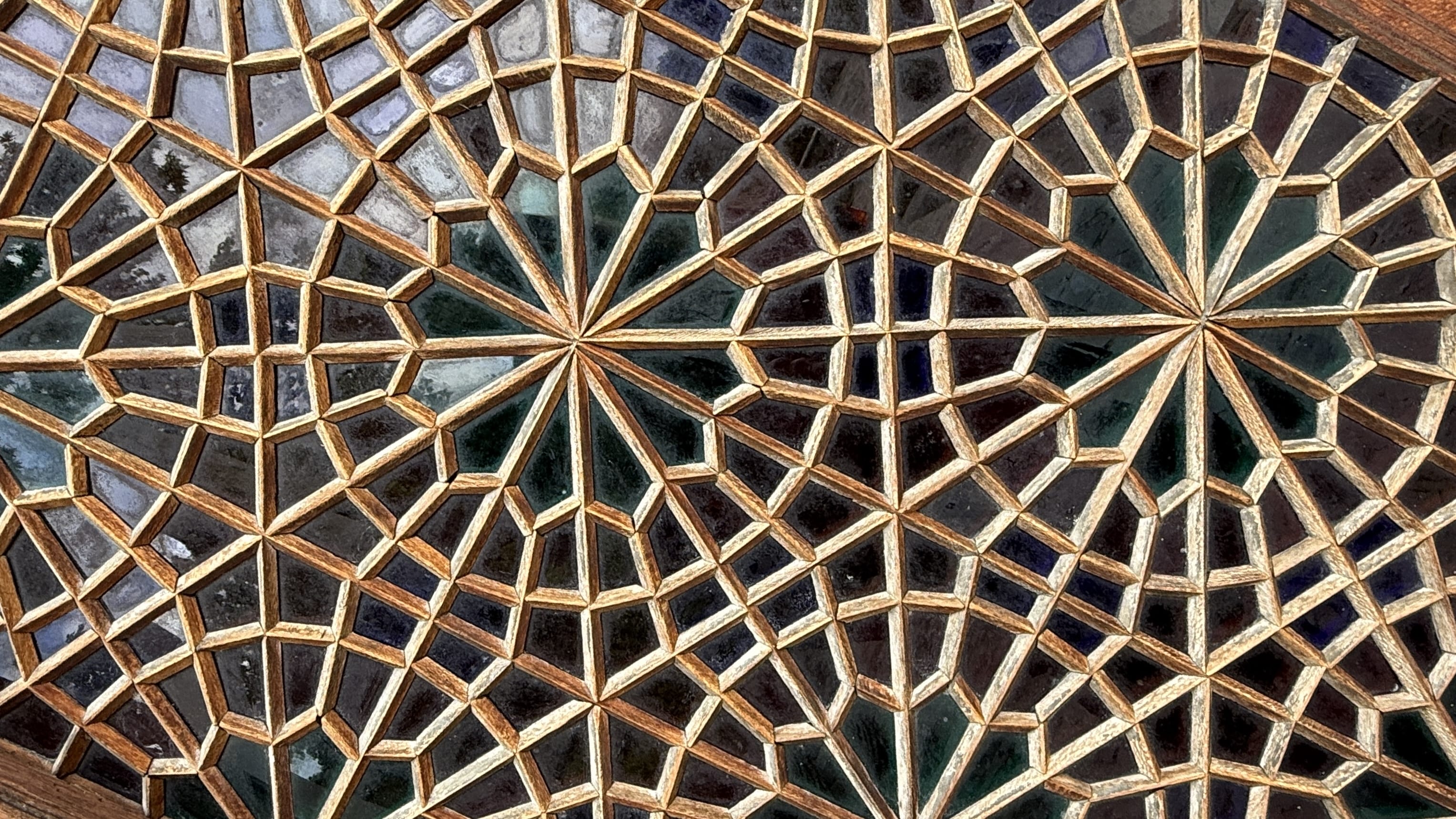
The windows are the real showpiece: massive wall-sized panels of shebeke, stained glass fitted into carved wood without glue or nails—just hundreds of tiny pieces locked together. Inside, the light through the glass changes everything. The colors are rich and bold, and the same patterns repeat in the ceilings, carpets, and even the room layout. Photos weren’t allowed inside, which was a shame, because it was unforgettable.
The shebeke windows at Shaki Palace are even more beautiful up close—layers of tiny wooden pieces fitted together without a single nail.
A close-up of shebeke—Sheki’s signature stained glasswork
In the garden outside, a line of tall cypress trees stood along the wall. Cypress trees here are a symbol of endurance and eternity—making their presence feel intentional.
Shebeke Workshop & Old Fortress Walls
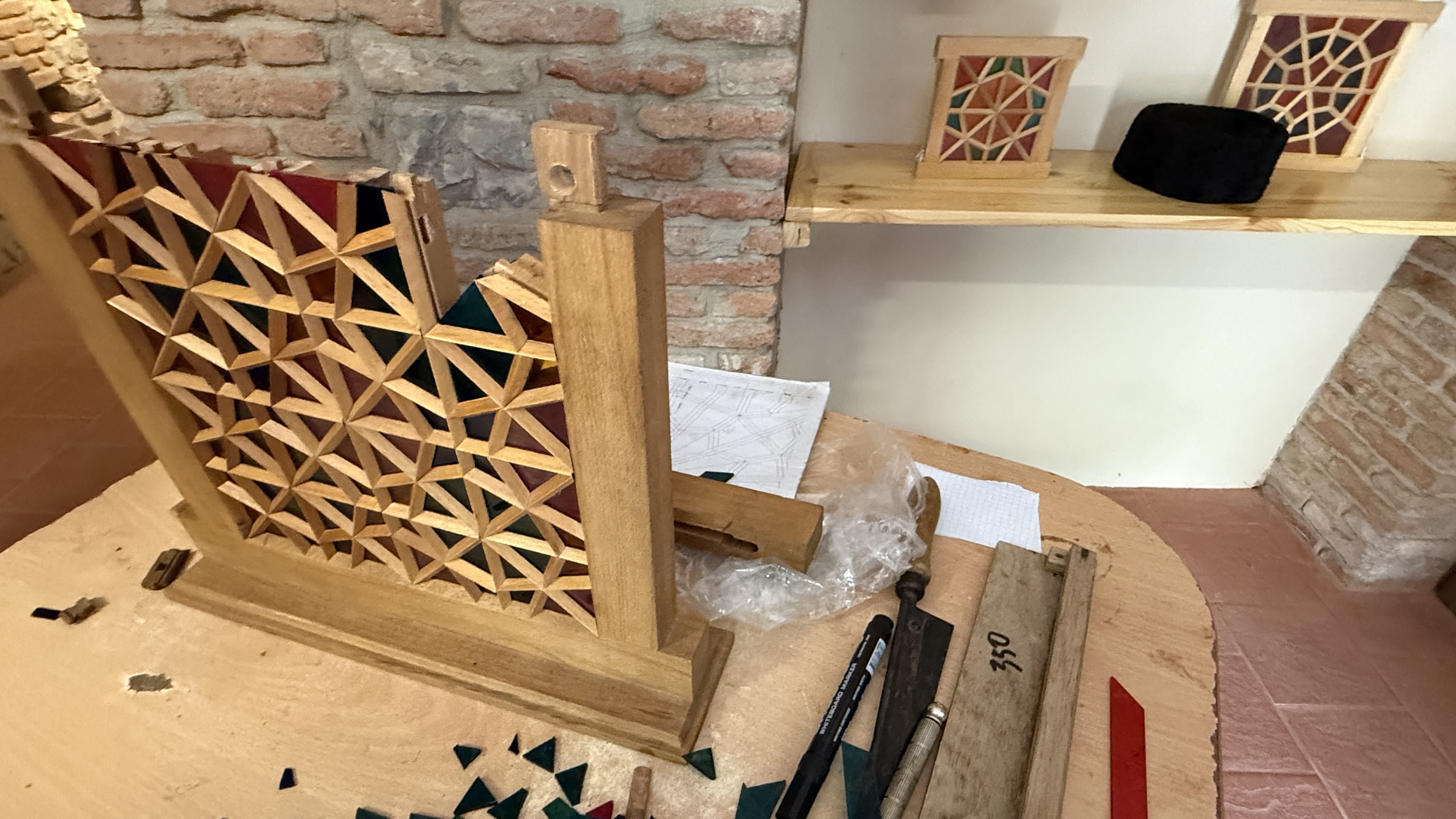
From the palace, we walked over to a shebeke workshop, where a fourth-generation craftsman still builds these designs the traditional way. No nails. No adhesives. Just experience and patience. Watching him work felt almost meditative. They even had a couple of sample pieces we could try ourselves, which gave me a new appreciation for how precise the cuts have to be. It really is ingenious.
Shebeke workshop, where artisans still make these tiny stained-glass panels the same way they did centuries ago.
We also visited the Shekikhanovs’ House (sometimes called Shakikhanov Palace). The name can be confusing, but this was a separate residence built around the same time as the Khan’s Palace, just on a smaller scale. It shares many of the same features—painted ceilings, carved woodwork, and stained glass—but in a more intimate setting. No photos were allowed inside, but it was worth seeing to compare the two: the Khan’s Palace full of color and light, and the Shekikhanovs’ House a quieter example of the same style.
Courtyard at Shekikhanovs’ House.
Then we explored the Sheki Caravanserai, a massive stone inn used by Silk Road traders. It’s built around a wide open courtyard, with arched rooms on both levels. Part of it is now a hotel; the rest houses shops selling crafts, honey, and sweets. I wandered to the far end and found a tiny, unmarked post office selling weathered old postcards and stamps—the only ones I’d seen all trip, and I wasn’t about to pass them up.
The old caravanserai in Sheki.
Kish: A Church on a Hill, a Soviet Car, and a Surprise Kiss
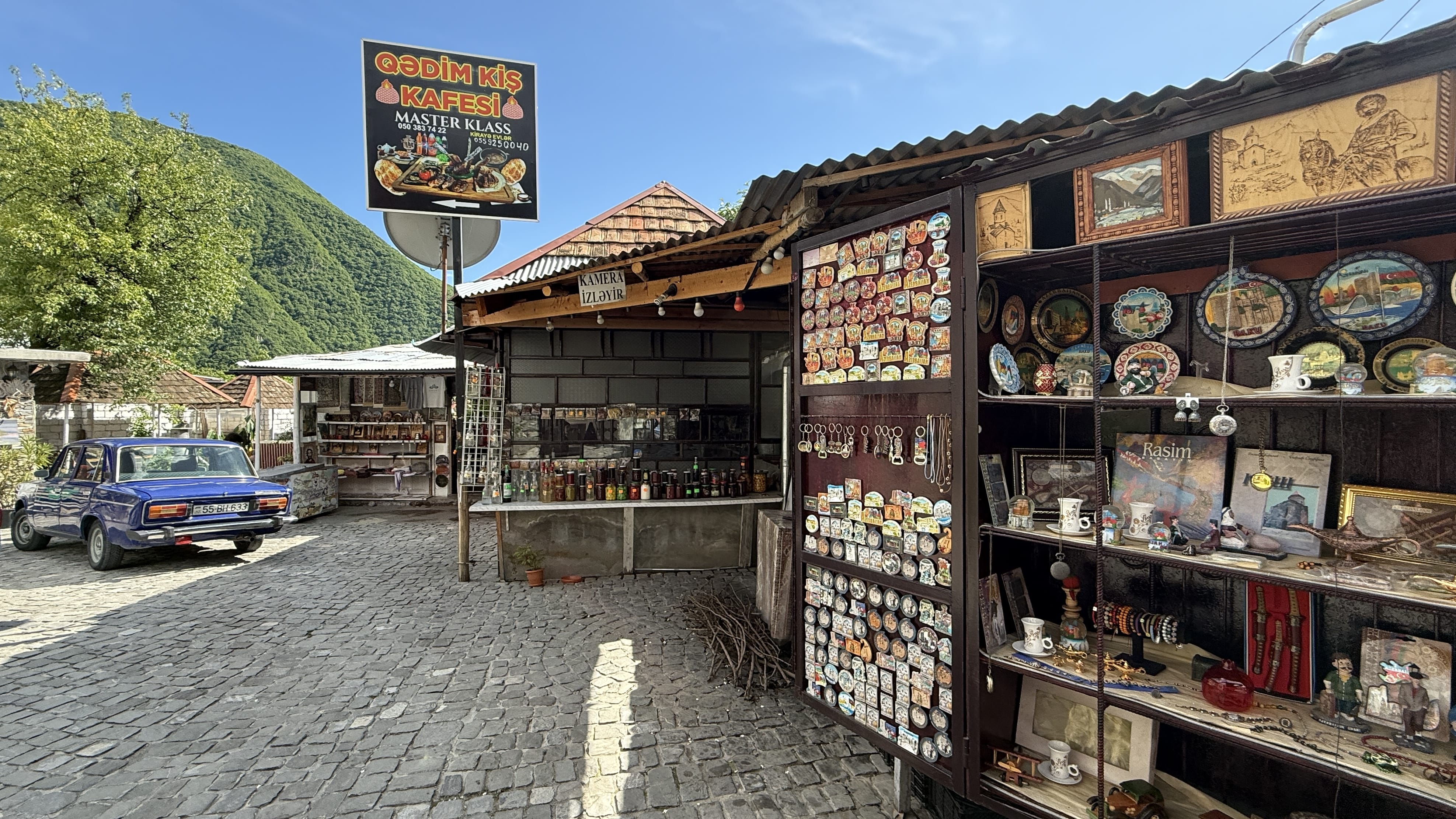
One of the drivers, Elvin mentioned, was a woman driving a beautifully restored seafoam-green Soviet-era Lada. And of course I got into her car—the badass behind the wheel. She handled the road like a pro: fast, smooth, completely in control.
We parked at a little café near the church and were immediately offered vodka. I was the only one who didn’t say no. I mean—vodka, in a mountain village? Yes, please. It was strong, sharp, and exactly right for the moment.
The little restaurant/bar at the top of the hill in Kish — with a few souvenir stands wrapped around it.
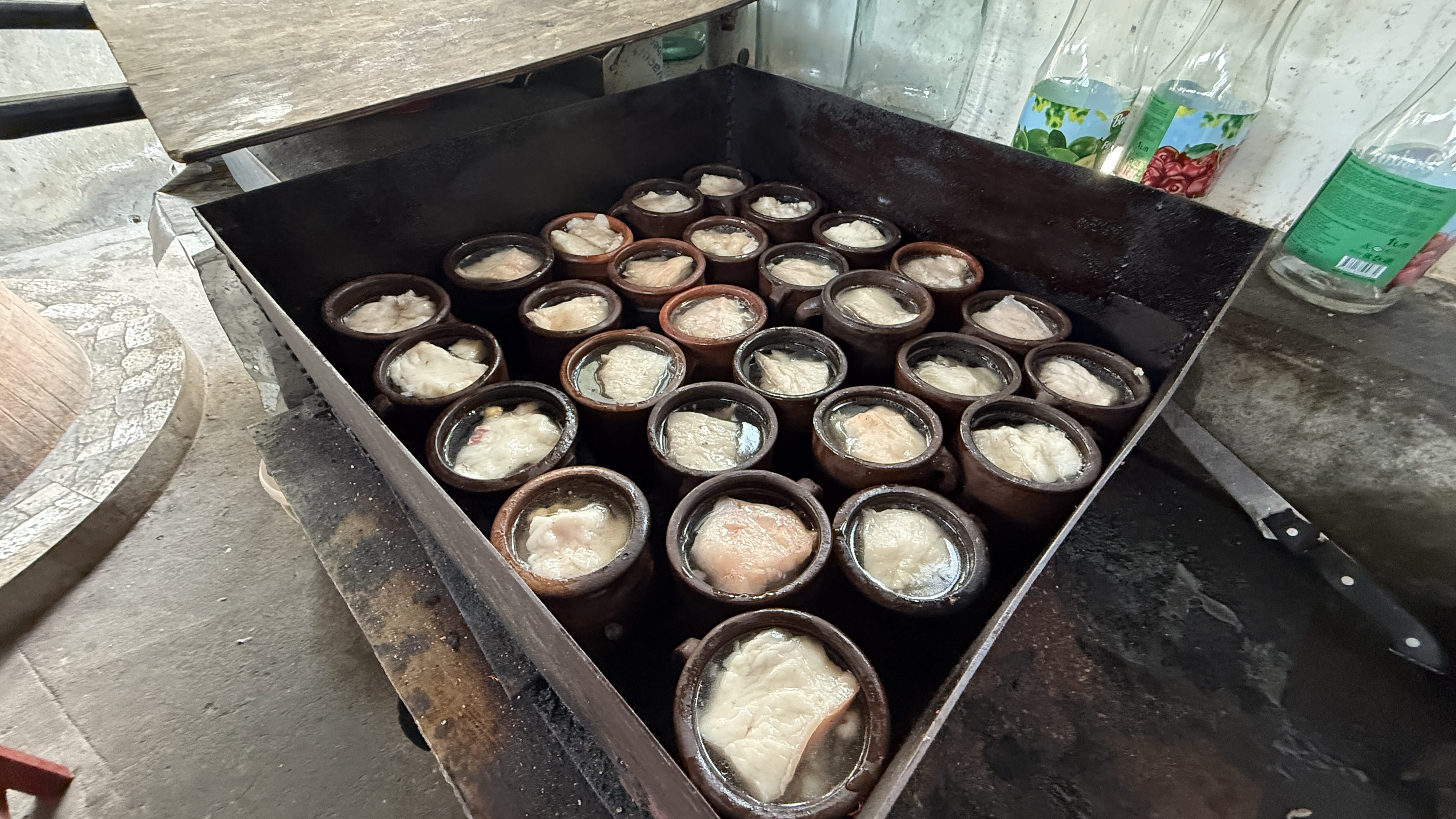
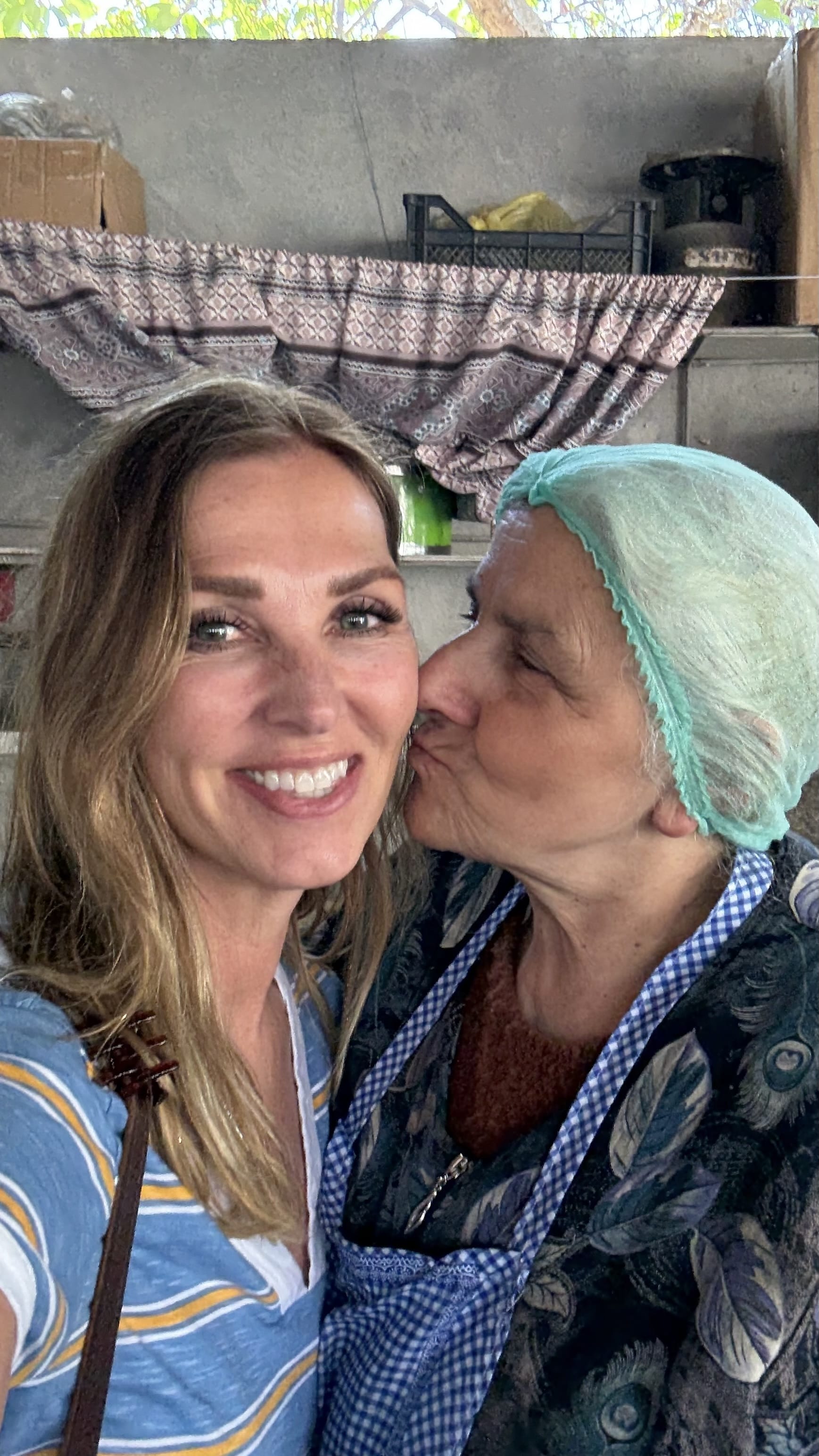
Inside, two women were cooking something that smelled amazing—I later learned it waspiti, a slow-cooked lamb-and-chickpea stew that’s popular in this region.
I asked one of women—gesturing awkwardly—if I could take a selfie with her. She smiled, nodded, and as I snapped the photo, she leaned in and kissed me on the cheek.
Traditional piti simmering in clay pots — a classic dish of Sheki.
Behind the scenes in the café kitchen — busy, warm, and wonderfully chaotic.
The Albanian Church of Kish
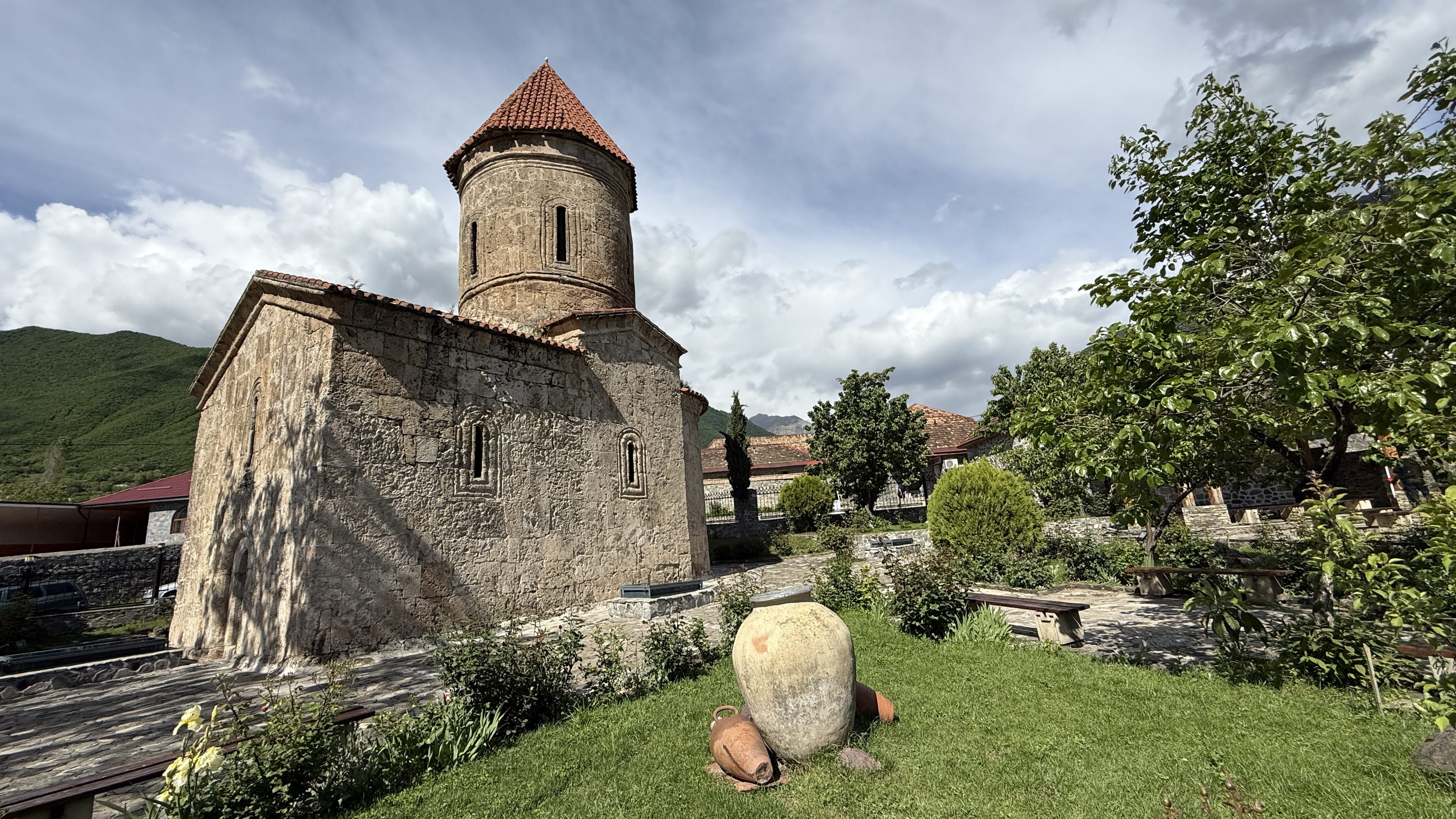
The Church of Kish is small and simple—stone walls, a red-tiled roof, and a quiet, humble interior. Inside is a glass-covered crypt holding human remains unearthed during excavations. The building dates to the 12th century, though its foundations may go back much further—possibly to Caucasian Albania (not the modern country, for the record).
The Albanian Church of Kish
On the wall, a list of visitor rules caught my eye—no loud voices, no climbing, no flash photography. They felt a little strict against the calm of the space, but also like a reminder of how layered and long the church’s history is. Nearby was an even older set of rules: 21 church laws from the year 488, adopted at the Council of Aluen.
Church laws from AD 488 displayed inside the Church of Kish.
Some of them were surprisingly harsh (and a little absurd): fines for anyone who shared a meal with a thief, a ban on arguing without a bishop’s judgment, and even a rule requiring people to hand over their tribute horse personally to the clergy, fully saddled and bridled.
Others bordered on bizarre: a murderer had to be judged by the bishop himself, confession wasn’t optional if you were accused of theft, and nobles had to pay two tithes—half to the main church, half to their local one. My favorite, though, might be the one advising priests to flee if threatened by their congregation—proof that even fifteen centuries ago, church politics could get messy.
The setting was perfect—at the edge of the village, with the Caucasus Mountains rising in the distance.
Sheki Impressions
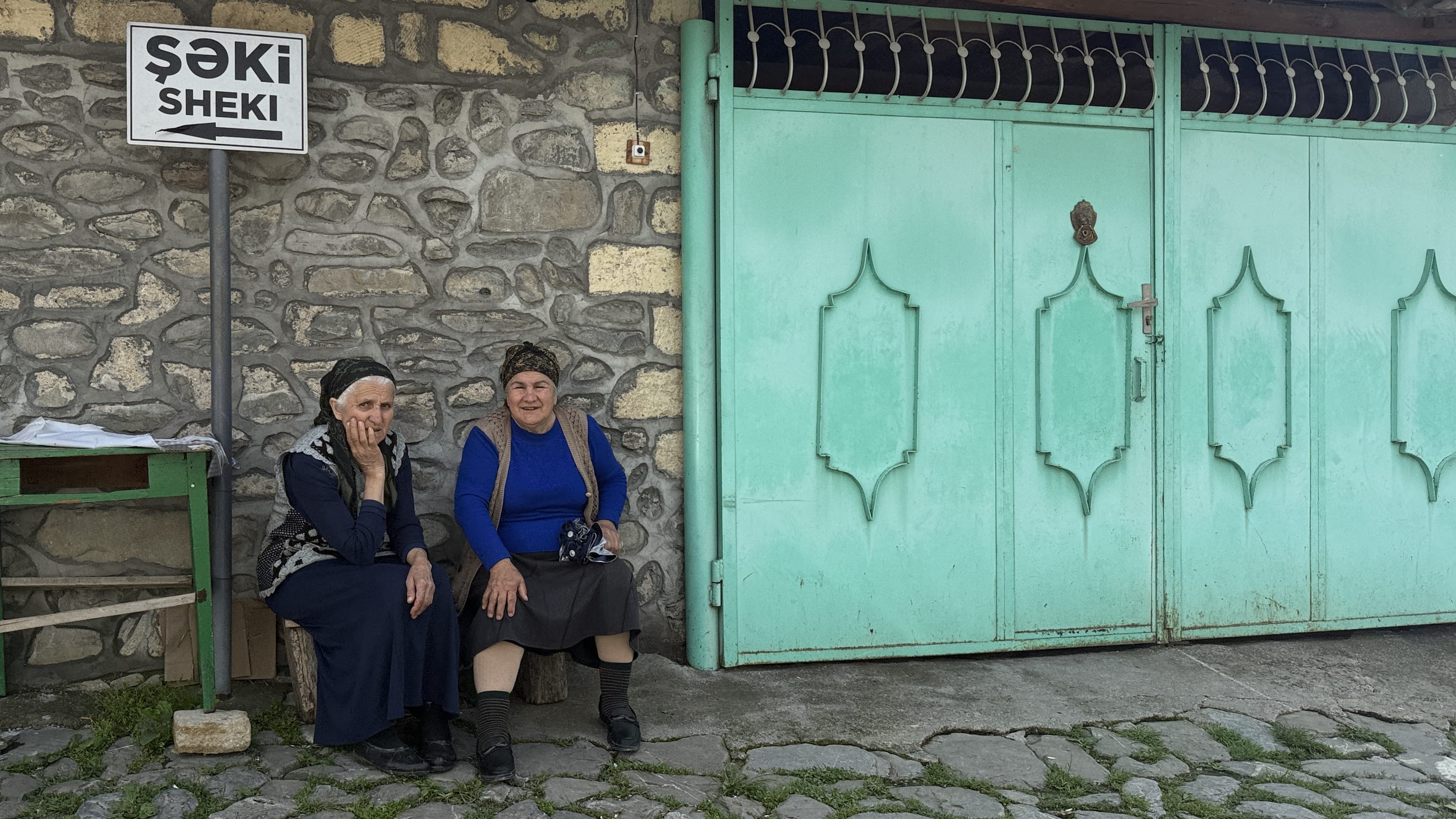
These faces needed to be captured on our way to Sheki.
Sheki is one of Azerbaijan’s cultural and historical centers—and it shows. The people were friendly, the food hearty, and the town had an easy, everyday rhythm to it. It felt like a place where life moves at its own pace.
We checked into the Sheki Palace Hotel in the late afternoon, and while the view of the snowcapped mountains was spectacular, the location was—inconvenient. The hotel sits pretty far from town, which meant dinner had to be at the on-site restaurant. It wasn’t terrible, just forgettable.
What I struggle with in group travel is being brought somewhere with no real choices, especially when choices do exist. And honestly, I should have found my own transportation back to Kish for dinner—that part is on me. We were also told not to walk outside the hotel because of the stray dogs, which only reinforced that stuck feeling. I let the convenience of the group schedule dictate the night, and it ended up being a missed chance for something more local and interesting.
The view from the hotel parking lot.
I spent the evening flipping through my photos, still smiling about Kish. A church, a Soviet car, a shot of vodka, and a kiss on the cheek. Quite a combination.
Looking Ahead: Georgia Bound
Tomorrow we’d be saying goodbye to Azerbaijan and crossing the border into Georgia—the start of Week 2. I wasn’t quite ready to leave. From misty mountain villages to stained-glass palaces, my 7 Days in Azerbaijan had given me more than I expected—kindness in unexpected places, quiet moments in ancient towns, and stories I’ll still be telling long after the journey ended.
Day 7 Saying goodye to Azerbaijian
👉 If you’d like to follow the rest of this adventure, read my next post: 7 Days in Georgia: Mountains, Monasteries & More (coming soon)
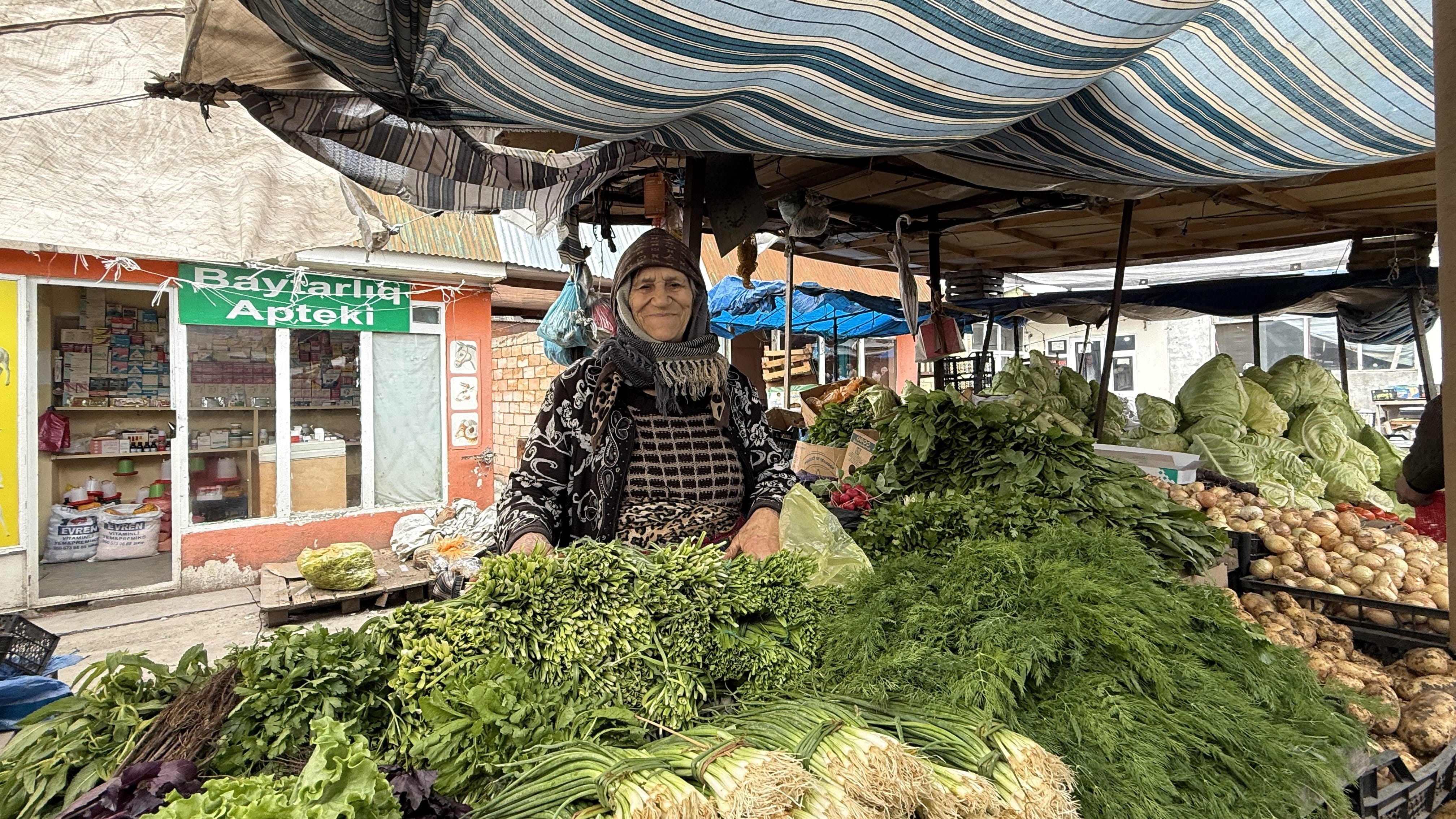
After breakfast we headed toward the Georgia border, but not before stopping at Taza Bazar, the main market in Sheki, Azerbaijan. Beneath a patchwork of tarps and corrugated roofs, bundles of vine leaves sat next to trays of Sheki halva, and crates of bright red and yellow cherries overflowed onto the tables. It was the kind of lively, everyday scene you find in a true Sheki market.
Scenes from the Sheki market — the freshest herbs you can imagine.”
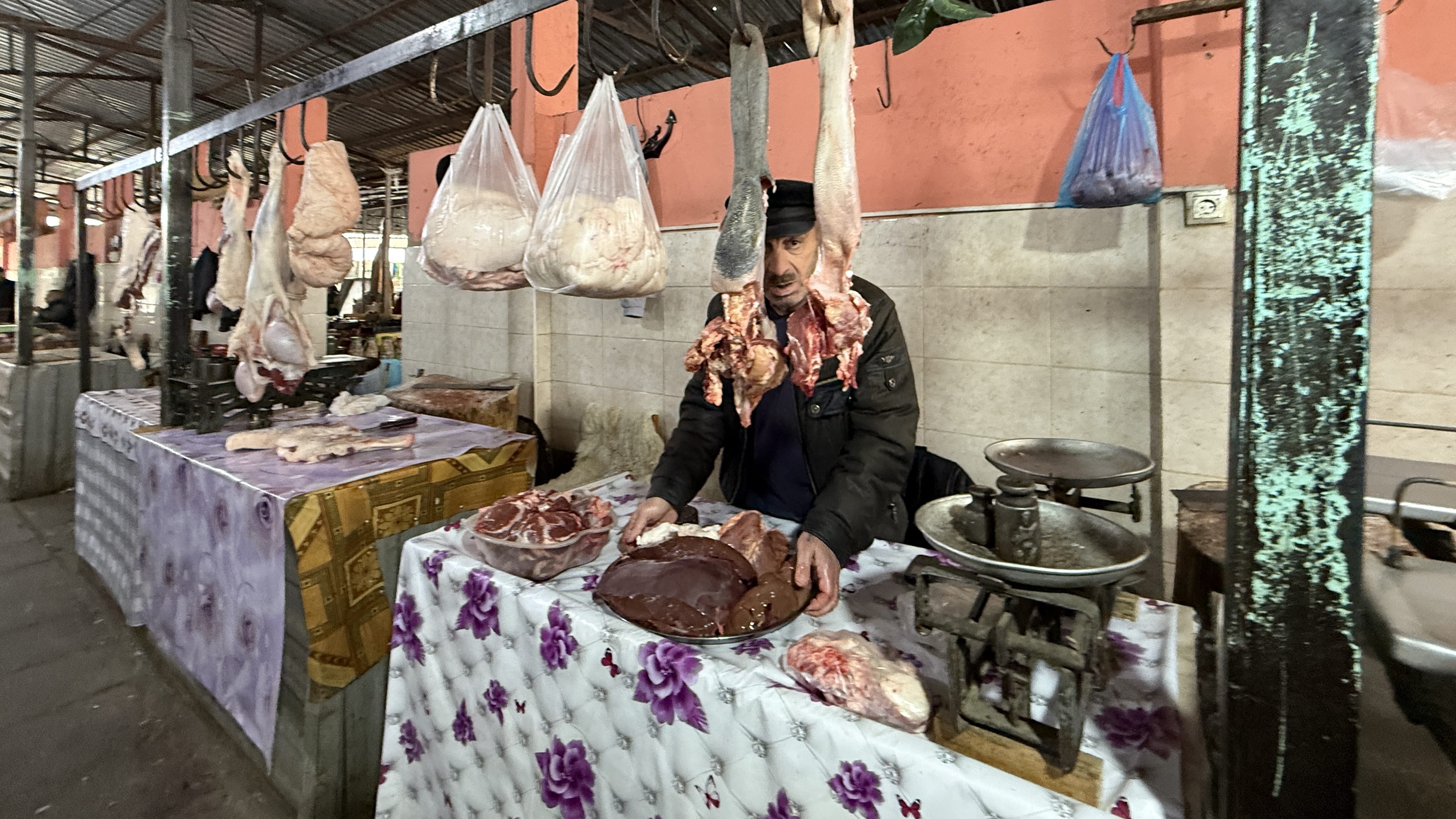
A quick glimpse inside the meat hall at the Sheki market.
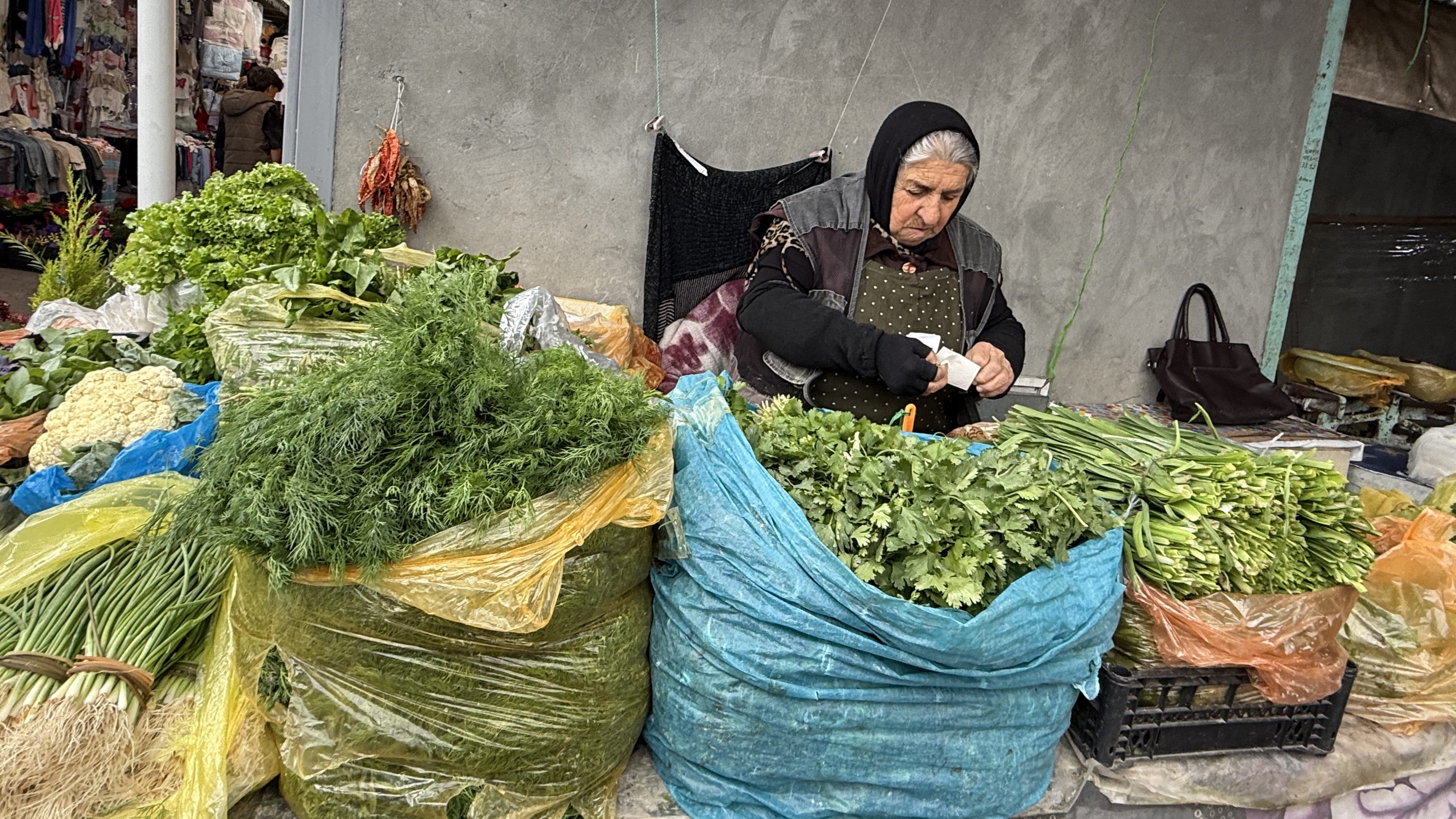
It was a blast to wander the market — it was a little of everything, and you truly get a snapshot of local life. We passed stalls stacked with herbs, cucumbers, and bundles of grape leaves, boxes of chirping ducklings, and trays of bright spices and dried fruit (a few of us couldn’t resist loading up on those for the road).
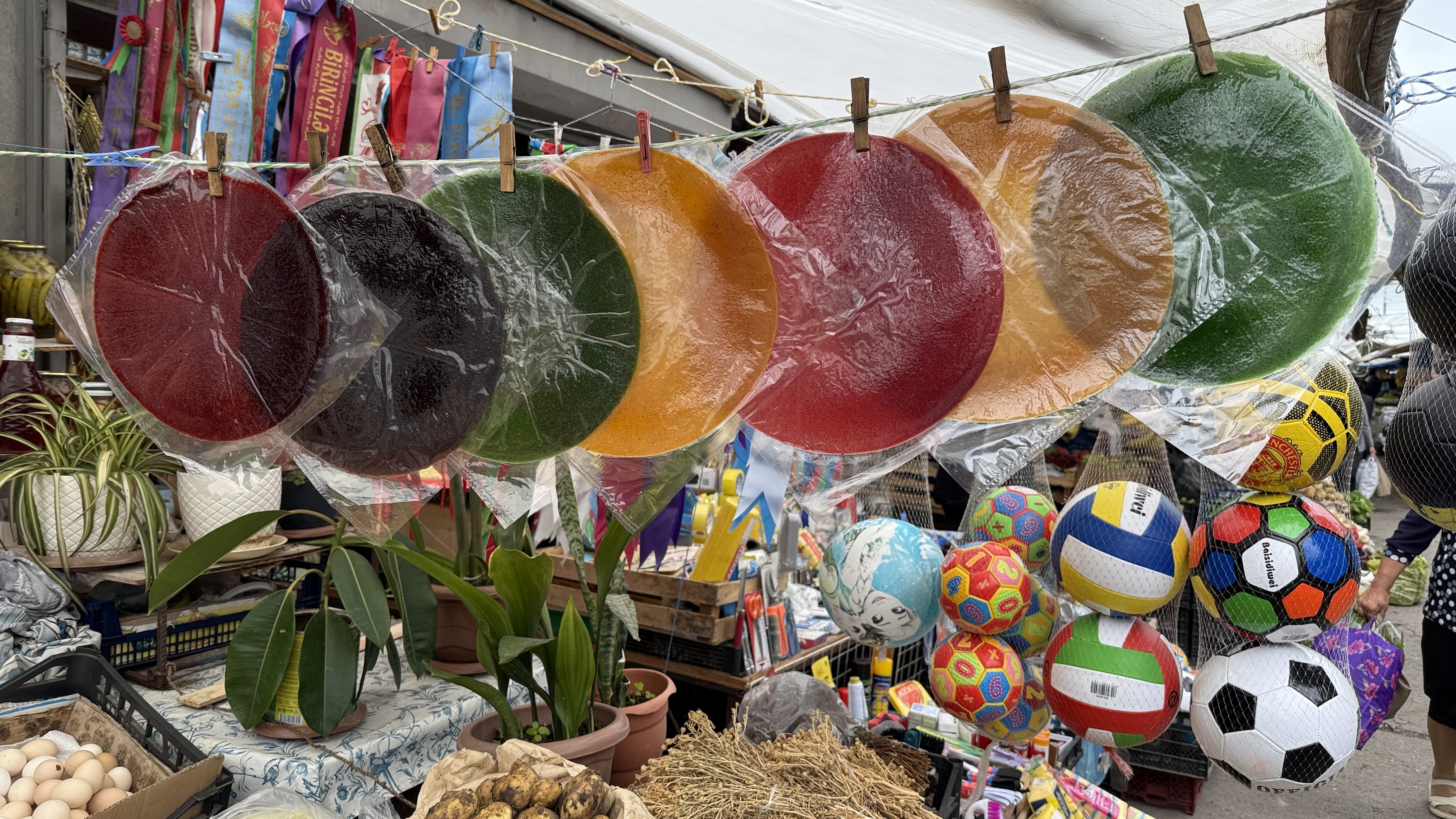
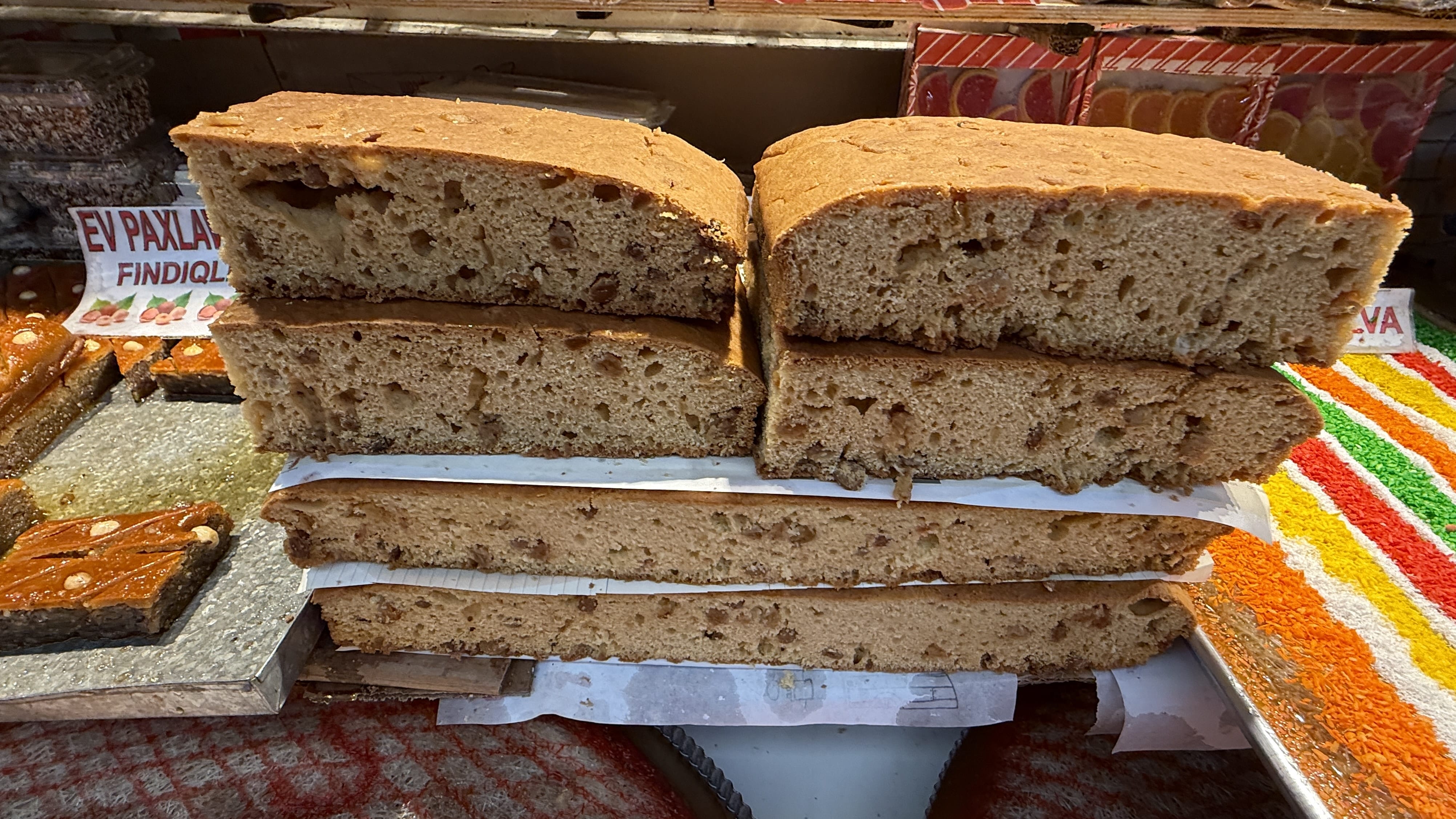
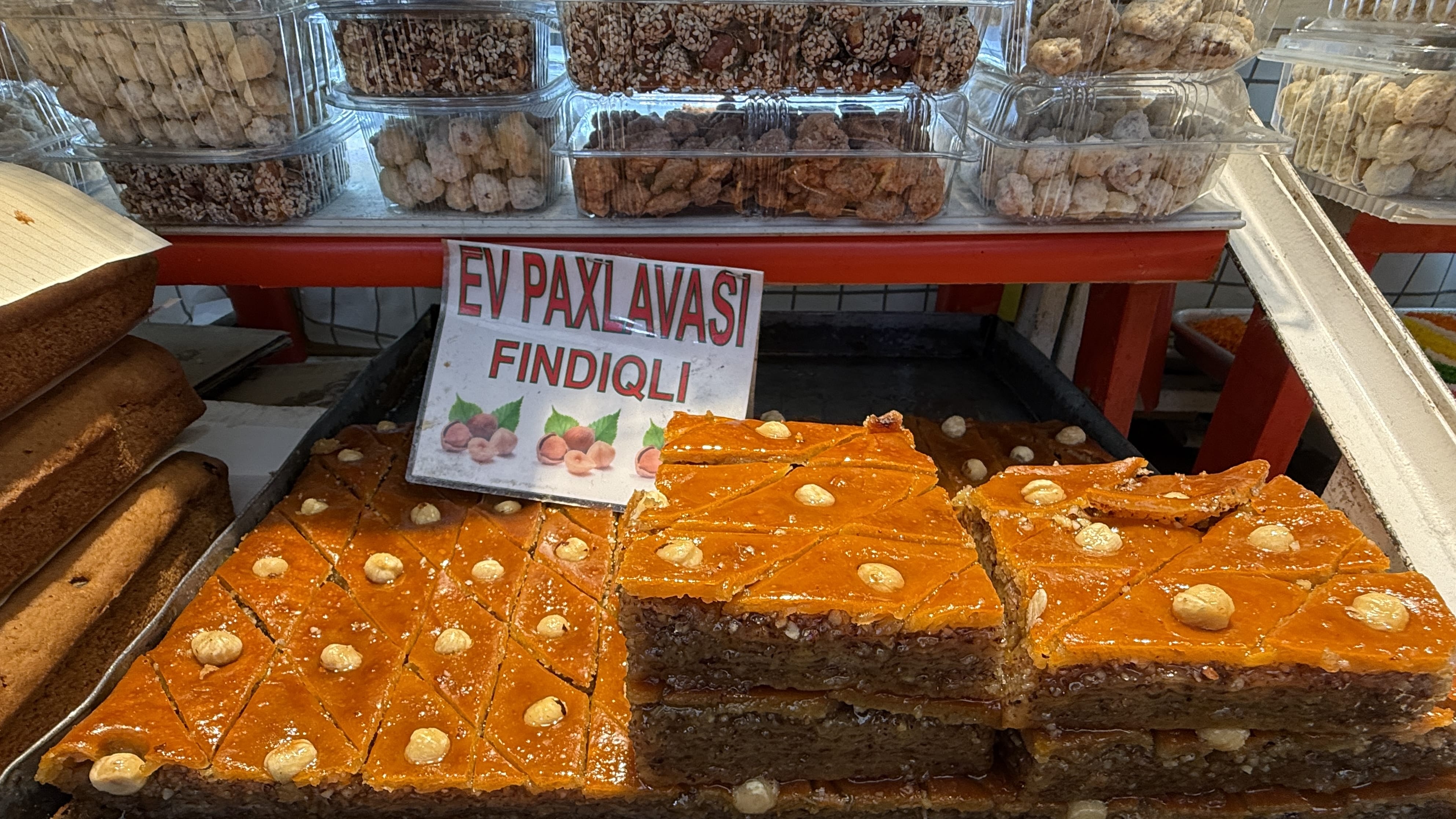
Sweet shops were piled with trays of Shaki halva and Dum-Dum halva decorated in rainbow stripes, syrupy fried pastries, and discs of homemade fruit leather hanging on strings like edible stained glass. Everywhere you turned, there was something new — a woman carrying home a chicken, vendors calling out prices, meat halls lined with cuts that weren’t for the faint of heart.
More greens at Sheki market.
Another slice of daily life at the Sheki market.
Then it was back in the van as we made our way to the Balakan–Lagodekhi border crossing, where we said our goodbyes to Alvin and to wonderful Azerbaijan, and hello to Georgia and the adventures still ahead.
Hi, I’m JoAnne—writer, wanderer, and lover of places that surprise me. I’ve traveled to 60+ countries (and counting), usually with a camera in one hand and a notebook in the other. I’m drawn to mosaics, markets, and mountains, and I write to remember what moved me. When I’m not traveling, I’m working on my blog Travels Afoot, trying new creative projects, or planning my next adventure.
📍 More about me | ✈️ Explore destinations