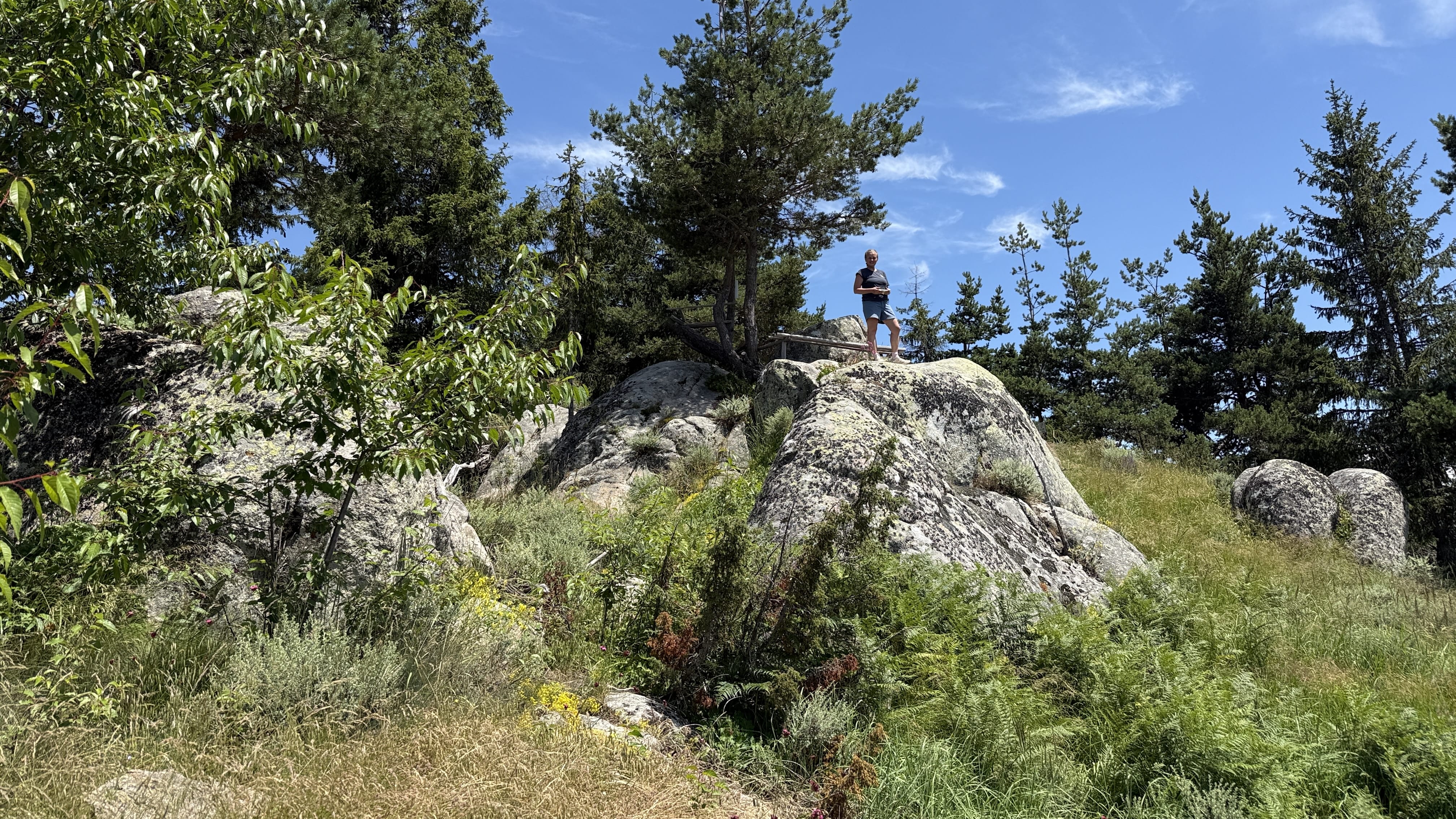
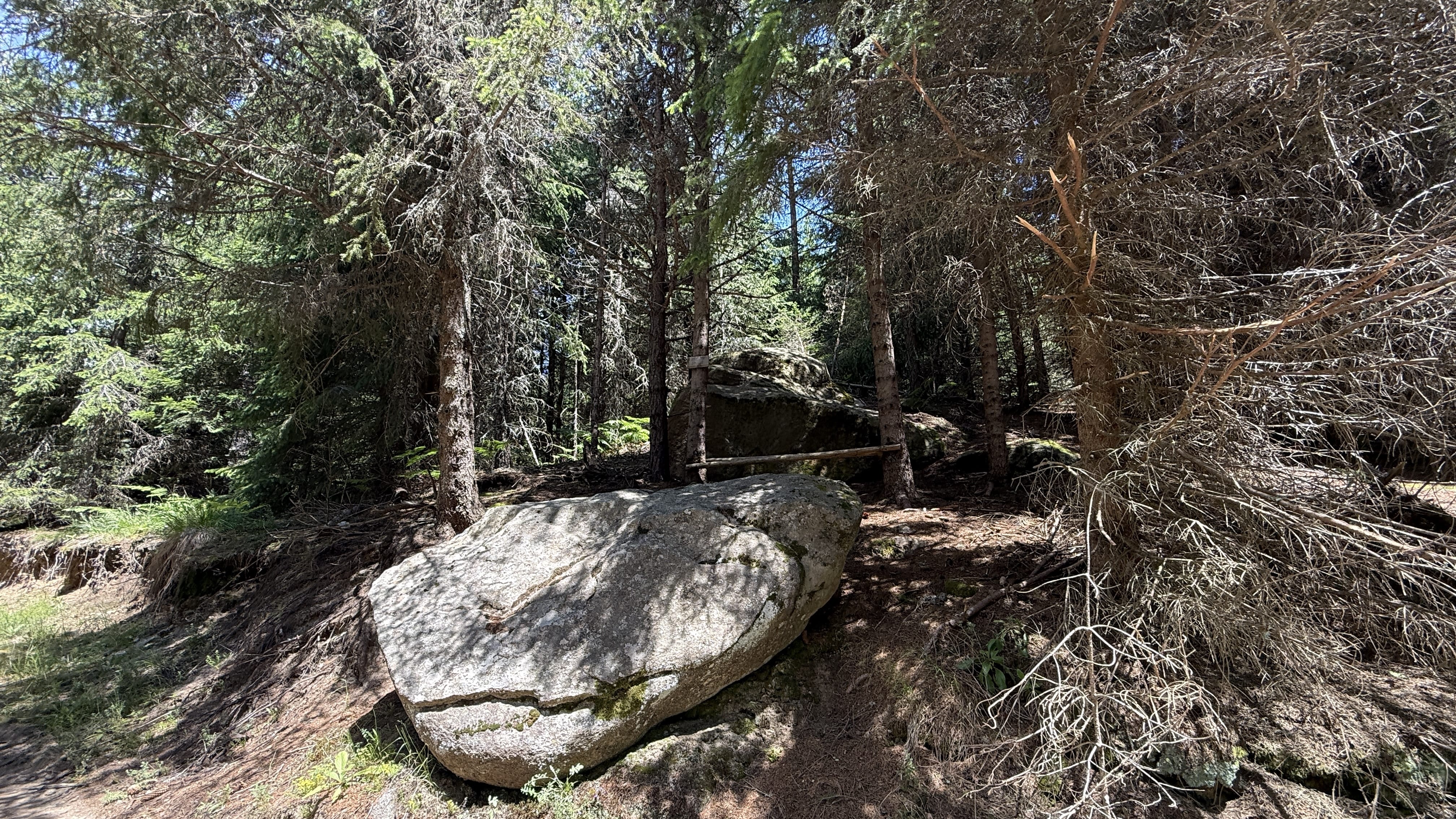
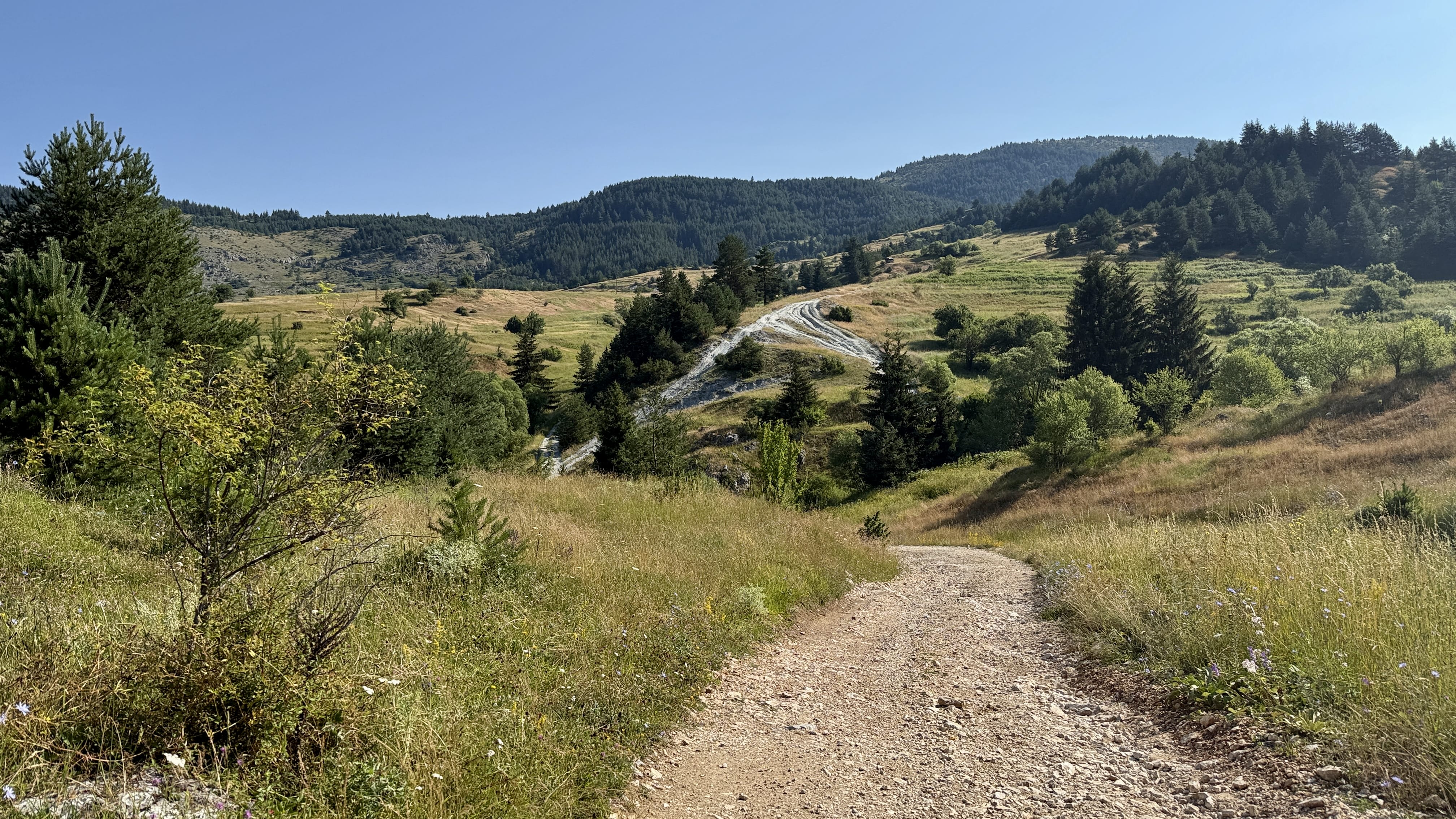

After spending two days exploring Plovdiv, it was finally time for six days of hiking in Bulgaria’s Rhodope Mountains, searching for Eurasian brown bears and exploring the remote mountain villages and trails around Yagodina.
This was the part of the trip I’d been looking forward to most.
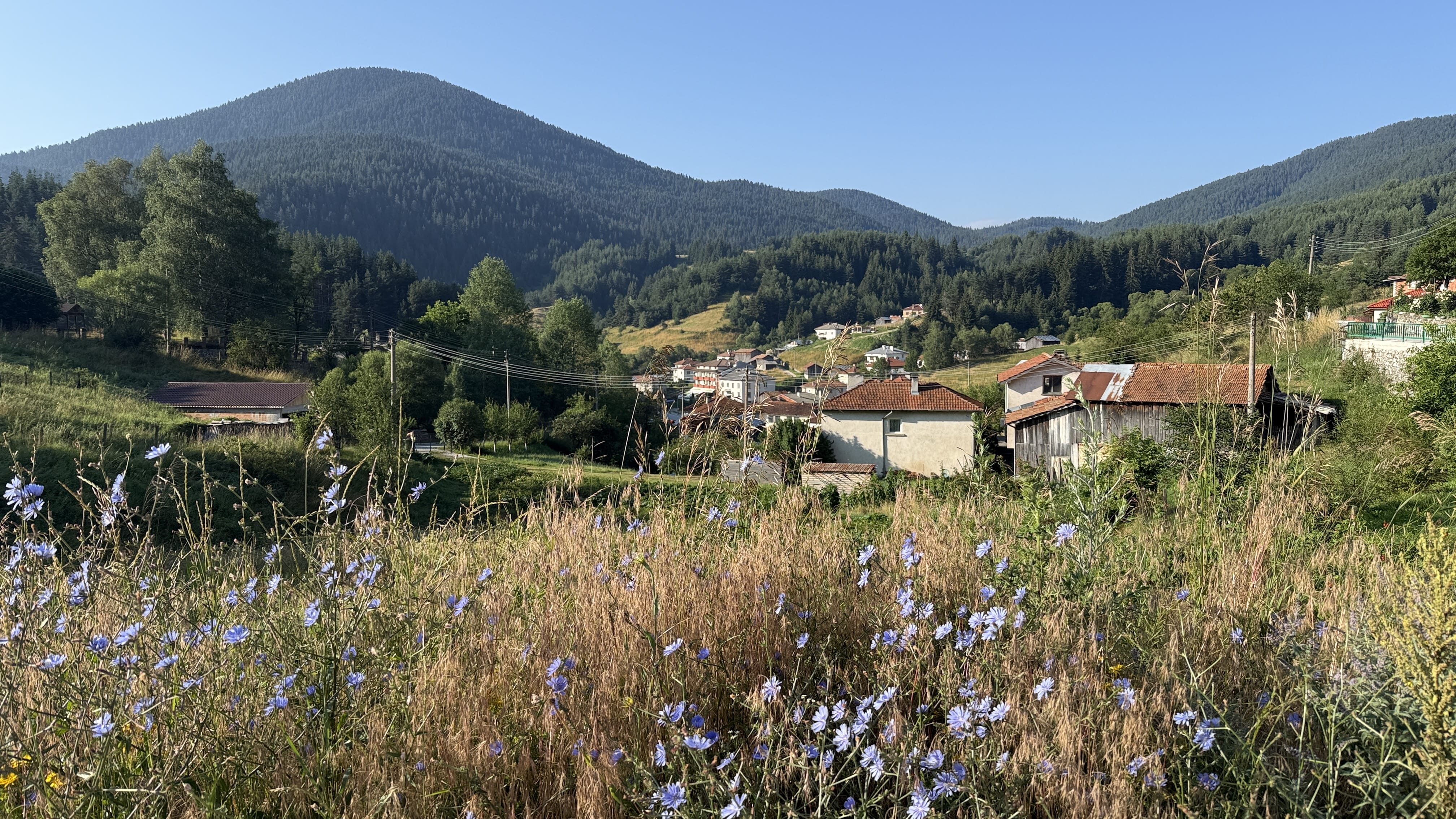
My destination was the tiny village of Yagodina, located deep in the Rhodope Mountains near the Greek border. Surrounded by forests, towering limestone cliffs, caves, and hiking trails, it would be my home for the next six days. Unlike many hiking trips where you move from hotel to hotel, I’d stay in one place and take day hikes into different parts of the mountains. I liked the idea of unpacking once and really getting to know one small corner of Bulgaria.
Since I’d built a couple of extra days into my trip to visit Plovdiv before the tour began, it would have made little sense to drive all the way back to Sofia just to meet the group’s transfer to Yagodina. Instead, I arranged a private transfer with Daytrip. It saved me several hours of unnecessary backtracking and let me head straight from Plovdiv into the Rhodope Mountains.
When I told the tour company that I planned to meet the group in Yagodina rather than return to Sofia for their transfer, they seemed pretty concerned about how I was going to get there. At first, I didn’t understand why. Eventually, I realized they thought I was planning to arrive in Plovdiv and simply hire a local taxi to take me all the way to Yagodina—which wasn’t going to happen.
What they didn’t realize was that I’d booked Daytrip, a company that arranges private, long-distance transfers between cities and destinations. My driver was already booked to pick me up at my hotel in Plovdiv and take me directly to Yagodina. I’d used Daytrip before in North Macedonia, Albania, and Portugal, so I knew exactly what I’d arranged.
My driver arrived right on time at my hotel in Plovdiv. We loaded my luggage into the car, and soon we were heading south toward the Rhodope Mountains.
Base: Yagodina, Bulgaria
Time: 6 days in the Rhodope Mountains
Trip style: Guided day hikes from one hotel
Hiking: Approximately 8–11 miles most days
Highlights: Buynovo Gorge, Kastrakli Nature Reserve, Bulgaria–Greece border trail, Golyam Perelik area, Gela and the Chamois Trail
Wildlife: European brown bears, wild boar, butterflies and signs of wolves
Favorite hike: The high mountain route below Golyam Perelik
Most unusual hike: The old Cold War border route and “dead zone”
Unexpected highlight: Seeing a wild Eurasian brown bear
Good to know: Yagodina is remote, and reaching it requires traveling through the narrow Buynovo Gorge
Next: Return to Sofia
As we drove farther south, the landscape slowly began to change.
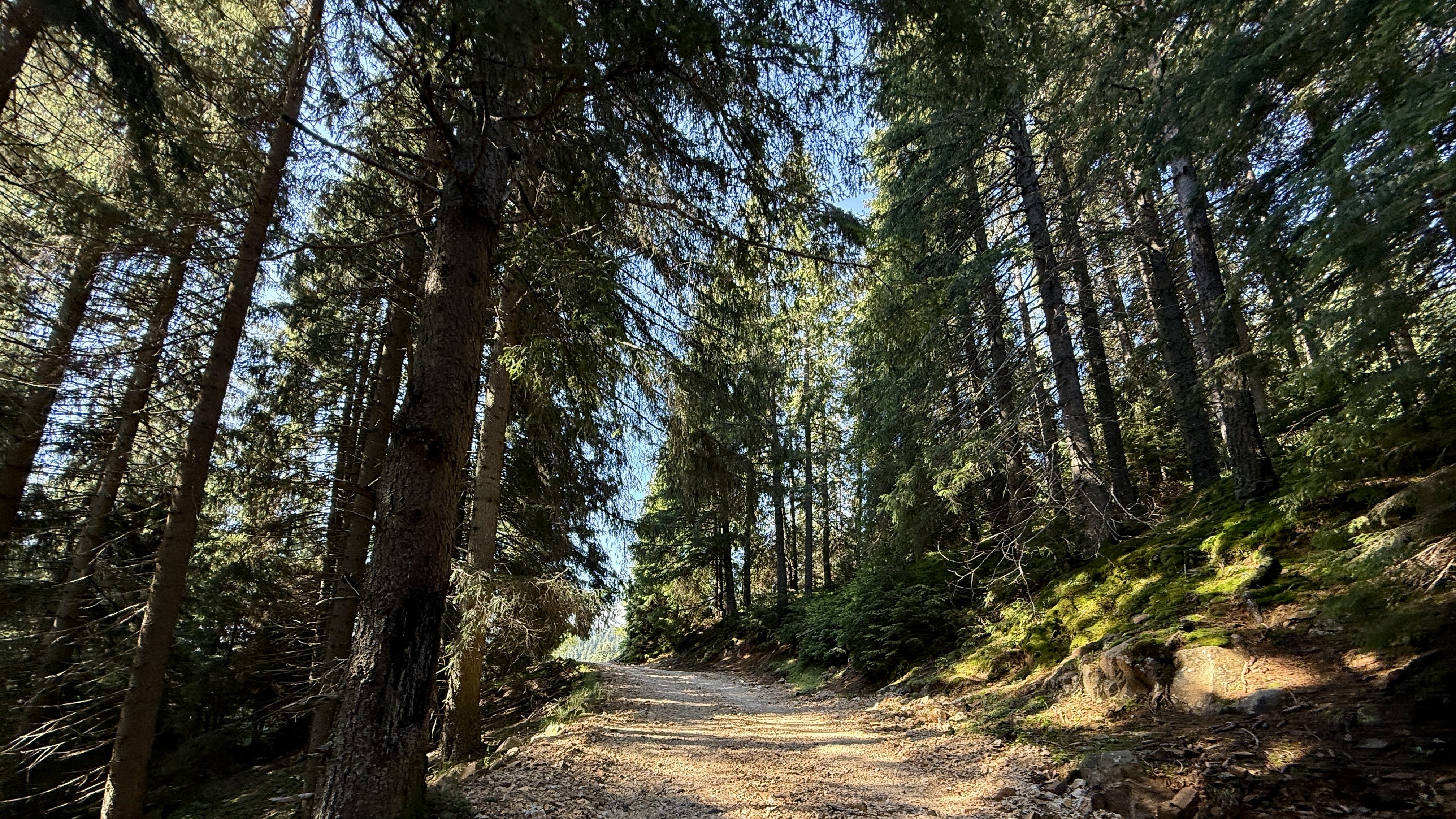
The busy roads became quiet country roads. Small villages appeared every few miles before disappearing again into thick forests. Tall evergreen trees lined the road, and moss covered rocks and tree trunks along the way.
The winding mountain roads reminded me a little of driving through western North Carolina, except these forests felt even more untouched.
One thing that definitely caught me by surprise was the music.
I also got a kick out of my driver’s choice of music. Of all things, he had Dolly Parton playing for much of the drive. So there I was, winding through the mountains of Bulgaria listening to Jolene and one familiar Dolly song after another. Who would have guessed I’d be listening to Dolly Parton on my way into the Rhodope Mountains?
Along the way, my driver pointed out villages and talked about life in the Rhodopes. He explained that the area had once been much more agricultural, but many younger people have left for larger cities in search of better jobs. There simply aren’t as many people left to keep the small farms going.
As we got closer to Yagodina, I finally understood why the tour company had been so concerned about me making my own way there.
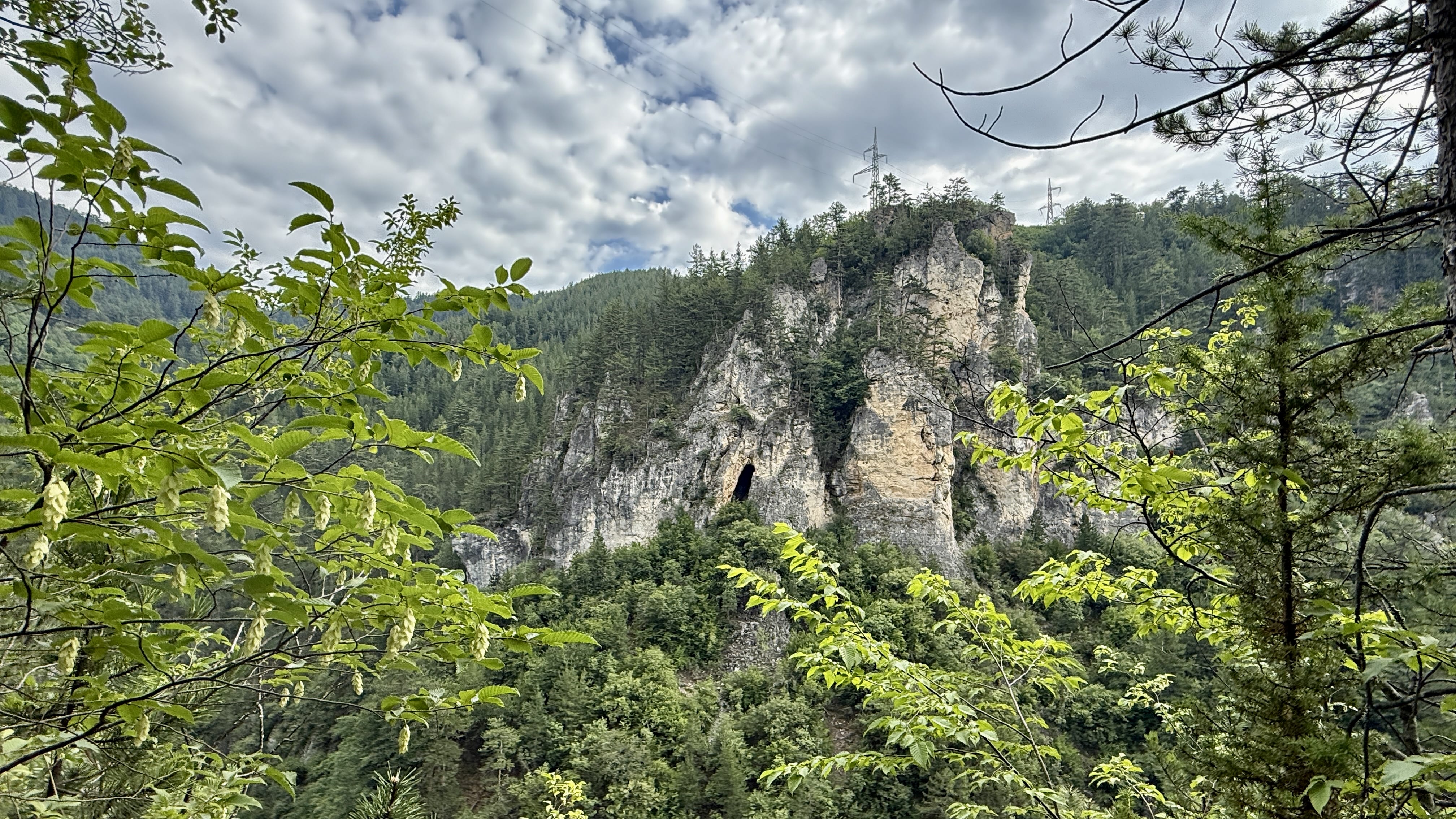
The last section of road follows the Buynovo River through Buynovo Gorge, the longest gorge in the Rhodope Mountains. Towering limestone cliffs rise almost straight out of the valley floor, and in several places the rock actually stretches over the roadway, creating natural tunnels that feel as though they were carved just wide enough for a vehicle to pass beneath.
The road itself narrows to little more than a single lane in many places.
Whenever another vehicle appeared around one of the blind curves, one driver often had to stop—or even back up—to the nearest pull-off so the other could carefully squeeze through. There was absolutely no rushing this drive. Everyone simply accepted that patience was part of traveling through the gorge.
All the while, the Buynovo River rushed through the gorge below us.
By the time we reached Yagodina, it was clear just how remote the village really was.
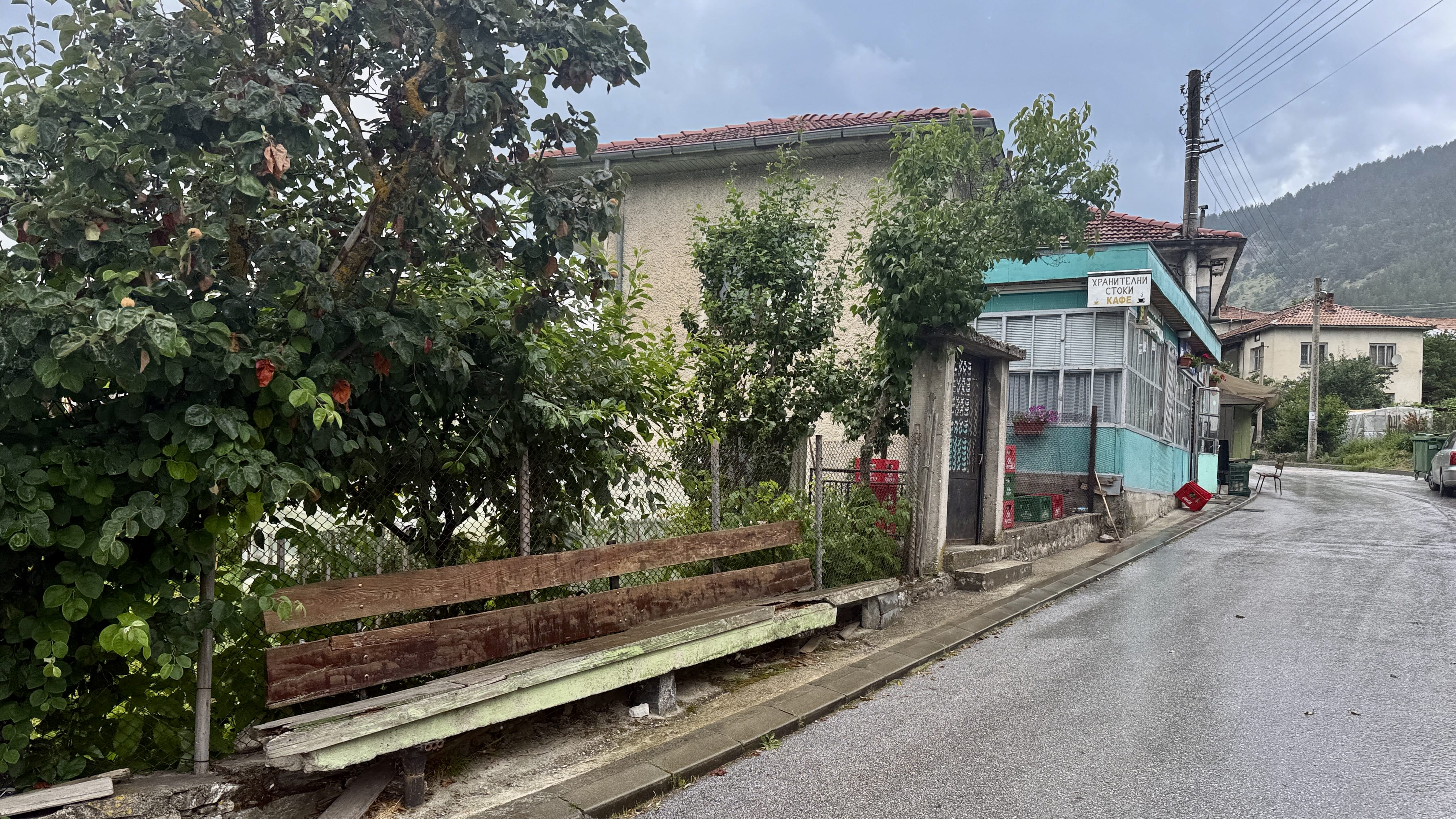
After getting settled into my room, I decided to walk down to the village grocery store for water and a bar of soap. Thankfully, it wasn’t nearly as far—or as steep—as I’d imagined.
It also became immediately obvious that English wasn’t nearly as common here as it had been in Sofia or Plovdiv.
Unfortunately, I hadn’t exactly mastered my Bulgarian phrases yet.
Trying to explain that I wanted a bar of soap turned into a hilarious game of charades. I rubbed my arms as though I were washing them, but the shopkeeper thought I was asking for lotion. Finally, I spotted the soap sitting behind the counter, pointed to it, and we both burst out laughing.
Mission accomplished.
Outside the little store, several local residents sat chatting on benches. Some of the older women wore colorful headscarves, and I remember wishing I could capture the scene without intruding on it. So I didn’t.
Later that evening, I met the people I’d be spending the next week with. There were six hikers in total, plus our Bulgarian guide—four from the United Kingdom, one from Belgium, and me, the lone American.
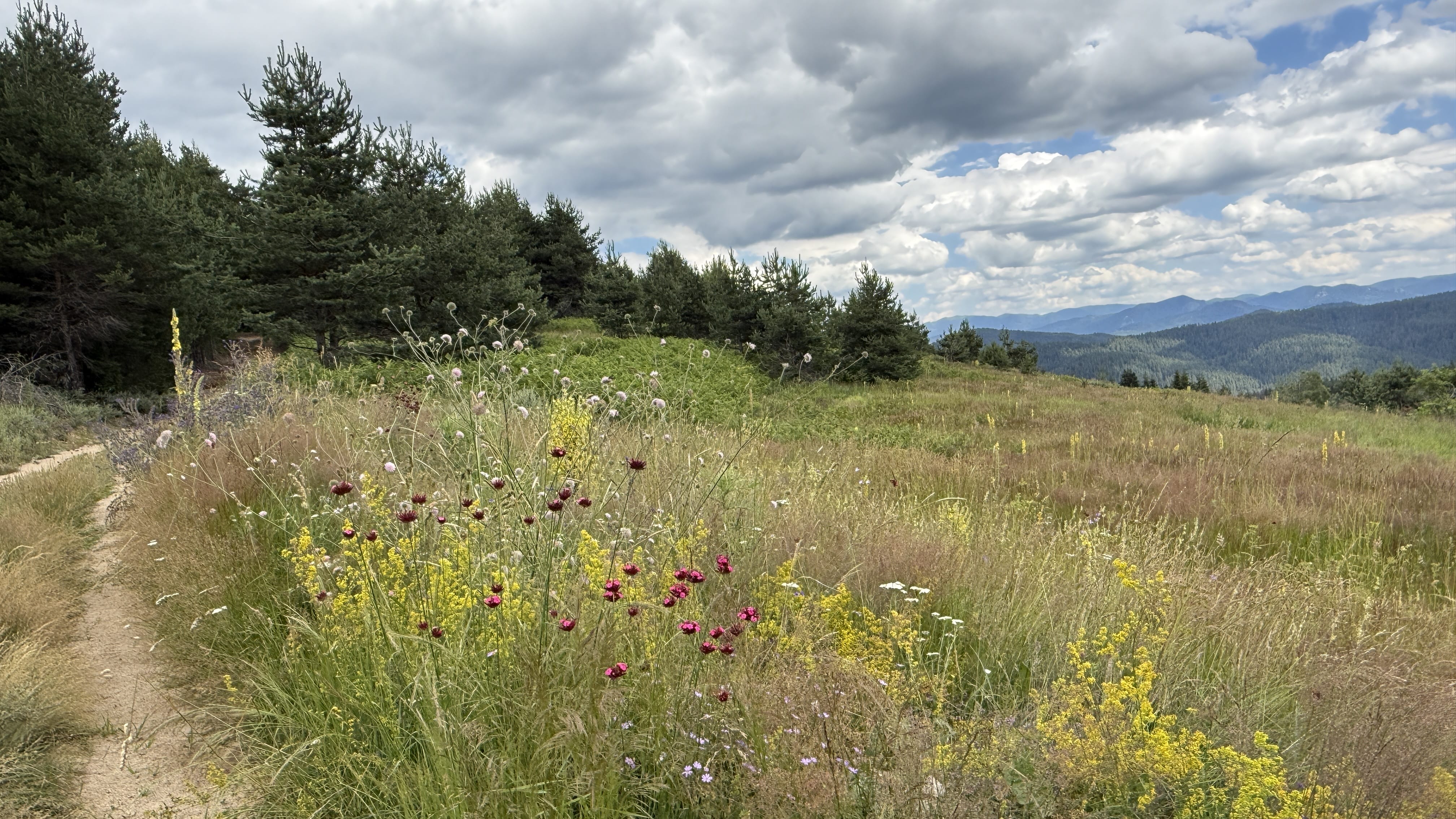
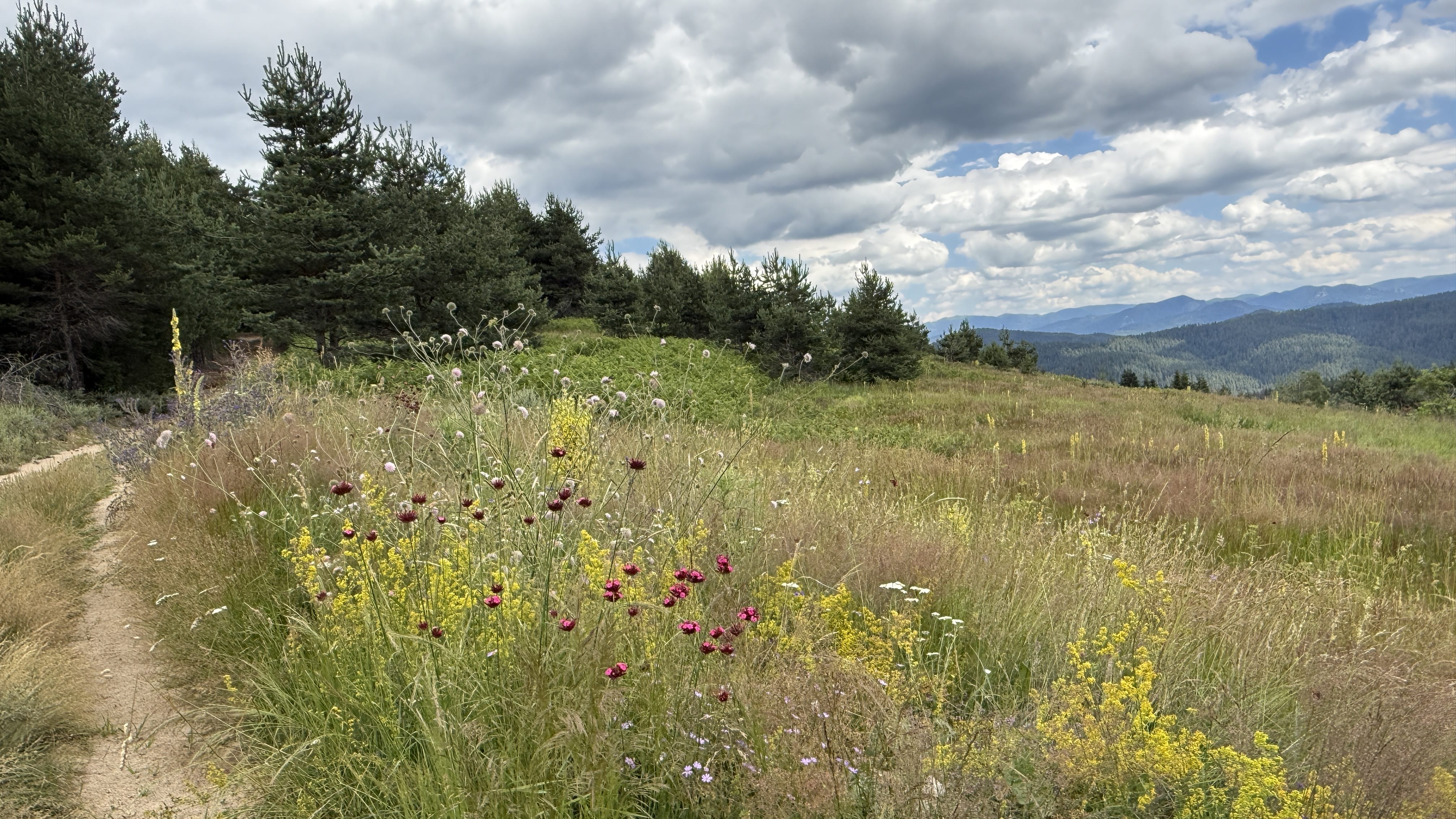
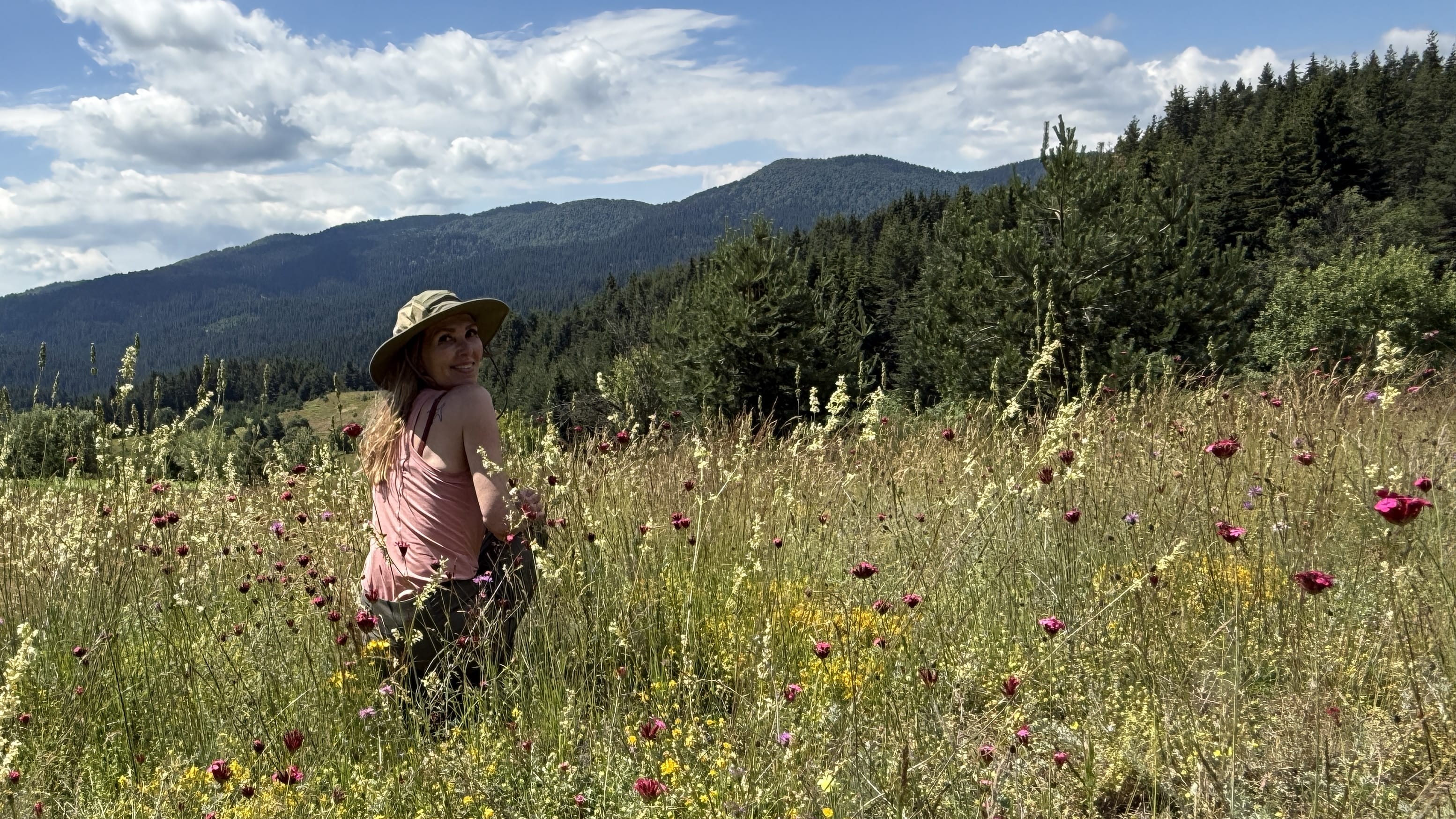
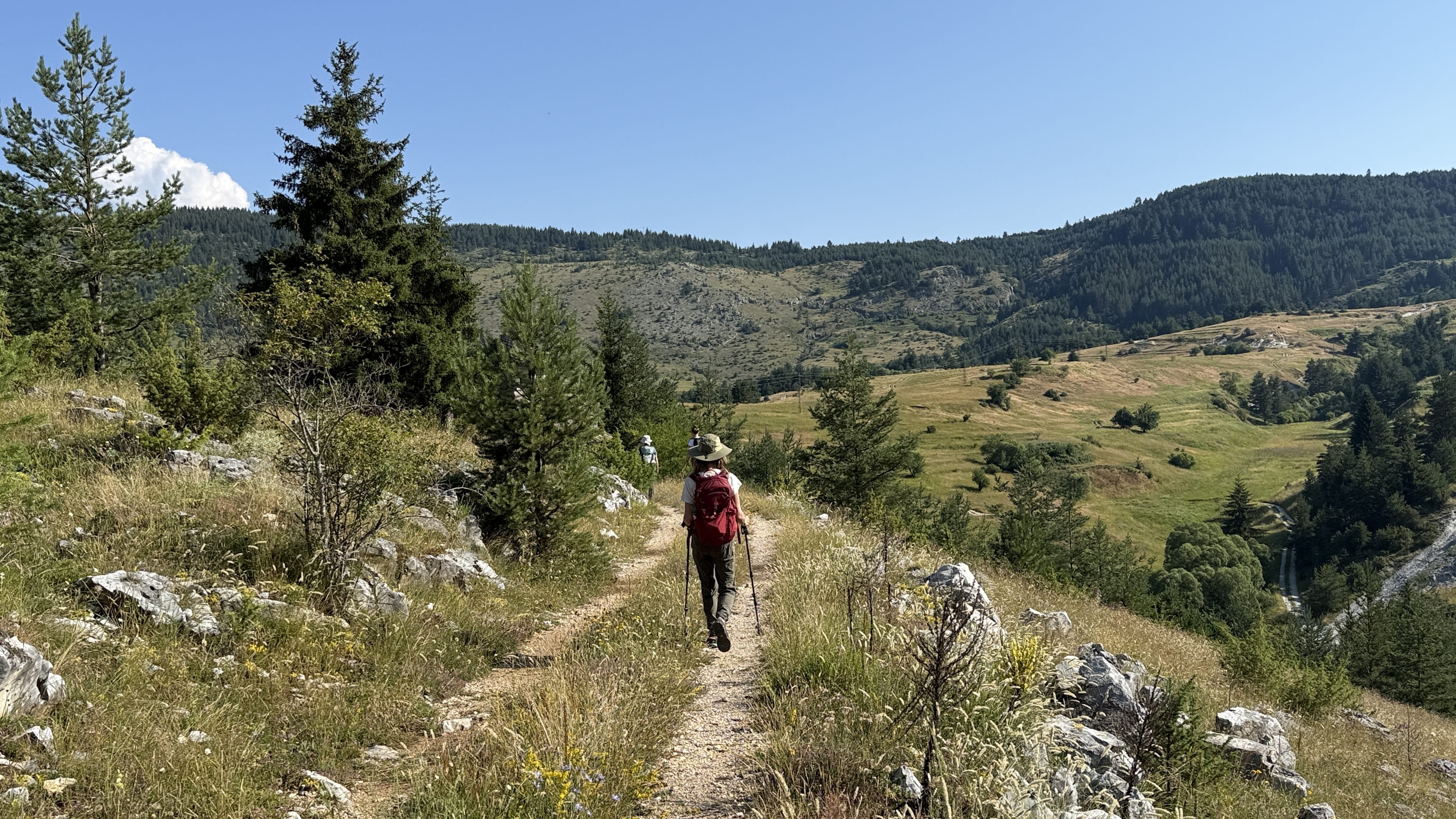
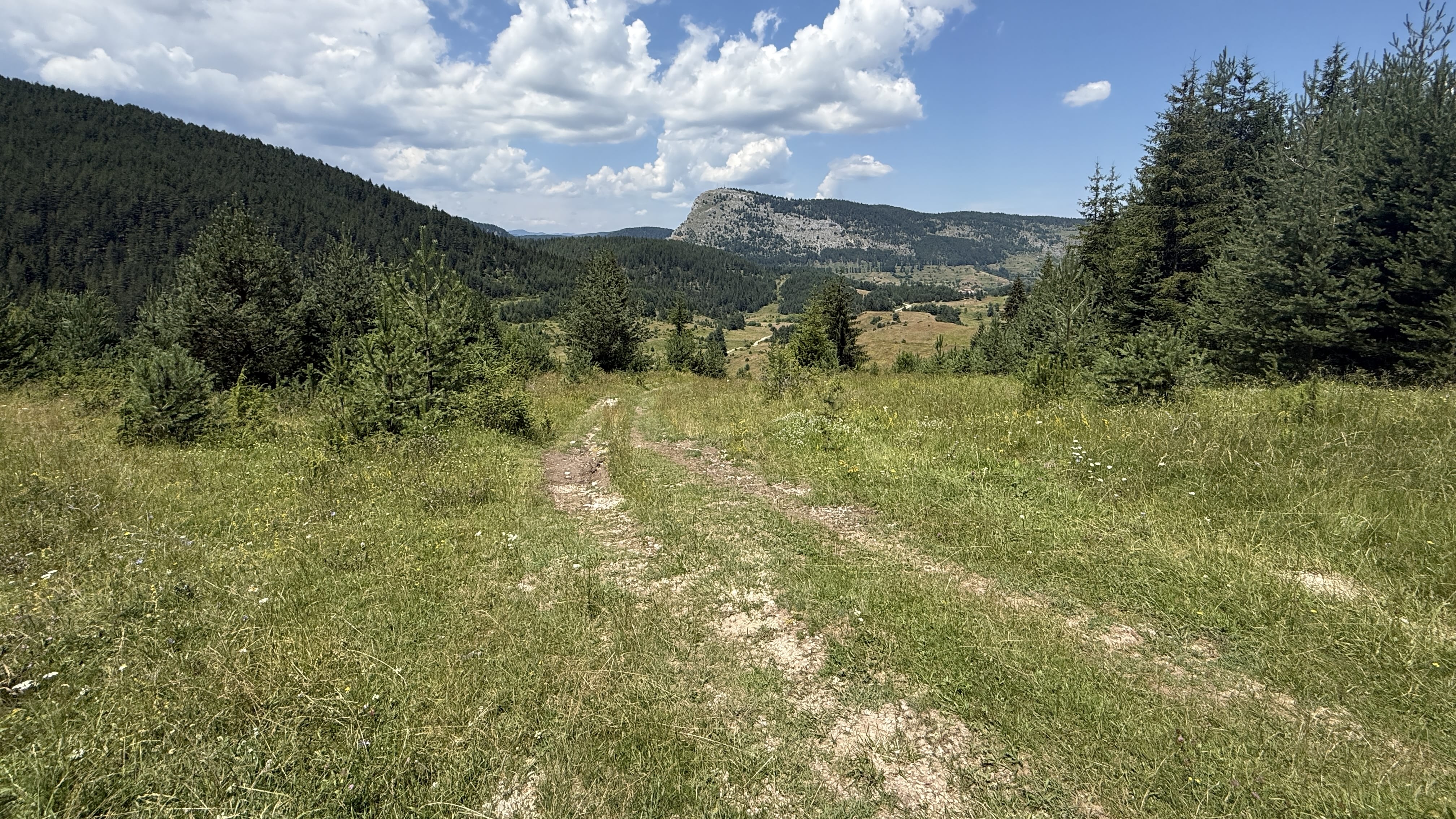
Our first hike was about 10 miles, beginning near the village of Borino and taking us into Kastrakli Nature Reserve. We spent the first part of the morning hiking beneath tall black pines, a welcome break from the July sun. The trail climbed gradually before the forest gave way to open meadows filled with wildflowers and views across the Rhodope Mountains.
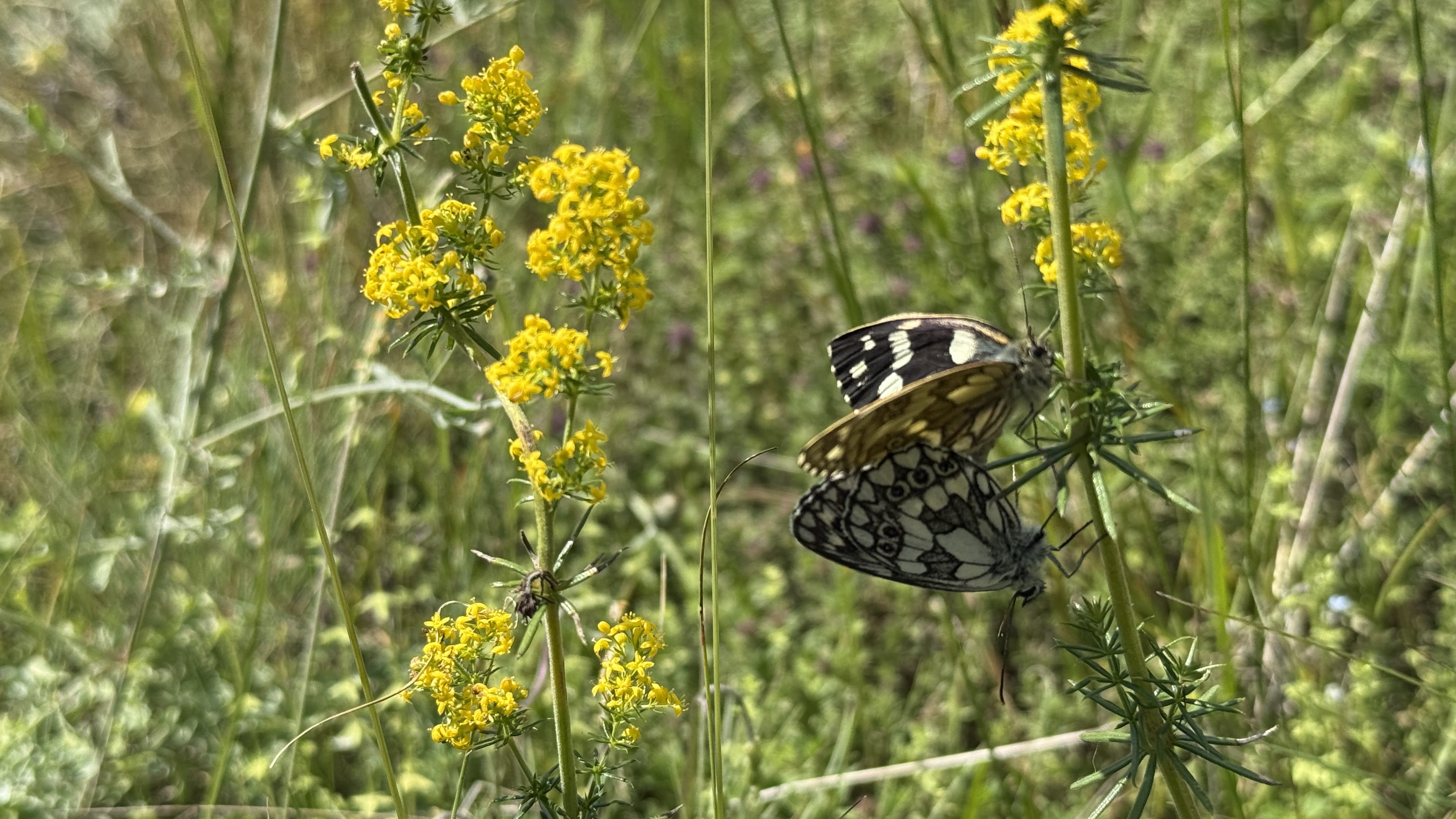
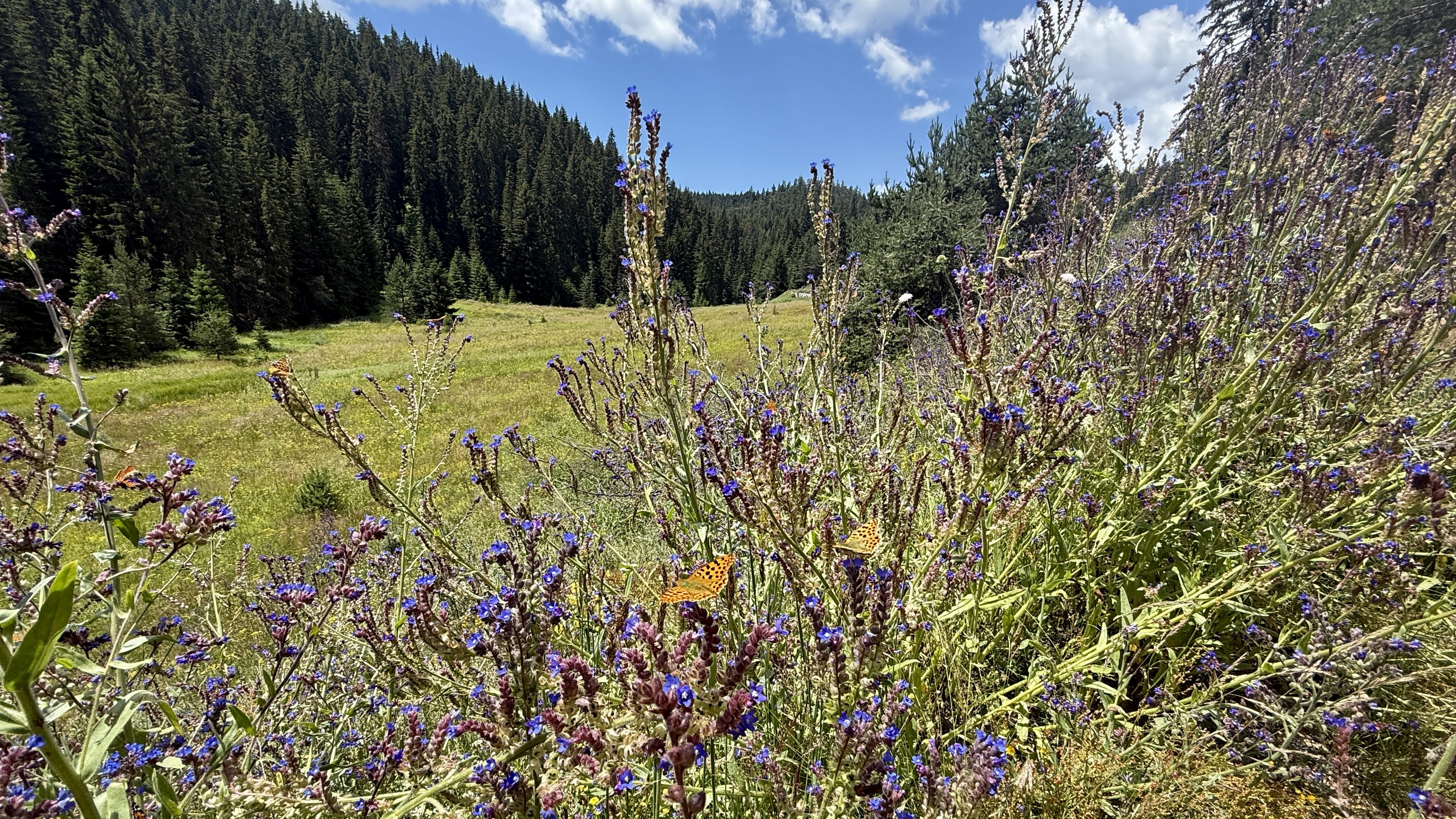
The meadows were filled with butterflies. We spotted dozens of Balkan Marbled Whites along with beautiful copper butterflies fluttering from flower to flower. We even caught a glimpse of a black squirrel darting through the trees.
We stopped for a picnic lunch overlooking the mountains, and I could have happily stayed there another half hour. Eventually, though, it was time to keep moving.
After lunch, we climbed back into the van for about a 20-minute drive to Buynovo Gorge. From there, the hike took on a completely different look.
Once again, we began beneath tall pines, but before long the trail started a long descent toward the gorge.
As we made our way down, the forest gave way to towering marble cliffs. By the time we reached the bottom, we were following the rushing Buynovo River through the narrow gorge. We crossed the river several times on wooden footbridges and boardwalks attached to the rock walls, making this one of my favorite parts of the day.
The next morning, we headed out for our second hike, this time along Bulgaria’s old border with Greece.
One of the things I appreciated most during the trip was our guide, Svetoslava (SVEH-toh-SLAH-vah). She’s an environmental anthropologist who studies how people and Eurasian brown bears coexist in the Rhodope Mountains. As we hiked, she explained the bears’ habitat, the research she does, and how local communities live alongside the wildlife in this region. Having someone who knew the area—and its wildlife—so well added a lot to the hikes.
After about a 30-minute drive from our hotel in Yagodina, we arrived in the tiny village of Buynovo, where our hike on the Kesten–Vodni Pad Border Circuit began. This roughly 9-mile (14.5 km) loop follows the Bulgaria–Greece border through the western Rhodope Mountains. Today, Buynovo is home to only a few hundred residents, but during the Cold War it lay within one of Bulgaria’s most heavily restricted border regions.
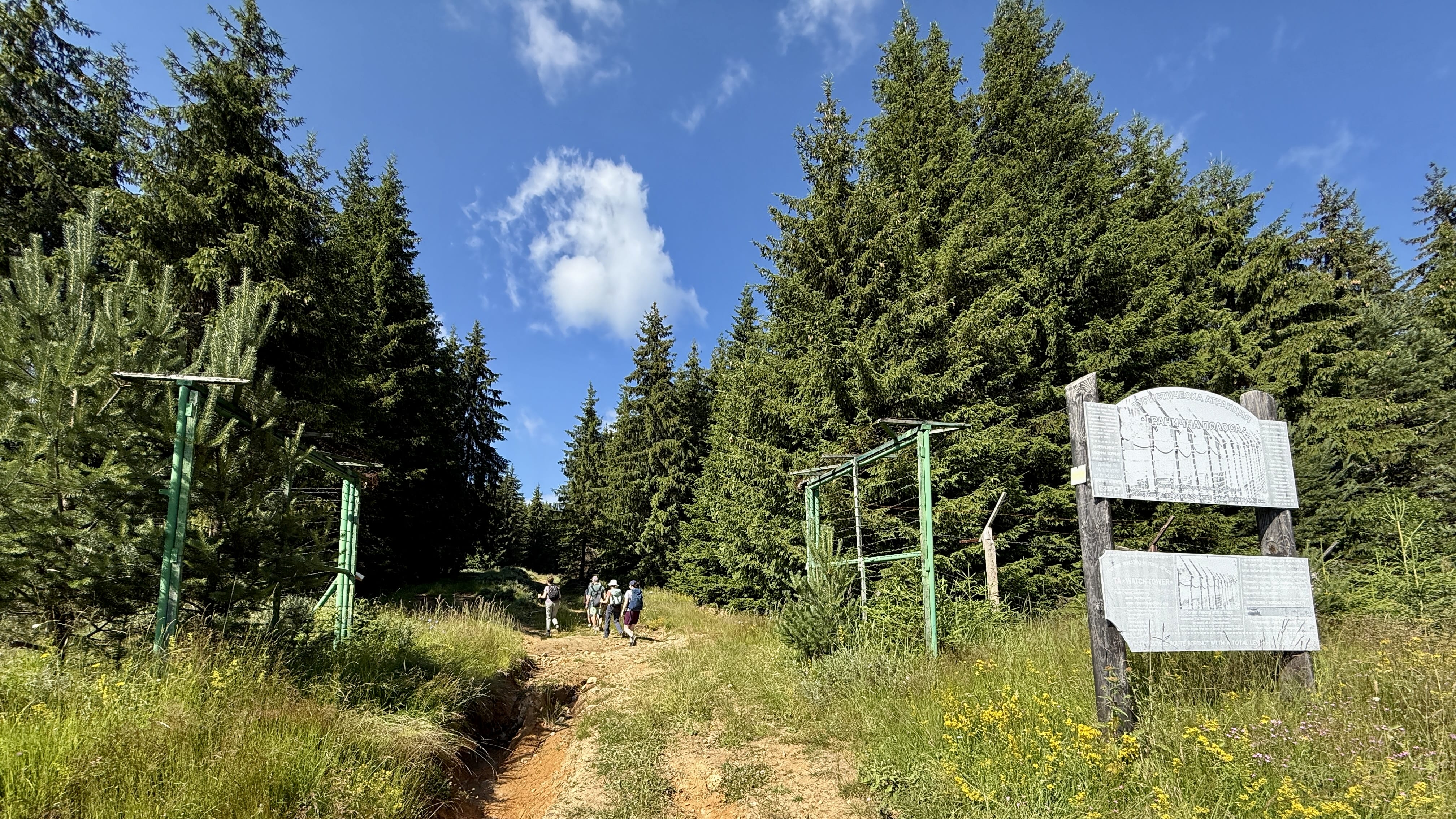
About 15 or 20 minutes into the hike, we reached a section where part of the old border fence still stands.
During the Cold War, this border separated communist Bulgaria from NATO-member Greece. Bulgaria, aligned with the Soviet Union, heavily fortified the frontier, and civilians were rarely allowed anywhere near it.
Once we passed the remains of the fence, we entered what was known as the “dead zone.” Many people believed that crossing the fence meant they had reached Greece, but the actual international border often lay another one to three kilometers away. Anyone caught in that buffer zone was still inside Bulgaria, making escape much more difficult than it appeared.
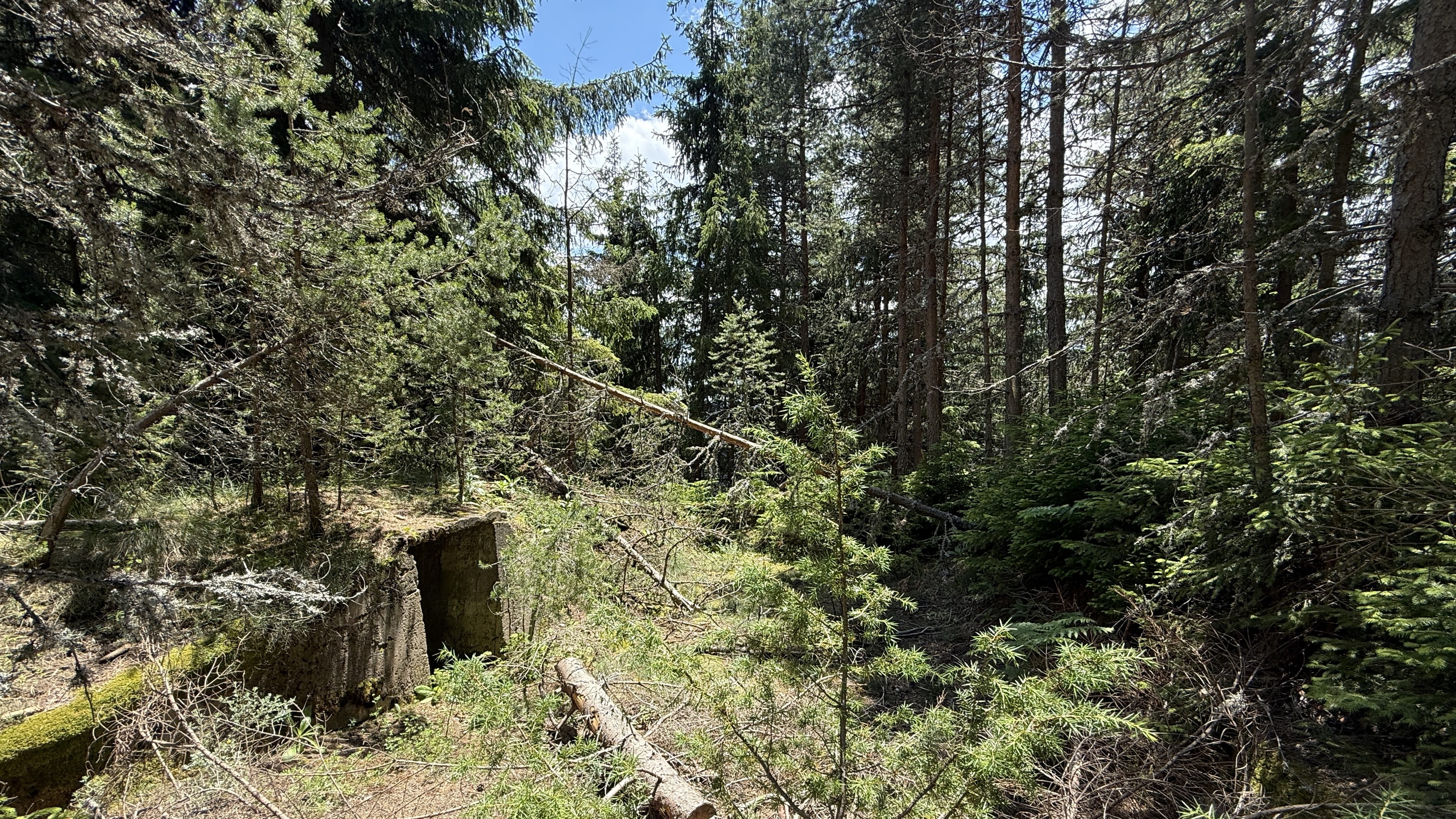
As we continued hiking, we came across more reminders of that history, including abandoned border bunkers and old military positions where tanks and other military vehicles had once been hidden.
We also passed through the tiny villages of Kesten and Vodni Pad, two of the most remote communities in the Rhodope Mountains.
History aside, this was simply a beautiful hike.
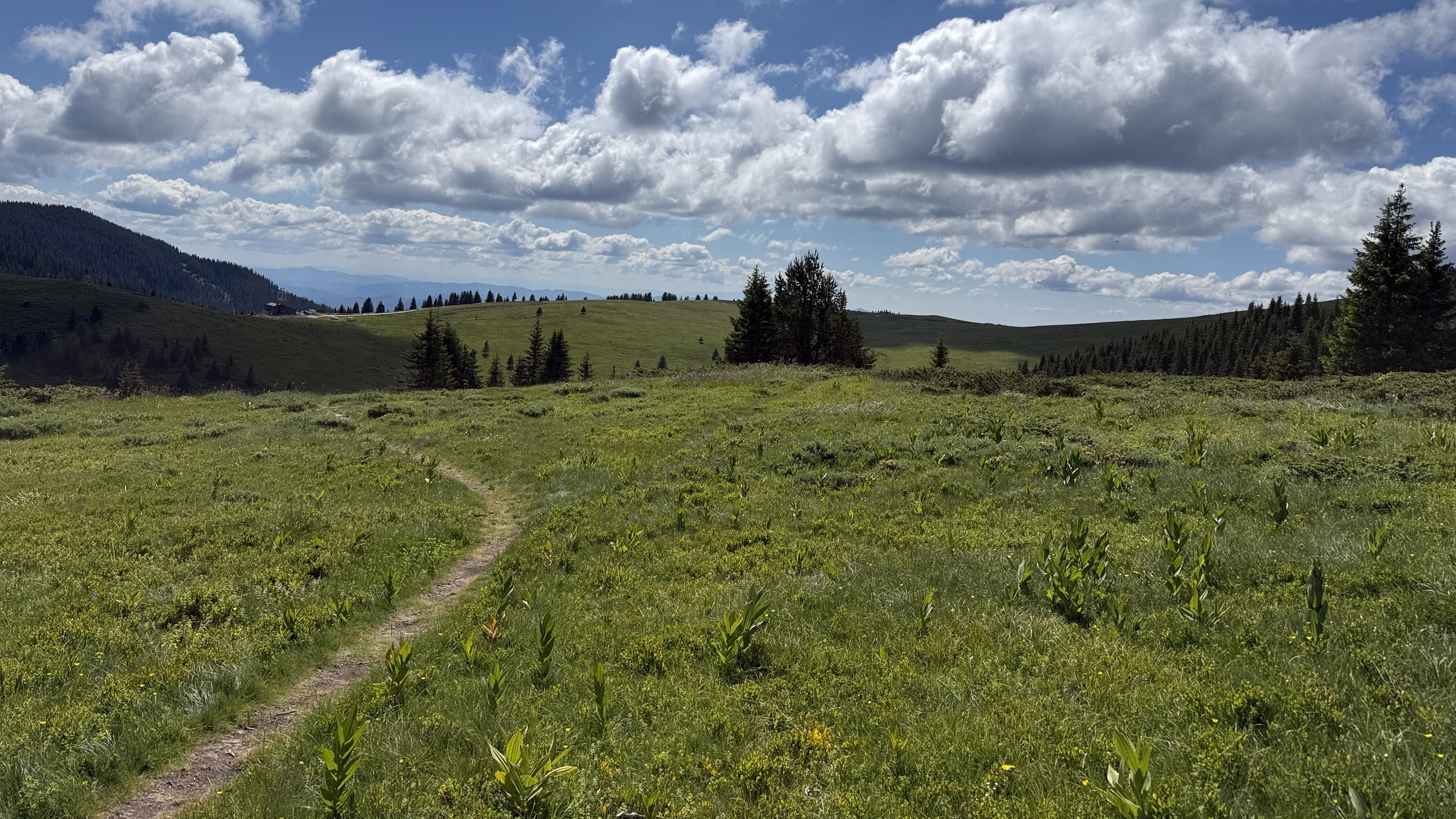
The trail wound through pine and beech forests before opening into meadows with sweeping views toward Greece. It was hard to imagine that a border once so heavily guarded could now feel so peaceful.
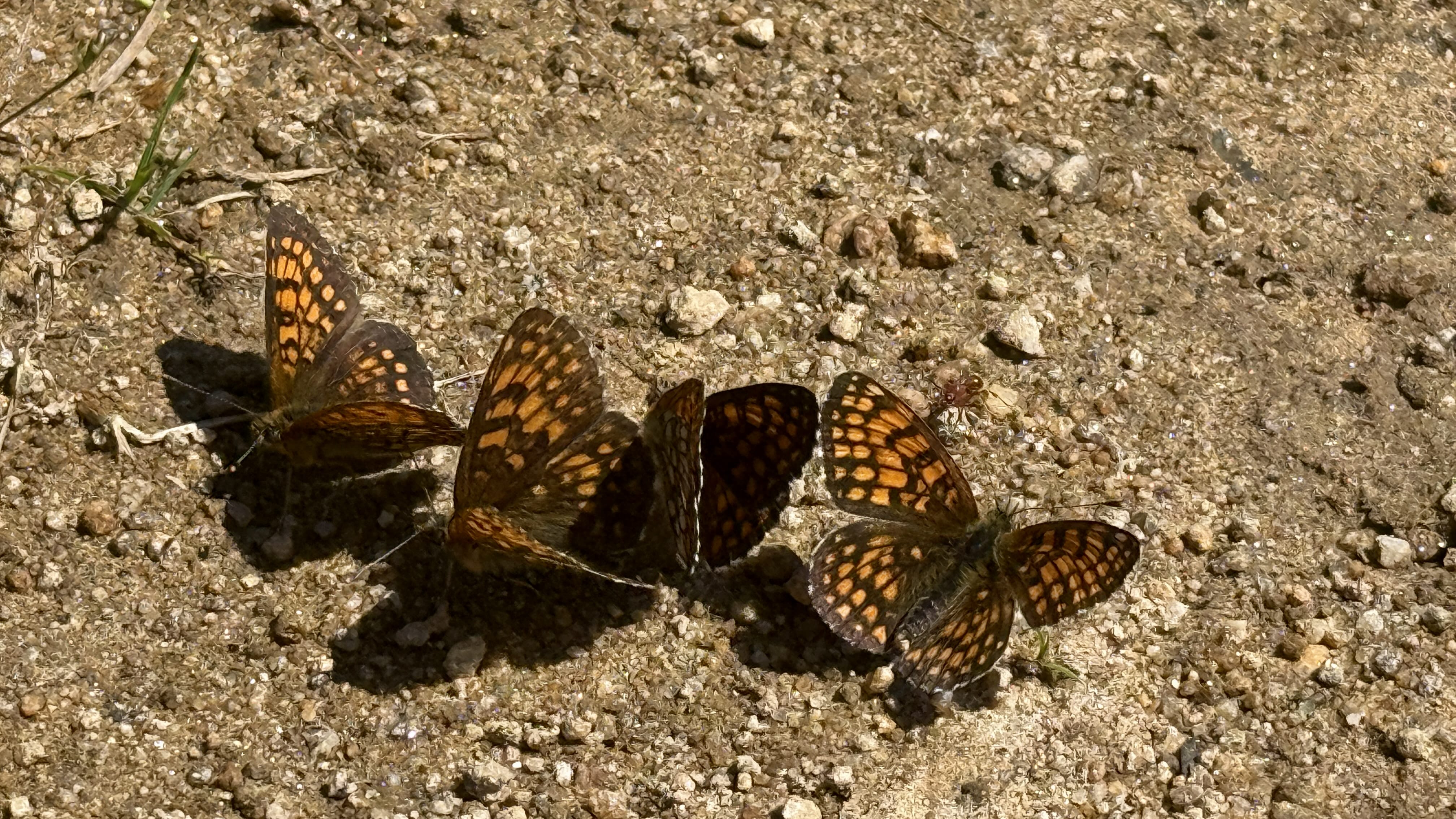
At several damp spots along the trail, dozens of butterflies gathered on the ground to absorb minerals and salts from the soil—a behavior called puddling. I’d never heard of it before. Apparently, it’s most common in male butterflies, which use those minerals during reproduction. I love learning little things like that because they’re details I’d never discover on my own.
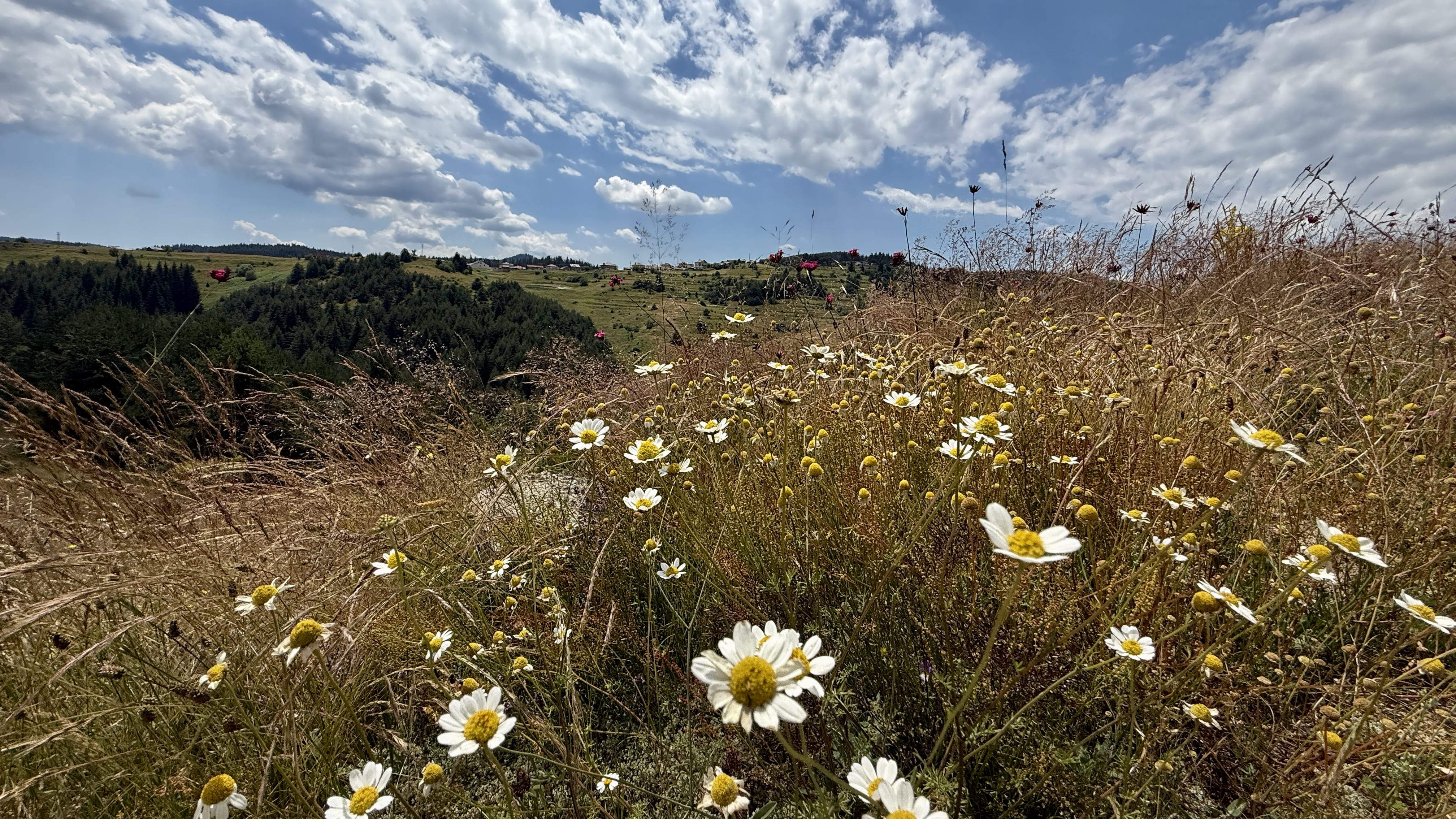
Summer wildflowers lined much of the trail, including bladder campion, mullein, wild thyme, wild violets, and maiden pink, along with countless others I couldn’t identify.
We also spotted several burnet moths, one of the few moths active during the day. Their bright red-and-black wings made them hard to miss.
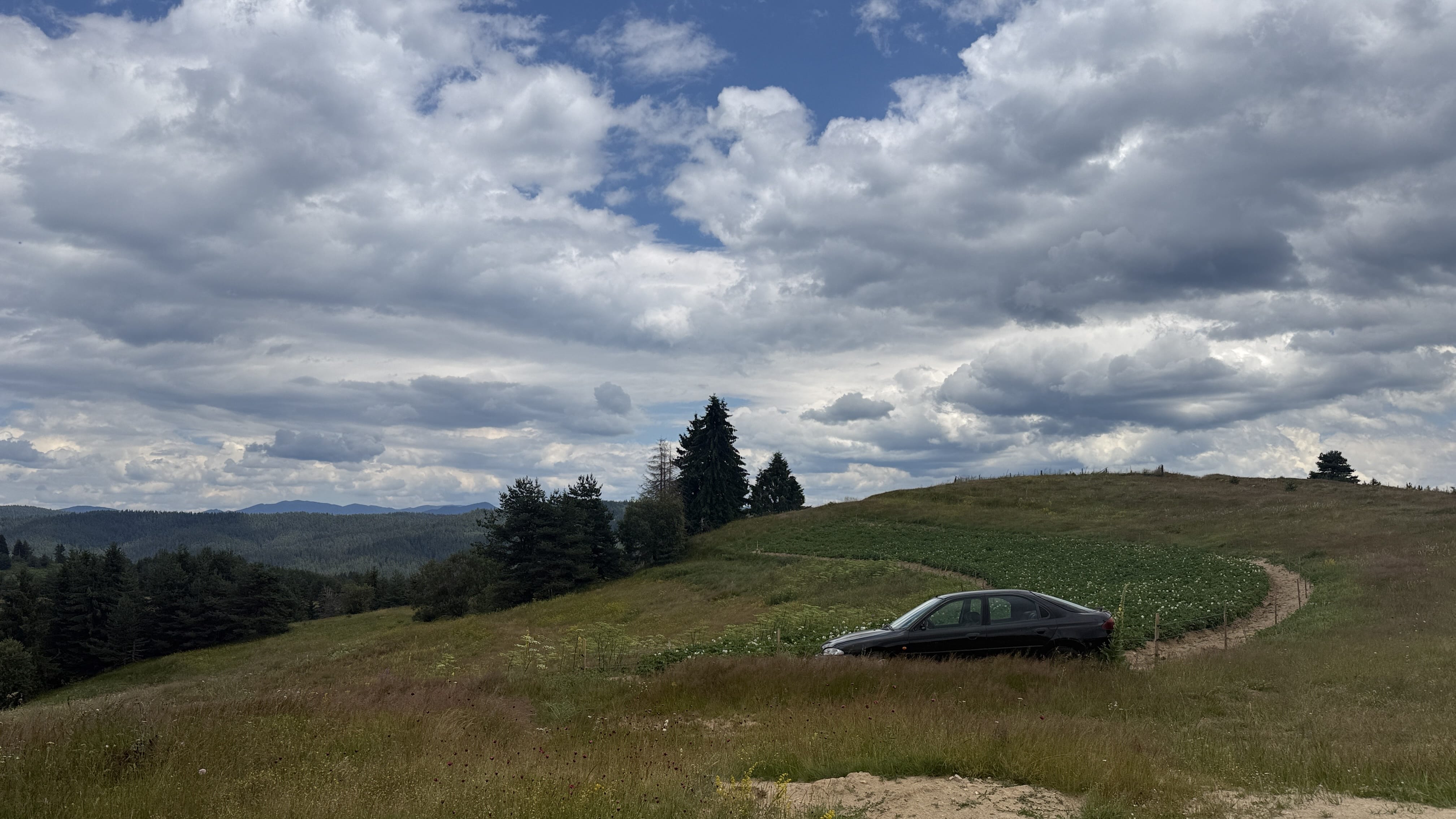
Toward the end of the hike, we came across what looked like an abandoned car parked beside a fenced potato field. Our guide explained that it wasn’t abandoned at all. A solar panel in the rear window kept the battery charged, and that battery powered the electric fence protecting the potatoes from wild boar. I never would have guessed.
Our third day of hiking would also be our longest, covering nearly 11 miles.
Since it was going to be a long day, breakfast was moved up to 7:30, and by 8:30 we were on our way. After nearly two hours of winding mountain roads, we reached the trailhead below Golyam Perelik, the highest peak in the Rhodope Mountains. Although the summit itself is closed because of a nearby military installation, the surrounding trails are open for hiking.
The weather couldn’t have been better. It was sunny most of the day, with a steady breeze that kept it comfortable.
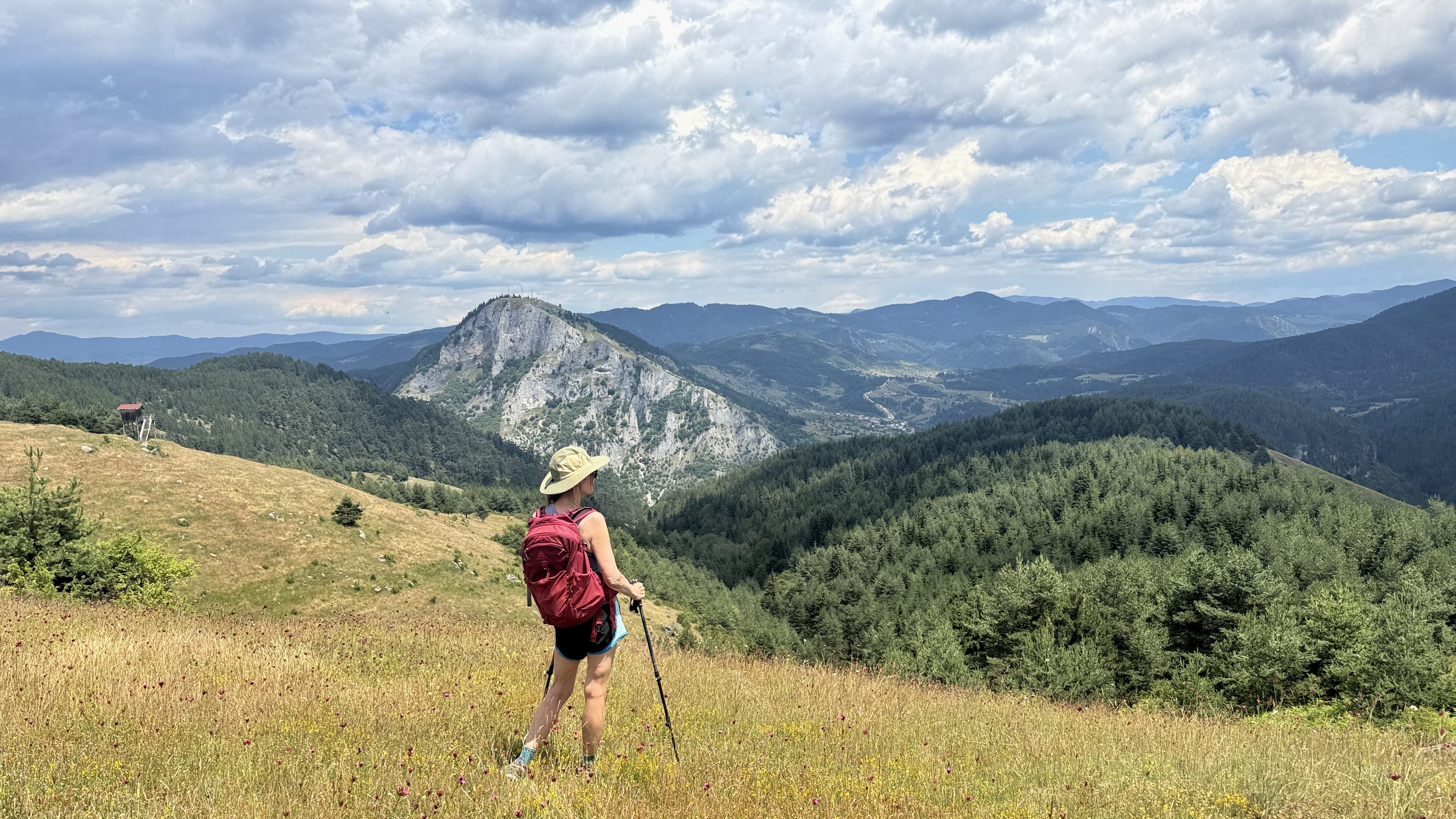
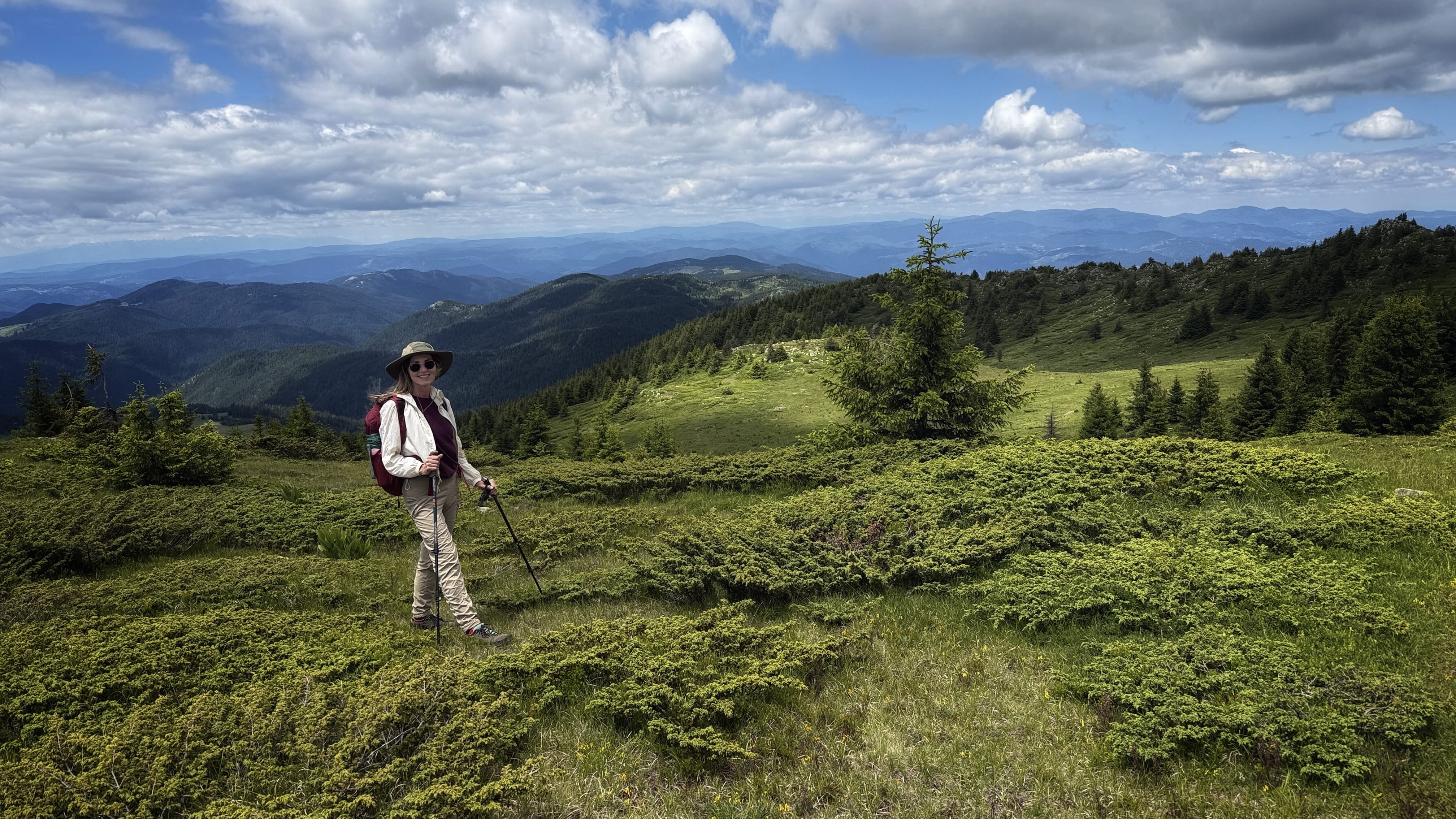
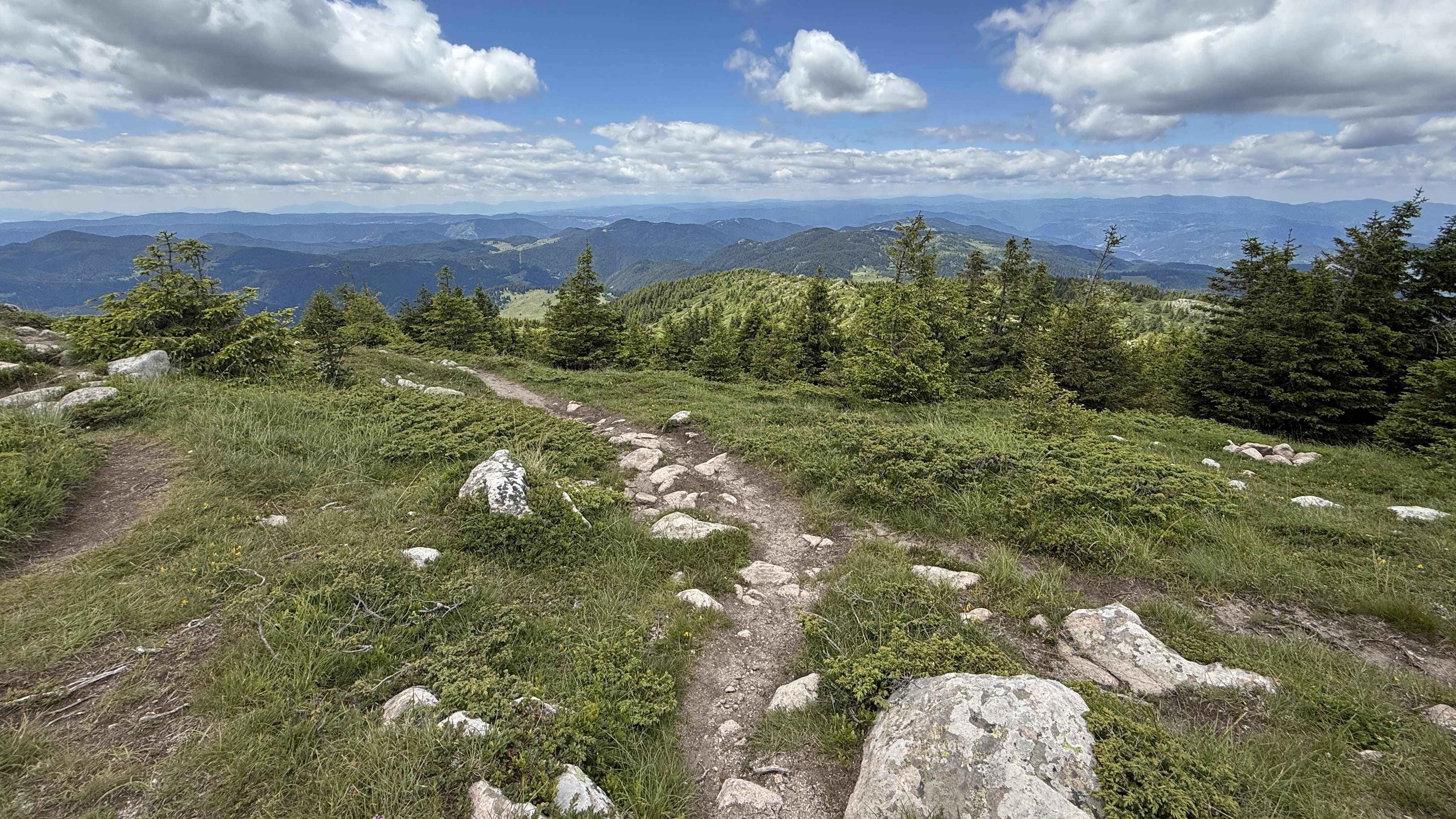
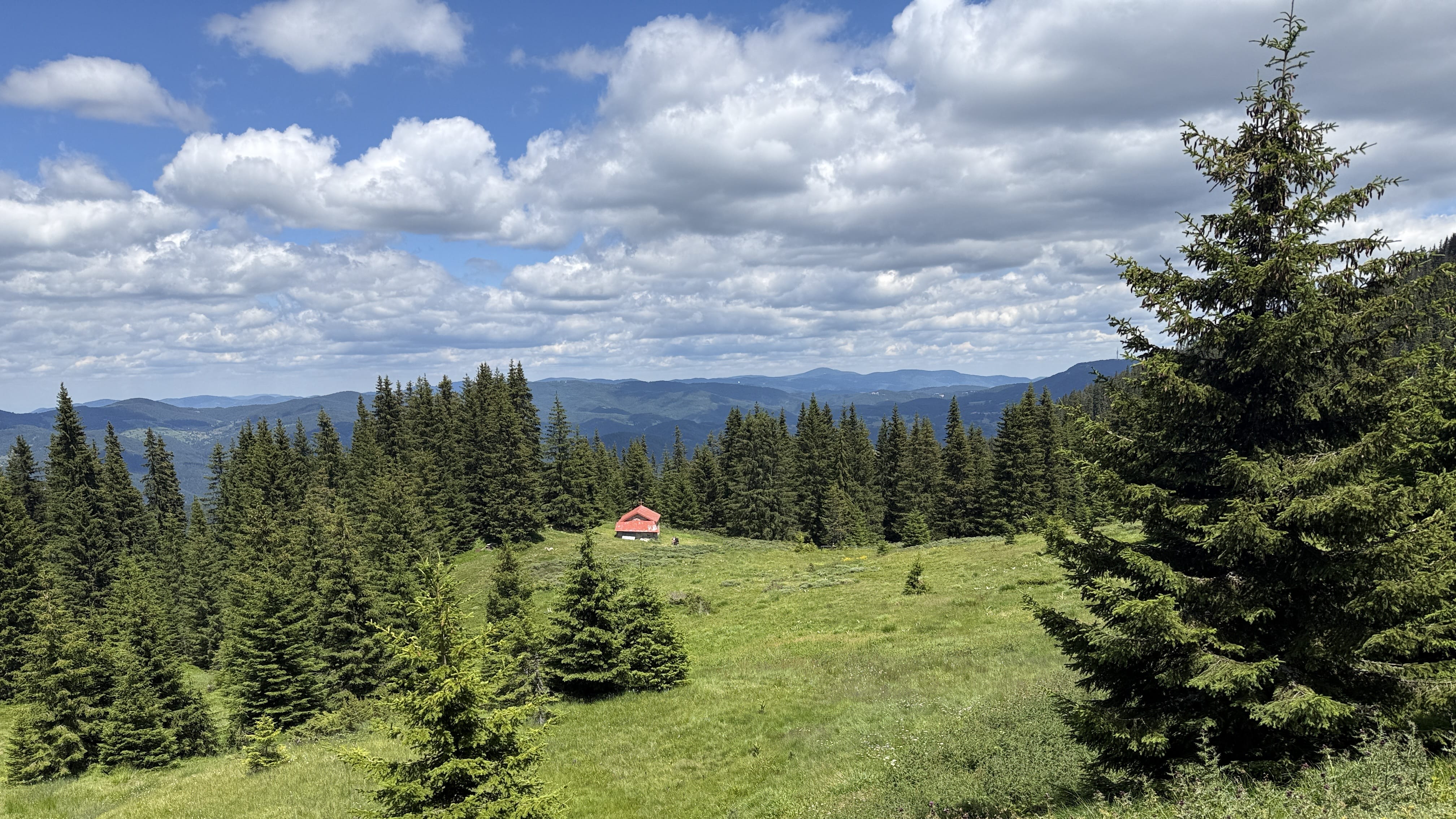
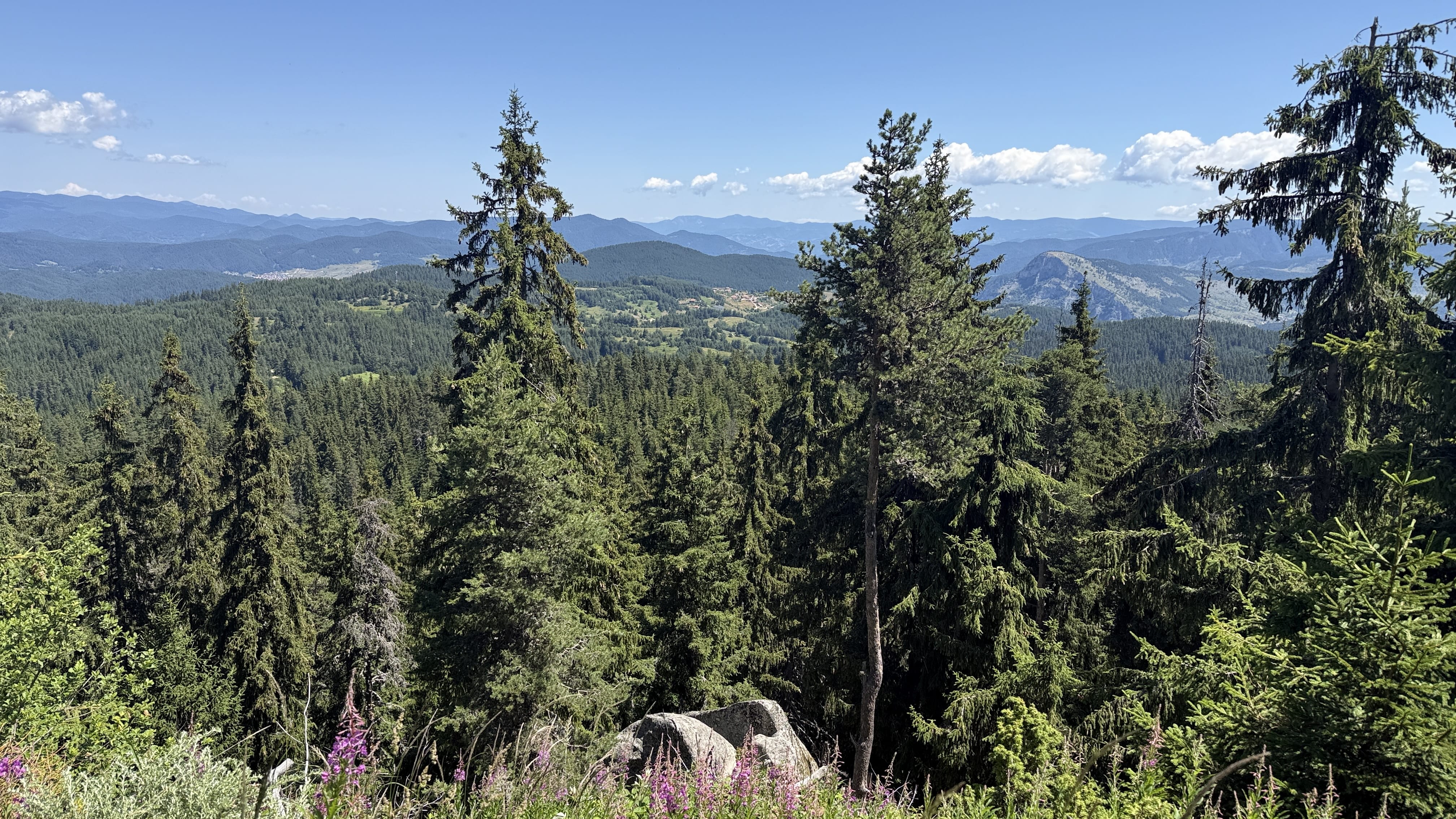
This ended up being one of my favorite hikes of the trip, even though my photos don’t really do it justice. Unlike some mountain hikes where there’s one dramatic viewpoint, the beauty here came from being completely surrounded by the Rhodopes. Rolling green mountains, spruce-covered hillsides, open meadows, and valleys stretched in every direction. For most of the day, we had the mountains almost entirely to ourselves. Over nearly 11 miles of hiking, I don’t think we passed more than four other hikers.
As we climbed higher, low juniper bushes lined the trail, and I started noticing bright yellow broom shrubs that reminded me of the gorse I’d seen while hiking in Scotland.
The wildflowers weren’t quite as abundant as they had been the previous day, although I still spotted orchids, thistles, sticky catchfly and plenty of others I couldn’t identify.
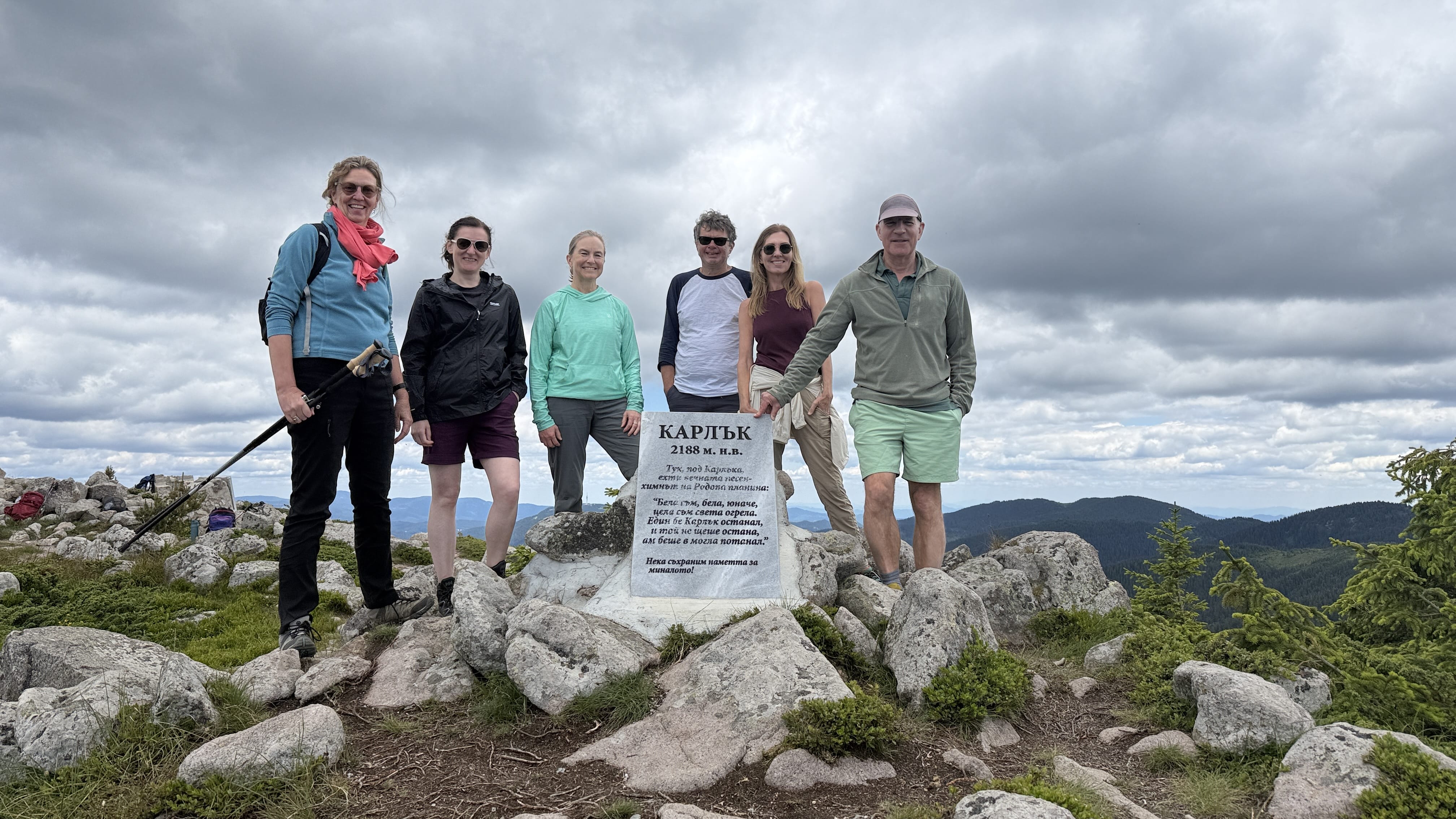
Around midday, we reached Karlak Peak at 2,188 meters (7,178 feet), where we stopped for lunch. From there, I could take in views across the mountains in every direction.
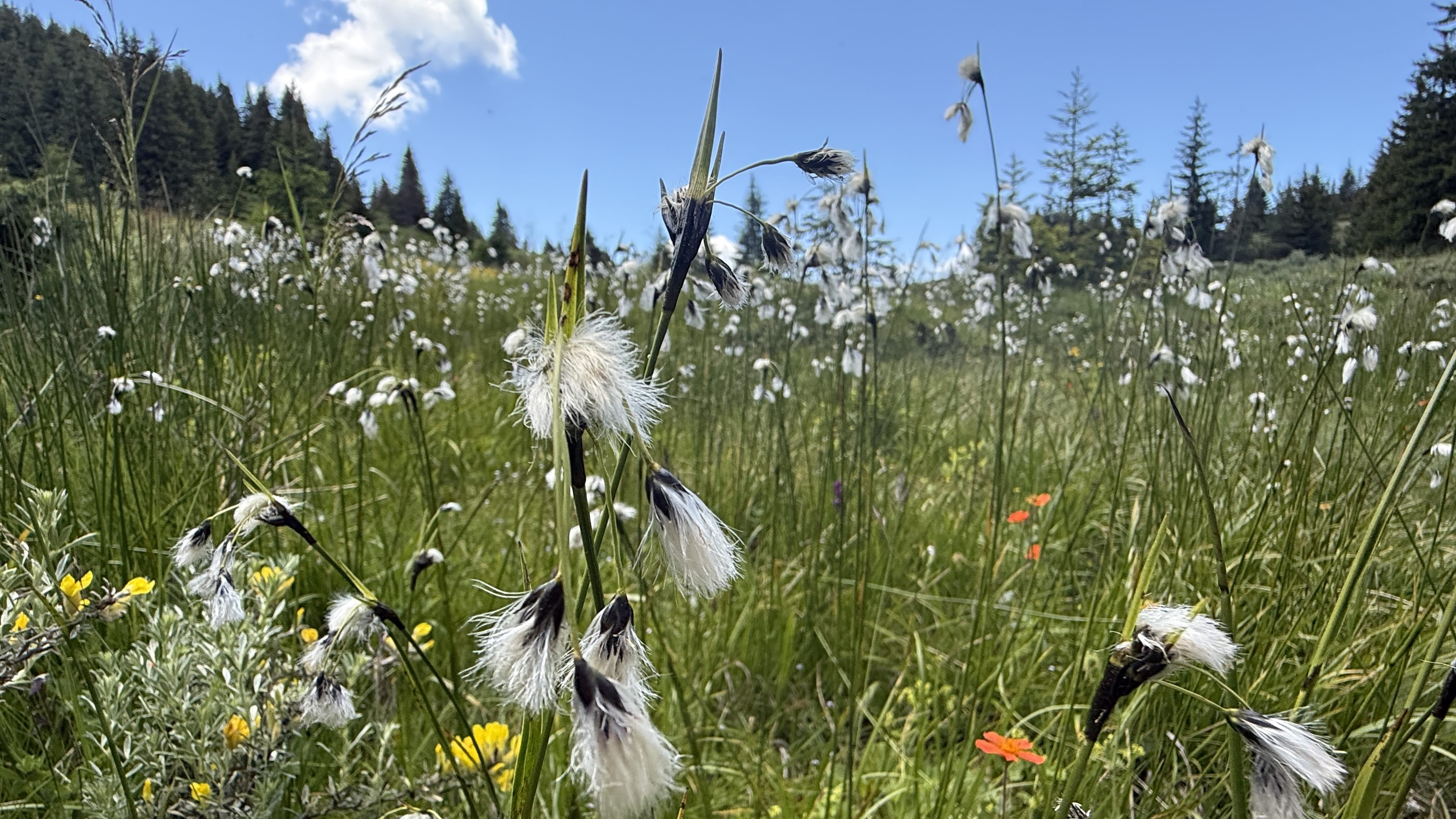
As we continued hiking, we crossed several small mountain streams. In the wetter, boggy areas, I noticed little white tufts that looked like cotton growing among the grasses. Svetoslava told me it was cottongrass, something I’d never seen before.
She also pointed out sticky catchfly, a flower I probably would have walked right past. The stems are actually sticky, which helps keep crawling insects, like ants, from reaching the flowers before pollinators have a chance to do their job.
Speaking of ants, we saw plenty of them throughout the day, along with several enormous ant mounds built from pine and spruce needles. I had no idea ant colonies could build nests that large. Most of the colony actually lives underground, with only the mound visible above the surface.
By late afternoon, we began the long descent toward the village of Gela.
Our fourth day of hiking took us back toward Gela, where the previous day’s hike had ended. Rain had been forecast for the day we were originally scheduled to do this hike, so Svetoslava moved it up a day to take advantage of the better weather.
After breakfast, we left the hotel around 9:00 a.m. for the drive back to Gela. Today’s route was about 8–9 miles and would take us through another section of the Rhodope Mountains. Along the way, we’d also learn about one of the region’s most famous legends.
Before we set off, Svetoslava explained why this trail is known as “In the Footsteps of Orpheus.” According to Greek mythology, Orpheus was a legendary musician whose music was so beautiful it could charm animals, trees, and even rocks. Although he’s best known as a figure from Greek mythology, the legend is also closely tied to the ancient Thracians, who lived throughout much of present-day Bulgaria.
The Rhodopes play a big part in the Orpheus story, and nearby Gela is traditionally believed to have been his birthplace. Later in the hike, we’d stop at an ancient Thracian sanctuary where, according to legend, Orpheus met his death.
According to legend, Alexander the Great once visited a Thracian oracle in these mountains before setting out on his military campaigns.
About fifteen minutes after leaving the trailhead, we crossed a small stream and started climbing through the pine forest—it was steady uphill for most of the morning. Every so often the trees opened up and we had views across the Rhodope Mountains. By the time we reached the summit, marked by a large Bulgarian flag, we were ready for our picnic lunch.
After lunch, we began the descent. Along the way, Svetoslava pointed out Orpheus’s Rock. Local legend says this is where Orpheus’s heart fell after it was torn in two. We also stopped at the remains of an ancient Thracian sanctuary. There isn’t a great deal left to see today, but listening to the stories while standing there made the stop much more interesting.
Farther down, the trail followed a mountain stream through the forest, where patches of yellow leopard’s-bane and blue-purple viper’s bugloss attracted butterflies and bees.
As we continued back toward the trailhead, I asked Svetoslava what she honestly thought our chances were of seeing a bear the next day. We were scheduled to spend the day tracking bears and wolves, and I couldn’t help hoping we’d actually see one.
She smiled and said, “In all honesty… not very good.”
We’d almost certainly find tracks, claw marks, or other signs that bears had been in the area, but actually spotting one was unlikely.
That reminded me of something she’d shown us on one of our earlier hikes. Hanging from a tree was a large feeder that slowly released corn to attract wild boar. Local hunters use these feeders, along with trail cameras, to monitor wildlife in the area. Since bears are sometimes drawn in by the corn as well, the hunters usually have a pretty good idea of what animals have been visiting.
“So why don’t we ask the hunters?” I suggested. “If they’ve been seeing bears in the evenings, maybe we’d have a better chance.”
To my surprise, Svetoslava said she could arrange exactly that.
After dinner that evening, a few local hunters would take us by jeep to one of their observation hides overlooking the forest. We’d quietly wait and see what appeared. There were no guarantees. We might only see wild boar—or we might see nothing at all. But if I was going to see a wild European brown bear in Bulgaria, this would probably be my best chance.
Needless to say, I didn’t hesitate to say yes. Two others from our group signed up as well, and suddenly I had something new to look forward to once our hiking day was over.
Little did I know the day’s biggest adventure was still ahead.
Then…
Read next: An Evening with a European Brown Bear in Bulgaria
Our fifth day of hiking was all about tracking bears and wolves. We hiked roughly 10 miles through the forests surrounding Yagodina, searching for signs of the animals rather than expecting an actual sighting. Our guide pointed out tracks, places where animals had crossed, and explained how to recognize clues that wildlife had recently passed through.
One of the highlights came when we realized we’d hiked into the very same meadow we’d driven through the night before on our way to the bear hide. We even walked to the exact spot where Caroline, Megan, and I had spotted the Eurasian brown bear. Standing there in broad daylight felt completely different from watching it through binoculars the evening before. We searched for tracks or other signs the bear had left behind, but nature had already done a good job of erasing the evidence.
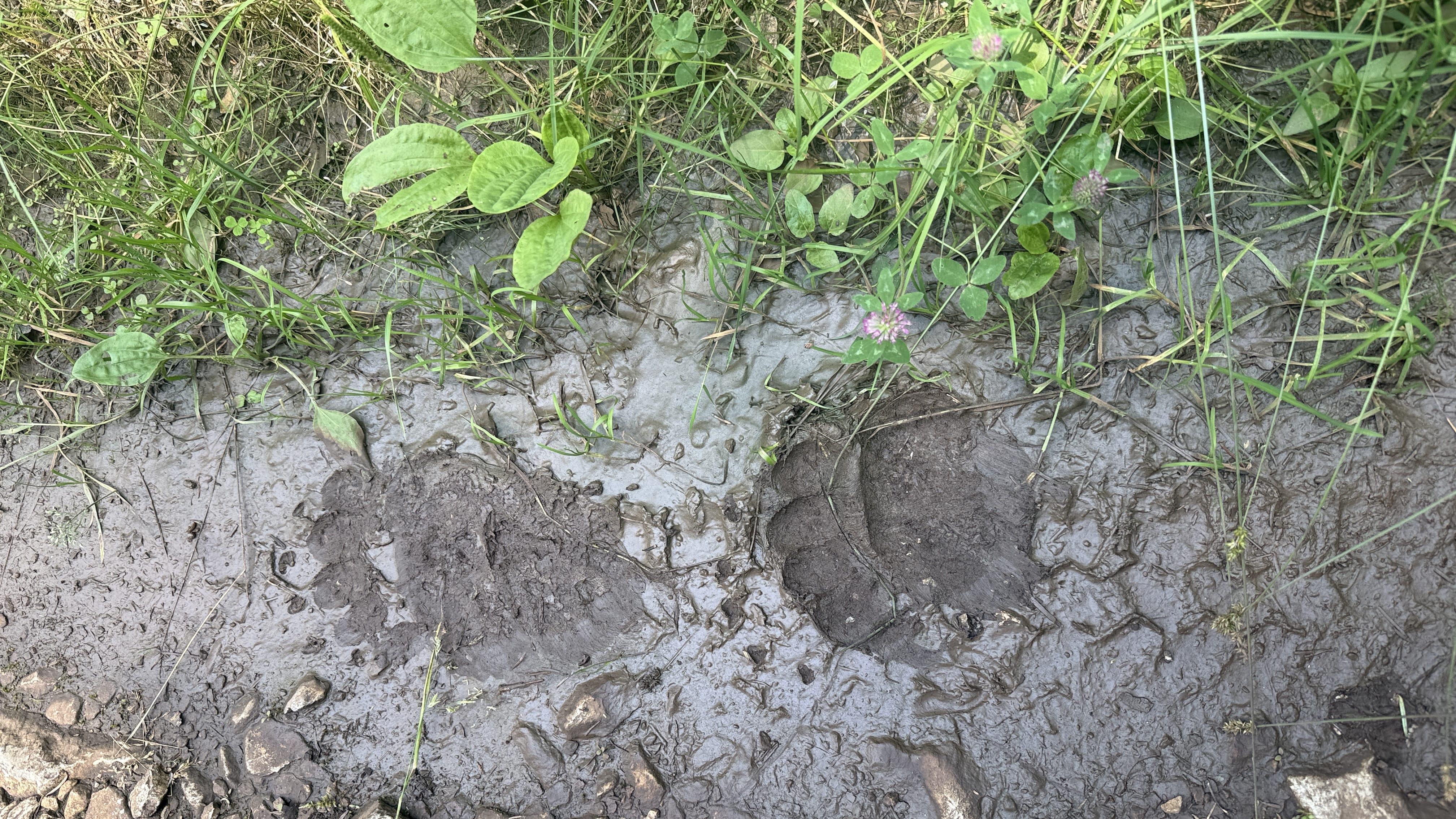
Later in the hike, though, we did come across several sets of bear prints in the mud. So even if that meadow had gone quiet, there was no question the bears were moving through the area.
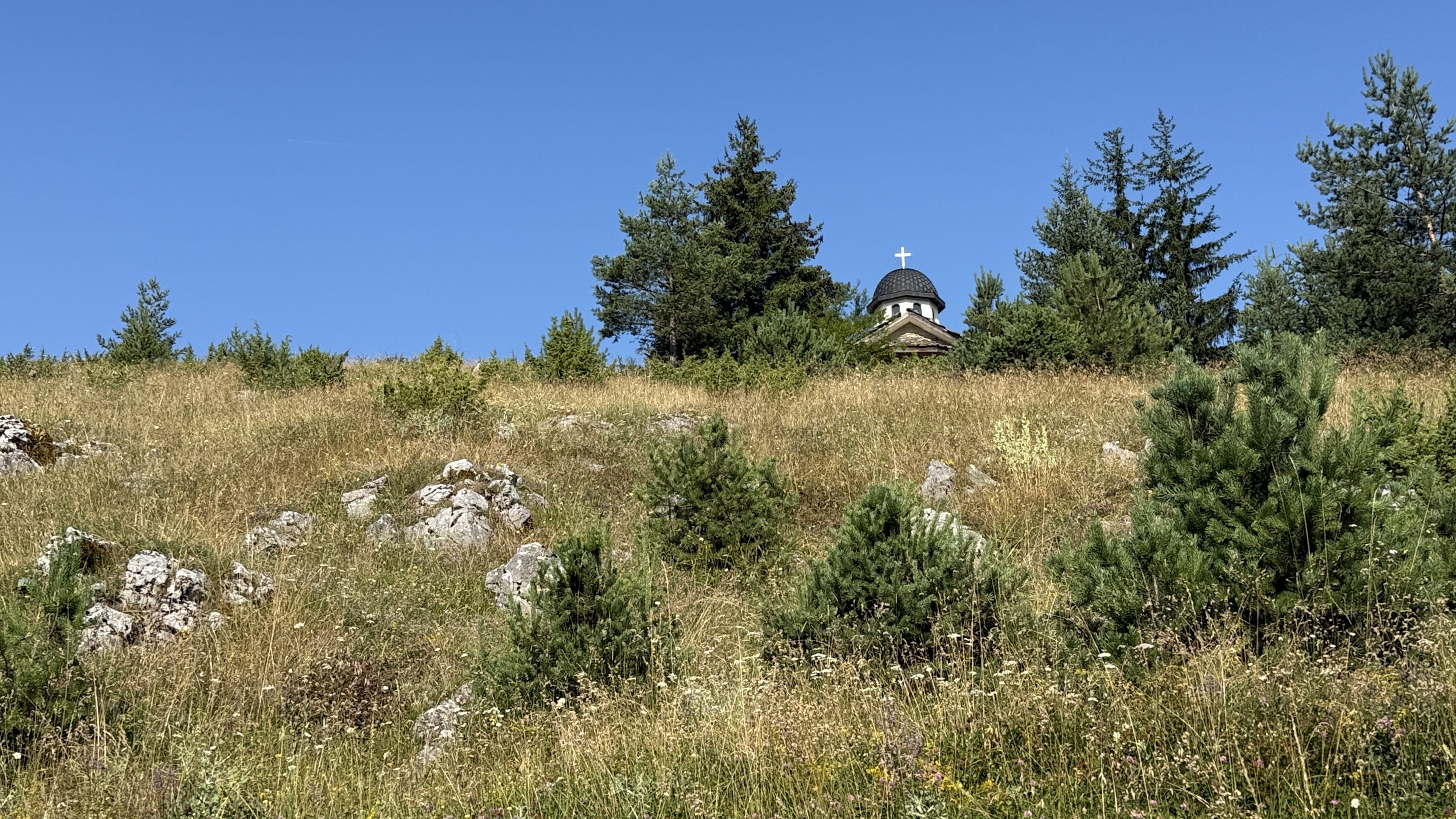
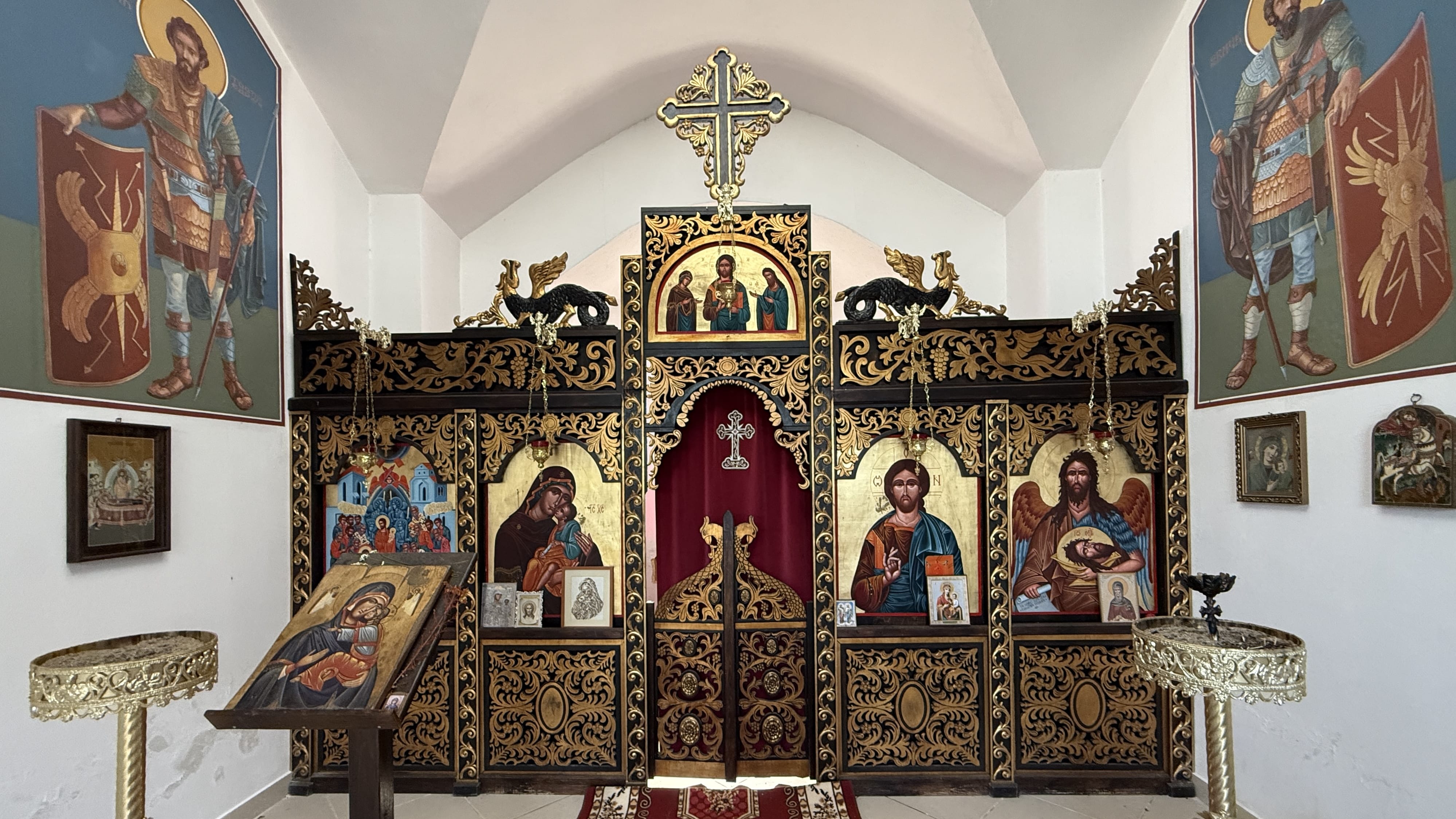
Early in the hike, we stopped at the tiny Orthodox Church of St. Elijah (Sveti Iliya) above Yagodina. It was so small there weren’t even any pews inside—just enough room for a handful of worshippers. That’s actually common in Orthodox churches, where people traditionally stand during the service rather than sit.
What immediately caught my eye was the beautifully carved wooden iconostasis—the ornate screen covered with icons that separates the sanctuary from the rest of the church.
Our guide explained that the village’s main mosque serves the area’s Muslim population, while this little church serves the Orthodox Christian community. In this part of the Rhodope Mountains, Christian and Muslim communities have lived alongside one another for generations.
The rest of the hike took us through forests and out to overlooks above Buynovo Gorge. Looking across the limestone cliffs and green mountains, it wasn’t hard to see why bears, wolves, chamois, and so many other animals continue to thrive in this part of Bulgaria.
Our sixth and final day of hiking began with an early breakfast before we loaded our bags into the van, said goodbye to Yagodina, and set out on foot for one last hike. Leaving the village, we climbed past the meadow where the annual summer music festival is held before joining the Chamois Trail, named for the Balkan chamois that make their home on the steep limestone cliffs surrounding Yagodina.
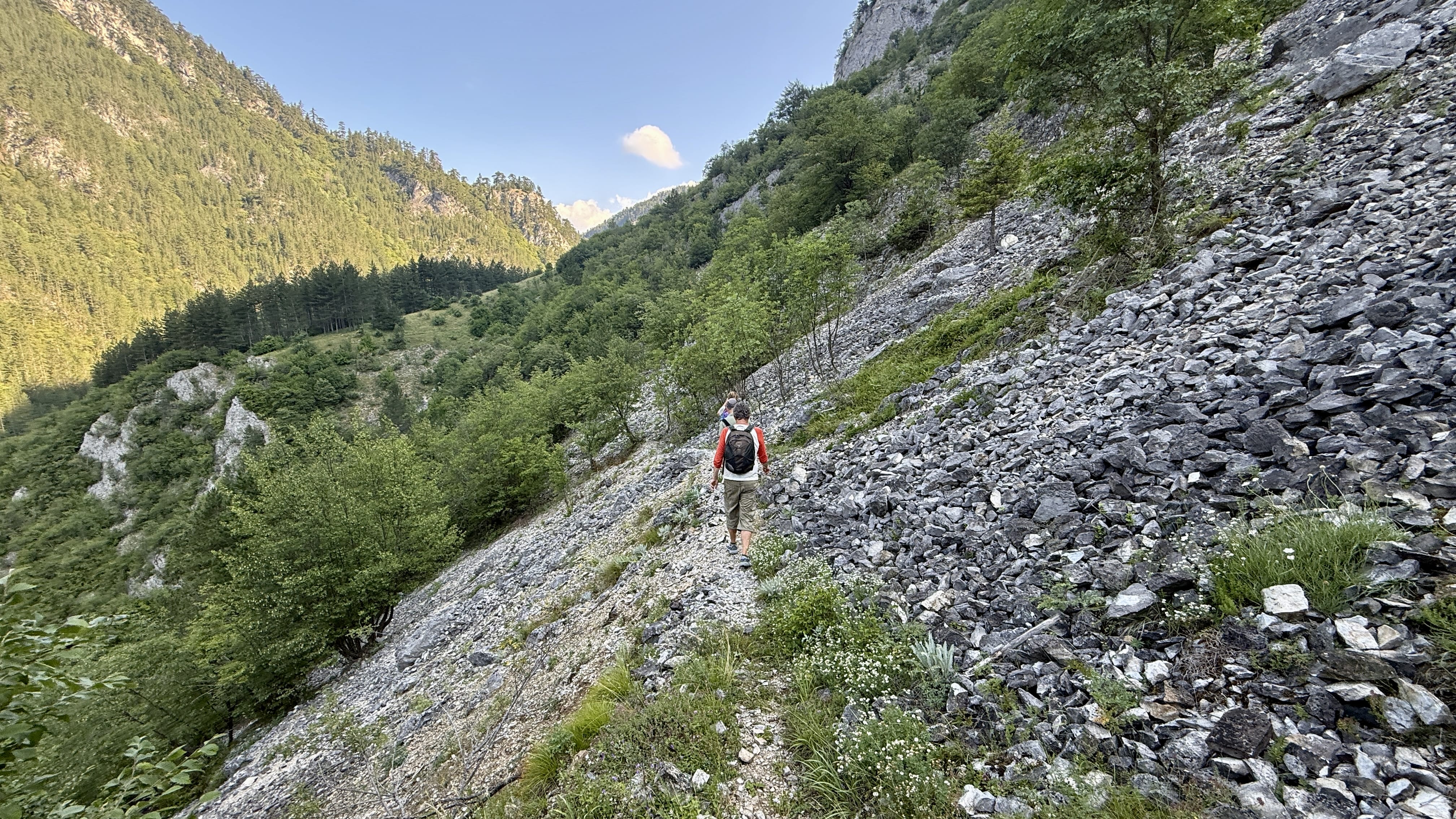
The trail wrapped around the mountainside, beginning with views back toward the village before narrowing into a rocky path carved into the hillside. At one point, we crossed a scree slope where loose limestone rocks had tumbled from the cliffs above. Every step required a little extra attention as the rocks shifted beneath our feet. In other places, the trail hugged the mountainside, with steep drop-offs into the valley below and towering cliffs above us. This was definitely chamois territory.
Eventually, the trail disappeared into the forest, where a thick blanket of leaves hid the rocks and roots beneath our feet. In some ways, those sections required even more concentration because you never quite knew what you were stepping on. One of my favorite parts of the hike was noticing tiny wildflowers and hardy plants somehow growing straight out of cracks in the limestone.
The final descent was steep, loose, and surprisingly slippery, and I was more than happy to have my trekking poles as we carefully picked our way down the mountain.
Back at the van, we began the roughly 3½-hour drive to Sofia, making one final stop at the Mihalkovo Spring House. The village is famous for its naturally carbonated mineral spring, and judging by the number of locals filling jugs and bottles, it’s clearly the place to come for fresh mineral water. Of course, I had to try it for myself. The water was lightly fizzy with a noticeable mineral flavor and a faint chalky aftertaste—definitely unlike any bottled mineral water I’d ever tasted.
As we continued toward Sofia, I found myself thinking about the past week. What I appreciated most about hiking in the Rhodope Mountains was how different each day had been. We followed old Cold War border trails, climbed high ridges, passed through tiny mountain villages, learned about Thracian legends, searched for signs of bears and wolves, and even stepped inside a tiny mountain church.
By the time we returned to Sofia, I felt like I’d gotten to know a very different side of Bulgaria. The Rhodope Mountains aren’t one of Europe’s big-name hiking destinations, and maybe that’s part of what I liked about them. We could hike for miles without seeing more than a handful of other people, and every day seemed to bring something completely different.
If you’re planning a trip to Bulgaria or simply want to read more about my time there, you might also enjoy these posts:
I’m always planning the next trip—and usually finding a few unexpected places along the way. Sign up to get my latest Travelsafoot posts and travel stories by email.

Hi, I’m JoAnne—writer, wanderer, and lover of places that surprise me. I’ve traveled to 60+ countries (and counting), usually with a camera in one hand and a notebook in the other. I’m drawn to mosaics, markets, and mountains, and I write to remember what moved me. When I’m not traveling, I’m working on my blog Travels Afoot, trying new creative projects, or planning my next adventure.