I’ve been to Delhi numerous times, but this visit was just a two-day layover before heading to Bhutan. Since I had the day free, I figured I’d try something different — something slower. I was originally thinking about getting a regular massage, but when I started Googling places, I kept seeing references to Ayurvedic massage. I knew Ayurveda was big in India, but I’d never tried it before. And I thought, well, if I’m going to do it anywhere, this is the place.
And honestly, trying an Ayurvedic Massage in Delhi felt like the right way to slow down and reset after so many hours of travel.
If India is known for anything beyond its color and chaos, it’s balance — and Ayurveda is one of the oldest systems built around that idea. The word itself means “knowledge of life.” It’s a 5,000-year-old medical tradition that sees health not just as the absence of illness but as harmony between body, mind, and spirit. Everything in Ayurveda is about restoring that balance — through food, herbs, breath, and touch.
Since I arrived very early this morning — around 12:30 a.m. — and didn’t get to sleep until close to 3 after passport control and unpacking, I decided today would be an easy one. No sightseeing marathons, just rest and a bit of care. I found a place called Dr. Sudha’s Ayurveda Kendra — a well-known center in Safdarjung Enclave, South Delhi, where people come for both wellness and medical treatments.
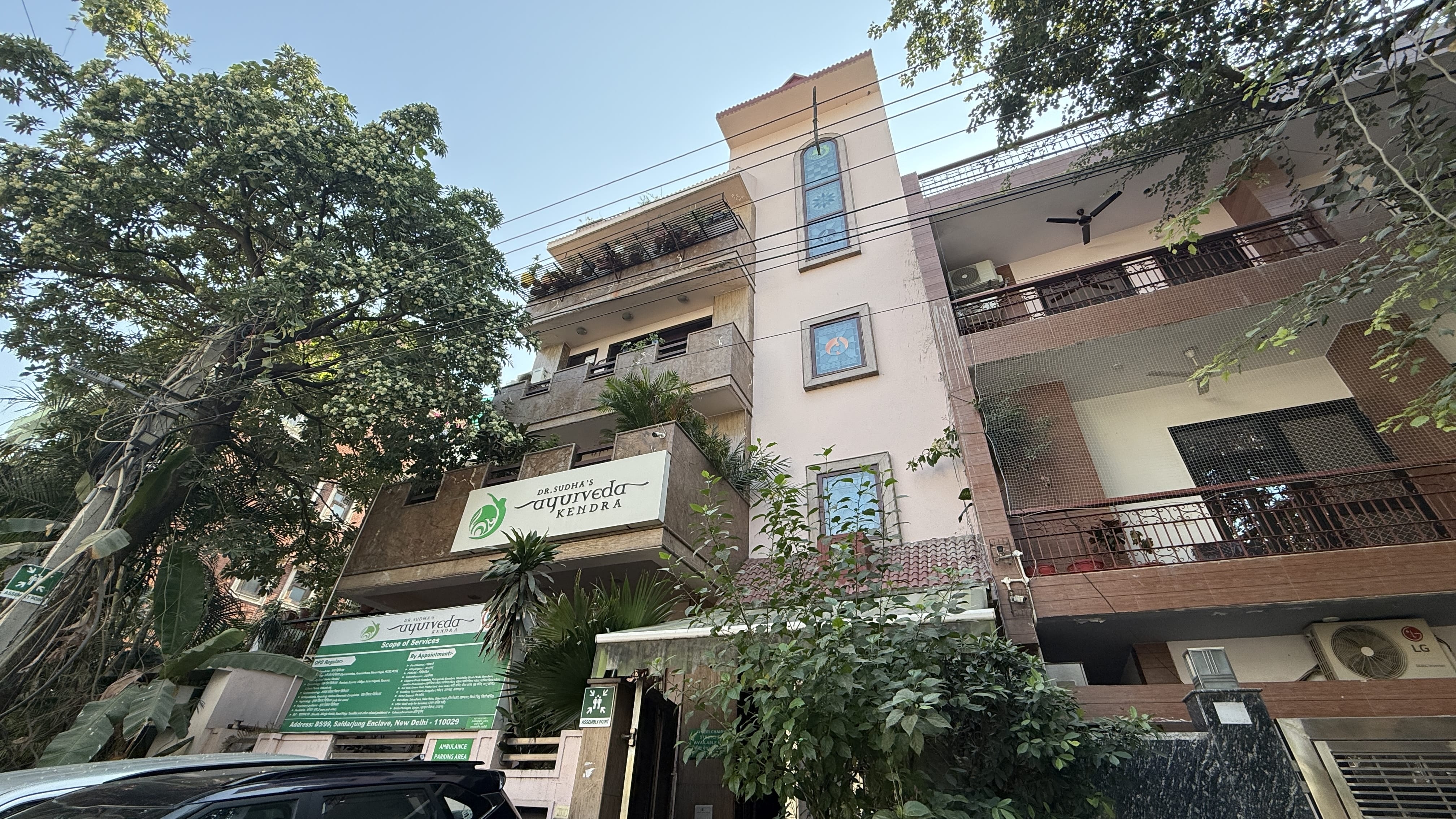
It’s not a hotel spa with a token “Ayurvedic” menu for tourists, but a working clinic founded in 1990 by Dr. Sudha Asokan, whose family has practiced Ayurveda in Kerala for generations. They follow traditional protocol: female therapists for female guests, consultations to determine your body type, and oils prepared from classic Ayurvedic recipes.
When I woke up, I sent a WhatsApp message to see if the clinic had any openings — and lucky me, they did. I didn’t have a set plan for the day, just the sense that I needed to slow down. Between jet lag, travel stress, and too many airports, my mind felt scattered, and I figured an Ayurvedic massage might help. I grabbed an Uber (super easy and convenient here) and headed out for the 25-minute ride to the center.
They offered several different treatments, but I decided on Abhyangam, the classic full-body 90-minute Ayurvedic oil massage. It’s less about deep pressure and more about long, rhythmic strokes — a treatment meant to calm the body’s energy, improve circulation, and bring the doshas back into balance.
If you’re trying an Ayurvedic Massage in Delhi for the first time, Abhyangam is usually the traditional starting point — simple, grounding, and deeply restorative.
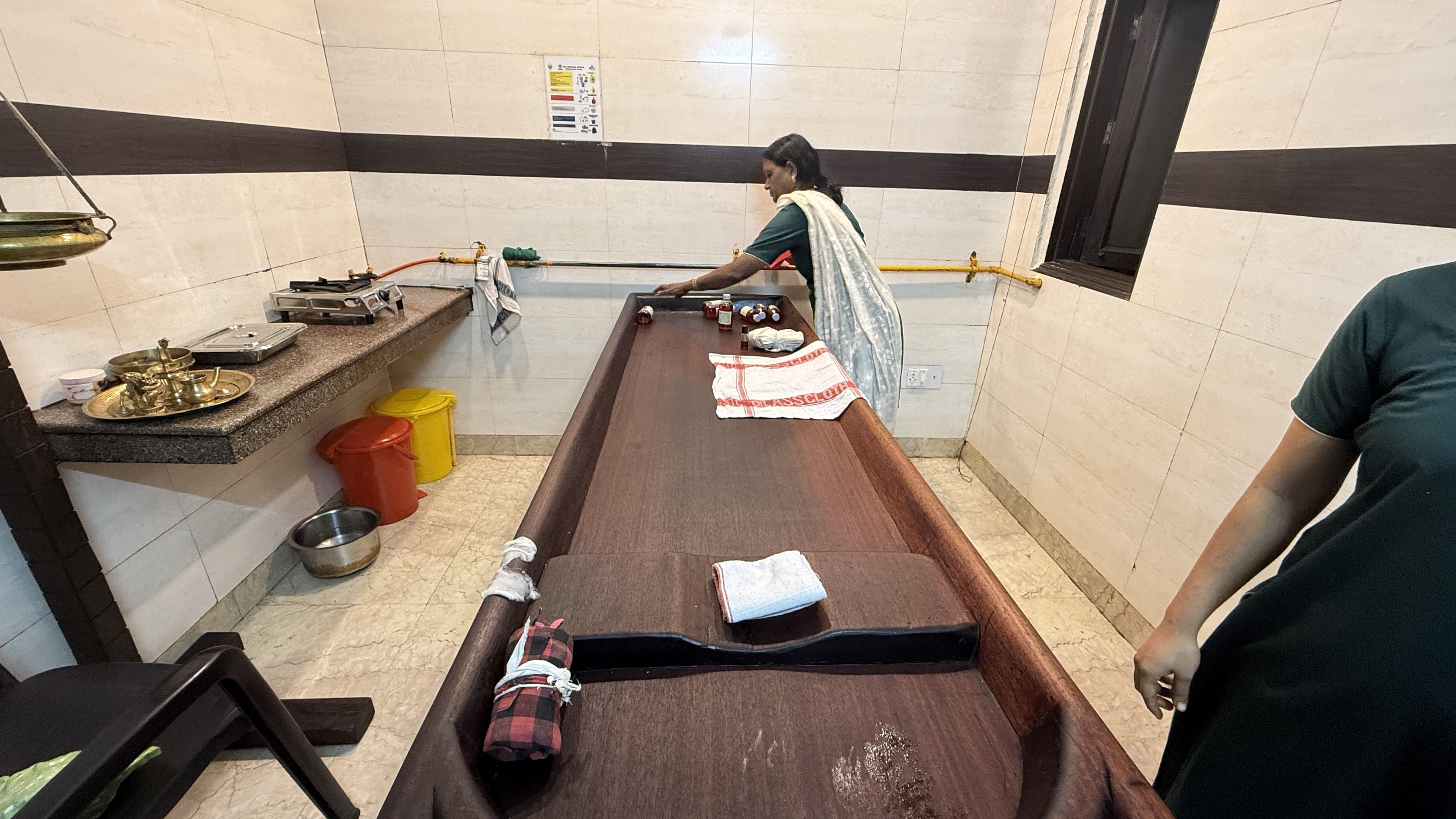
At my appointment time, I was led into a small treatment room where a large wooden table stood in the center. It wasn’t a regular massage bed but a traditional Ayurvedic table called a droni — carved from a single piece of wood with raised sides to collect the oil. Imagine something like a long, shallow trough — almost like one of those old wooden olive trays — smooth, slightly curved, and built to let the oils flow and be gathered again for reuse during the treatment.
I was expecting just one attendant, but there were three. I’d completely forgotten that the massage was a four-hand treatment — one woman on each side of me, working in perfect rhythm, while a third stood nearby tending to a small electric stove where she kept heating the oil to the perfect temperature for the session.
But I’m getting ahead of myself.
When I was led into the room, communication was more gestures than words. One of the women motioned for me to remove all my clothes. I mean, I knew that was coming — I’ve stripped down for hammams in Morocco, a sulfur scrub in Georgia, and a few other cultural treatments over the years. I actually love these kinds of experiences — the chance to see how different places approach wellness and ritual. But still, walking into a small room with three women standing there waiting for you to undress feels… very immediate.
After I’d done so, one of them tied a thin cotton string around my waist, then threaded a narrow piece of gauze-like fabric through it — from front to back — and tucked it in. So technically, I wasn’t completely nude. It was sort of like a homemade version of disposable underwear, though “underwear” might be a generous word for it. I had to smile at the practicality of it all — part modesty, part tradition, part well, this is happening.
And while I’m at it, I’ll admit — part of me felt a little self-conscious. Not for any big reason, just that quick awareness we all get sometimes — of flaws, of being seen, of being human. It’s not like these women cared; they do this all day. But in your own head, it flickers for a second, until the warm oil hits your skin and the thought just… slips away.
I’m sharing all this because if anyone else ever considers trying it, you’ll know exactly what to expect. It’s not awkward once you surrender to the process — and the women are professionals who do this every day.
Once everything was ready, I was asked to sit on the edge of the wooden table, feet hanging down. The lead therapist motioned for me to bring my hands together in prayer, and the other two attendants did the same. The lead woman said a short prayer in Sanskrit before beginning — soft and melodic, like a blessing over the treatment. Somewhere behind us, that low, steady chanting had already started — easy to miss at first, more atmosphere than music.
When she finished, one of the attendants began pouring warm oil across my scalp and massaging it in small, slow circles. She took her time — maybe ten minutes — working it into my temples and down to my neck. Once she was done, she twisted my hair into a bun and applied a paste the color of chili powder — an herbal mask made from powdered roots and oils.
Then came the main part of the treatment. The music shifted into that steady, trance-like Indian chanting — repetitive but calming, the kind that settles into your body before you even realize it.
I lay back on the table, face up, while two women began to work in perfect synchrony. Their movements were long and rhythmic — sometimes light and sweeping, sometimes pressing deeply with the palms of their hands. Between motions, the third woman dipped thick cotton cloths (called kizhi or boluses) into freshly heated oil and passed them to the others.
The oil was hot — just this side of scalding — and it felt incredible. The women would ball the soaked cloths and press them firmly into my skin, then unroll them and drape the warm fabric across different sections of my body before moving on. At other times, they used their hands again, repeating the rhythmic movements in unison — up the arms, down the legs, across the chest — never breaking pace.
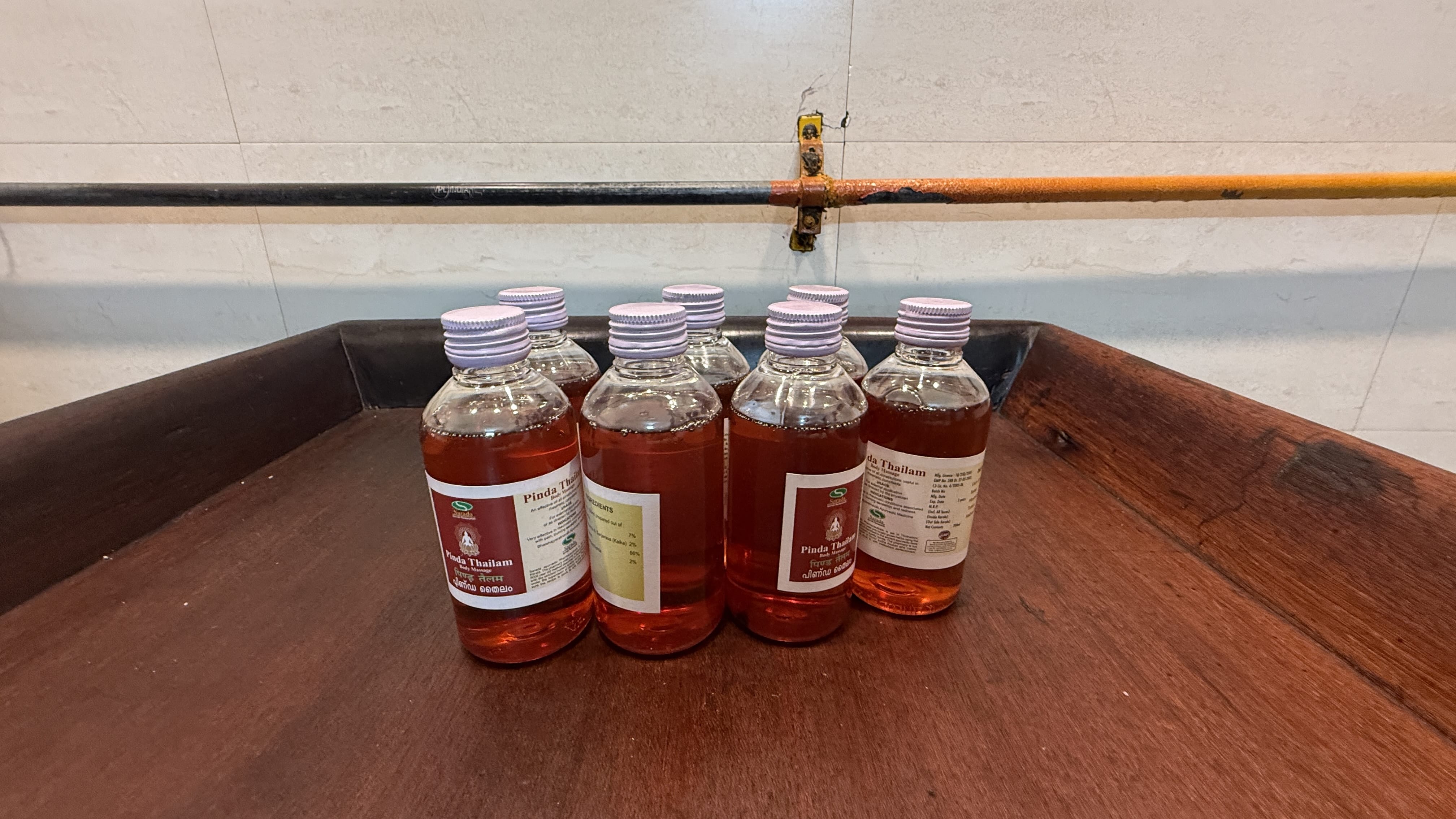
The oil they used was called Pinda Thailam, a reddish herbal oil meant to ease muscle tension and improve circulation.
Before turning me over, one of them gestured for me to slide my leg up and down several times, almost like a gentle stretch. Then I turned onto my stomach, and they repeated the same sequence on my back. By that point, my mind had drifted somewhere between sleep and awareness.
The music playing in the background wasn’t the usual spa kind. It was more hypnotic — that steady, almost trance-like Indian music with drums and soft chanting. Not devotional music, exactly, but it had that same meditative, rhythmic feel that just pulls you in.
When it was over, the women carefully wiped away the pools of oil from the table and began patting my skin with clean white cloths — like dishtowels, but softer — to remove the excess oil. There was still a faint sheen left on my skin, which they told me to keep on for a few hours.
I was helped to sit up and handed a light cotton wrap — almost like a short mumu — and a pair of flip-flops. Another attendant lit a stick of incense and had me inhale deeply a few times before leading me across the hall for a short steam bath. Before stepping inside, she made sure I drank an entire bottle of water.
After about ten minutes in the steam, I dried off, got dressed, and thanked them all. They reminded me to rest and let the oil stay on my skin as long as possible before showering. I managed about an hour — I tried to relax as instructed, but eventually had to get moving for the Indian cooking class I’d booked later that afternoon.
As first experiences go, my Ayurvedic Massage in Delhi was grounding, calming, and surprisingly emotional in a way I didn’t expect.
I may not have reached the calm detachment of a true Ayurvedic devotee, but I walked out feeling looser, lighter, and just a little bit glossier than when I went in — and sometimes that’s all a day needs to be.