
2 Days in Delhi: Easing In with Ayurveda, Cooking, and Old Delhi Life

I’ve been to Delhi a few times now, and every visit feels a little different. That’s the thing about this city — it never runs out of layers. You can come for food, culture, history, spirituality, or the pure energy of Old Delhi, and there’s always something new to discover or rediscover.

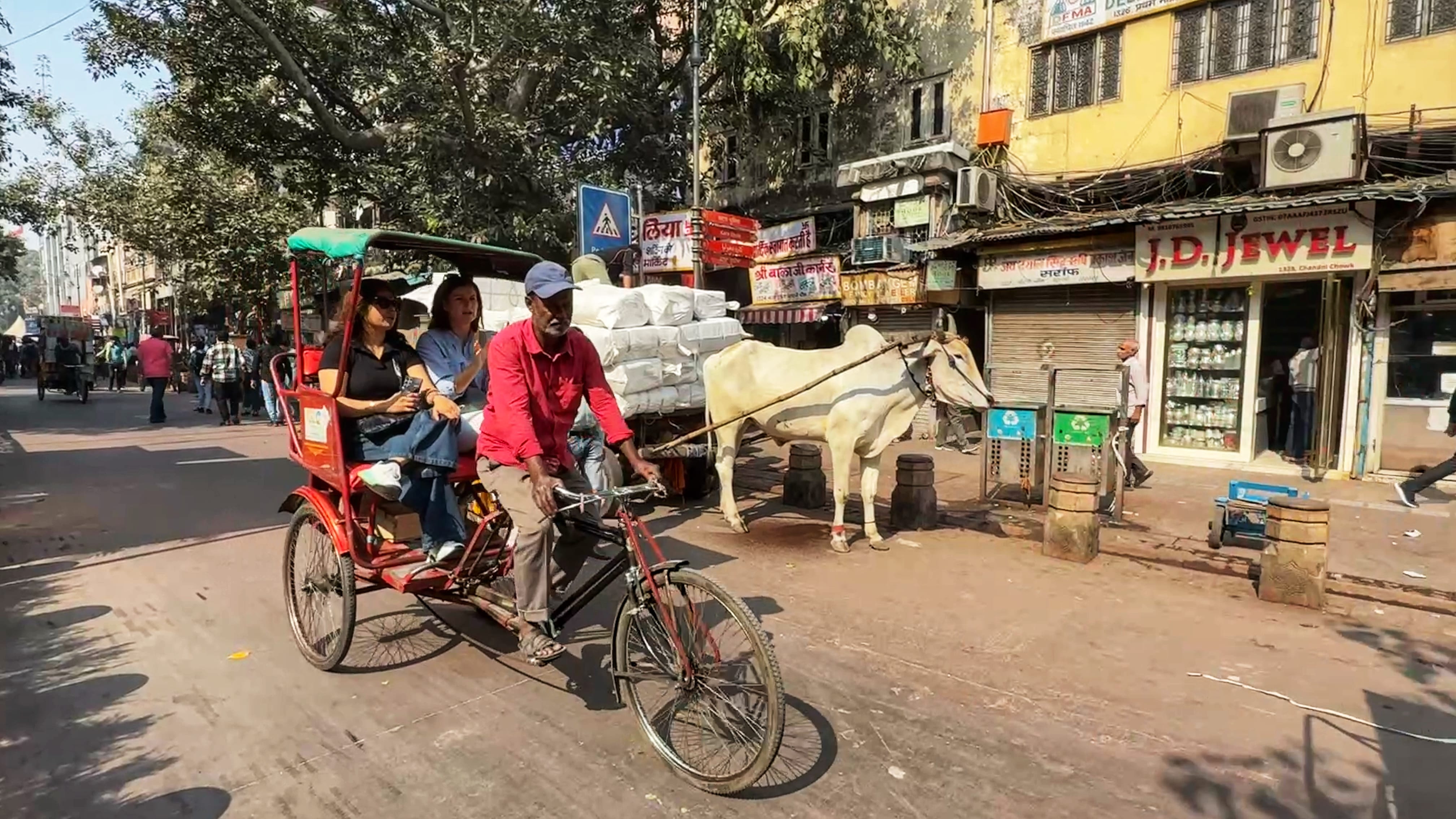
Rickshaw ride through Old Delhi streets during my 2 Days in Delhi itinerary, with cows, vendors, and local shops in the background.
A typical street scene in Old Delhi.

This time, I wasn’t trying to “see everything.” I only had two days before heading to Bhutan, and after a long flight from the States, all I wanted was something slower—something that let me ease in, stay curious, and try a few new things: an Ayurvedic treatment, a home cooking class, and a quieter walk through places I’d seen before.

Even after several visits, Delhi still surprises me. It’s one of those cities where calm and chaos live side by side — and you can experience both in the same morning.

Even with such a short window, I wanted this visit to feel grounded. Instead of racing through a checklist, I focused on experiences that felt personal—wellness, food, and revisiting Old Delhi with fresh eyes. 

Quick Snapshot: What My 2 Days in Delhi Actually Looked Like

Ayurveda, a home cooking class, chai in clay cups, photographing doorways in Old Delhi, and wandering into places I’d somehow never visited before. Here’s the short version before the full story.

Day 1

  • Late arrival and rest
  • Ayurvedic treatment at Dr. Sudha’s Ayurveda Kendra
  • Afternoon home cooking class in Uttam Nagar
  • Market walk with the instructor
  • Back to the hotel early (jet lag was real)

Day 2

  • Jama Masjid
  • Morning markets around Chandni Chowk
  • Wedding Market + Naughara Lane
  • Digambar Jain Temple
  • Street snacks – jalebi, samosas, paratha thali
  • Chai served in clay cups
  • Khari Baoli spice market
  • Press Enclave Dhobi Ghat (“Washermen Street”)
  • Agrasen ki Baoli stepwell
  • Purana Qila + Qila-e-Kuhna Masjid
  • Lotus Temple (from the outside – interior was closed)
  • Lodhi Art District

Day 1 in Delhi: Ayurveda, Cooking, and Easing Into the City

Since I was flying from the States, the travel day felt endless — not just the flight itself, but everything around it. The drive to the airport, the layovers, passport control, the late-night arrival… by the time I finally reached my hotel in Delhi, it was after 3 a.m. I took a long, hot shower just to wash off the travel and told myself that my “first day” — also my arrival day — would stay easy.

Ayurvedic Treatment

After a few hours of sleep, I woke up feeling like a massage might be a good idea. I’d never had one in India, and as I started Googling spas, Ayurvedic massage kept popping up. I’d honestly forgotten how deeply India is tied to Ayurveda, and suddenly the idea of a regular massage felt boring in comparison. How often am I actually in India?

I wanted a real, local experience — not a hotel spa’s “Ayurvedic-inspired” version — so I messaged Dr. Sudha’s Ayurveda Kendra in Safdarjung Enclave. It’s a well-known center (not fancy, very local) founded in 1990 by Dr. Sudha Asokan, whose family has practiced Ayurveda in Kerala for generations. They had a noon opening, so I took it.

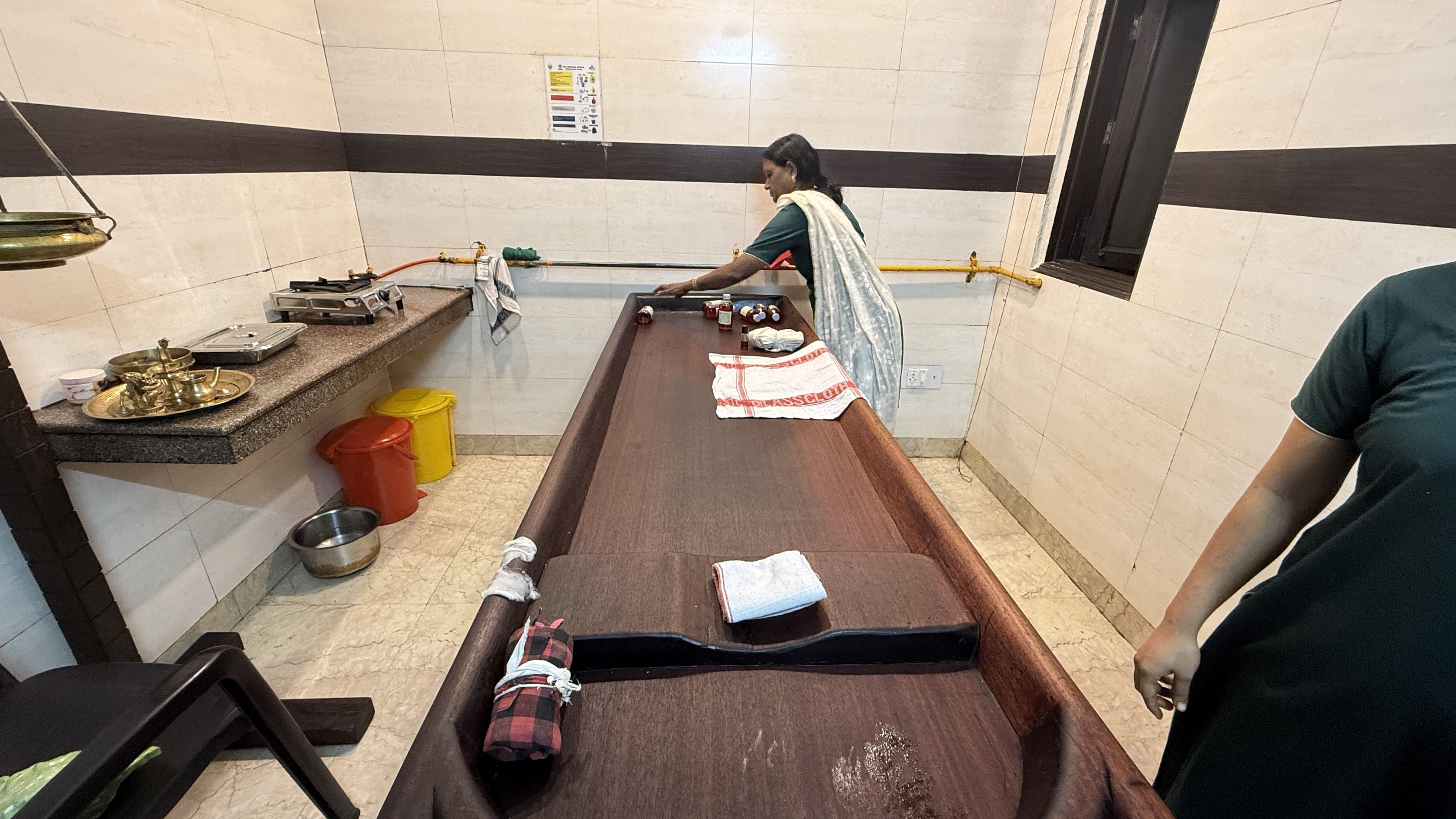
Ayurvedic therapist preparing a traditional wooden droni massage table at Dr. Sudha’s Ayurveda Kendra in Delhi, with oils, boluses, and towels set out for an Abhyangam treatment fro my The outside of Dr. Sudha’s Ayurveda Kendra in South Delhi — not a hotel spa, but a working Ayurvedic clinic where many people come for an Ayurvedic Massage in Delhi —Ayurvedic spa included in this 2 Days in Delhi itinerary
Inside the treatment room at Dr. Sudha’s Ayurveda Kendra.

This was also my first time using Uber in India, and it was great — reliable and surprisingly easy. The drive took me through a part of Delhi I hadn’t explored before, so in a funny way, the ride itself felt like part of the experience.

I actually wrote a separate post about the full Ayurvedic treatment (read: My Ayurvedic Massage Experience in Delhi), but in short: warm oil, rhythmic movements, and being fully exposed because that’s how the therapy works.

I left the center lightly coated in oil, with instructions to avoid showering for at least two hours and to rest and hydrate. I had exactly two hours, because before leaving the hotel that morning, I had also booked another first for me in India — an afternoon cooking class.

Authentic Cooking Class

It already felt like a day of firsts—starting with the Ayurvedic massage and even my first Uber ride in India—so I decided to keep going. I booked an afternoon Indian cooking class on Viator, and the host accepted my same-day request because I was within the three-hour window before the start time. Preeti, the instructor, confirmed quickly and was waiting for me when I arrived in Uttam Nagar — an area I’d never visited before (another first for the day).

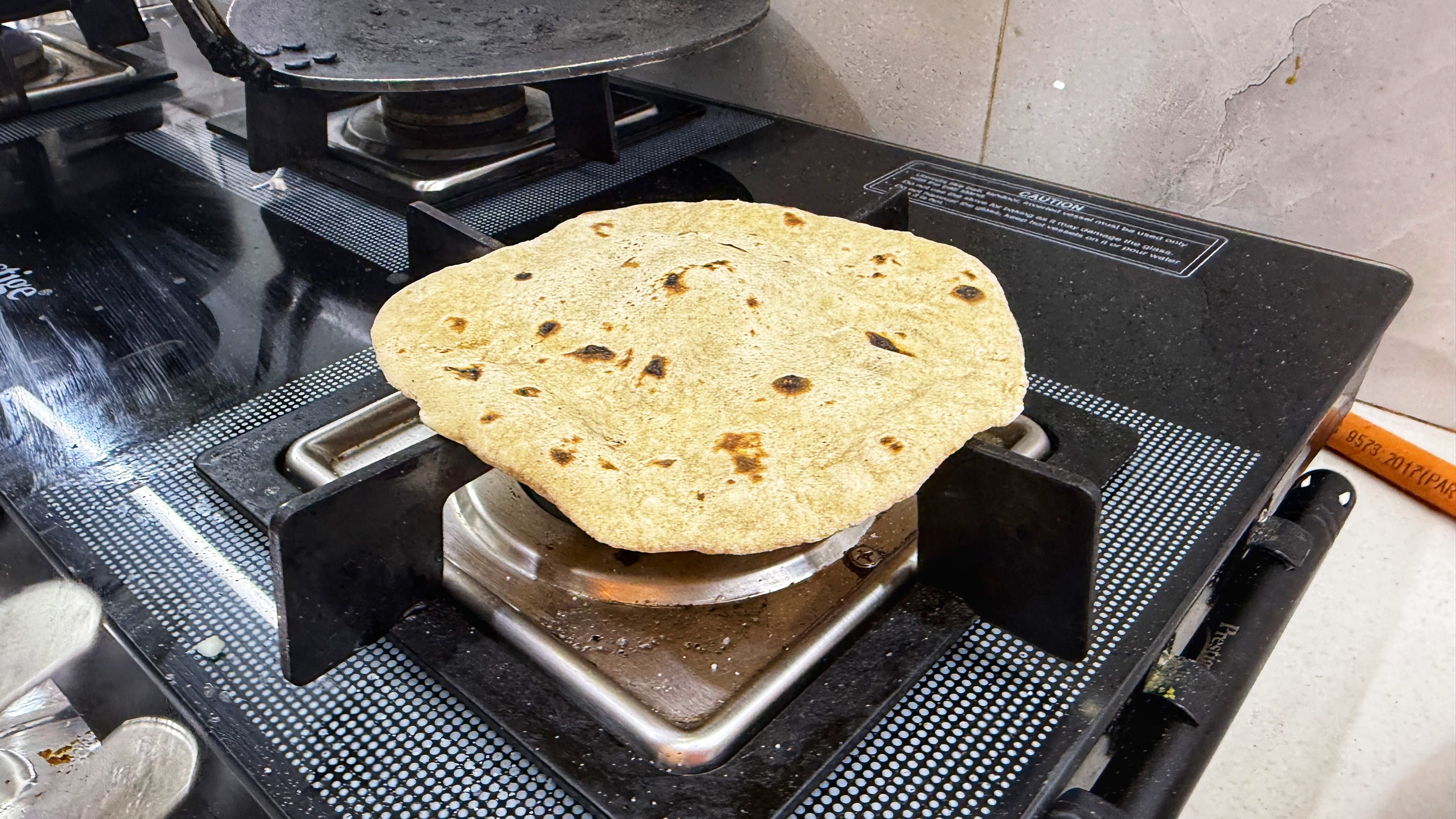
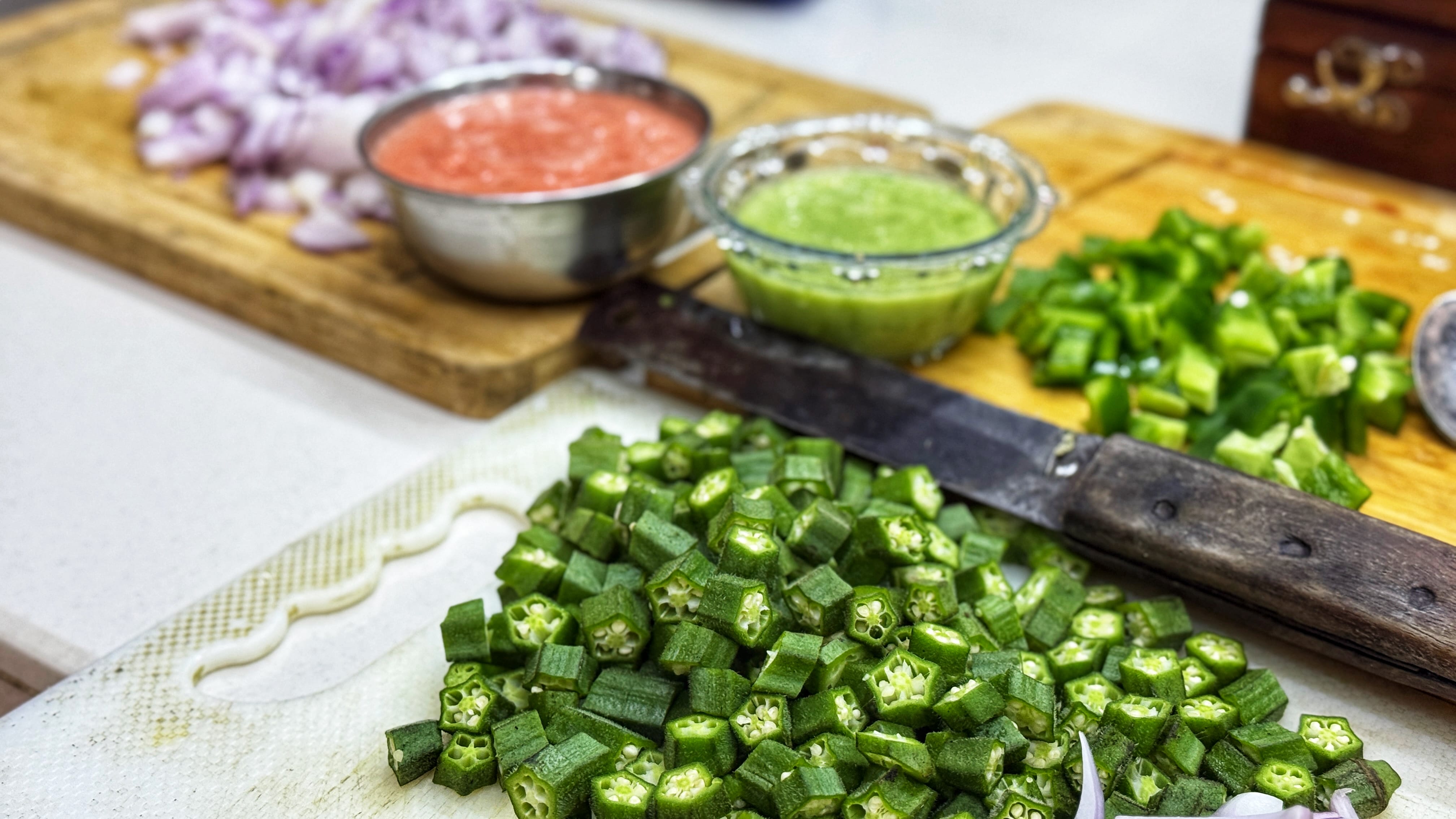
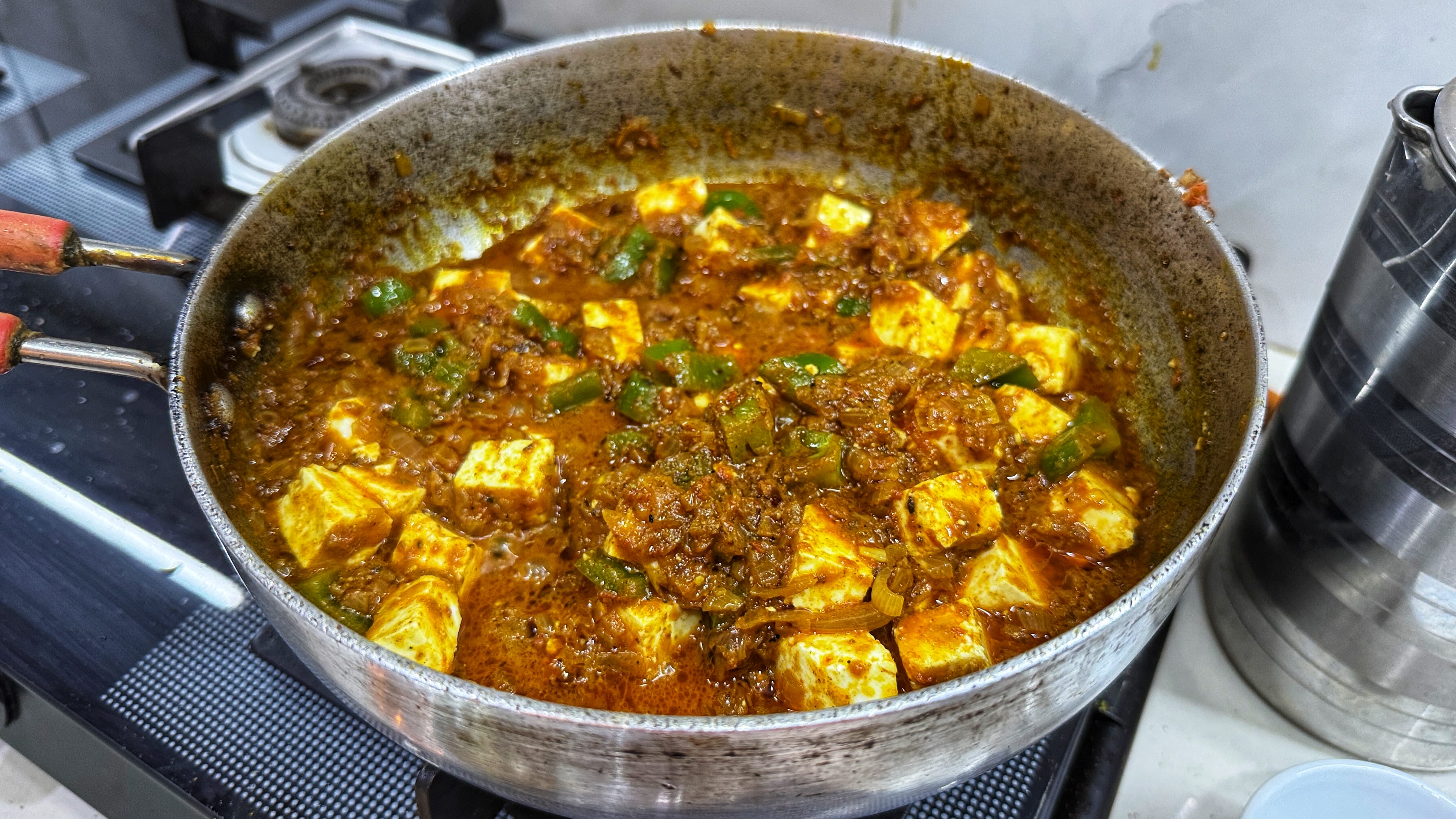
The drive from Connaught Place took about 75 minutes in traffic. When I arrived, Preeti welcomed me with chai in her living room, and then we moved into the kitchen to start cooking a full vegetarian meal: okra, yellow lentils, Kadai paneer, cumin rice, fresh chapati, and suji halwa (a warm semolina dessert with ghee, sugar, and cardamom).

I do cook at home, but I honestly enjoy other things more — yet while traveling, I really love taking classes like this. Preeti was patient and had a great way of explaining things. Even something simple, like when to add spices, made a difference. In a few dishes, the spices went in early; in the Kadai paneer, they were added after the onions and tomatoes had cooked down. I didn’t think timing mattered that much — but it does.

Preeti told me she changes her recipes from class to class, so every lesson is a little different. The food was genuinely delicious — probably the best Kadai paneer I’ve ever had — and afterward, her husband walked me through the local market, then brought me to the main street to help me get an Uber. He stayed with me until the driver arrived, which I really appreciated.

By the time I got back to my hotel, it was after 8 p.m. Jet lag hit hard. I forced myself to stay awake until 9, hoping for a full night’s sleep and a smooth shift to Delhi time.

Day 2 in Delhi: Old Delhi Markets, Mosques, Food, and Unexpected Corners

Day two was all about Old Delhi: food, markets, mosques, and the everyday rhythm of the city.

About a week before arriving in Delhi, I sent a message to one of the local guides from Tours By Locals. Most guides follow a set itinerary, but since I’d been to Delhi before, I didn’t want to repeat everything. So I sent Mona a note with a proposed plan, and he responded quickly—saying we could do exactly what I suggested and adding a few thoughtful ideas of his own.

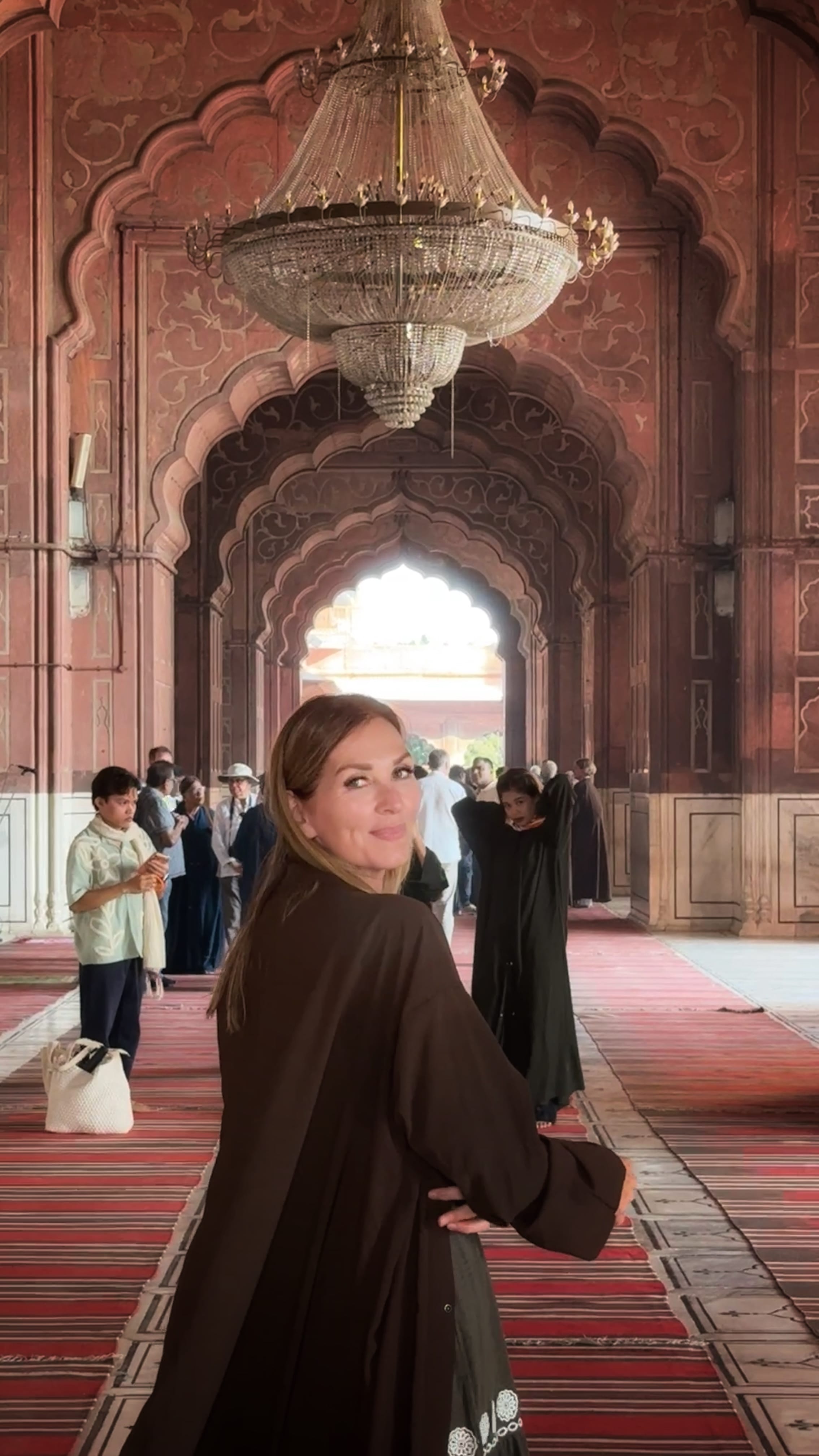
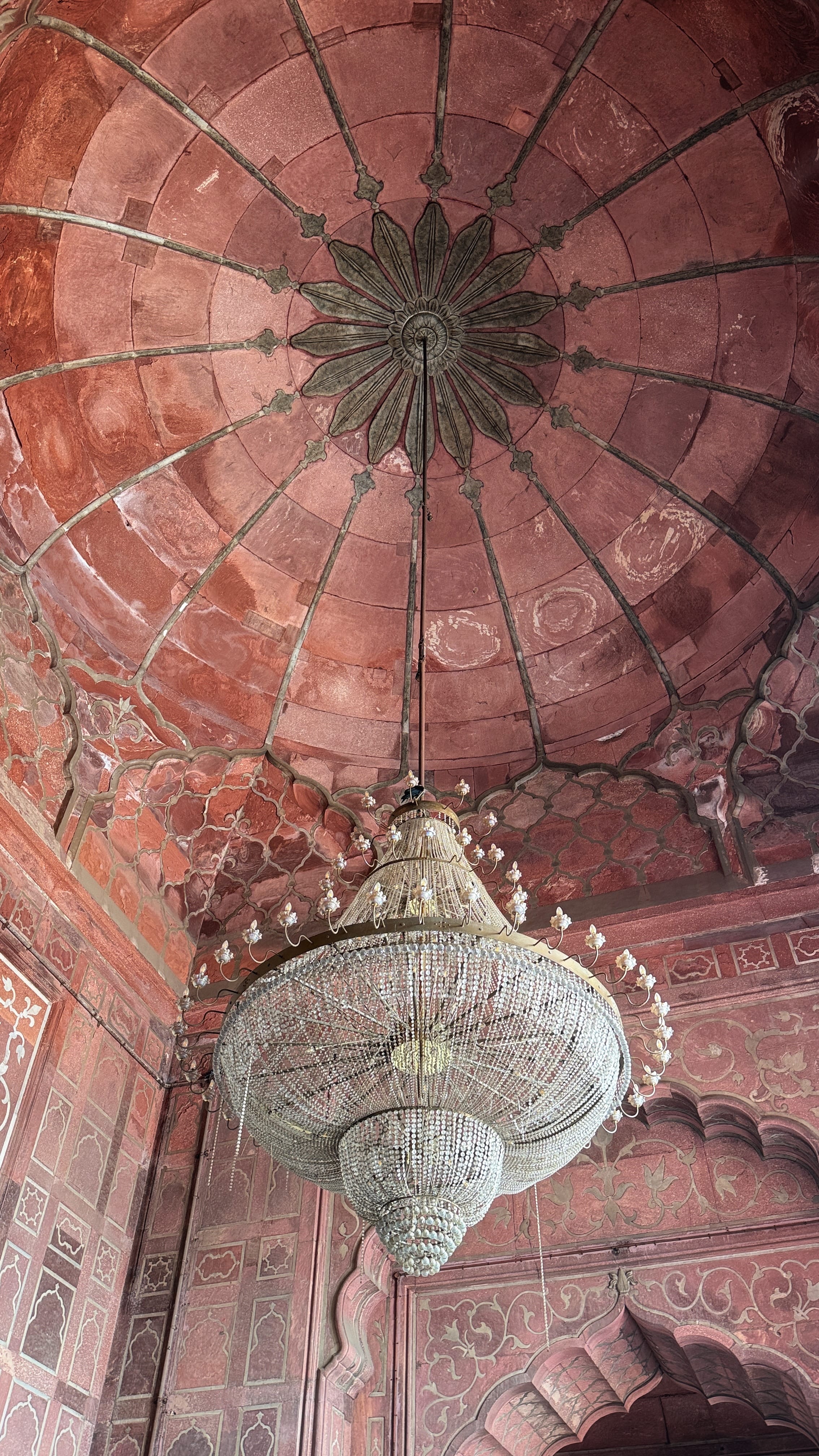
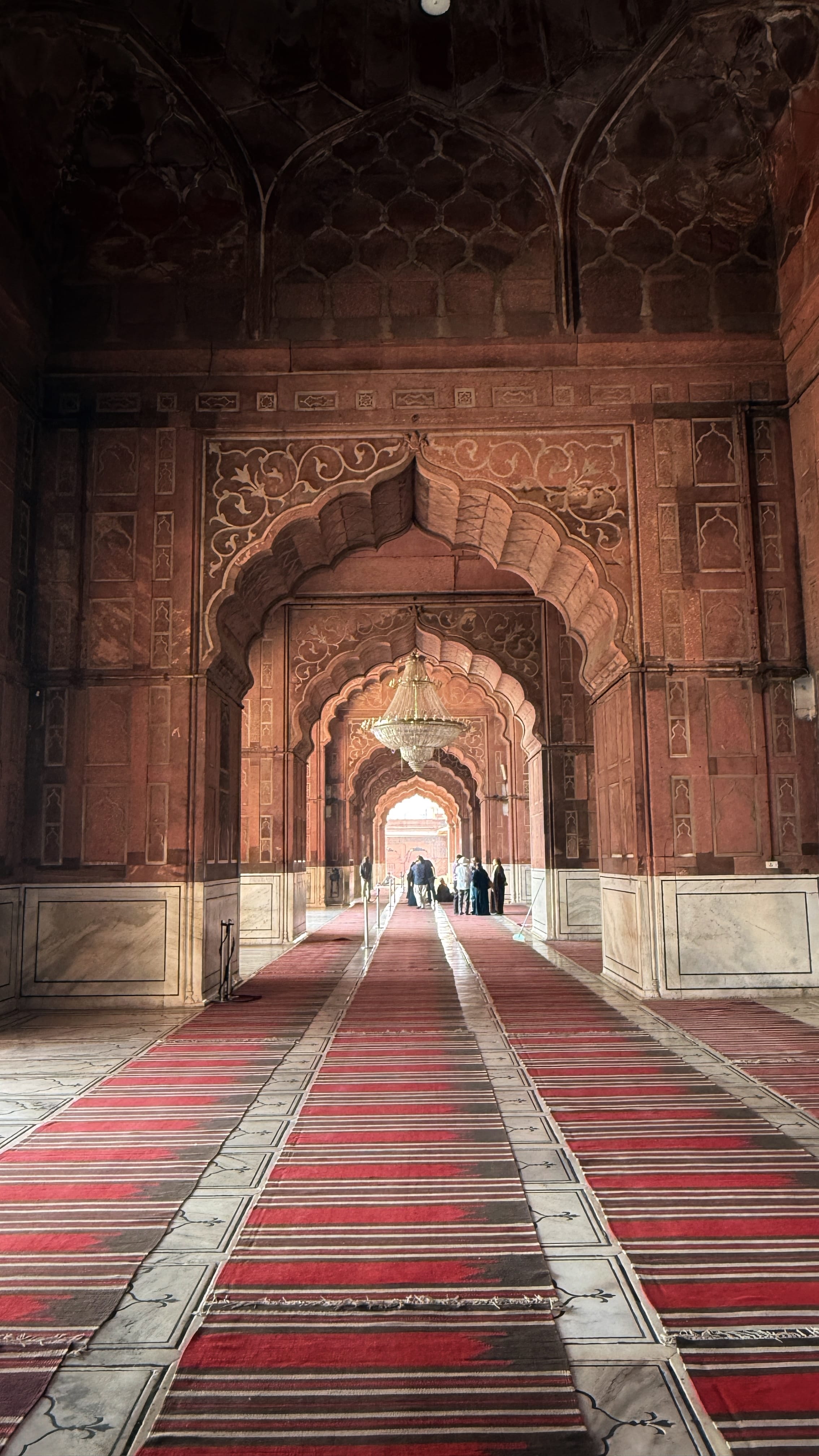
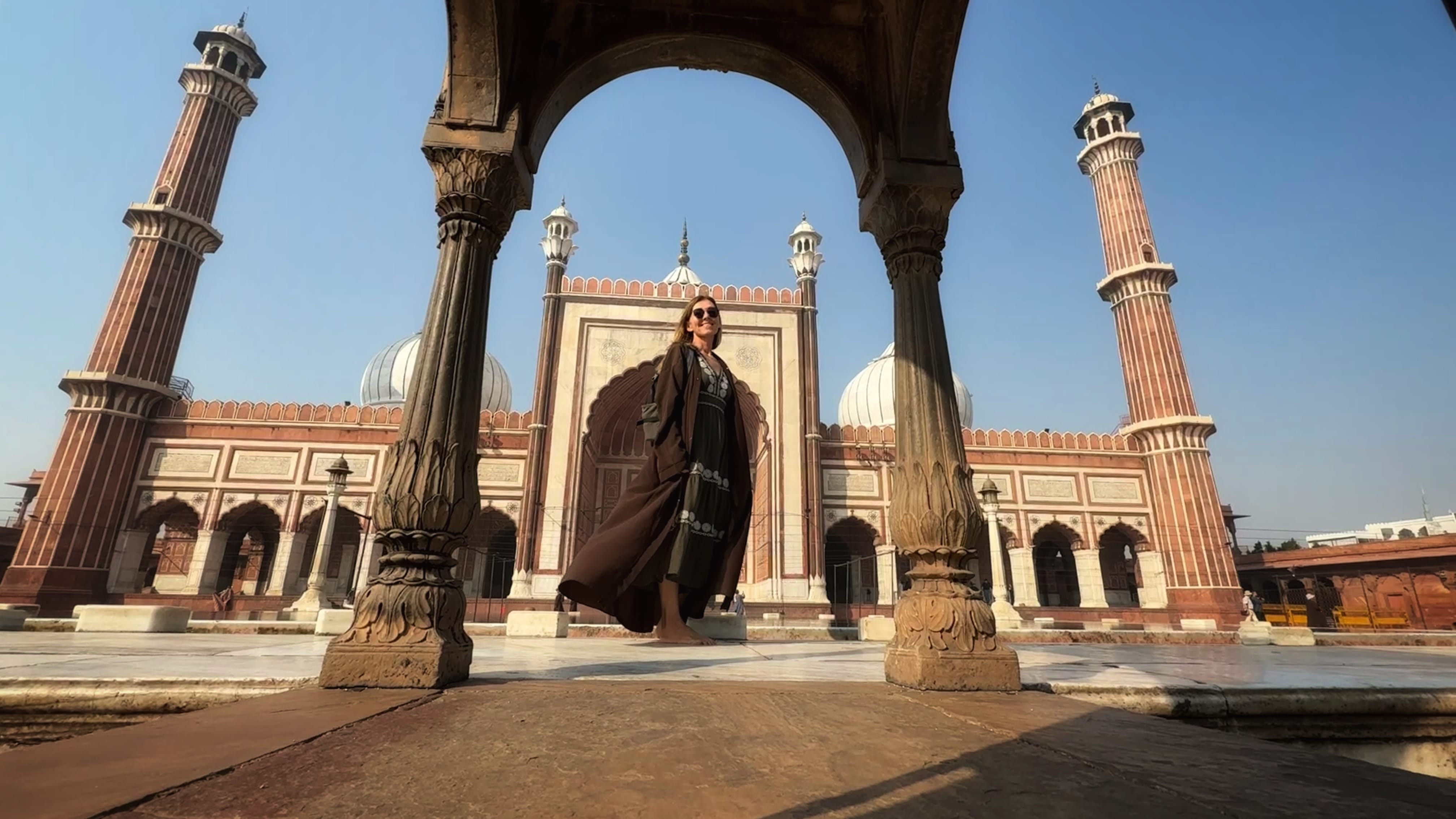
Mona met me in the lobby of my hotel at the arranged time, and we started the morning at Jama Masjid, Delhi’s largest mosque. Built in the 1600s by Shah Jahan (the emperor behind the Taj Mahal), it took more than a decade and thousands of workers to complete. Made of red sandstone and white marble, it sits above Old Delhi with three gates, four towers, and two towering minarets. The courtyard can hold up to 25,000 people during prayers.

Standing inside Jama Masjid courtyard during my 2 Days in Delhi itinerary, surrounded by Mughal-era arches and tall minarets.
Standing in Jama Masjid’s courtyard—barefoot, draped in a borrowed robe.

When I visited, men were laying long cotton durries across the marble courtyard for the afternoon prayer session. Mona mentioned that during Shah Jahan’s time, the floors were covered with floral Persian carpets — fitting for an emperor obsessed with craftsmanship. Along the covered walkways, the stonework still shows hand-carved lotus and floral motifs, a blend of Islamic and Hindu styles you see throughout Mughal architecture.

Even from inside the mosque, you can hear Old Delhi — rickshaws, vendors, traffic, the whole hum of Chandni Chowk right next door. Mona explained that the mosque sits between two distinct neighborhoods: a Muslim area known for butcher shops and Mughlai food stalls (and the birds hovering overhead), and a mostly vegetarian Hindu area known for sweets and produce markets. Rhesus monkeys also live around the mosque, jumping from domes to ledges like it’s their natural playground.

Chandni Chowk

From Jama Masjid, we crossed directly into Chandni Chowk, which was just waking up. Delivery carts rattled through the alleys, men carried bundles on their heads, and shopkeepers rolled up shutters. Built by Shah Jahan in the 1600s, it remains one of Delhi’s busiest and most iconic markets.

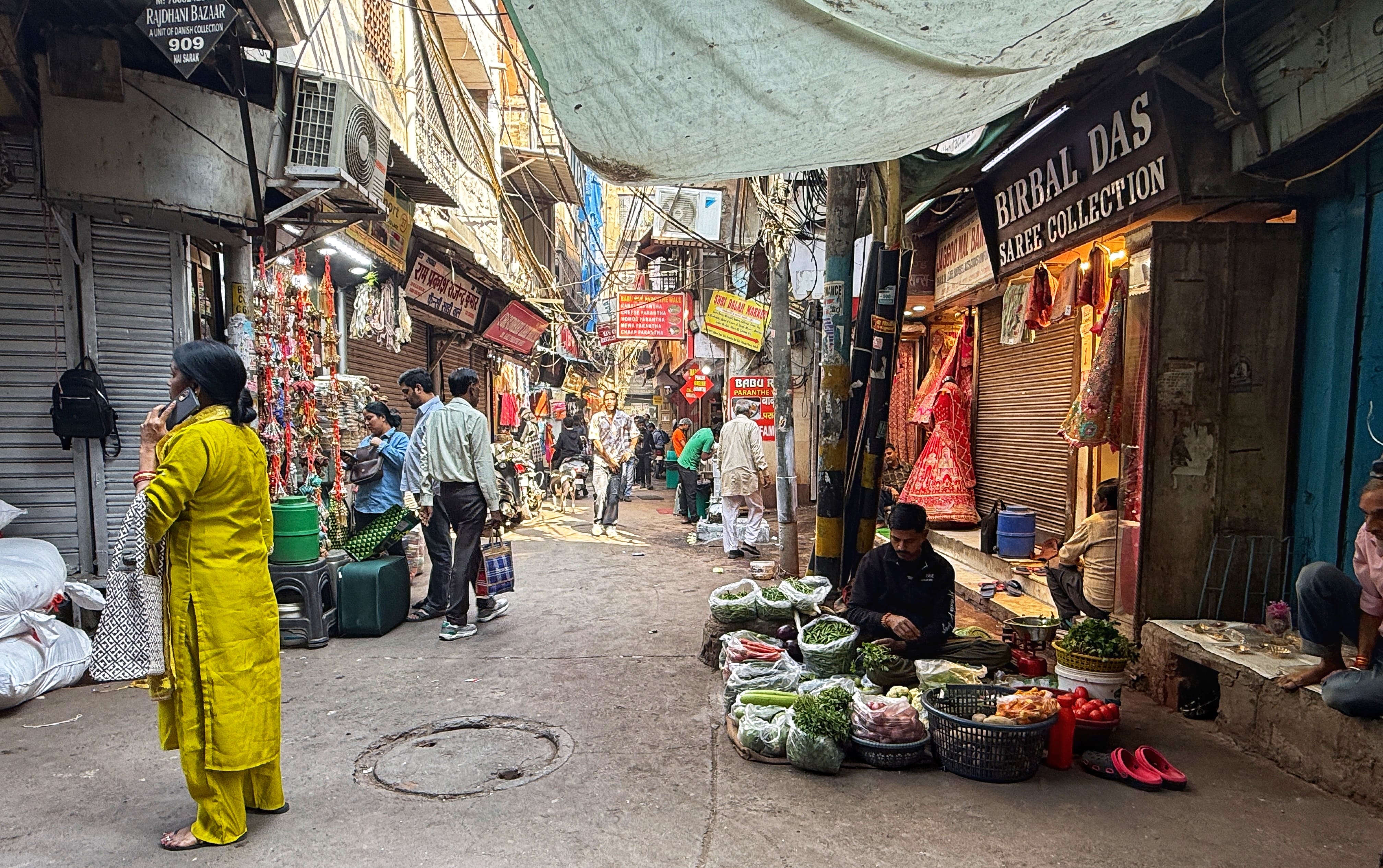
Vegetable stalls and sari shops inside narrow market lanes explored on my 2 Days in Delhi itinerary.
A typical moment in Old Delhi

We walked through scenes that felt like everyday Delhi: women threading marigold garlands, a man pushing a cart piled with bananas and guavas, another frying fresh jalebis. The smell of ghee and spices drifted everywhere, and the noise made conversation almost pointless.

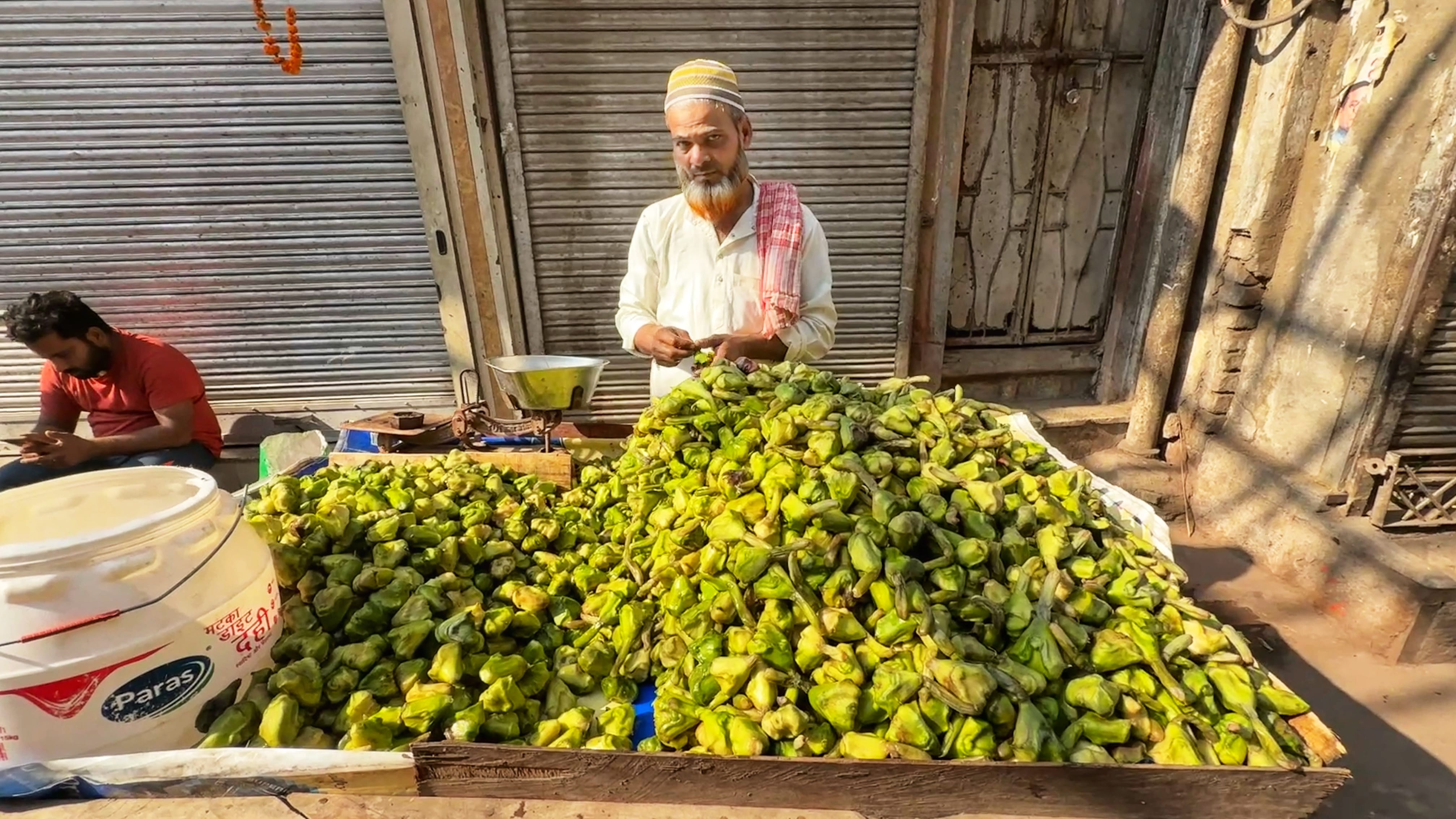
Man selling piles of green singhara (water chestnuts) on a wooden cart in Old Delhi, sitting in front of closed metal shutters
A pile of fresh singhara—water chestnuts sold by weight, right on the street.

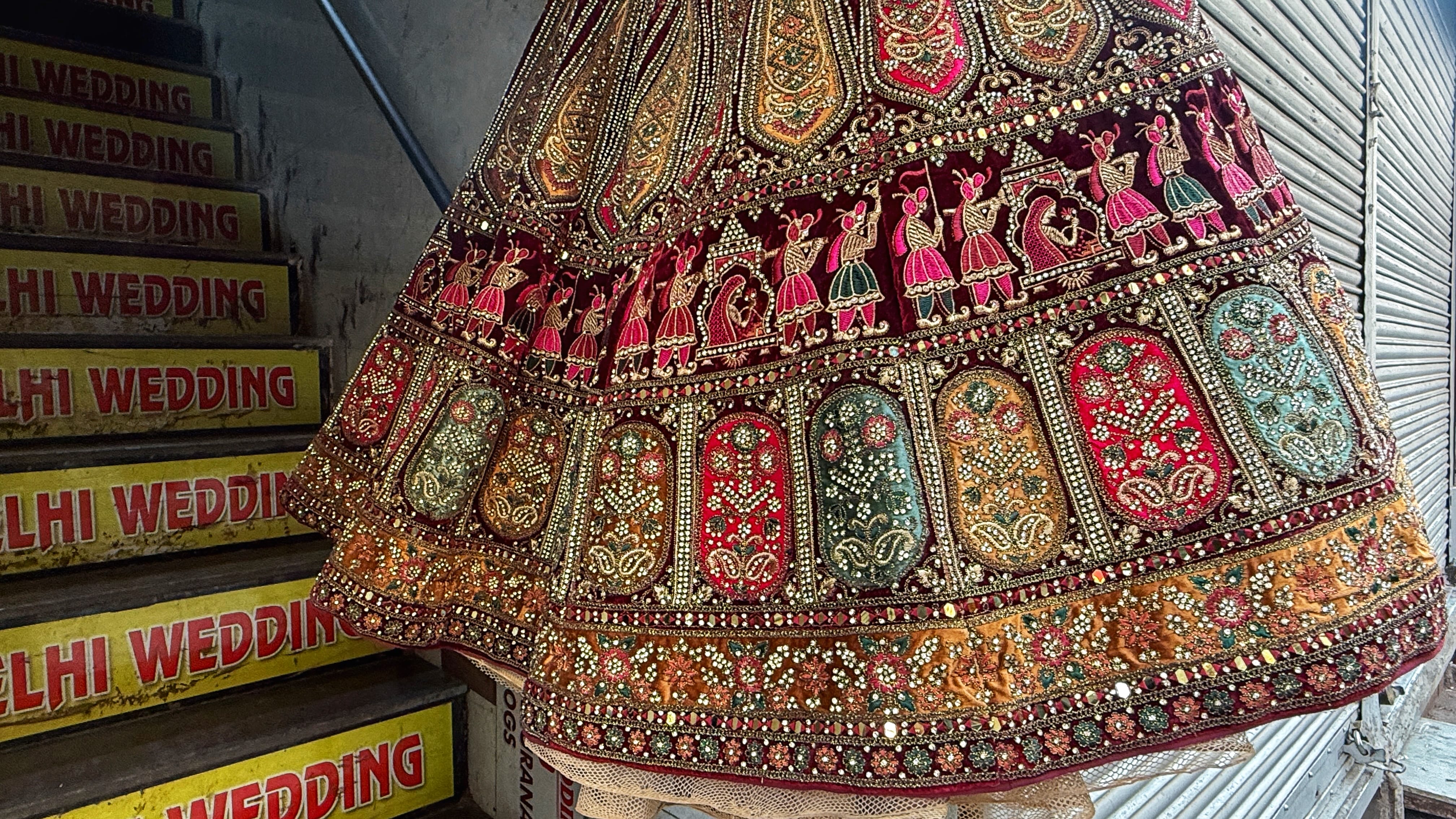
We then reached the wedding market—endless shops of bright red and gold lehengas, embroidered shoes, sequined purses, and entire walls of bangles, all arranged for the peak wedding season.

Bridal lehenga covered in intricate hand embroidery seen during my 2 Days in Delhi walking through the wedding market lanes near Chandni Chowk.
The detail in these bridal lehengas is unreal—tiny sequins, embroidery, mirror work—all done by hand.

Naughara Lane (Nine Houses Lane)

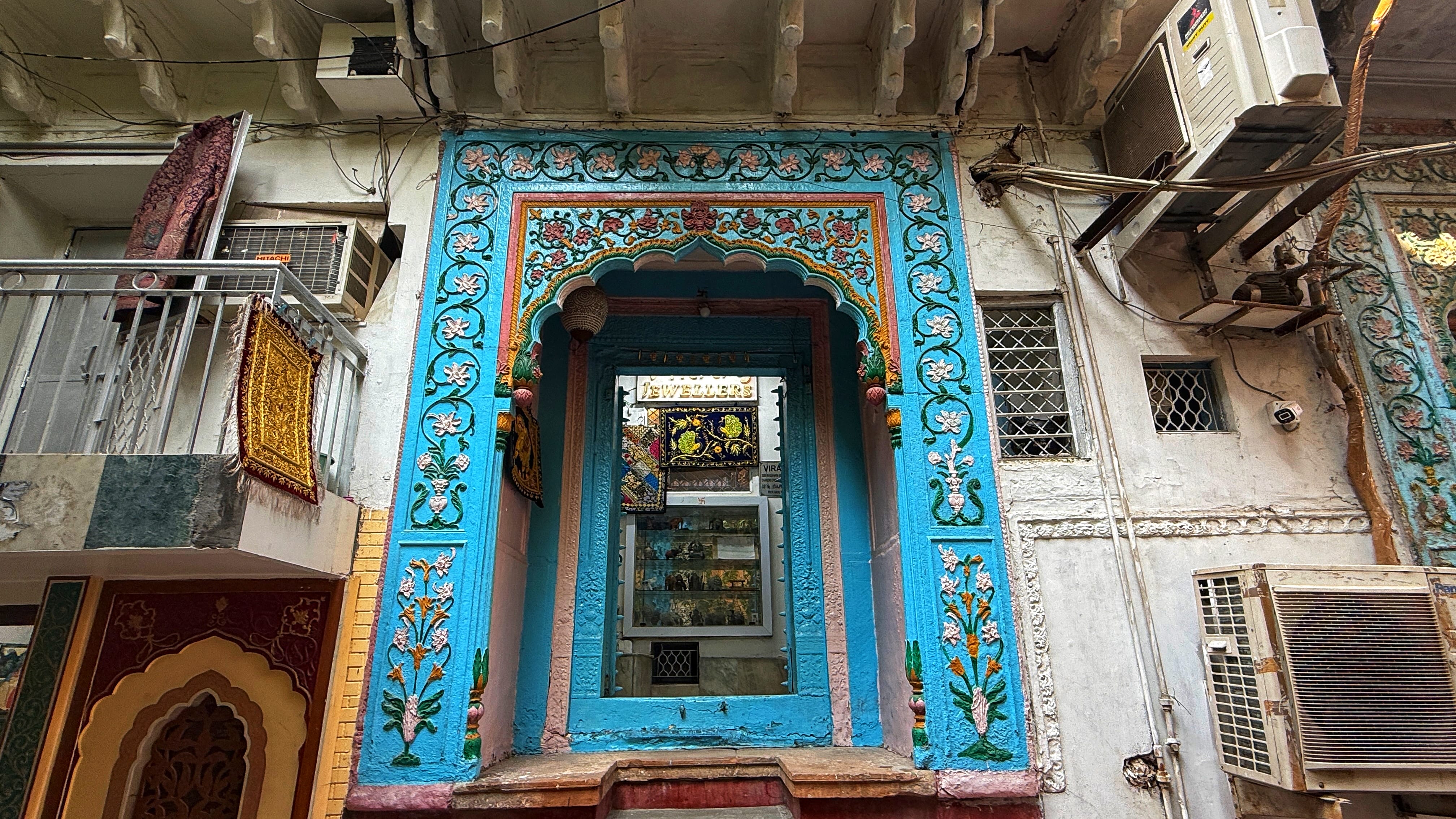
A few turns later, we stepped into Naughara Lane — naughara meaning “nine houses” — a quiet side alley lined with nine restored Jain merchant homes. Soft pastel facades, carved wooden doors, and peaceful stillness — worlds away from the chaos outside. 

Colorful painted doorway in Old Delhi seen during my 2 Days in Delhi exploring markets and historic lanes.
This entrance along Naughara Lane —bright floral carving, turquoise paint, and a tiny jeweler’s counter tucked inside.

The doorways were incredible—each different, each with its own small details. Every house had a distinct shade and subtle artistic touches, whether it was a carved panel, a painted flower, or a pattern that felt almost personal. Standing there, you could feel how much care went into these homes.

Even with the inevitable air-conditioners and stray wires breaking up the scene, the lane still feels special. It’s just a small cluster of nine houses, but the colors and details make it easy to linger and let the outside noise fall away.

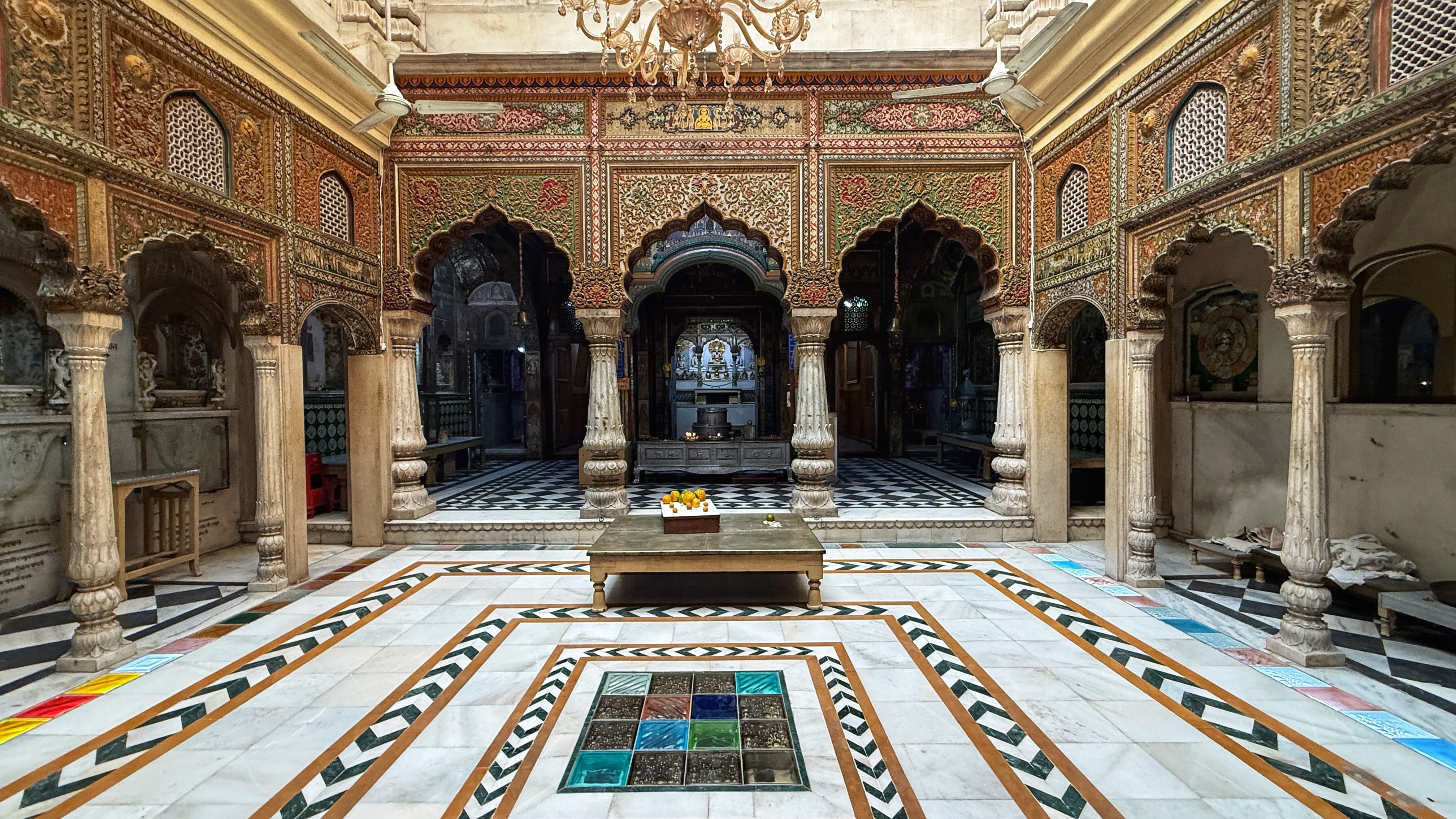
A small Digambar Jain temple temple made of pale marble. Inside, every surface is covered—mirror tiles, painted scenes, carved borders, so much going on at once that I didn’t even know where to look first. It should feel overdone, but somehow it doesn’t. Instead, it’s just strangely fascinating. I kept noticing new details—tiny figures, animals, scenes stacked on top of each other—and it was almost like the walls were telling several stories at the same time. It was a lot, but I genuinely loved it. I stayed longer than I planned, just trying to take it all in.

Ornate Jain temple courtyard visited during my 2 Days in Delhi itinerary, featuring arches, carved pillars, and patterned marble floors.
Inside the Jain temple courtyard—marble pillars, delicate carvings, and colorful inlay everywhere.

The temple was silent and cool inside. Digambar (“sky-clad”) Jains believe in extreme renunciation and complete nonviolence — a philosophy that shapes even what they eat. It felt surreal that one of the busiest markets in India was happening just beyond the entrance.

Intricate mosaic room inside a Jain temple visited during my 2 Days in Delhi itinerary, featuring mirrored tiles and painted religious scenes.
One full wall of storytelling—hundreds of tiny mosaic pieces showing Jain teachings, legends, and everyday scenes.

A Little Food Tasting

From the temple, we stopped at Old Famous Jalebi Wala (right off Chandni Chowk Road), a family-run shop that’s been around since 1884 and is famous for its warm, freshly made jalebi. What sets their version apart is that it’s cooked in clarified butter and dipped in khandsari sugar syrup rather than regular sugar. But what really elevated this sweet treat was the creamy, freshly made rabri it was served with — something I’d never tried before but now can’t imagine not pairing with jalebi.

Street food vendor serving puri and samosas in Old Delhi, one of the tastiest stops during my 2 Days in Delhi.
Early-morning street food in Old Delhi—fresh puri, crisp kachori, and hot samosas coming straight from the fryer.

I’ve never liked jalebi — usually too sweet — but this was fresh, warm, crunchy, and somehow lighter. Almost like a honey-soaked funnel cake, but more delicate.

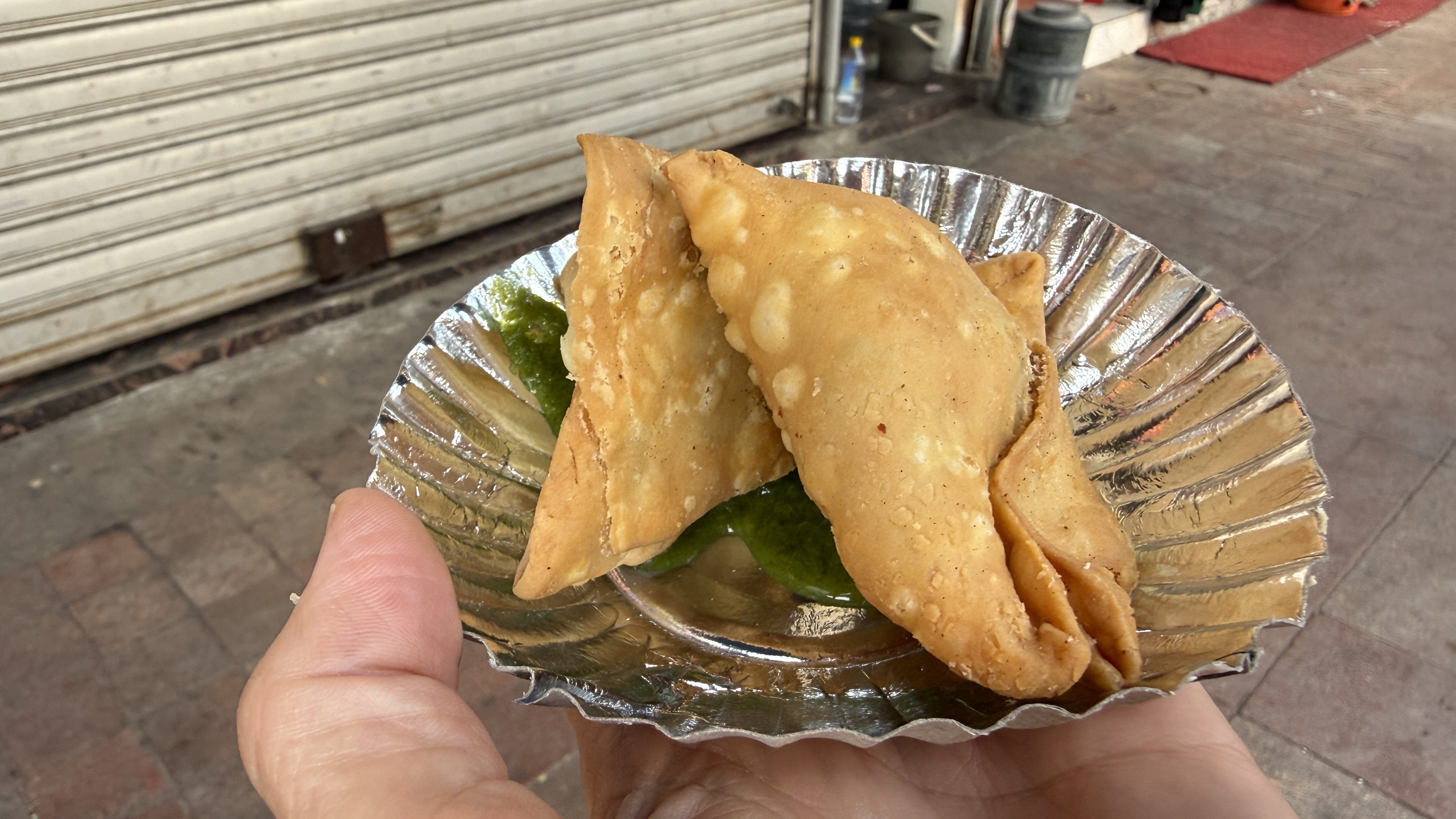
At another nearby stall we tried a  freshly fried samosas, also cooked in clarified butter and served with the most delicious mint chutney. Pure perfection.

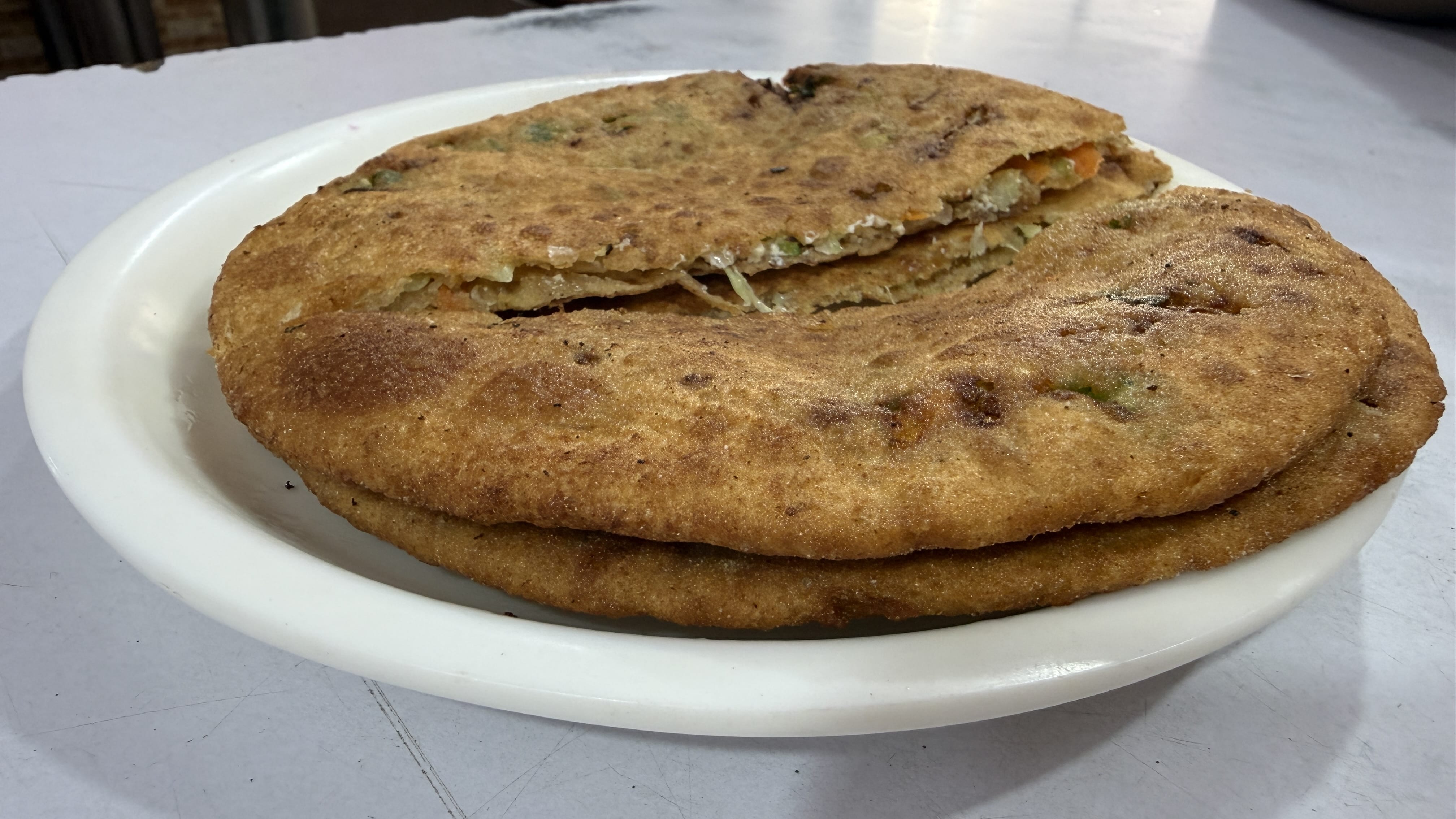
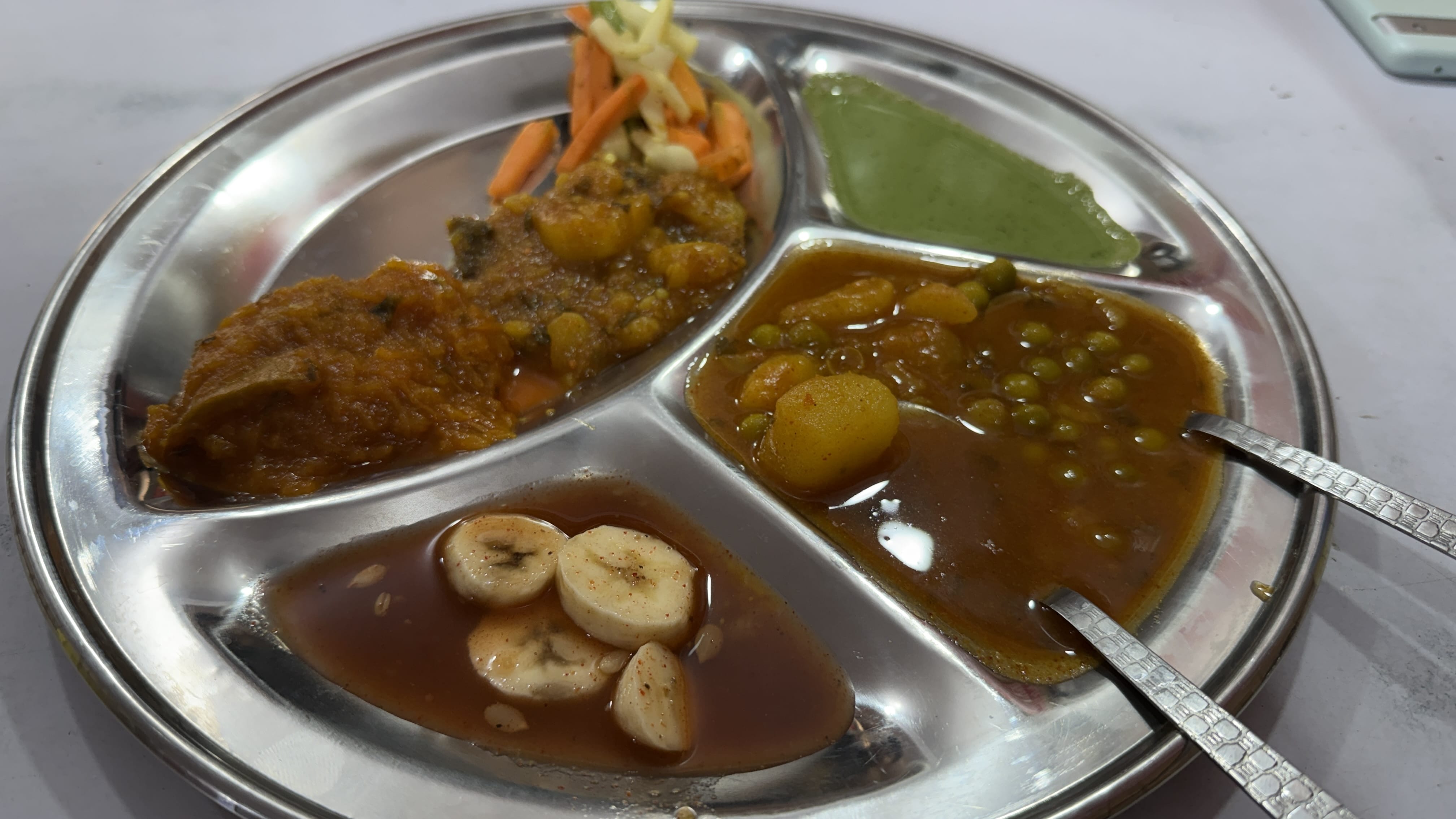
We went to Gali Paranthe Wali, popular for its thalis with vegetable curries, pickles, and a stuffed fried paratha that became an instant favorite. I also learned something I probably should’ve known already: none of the shops here use onion or garlic. It’s a tradition of the Brahmin families who run them, and honestly, I wouldn’t have guessed — the food had plenty of flavor on its own.

After lunch, Mona brought me to Nagori Chai, where they serve chai in clay cups. Hot, milky, cardamom-heavy—and honestly, maybe the best chai I’ve ever had.

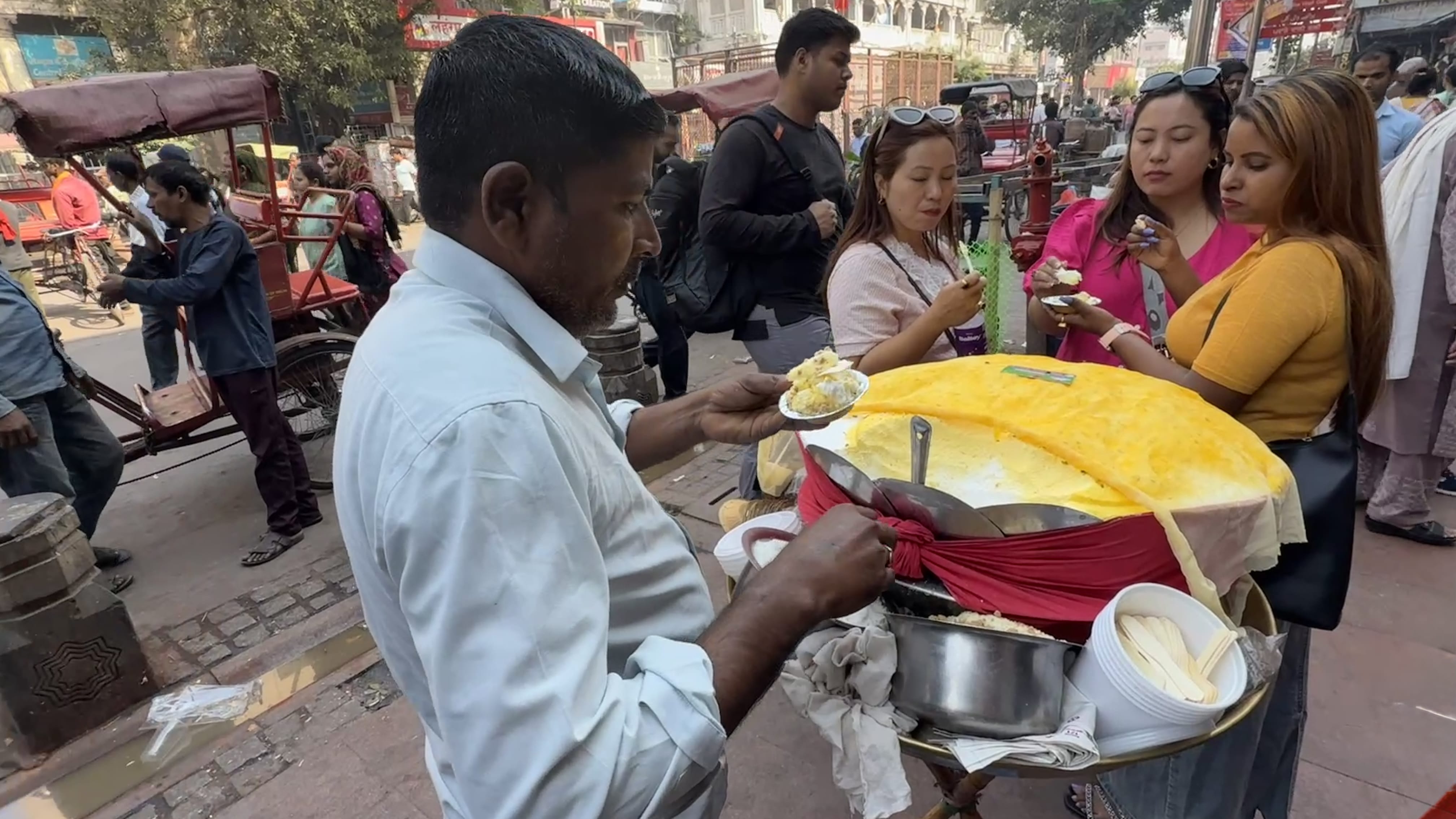
We also passed a vendor selling daulat ki chaat, a winter specialty made from whipped milk froth — so light it’s almost a dessert made of air.

Man serving daulat ki chaat from a street cart in Old Delhi during my 2 Days in Delhi itinerary, with people sampling the dessert beside rickshaws and market stalls.
Daulat ki chaat—Delhi’s winter-only dessert. I

And a little farther on was Chaina Ram, a legendary sweet shop from 1901. I had no room left to try anything but made a mental note for next time.

Khari Baoli

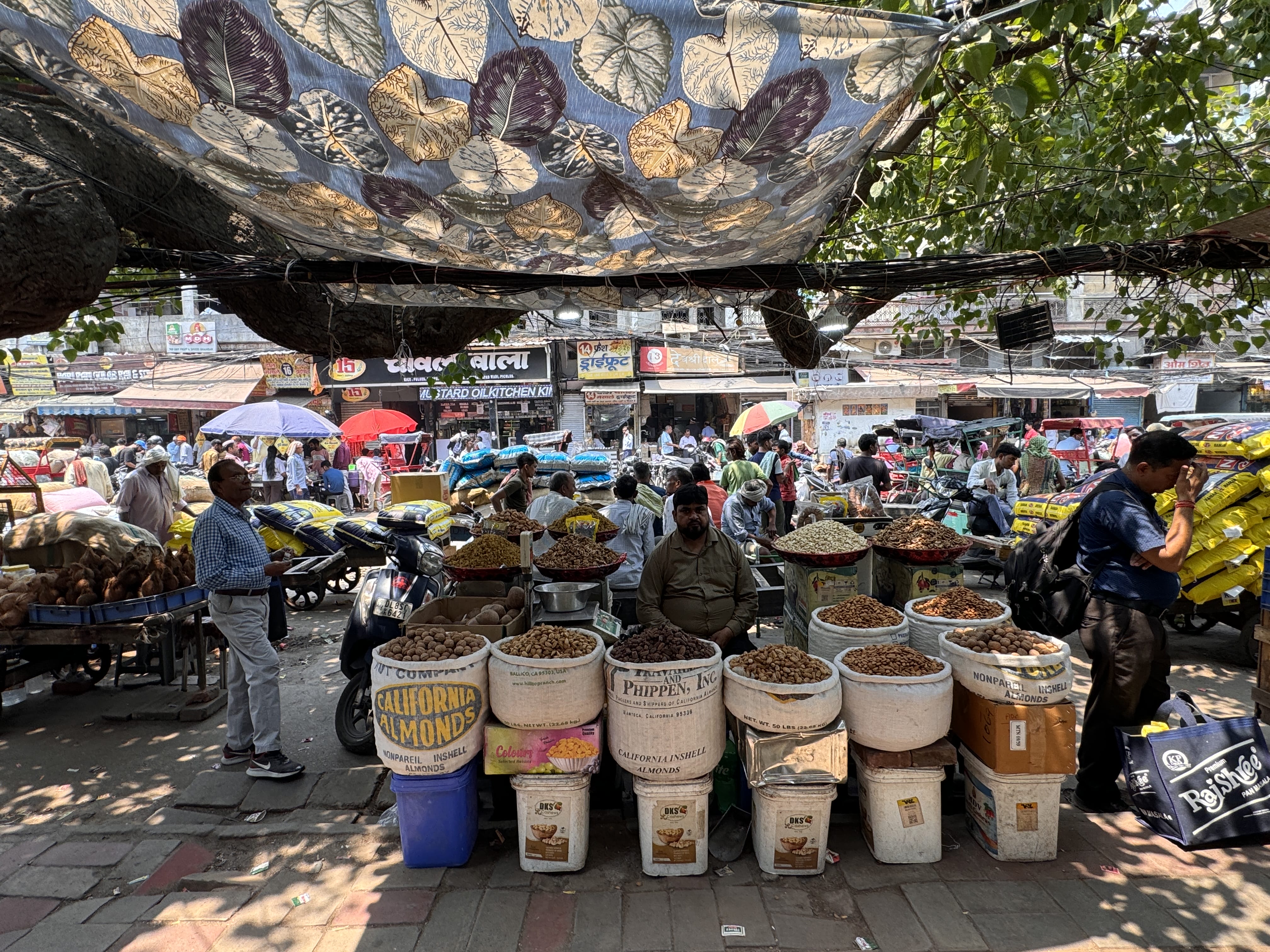
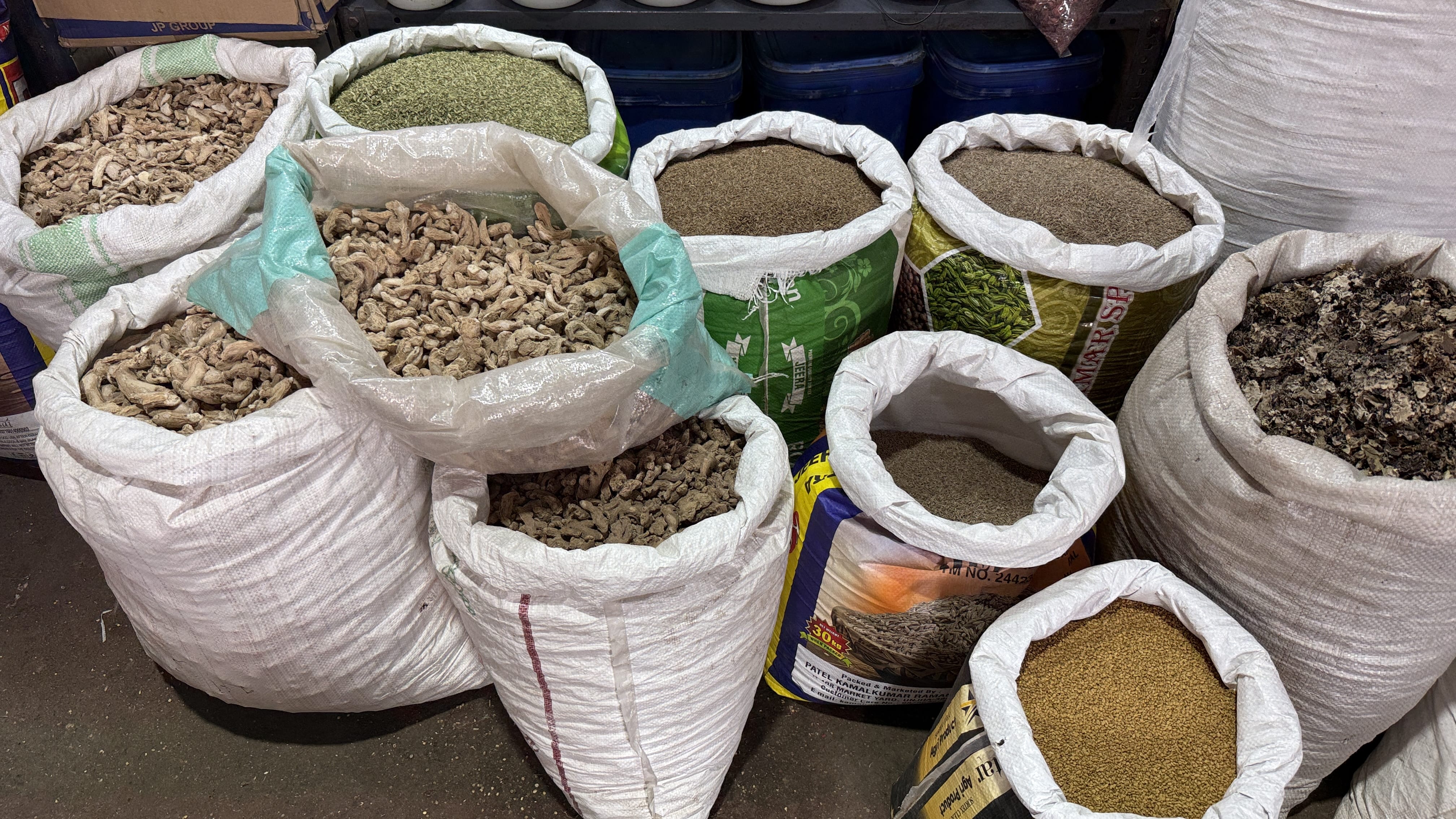
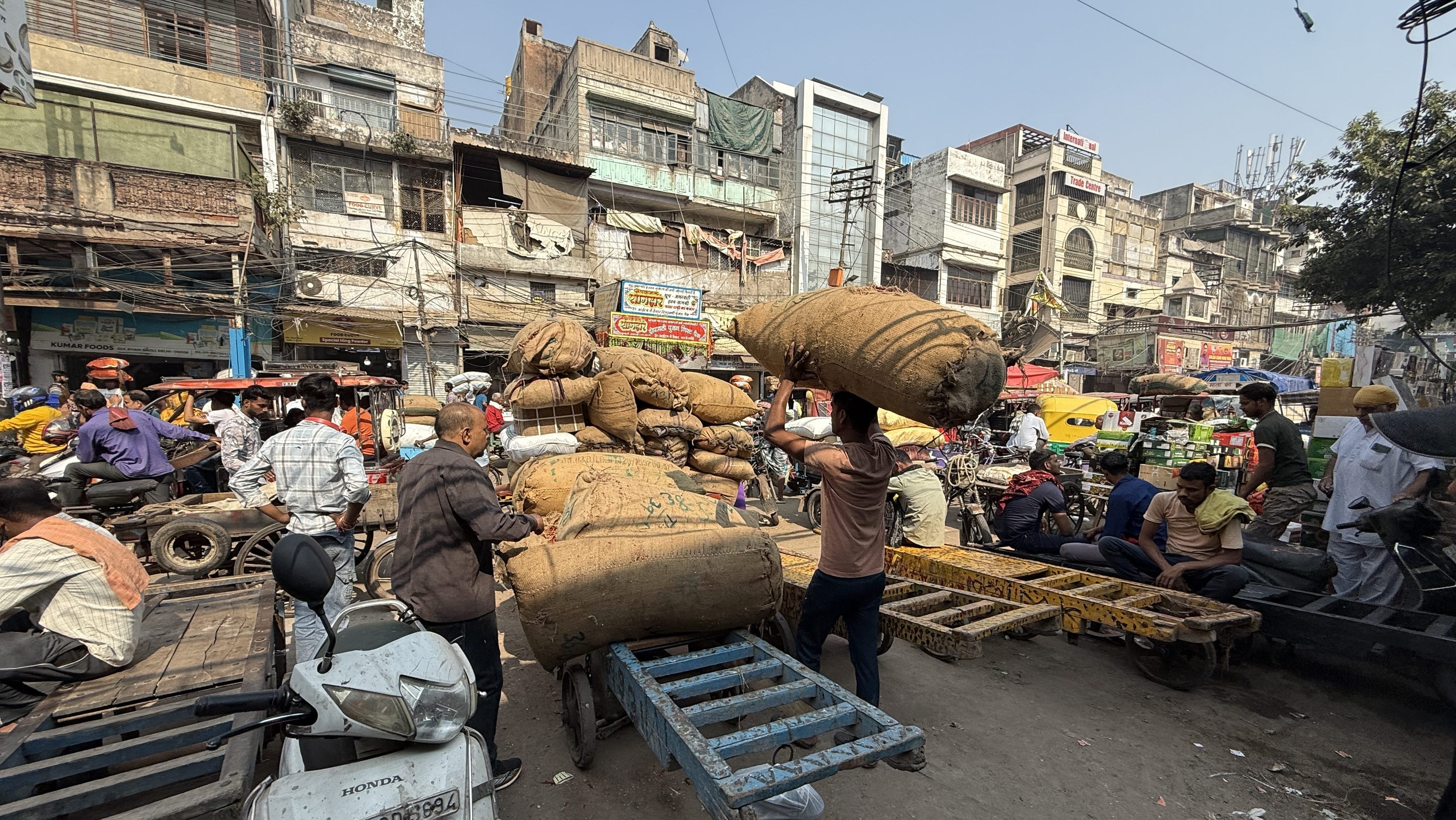
After a bit of food tasting, we walked into Gadodia Market, the old courtyard building at the center of Khari Baoli, Old Delhi’s wholesale spice market and a place I’ve been before. Every single time, I forget how fast it hits. The smell isn’t just aroma—it’s actual spice dust moving in the air. You take one breath and immediately cough. There’s no easing into it. Chili powder, turmeric, dried ginger—they’re all suspended because sacks are constantly being opened, filled, sealed, and shifted.

Workers loading market goods in Old Delhi during my 2 Days in Delhi itinerary, surrounded by carts, scooters, and historic storefronts.
Khari Baoli at full speed.

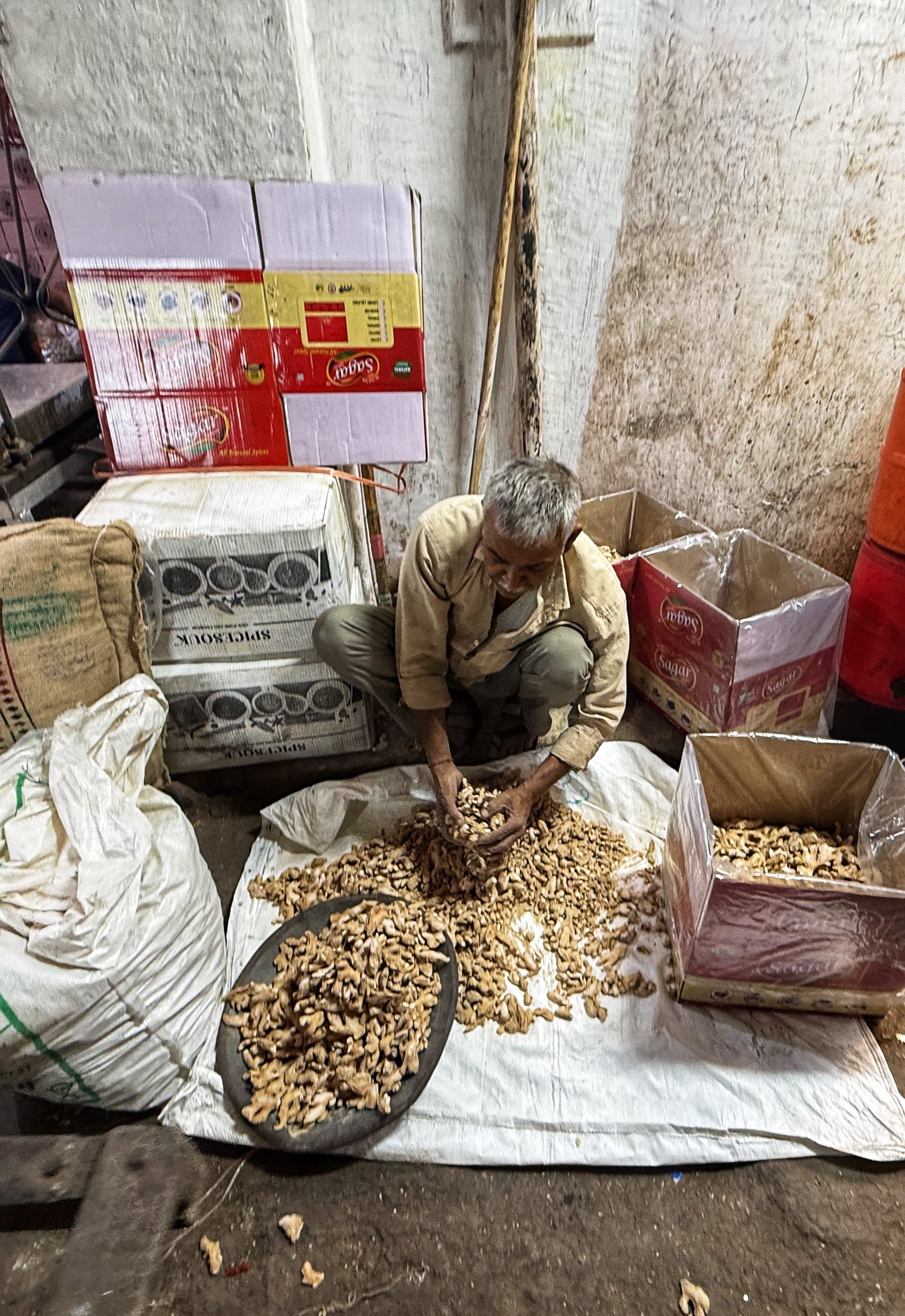
Men were hauling huge burlap sacks on their backs—easily 50 or 60 kilos each—and loading them into vans or onto pushcarts waiting right outside. Meanwhile, the workers seemed to be breathing normally—no coughing, no reaction at all. They cut open sacks, funnel spices into smaller bags, shake them flat, weigh them, reseal them, and load them again. Every movement releases more dust into the air, which explains why it hits your throat so fast.

Khari Baoli dates back to the 1600s, when caravans arrived from Central Asia and unloaded goods along these lanes, and it still functions at that same scale. Shops are stacked floor to ceiling with coriander seeds, black cardamom pods, whole fennel, dried ginger pieces, and every kind of chili. Nothing is displayed for effect; everything is being packed, weighed, sold, and sent somewhere.

 Most of what leaves here doesn’t even end up in the immediate neighborhood—it goes to wedding caterers, restaurants, food distributors, and markets across the country.

You walk through coughing and wiping your face, and five seconds later they’ve already sealed another bag, loaded another cart, and sent another order down the lane. It’s constant motion.

Dhobi Ghat near Connaught Place

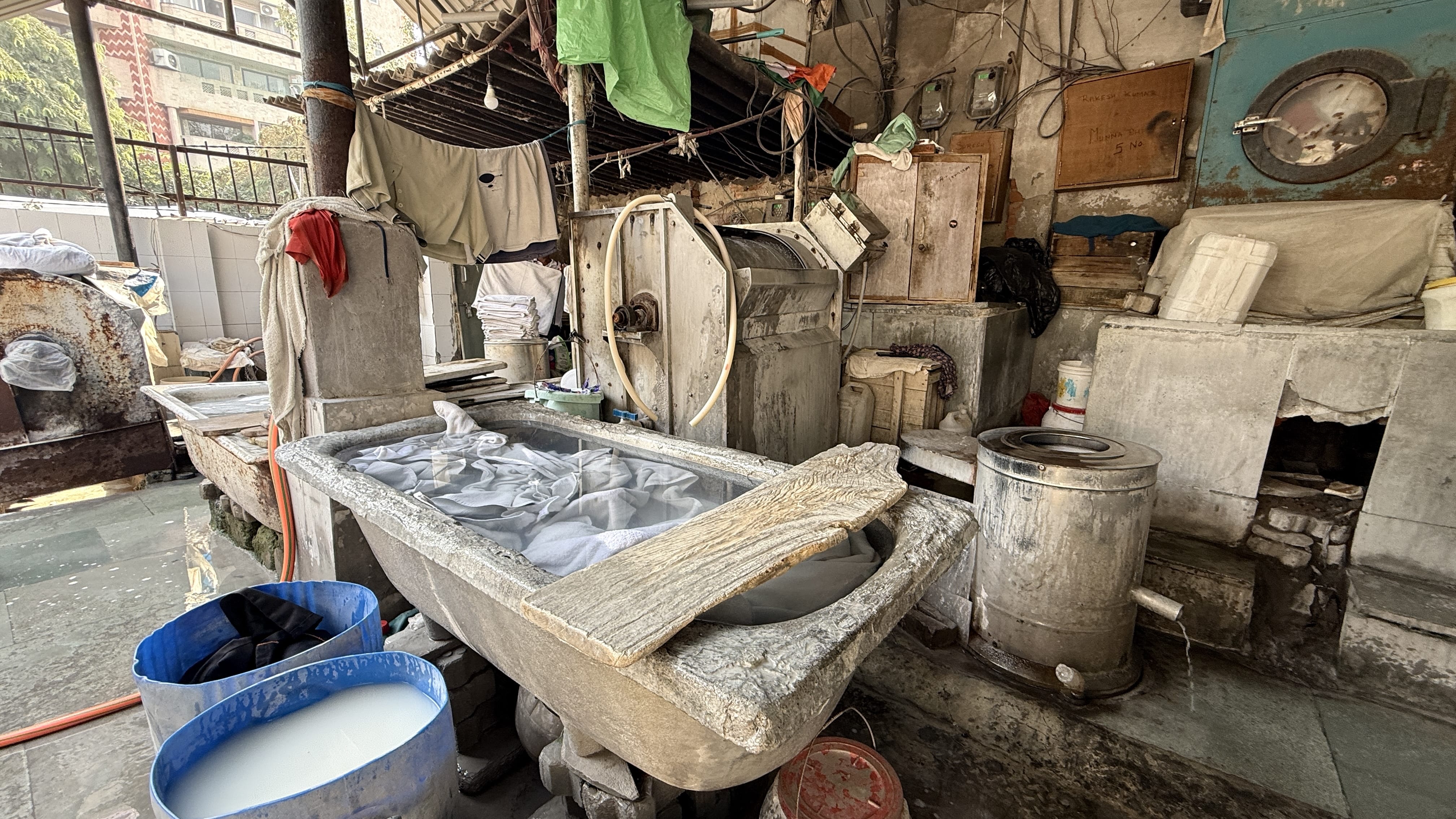
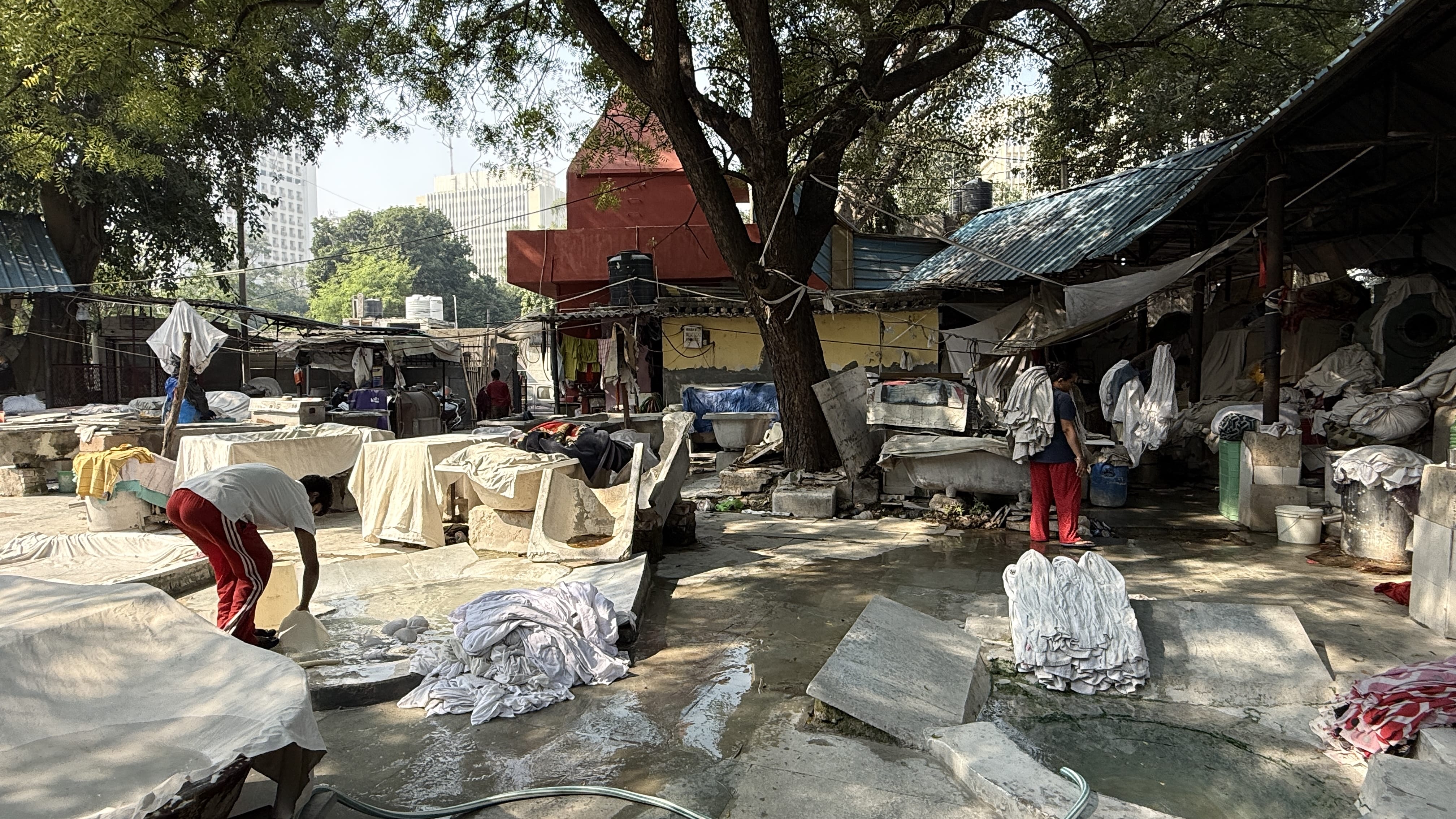
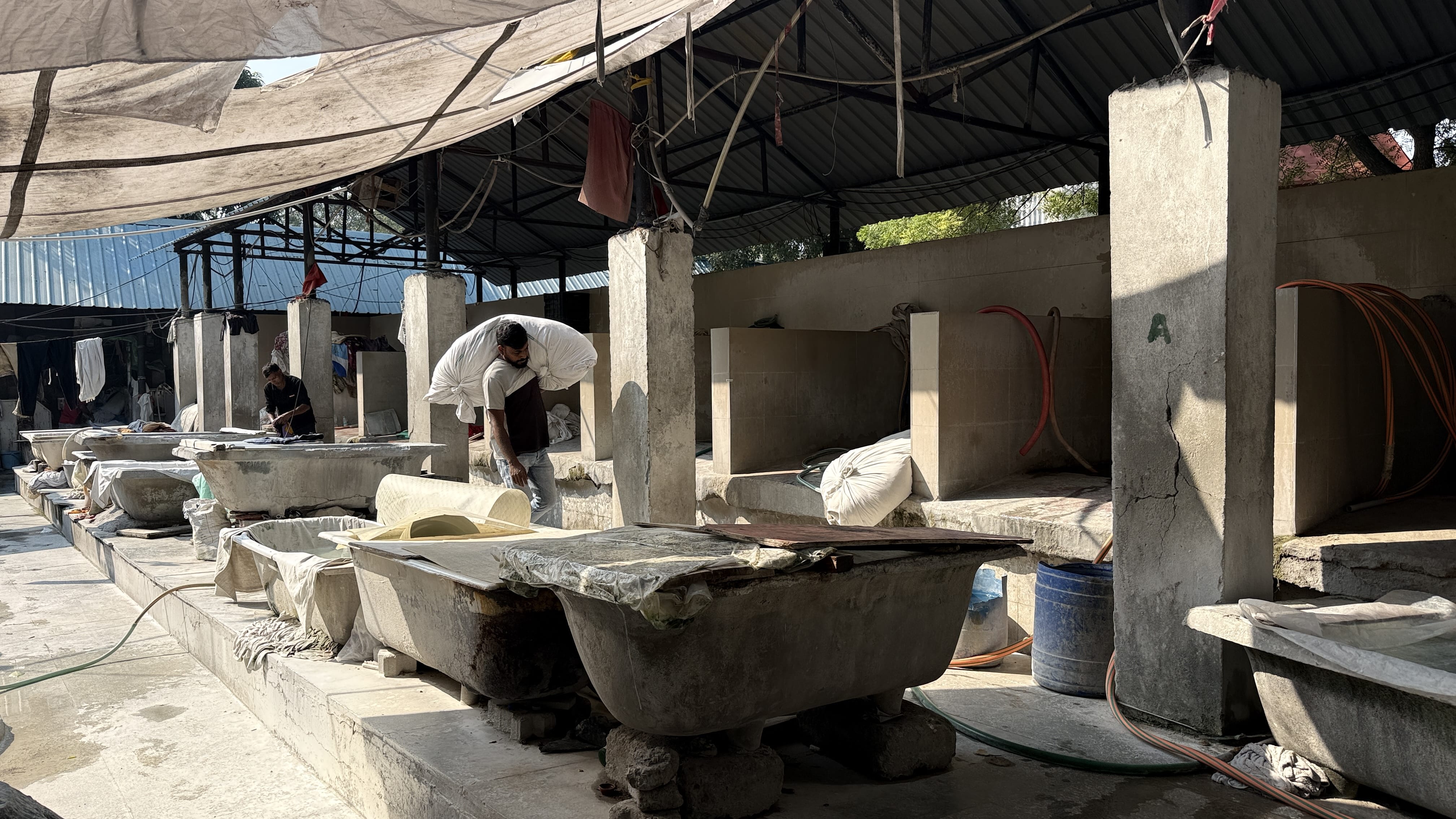
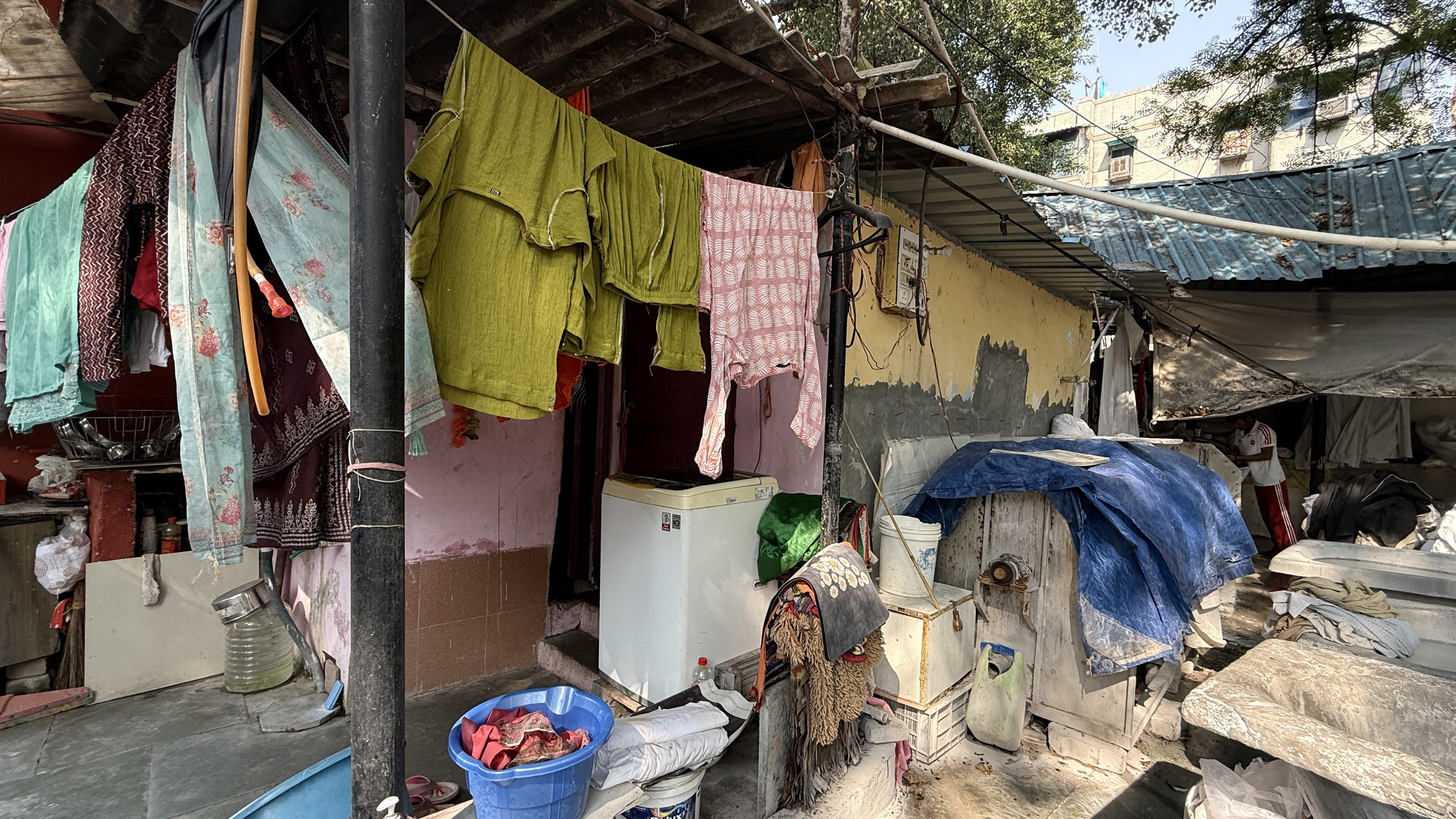
From the spice market, we grabbed a rickshaw and made our way toward Press Enclave Dhobi Ghat, known locally as “Washermen Street.” It’s one of Delhi’s last active inner-city laundry areas, and generations of washermen still work here—each family running its own narrow stall with stone washing pits, patched metal drums, and endless lines of drying clothes. Many of these spaces have been passed down for decades, long before this part of Delhi turned into the commercial center it is now.

Colorful clothing—greens, red, pink—hanging to dry at a dhobi ghat in Delhi alongside household laundry machines and buckets.
Bright fabrics drying in the sun—sarongs, kurta sets, and everyday clothes hanging over improvised lines inside a dhobi ghat.

I’d actually asked a guide about this on an earlier trip, and he looked at me like he had no idea what I meant. I knew I’d read about it somewhere, so I was glad I finally asked Mona—because he knew exactly what I meant and took me right to it.

It’s a maze of movement and color: water sloshing in concrete tubs, shirts snapping on lines, steam rising from open-air boilers. Men slap sheets rhythmically against stone, and massive old dryers spin beside newer steel ones. They wash for whoever needs them — nearby hotels, restaurants, and families who still prefer the dhobis over commercial laundromats.

Despite the chaos, there’s a method to everything. Each family knows exactly which pile belongs to which hotel, restaurant, or household — no labels, just long-standing systems of marks, threads, and memory. Watching them move through the space, weaving around cracked basins and piles of cloth, you realize how much of this place runs on skill and routine rather than equipment. It’s amazing to think they keep everything organized by memory alone, even with mountains of laundry moving through each day.

Places like this interest me as much as the monuments. 

Agrasen ki Baoli

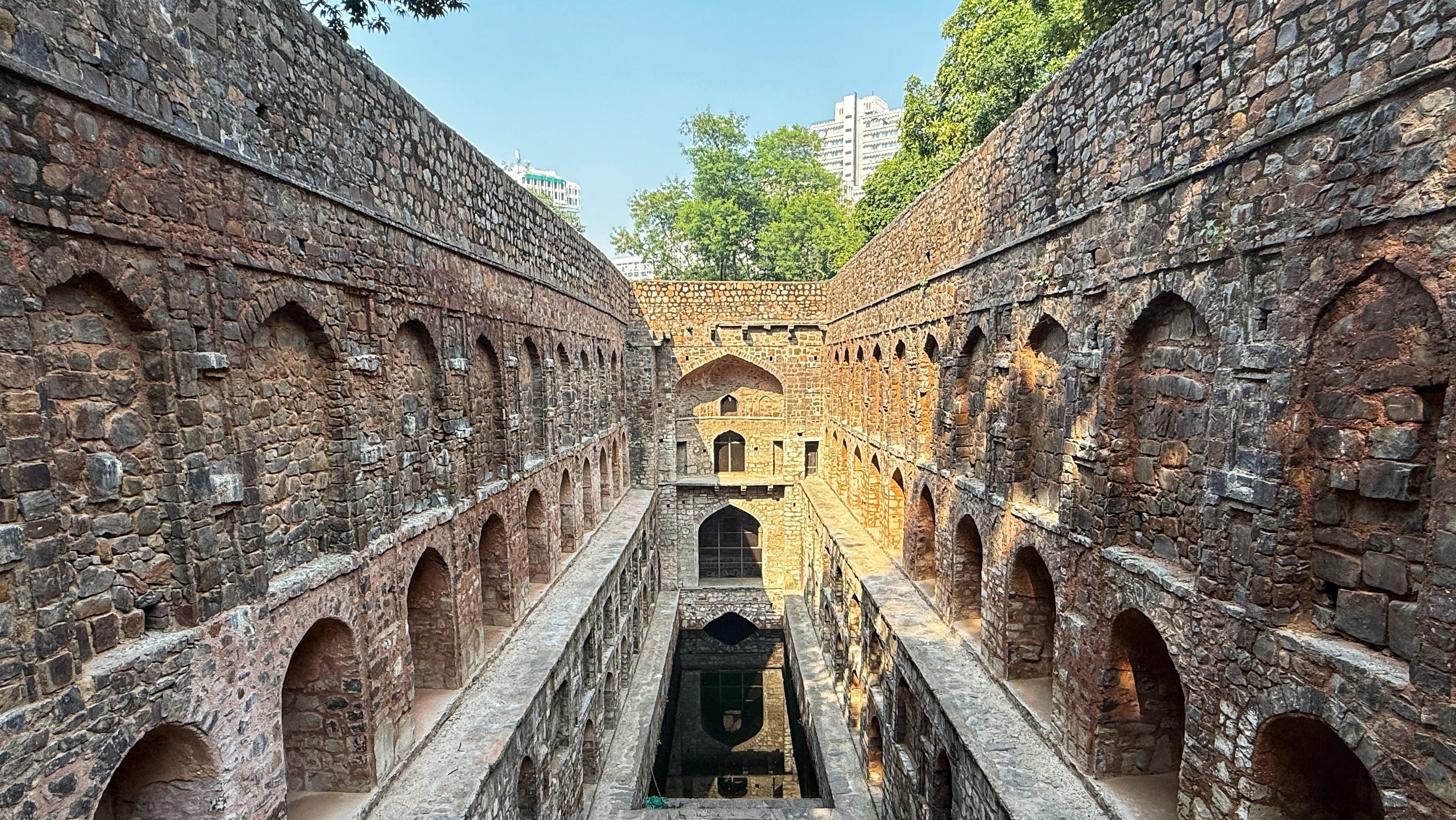
From the dhobi ghat, we walked just a few minutes around the corner to Agrasen ki Baoli, one of Delhi’s oldest stepwells. From the outside it doesn’t look like much, but once you step through the archway, the whole structure drops open in front of you—a long corridor of perfectly repeating stone steps descending toward what used to be a deep water reservoir. 

Agrasen ki Baoli stepwell, a stop during my 2 Days in Delhi itinerary, showing its multi-level archways and reflective pool.
Agrasen ki Baoli—perfect symmetry and stone corridors leading down to the old water level.

The baoli would once have filled with rainwater during the monsoon and served as a community well, but now it sits mostly dry, which actually makes the geometry even more striking. You might wonder why it doesn’t fill up anymore if the monsoon still comes every year—over time, Delhi’s water table has dropped, and most rainwater is carried away by modern drains and pipes, so the old channels that once fed the stepwell no longer do.

 It’s quiet in that echoing, slightly eerie way old places can be, with a few bats hanging in the arches and people scattered along the steps taking photos or just escaping the noise of the city outside.

Purana Qila & Qila-e-Kuhna Masjid

From Agrasen ki Baoli, we hopped back into the car and drove over to Purana Qila, another place I’d somehow never visited on previous trips to Delhi. You enter through one of the massive old gates—thick stone walls, arched passageways, and a faint echo when you walk through. The whole fort complex feels surprisingly open and quiet, almost like Delhi forgot to grow in this one spot.

Grand stone gateway of Purana Qila in Delhi, showing the massive round bastions and arched entrance from the Mughal era.
The main gate of Purana Qila — heavy, imposing, and somehow still elegant after nearly five centuries.

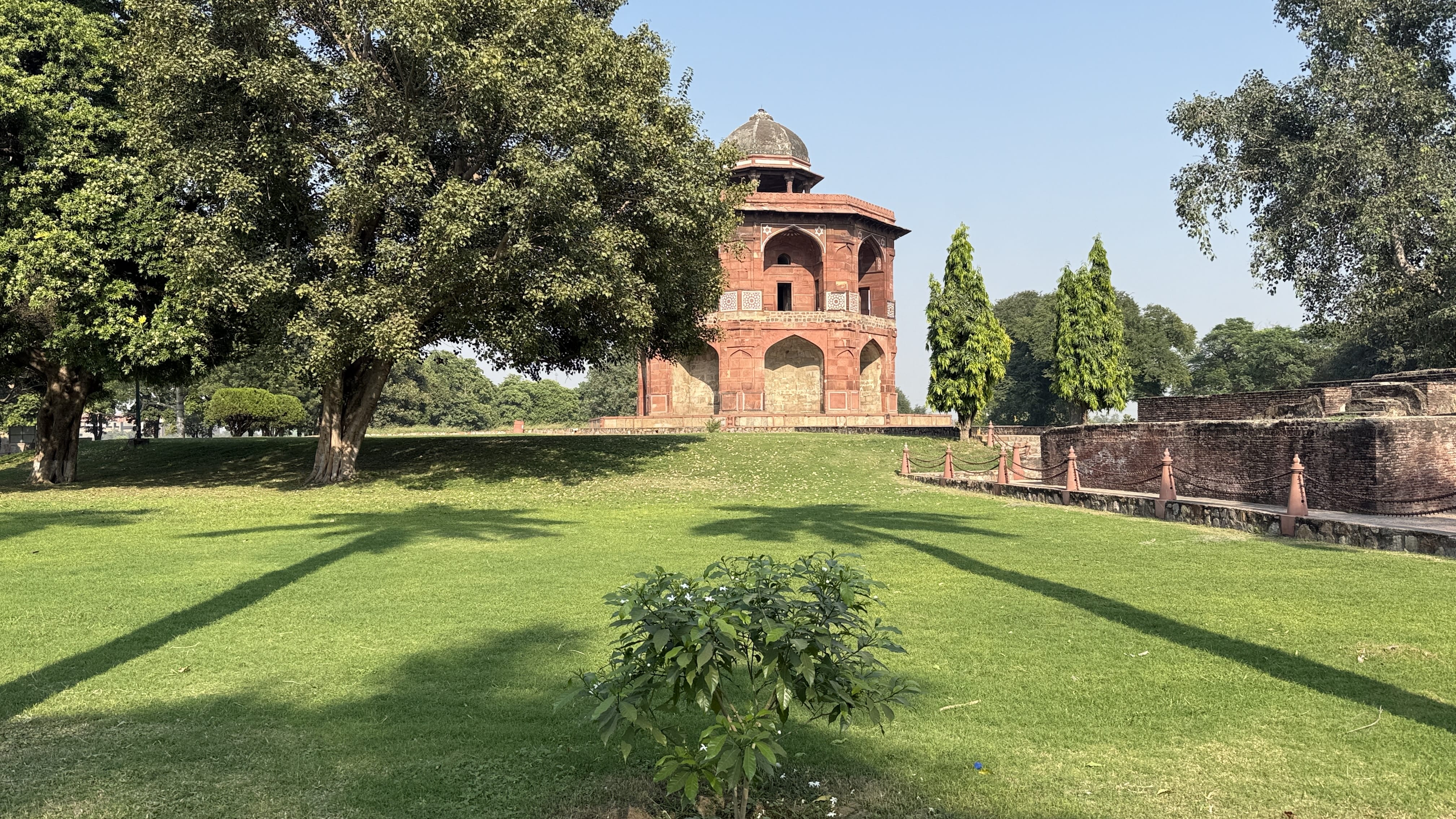
Mona pointed out Sher Mandal, the small octagonal tower inside the fort where Sawai Jai Singh II —the astronomer-king who later built the Jantar Mantar observatories — is said to have fallen while taking measurements. It’s one of those Delhi stories where the line between history and legend gets blurry, but it adds a strange poignancy to a place already layered with time.

Sher Mandal pavilion at Purana Qila, Delhi, standing on a grassy hill surrounded by trees. The octagonal red-sandstone structure dates to the Mughal period and overlooks the archaeological remains of the old fort.
Sher Mandal inside Purana Qila

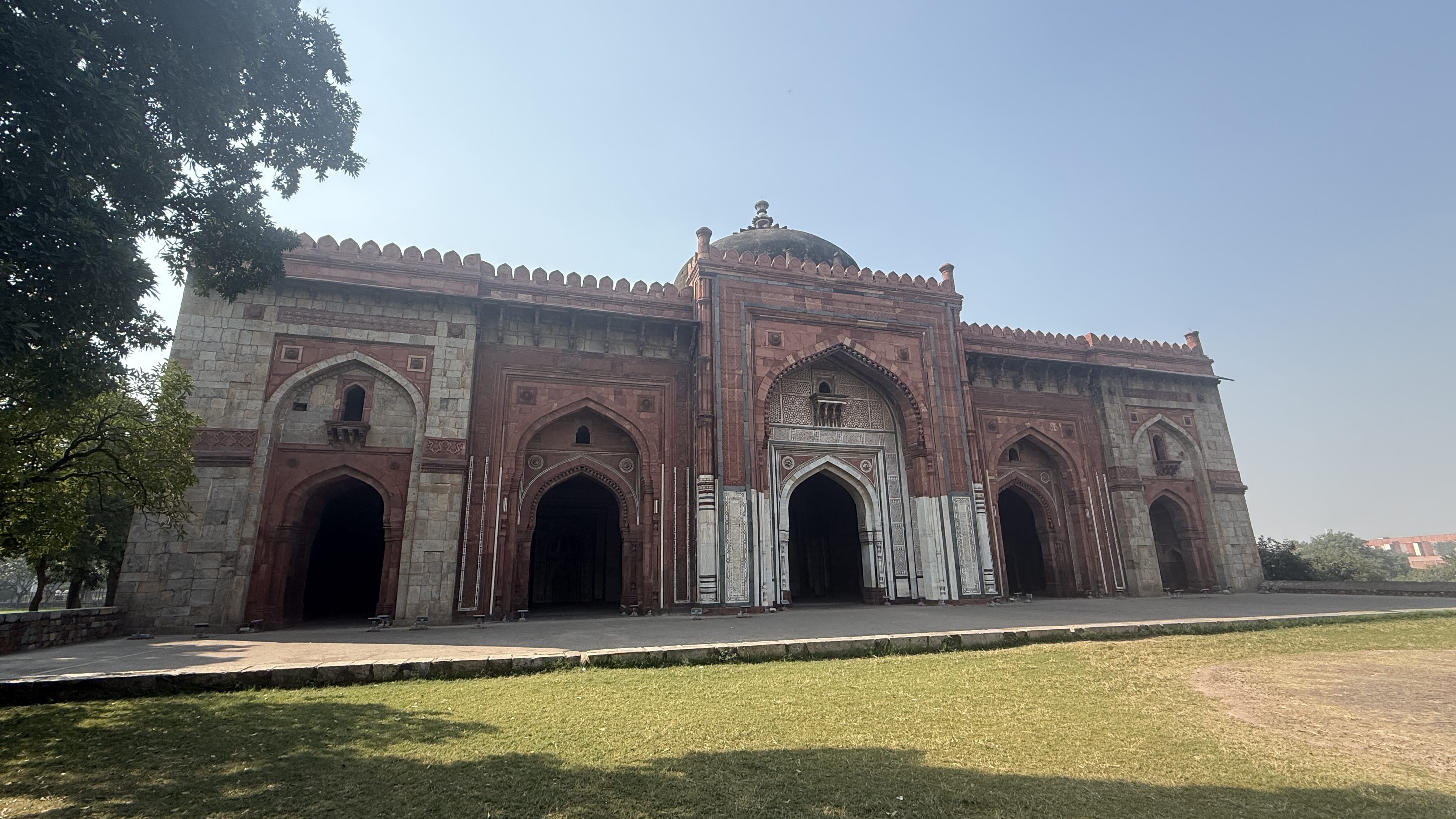
We wandered across the grounds toward Qila-e-Kuhna Masjid, the congregational mosque built by Sher Shah Suri in 1541. Even from a distance it’s striking: layers of red and yellow sandstone with white and black marble inlaid into the façade. Up close, the details are even better—carved geometric panels, elegant arches, tile work, and a row of jharokhas (small projecting windows) that you instantly recognize as early Mughal style.

Exterior façade of the Qila-i-Kuhna Mosque at Purana Qila in Delhi, featuring red sandstone arches, white marble inlay, and a domed roof from the 16th-century Mughal period —2 Days in Delhi.
The Qila-i-Kuhna Mosque, built in 1541 inside Purana Qila.

Inside, the mosque is long and narrow, with a central mihrab marking the direction of prayer. I didn’t see any modern signs, paint, or markers—just the original architecture doing the job it’s always done. The stone still shows faint divisions where worshippers once lined up shoulder to shoulder. Even though parts of the building are clearly in need of restoration, it’s still incredibly beautiful. The craftsmanship is everywhere, even in the worn sections: inlay that’s half faded, carved panels softened by centuries of weather, and turrets that still hold their shape.

Walking back through the gate, the modern city suddenly reappears—traffic, horns, noise—and it’s hard to believe that inside those walls is a quiet pocket of history that most people drive right past.

Lotus Temple

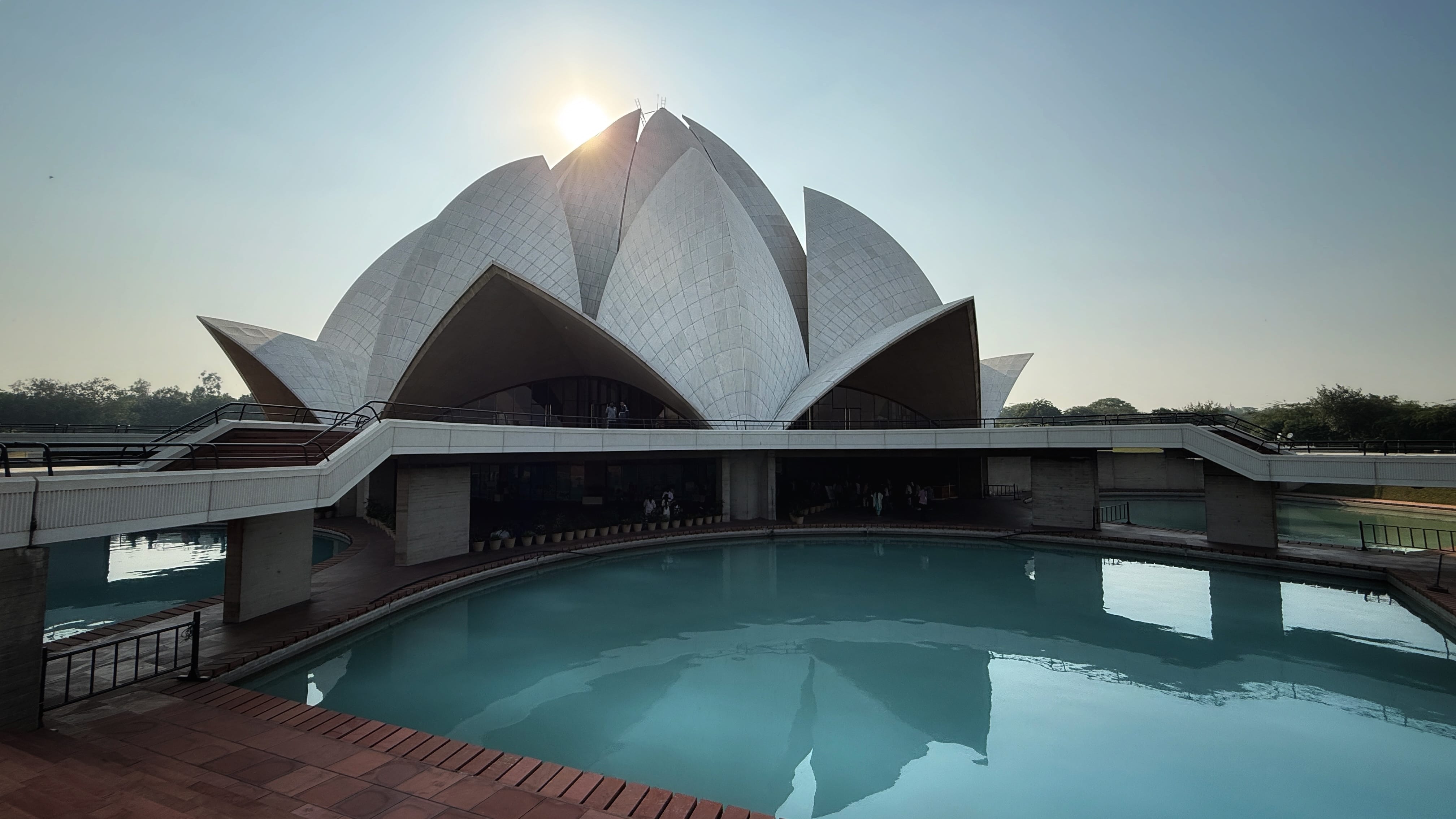
From there we drove to the Lotus Temple, which I’d visited years ago but only from the outside. And once again, that’s all I saw this time—the inside was closed for renovation. The Lotus Temple is actually a Bahá’í House of Worship, part of a modern faith that focuses on unity and equality, but you don’t need to know any of that to appreciate how striking it is. When it’s open, the inside is simply a quiet space where anyone can sit, pray, or just breathe for a minute—no statues, no big ceremonies. 

Still, it’s such a fascinating building to look at. The gardens were beautifully landscaped, and the whole place felt calm even though it was probably the most crowded site I visited in Delhi. (I’m not counting Chandni Chowk because that’s not a “site”—that’s its own world.) Even without going inside, it’s one of those structures that makes you stop and stare for a minute.

Lotus Temple in Delhi, India, showing the white marble flower-shaped structure reflected in the surrounding pool of turquoise water —2 Days in Delhi.
Late afternoon light over the Lotus Temple.

Lodhi Art District

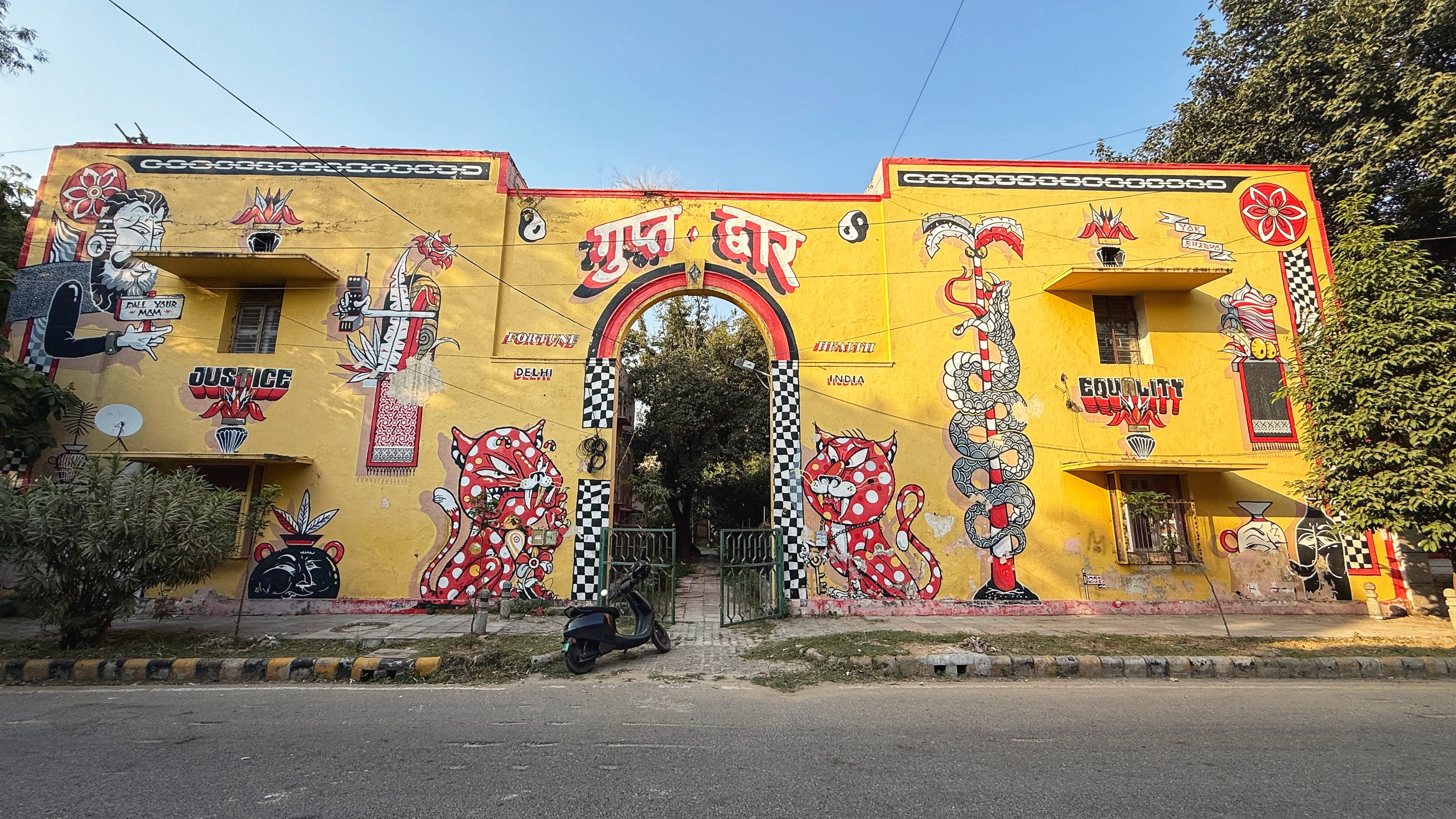
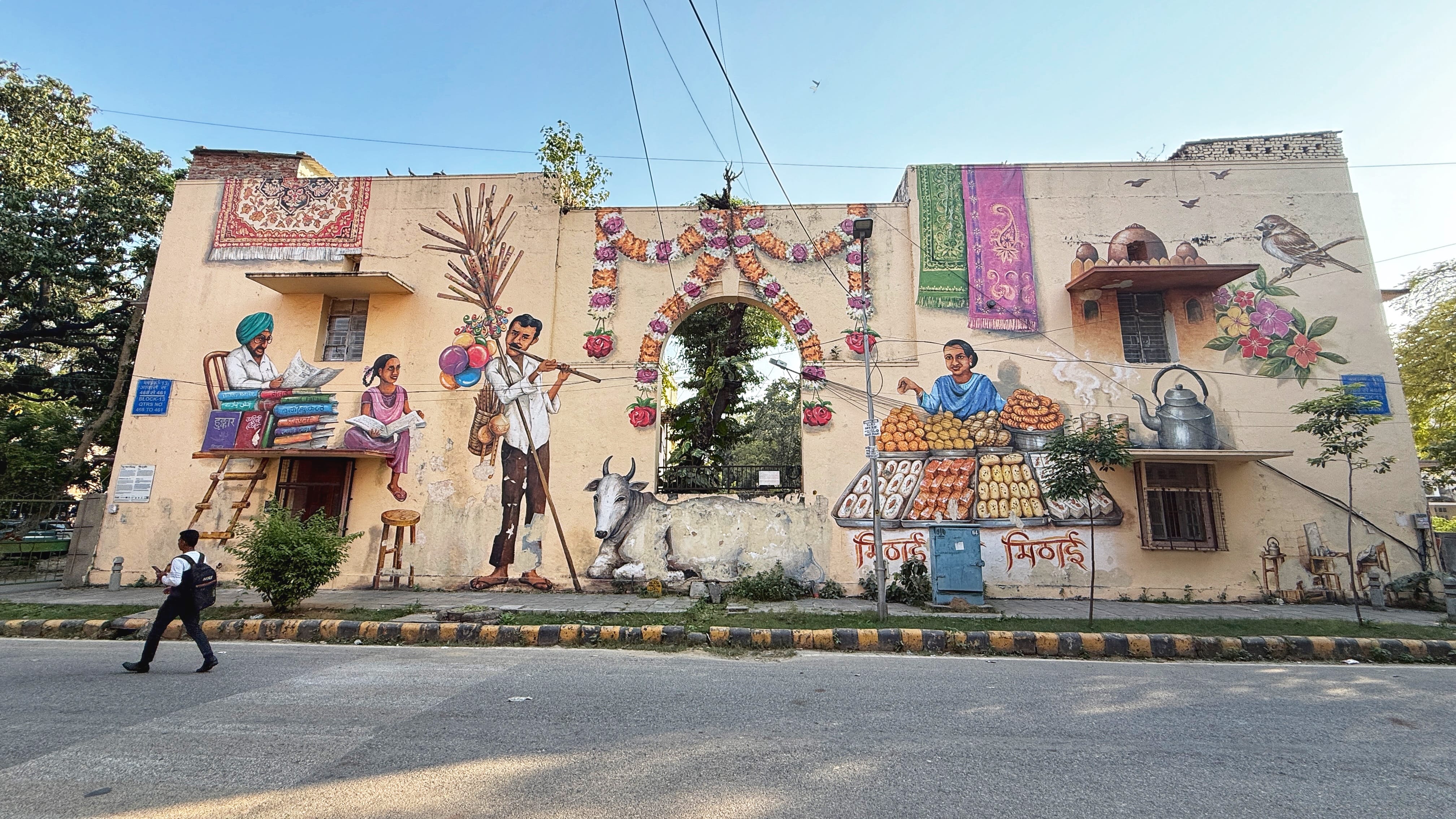
We ended the day with a walk through the Lodhi Art District, wandering past the murals scattered around the neighborhood. Some of them could use a little touch-up, but the area still has this relaxed, creative feel. There’s talk about new apartment buildings going in, which would definitely change the atmosphere—because the street art works so well on these older, low-rise walls. Who knows what it’ll look like in a few years, but for now it’s still a fun area to walk through.

Large yellow mural building in the Lodhi Art District in Delhi, featuring bold street art with red tigers, snakes, graphic lettering, and symbols around a central arched gateway—2 Days in Delhi.
A splash of bold color in the Lodhi Art District—painted tigers, snakes, and graphic motifs covering an entire building façade.
Street art mural at Lodhi Art District in Delhi showing everyday life scenes—vendors selling sweets, a family reading, a cow resting, garlands, textiles, and floral details—2 Days in Delhi
Everyday Delhi scenes painted across the building like a neighborhood storybook.

Wrapping Up

It was fun revisiting places I’d seen before, but also doing things I’d never done in Delhi—like the Ayurvedic treatment and the cooking class—along with some newer stops on the tour, like Washerman Lane and the Jain temple. Having Mona from Tours by Locals made a big difference; he might be the best guide I’ve had in India. He actually listened to what I wanted rather than pushing his own agenda, and that shaped the day in such a personal way. Delhi always fascinates me. It truly has something for everyone: history, food, chaos, calm, and everything in between.

Final Reflection

I’ve written about Delhi before, in totally different ways, but this visit reminded me why I keep returning. Delhi isn’t one thing — it shifts depending on how you approach it. This time, I found a version that felt slower, more personal, and surprisingly restorative. Even with just two Days in Delhi, the city gave me new corners, new flavors, and a fresh way of easing back into travel after a long journey.

If someone asked what to do with 2 Days in Delhi, I’d say this—don’t try to cover everything. Choose a few things that feel meaningful: wellness, food, a little wandering, and time to just absorb the city. For me, that combination turned what could have been a rushed stopover into something grounding and memorable.

India Related Blogs:

JoAnne Cross headshot

About the Author

Hi, I’m JoAnne—writer, wanderer, and lover of places that surprise me. I’ve traveled to 60+ countries (and counting), usually with a camera in one hand and a notebook in the other. I’m drawn to mosaics, markets, and mountains, and I write to remember what moved me. When I’m not traveling, I’m working on my blog Travels Afoot, trying new creative projects, or planning my next adventure.
📍 More about me | ✈️ Explore destinations