Tanzania Safari: 7-Day Yoga & Wildlife Adventure in Serengeti & Ngorongoro

Before arriving in Tanzania, I was in Kenya hiking Mount Kenya on a five-day trek with a couple of friends. You can read more about that part of the trip here: Exploring Africa’s Heights: A Five-Day Mount Kenya Hiking Adventure.

From Nairobi, I flew into Tanzania with the two friends I’d been hiking with in Kenya to begin the next leg of my East Africa trip—a seven-day yoga-and-safari experience.

I booked this portion of the trip with SUP YO Adventures, a company I’ve traveled with before. Every experience I’ve had with them has been well-organized and exactly the kind of travel I gravitate toward—active, personal, and a little adventurous. 

🌍 Trip Snapshot — What’s Included

  • 7-day itinerary
  • Kilimanjaro day hike
  • Hot air balloon safari
  • Ngorongoro Crater game drive
  • Yoga most mornings
  • Small-group travel (only 5 participants)
  • Beautiful lodge stays

Day 1 – Arrival in Arusha

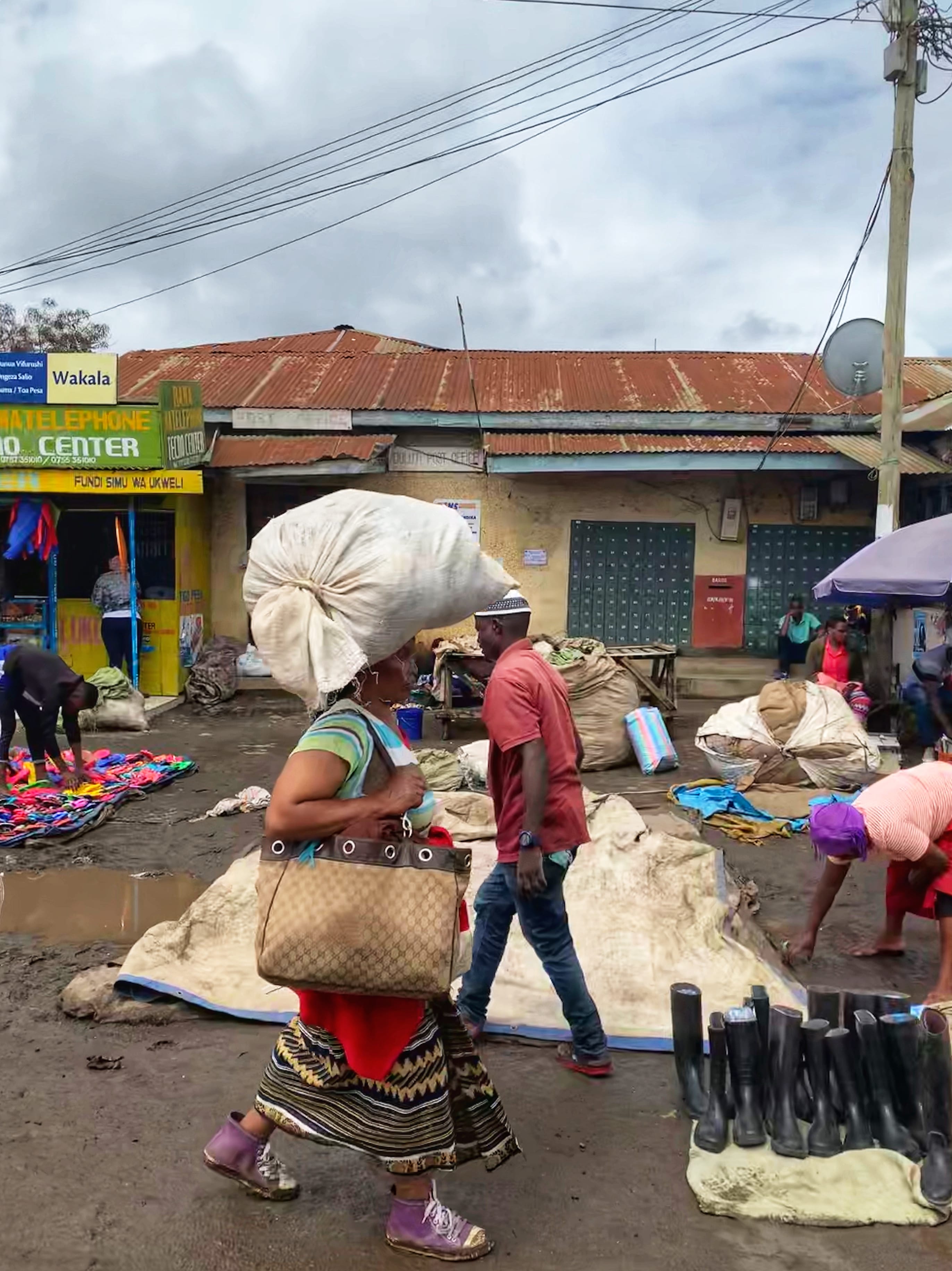
The drive from Kilimanjaro International Airport to our lodging—the Arusha Serena Hotel—took about 50 minutes. Along the way, we passed an open street market—rows of clothes spread out on the ground, produce piled high, and women in bright, patterned kangas and kitenges moving through the market with huge bundles balanced on their heads.

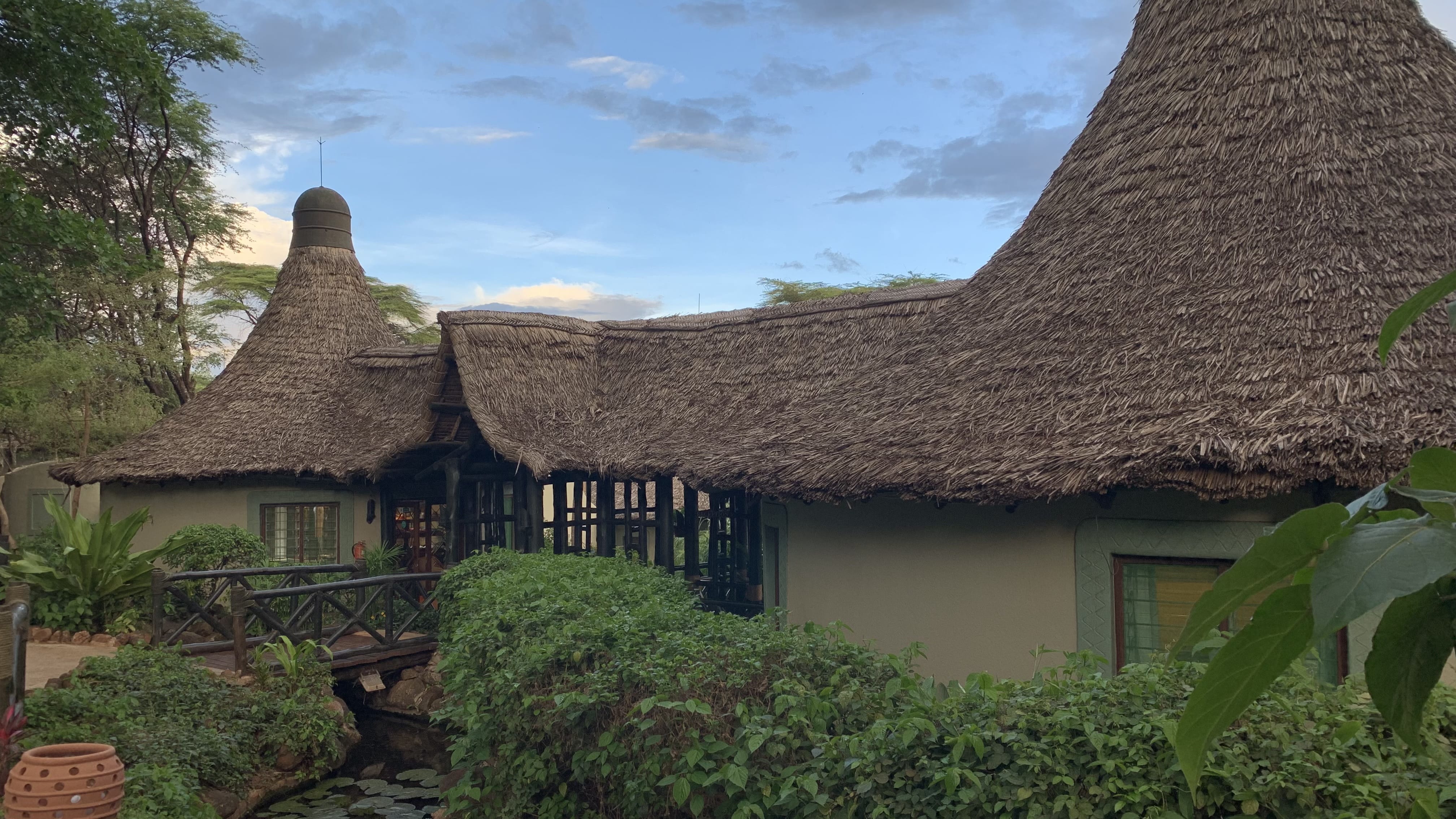
The Arusha Serena Hotel sits on the edge of Lake Duluti, with round thatched-roof cottages set among gardens. Walkways curve between beds of bright flowers and glossy green leaves. I was there for the next two nights, a perfect start to my seven-day Tanzania safari and yoga adventure.

Day 2: Kilimanjaro Day Hike

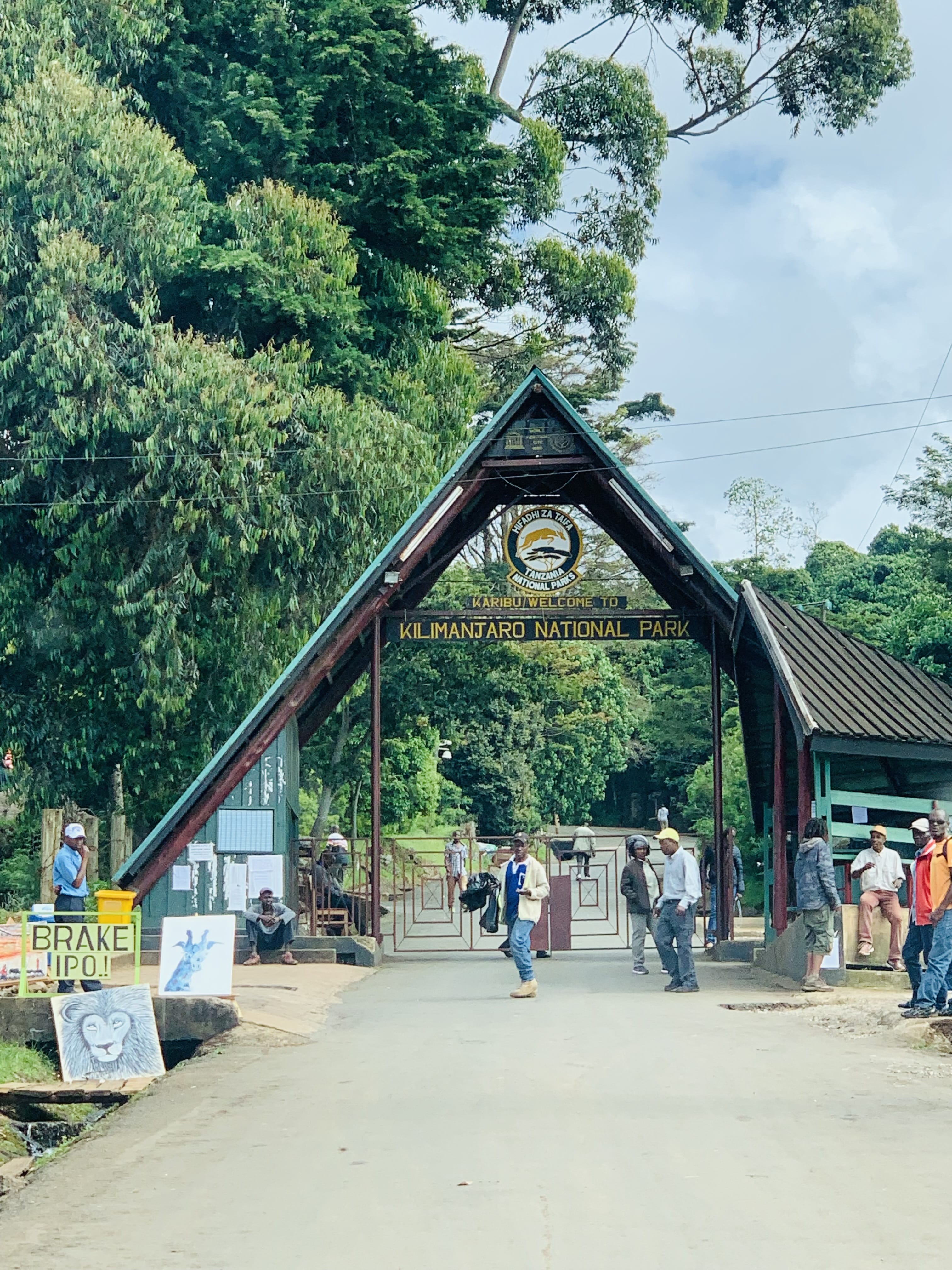
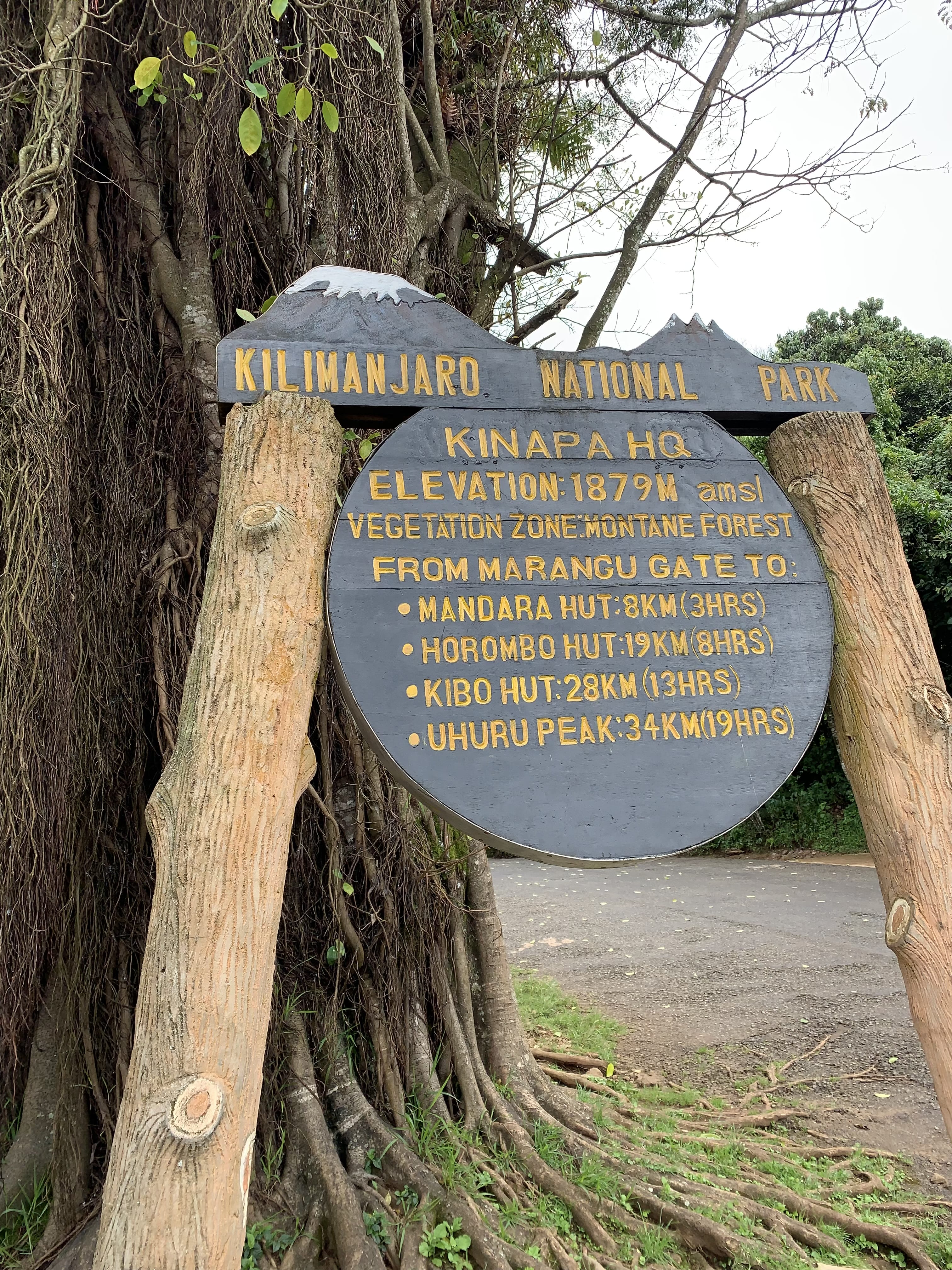
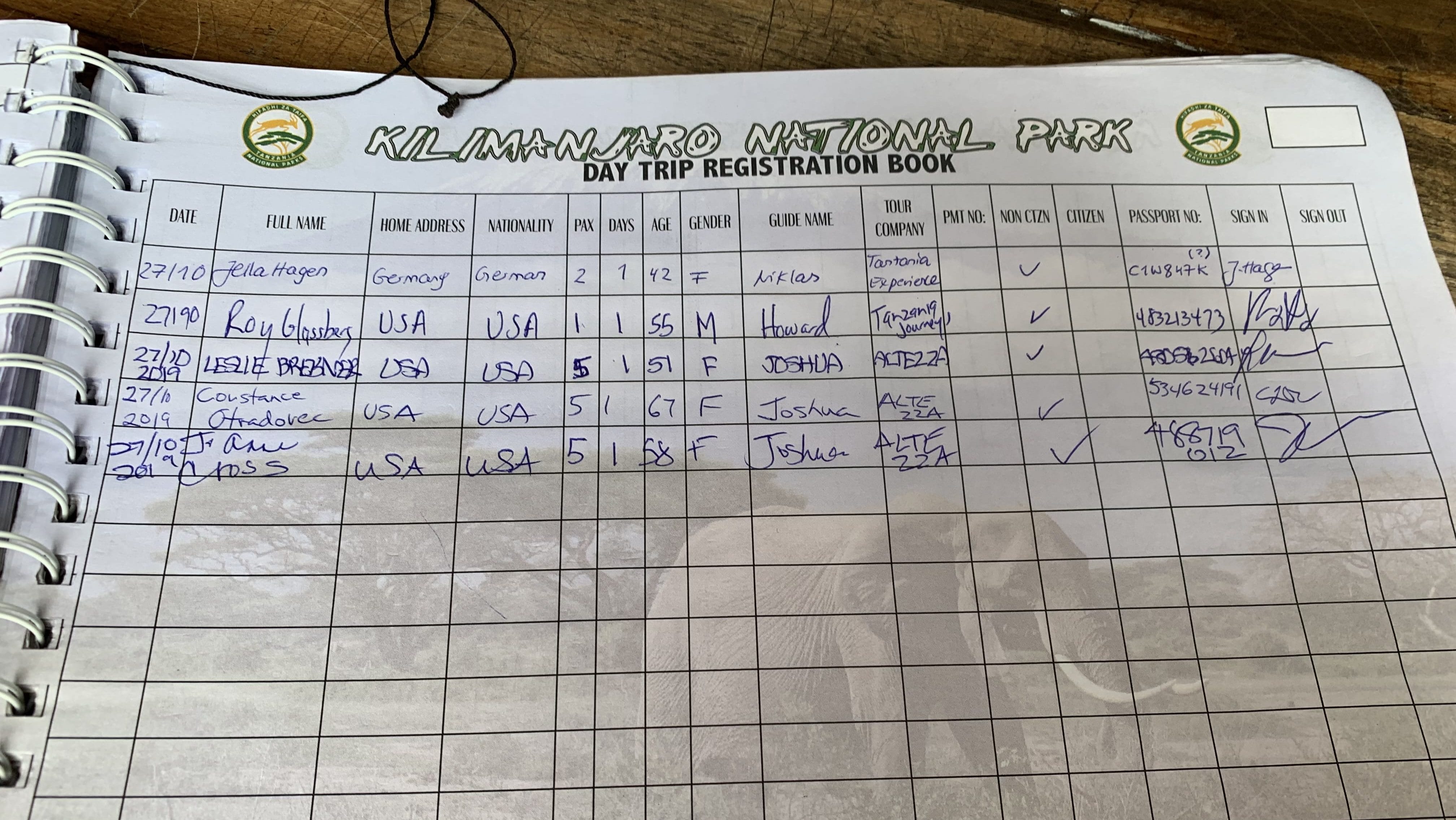
This morning, we drove to Marangu Gate, one of the main entrances into Mount Kilimanjaro National Park. The drive took about two hours, passing small towns, farmland, and stretches of open road. Once there, we met our local guide, Joshua, signed in at the park registration office, and began the hike from an elevation of about 1,879 meters (roughly 6,100 feet).

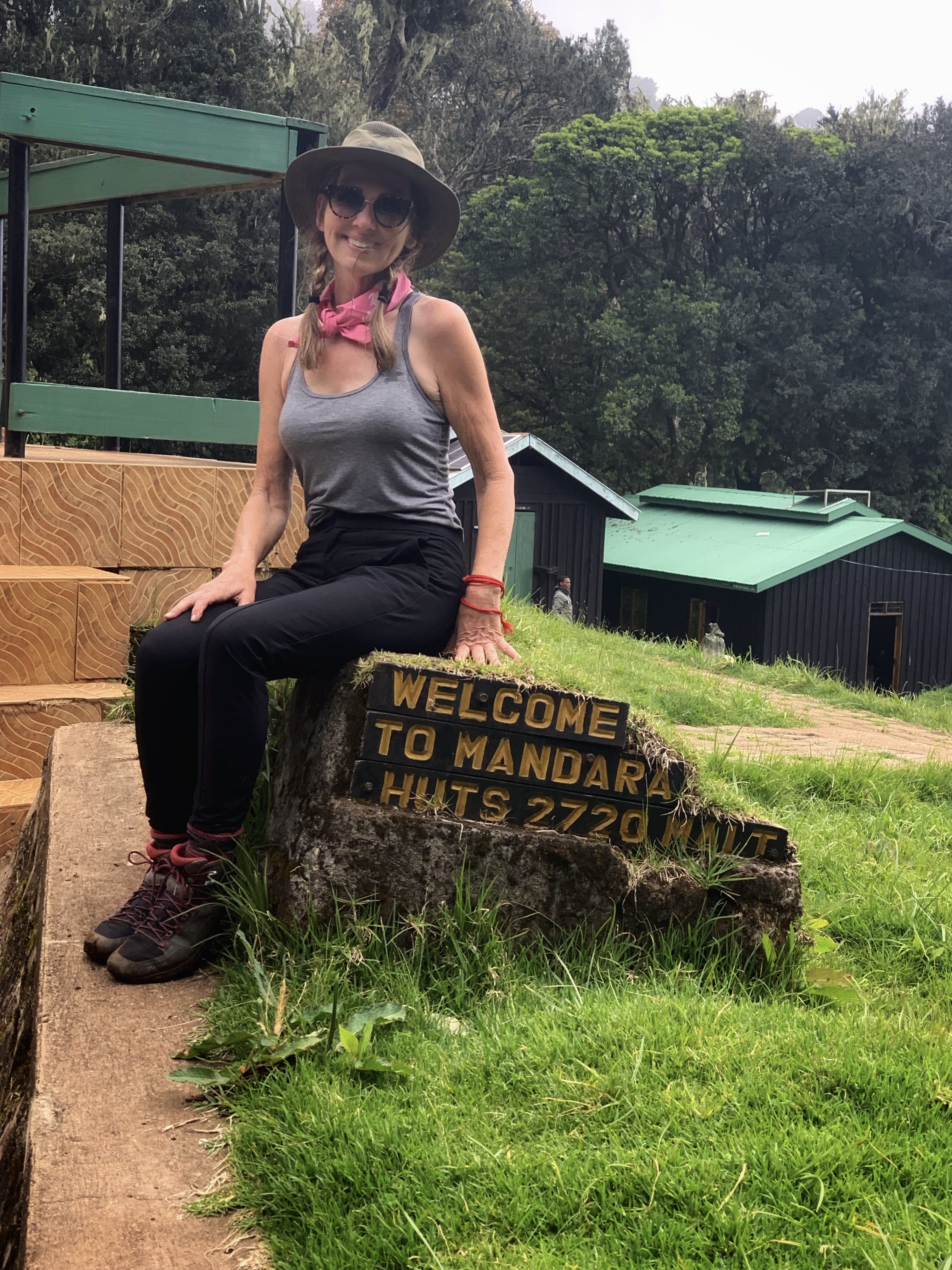
This first section follows the Marangu Route, often called the “Coca-Cola Route,” the classic path up Kilimanjaro. Our turnaround point was Mandara Huts, about 8 kilometers in, a roughly three-hour hike, at an elevation of about 2,720 meters (around 8,900 feet).

The trail climbed steadily through dense rainforest — ferns, moss-covered trees, and occasional movement overhead as monkeys passed through the canopy. 

At the Mandara Huts, we stopped for lunch and a much-deserved break. The area is a small clearing with a cluster of huts and shared spaces. It’s the first overnight stop for climbers continuing higher, but our turnaround point.

The descent was quicker. As we went, afternoon light filtered through the trees, and we continued on, enjoying the sounds of the forest. At one point, someone started singing John Denver’s “Take Me Home, Country Roads,” and the rest of us joined in — not what you’d expect on a Kilimanjaro trail, but it worked.

We reached the gate again, tired from the day but in a good way, and drove back toward Arusha. Dinner and a short yoga session afterward.

Day 3: Mto wa Mbu Village, Lake Manyara & On to Rhotia

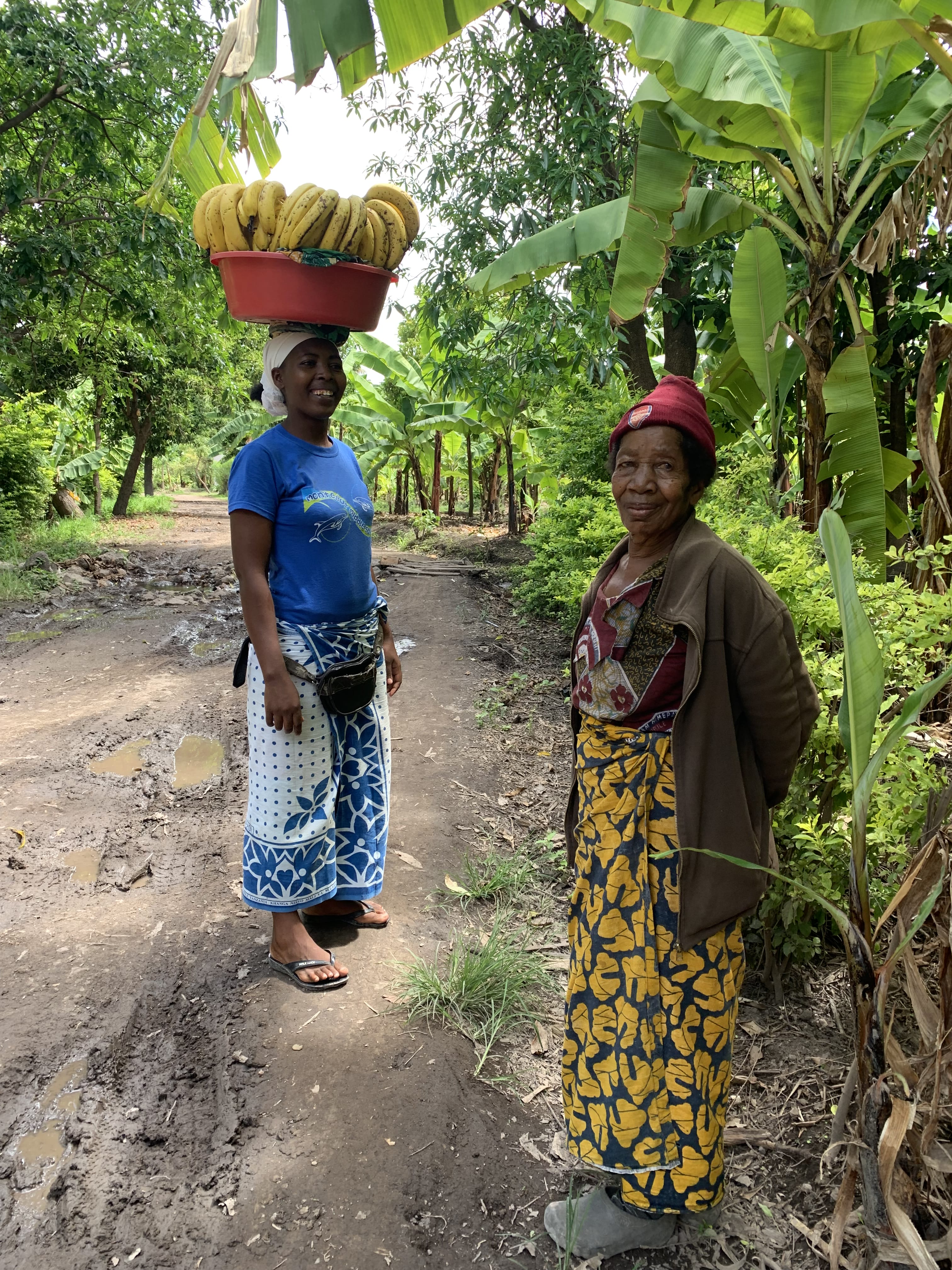
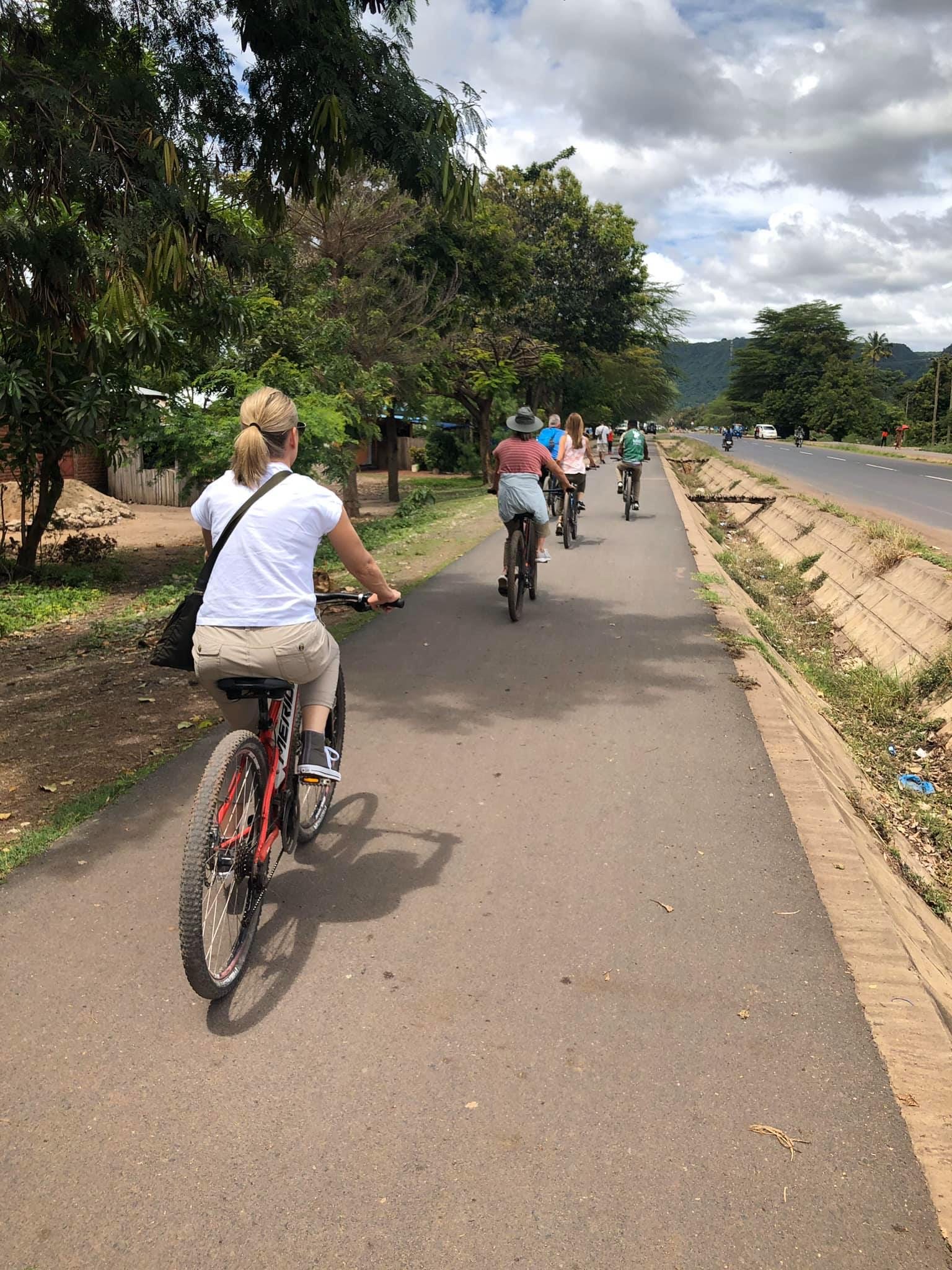
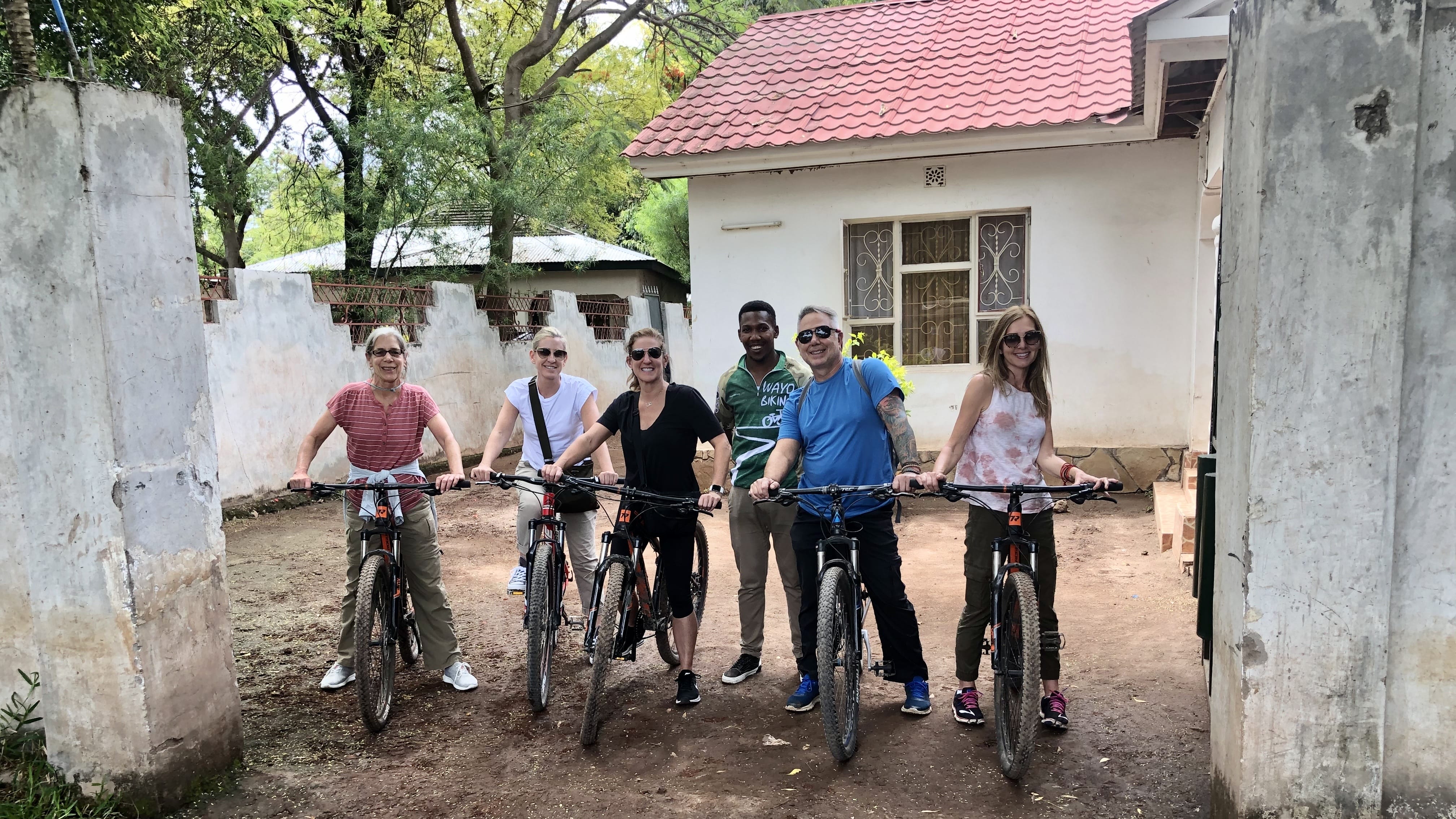
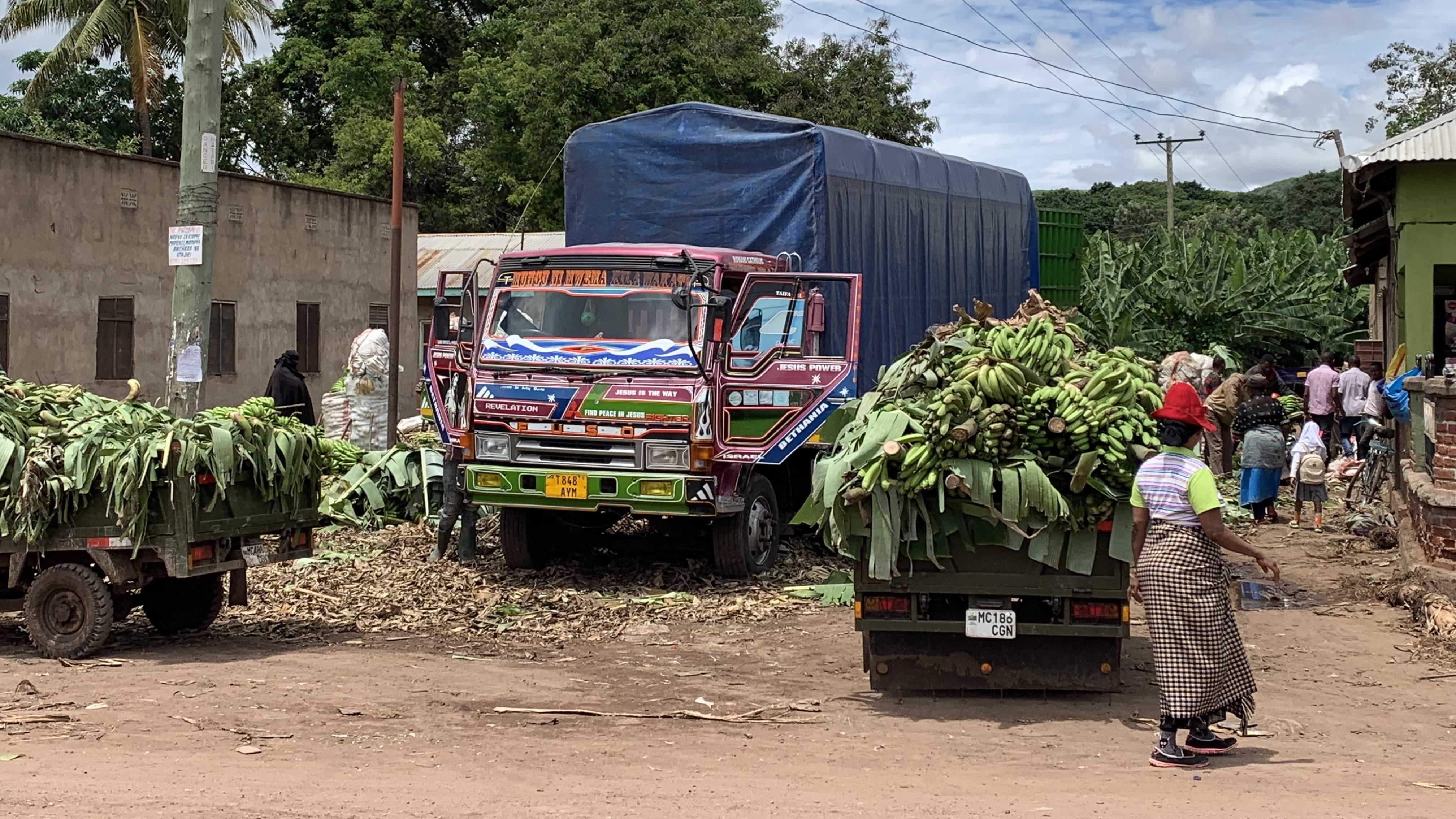
After breakfast and yoga, we headed to Mto wa Mbu—a village a village home to more than 120 different tribes. We did a bike ride with Wayo Biking, pedaling past farms, rice paddies, trucks stacked with bananas, and women walking with enormous baskets balanced on their heads.

Small group posing with bicycles during a local village visit in Tanzania as part of a Tanzania safari itinerary.
Starting the day on two wheels.

We stopped briefly at the Mto wa Mbu Market, the village’s main market for everyday goods. The whole area felt like a working hub — trucks piled high with bananas pulling in and out, men shaking loose the leaves used as packing, and vendors unloading baskets straight onto the dirt.

Trucks loaded with green bananas at a busy roadside market in Mto wa Mbu, Tanzania near Lake Manyara.
Trucks filled to the top with bananas.

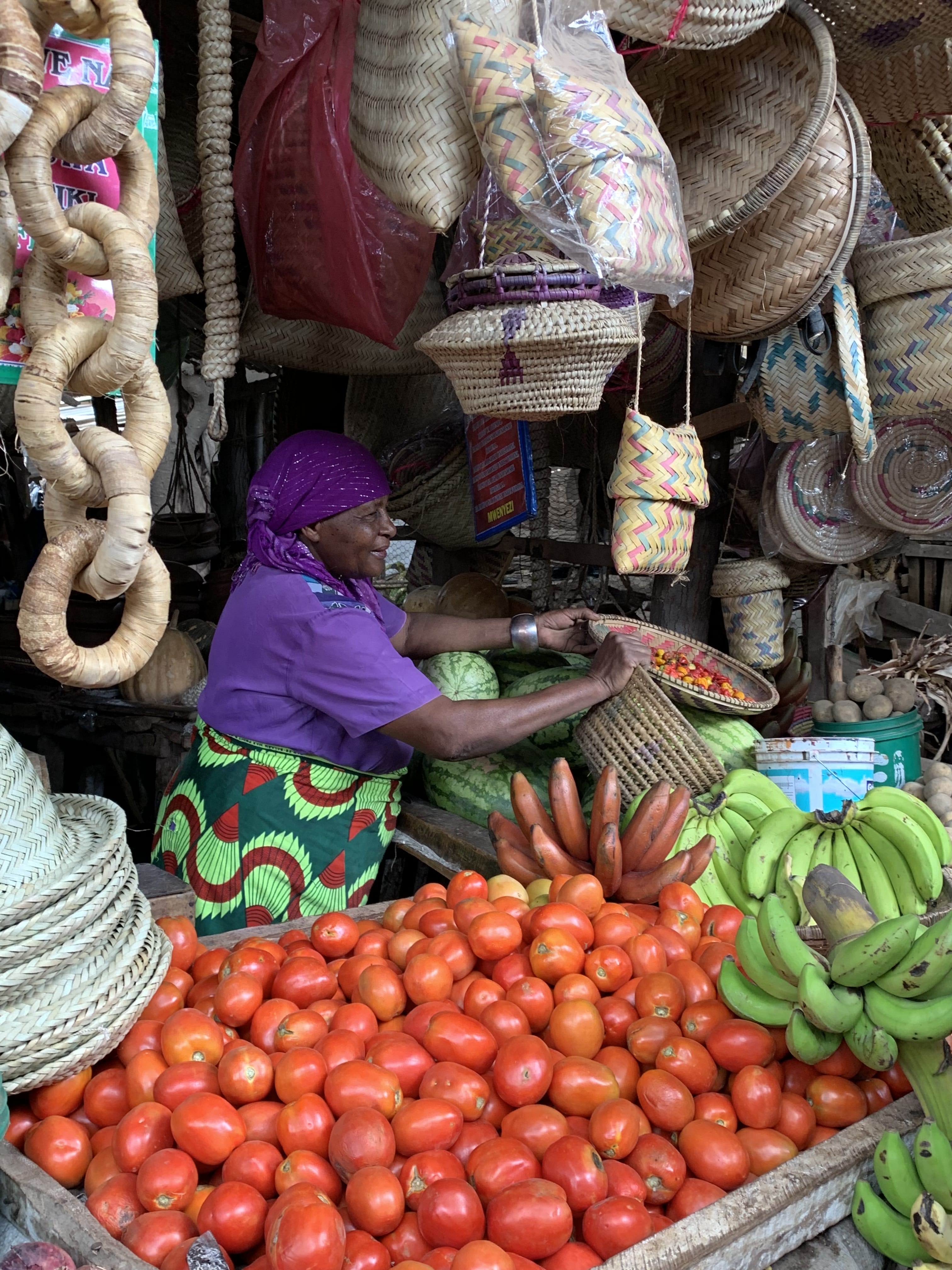
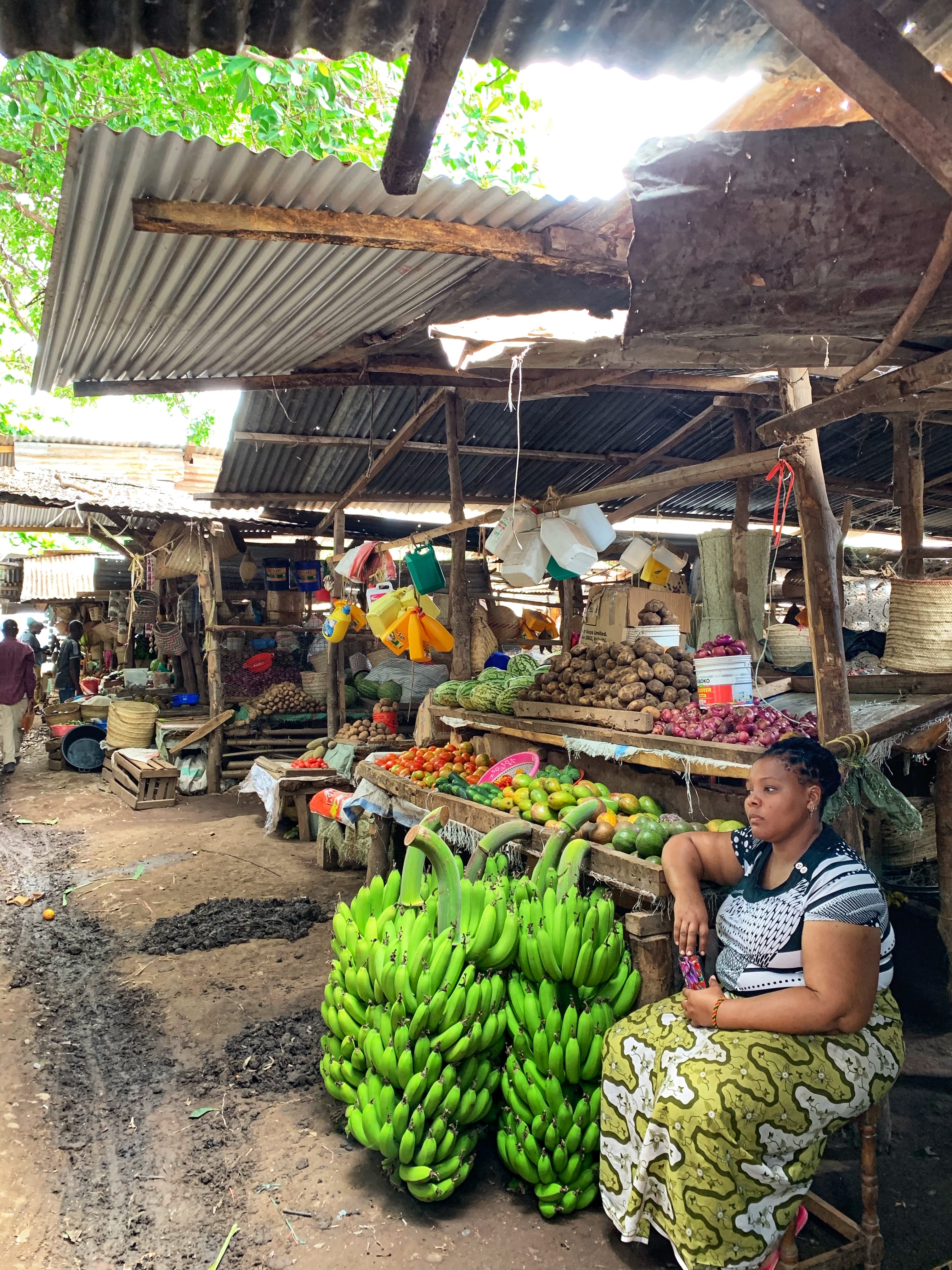
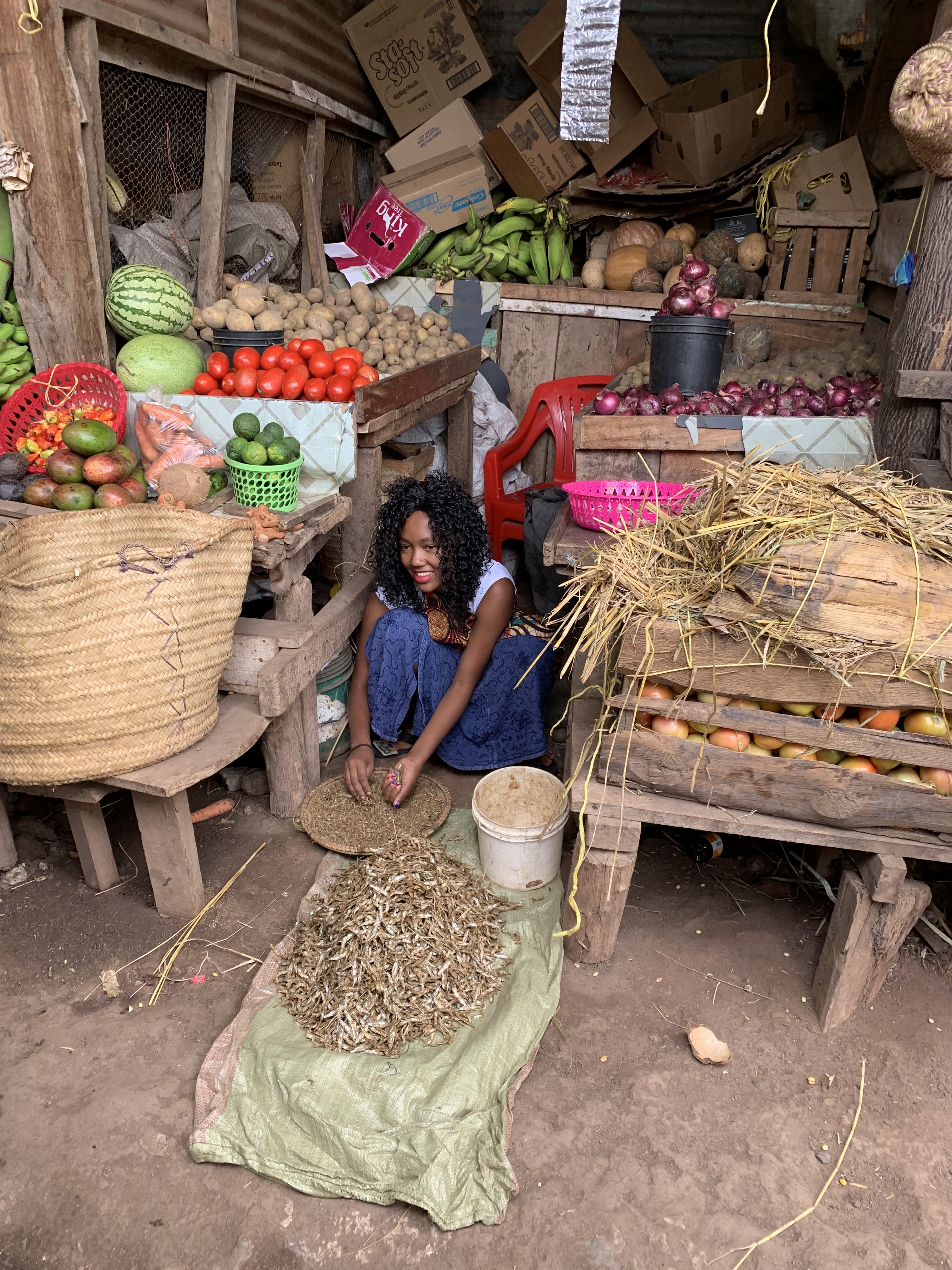
Inside the market, the aisles were narrow and uneven — baskets hung from the tops of wooden stalls. Many vendors sold vegetables and fruit — onions, avocados, and bananas stacked in small piles — while others offered nuts and spices. It wasn’t so different from other markets I’ve visited, but there were always small differences—bananas still hanging in full bunches, unfamiliar fruits and vegetables — that made it feel specific to this village and the people who call it home.

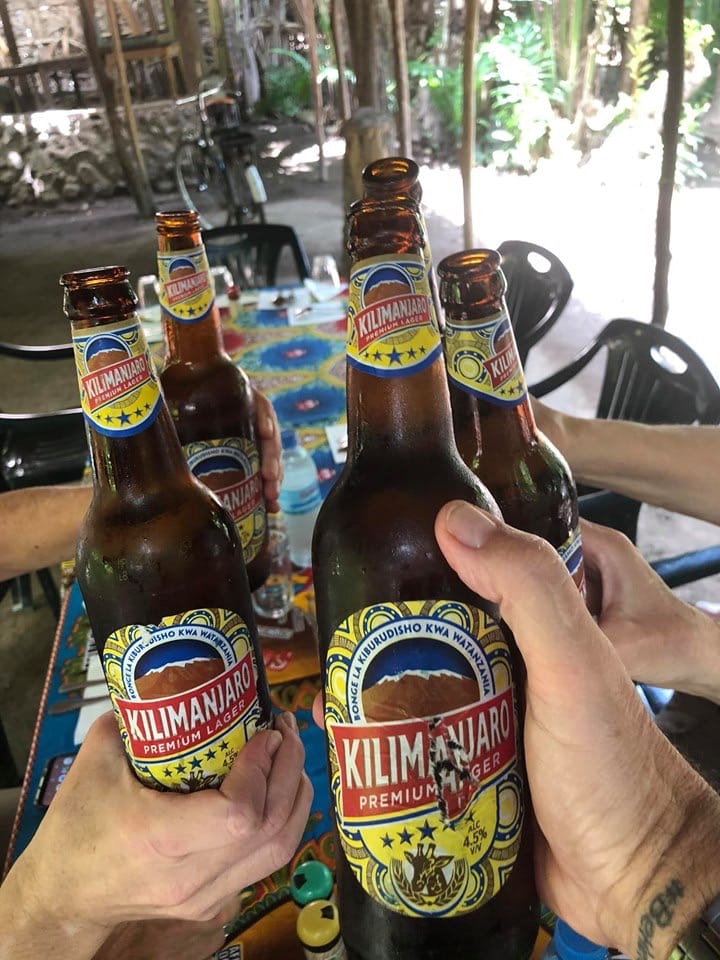
Lunch was served under banana trees, with simple tables set up in the shade. The food was traditional — rice, vegetables, beans, fresh fruit — and cold bottles of Kilimanjaro beer.

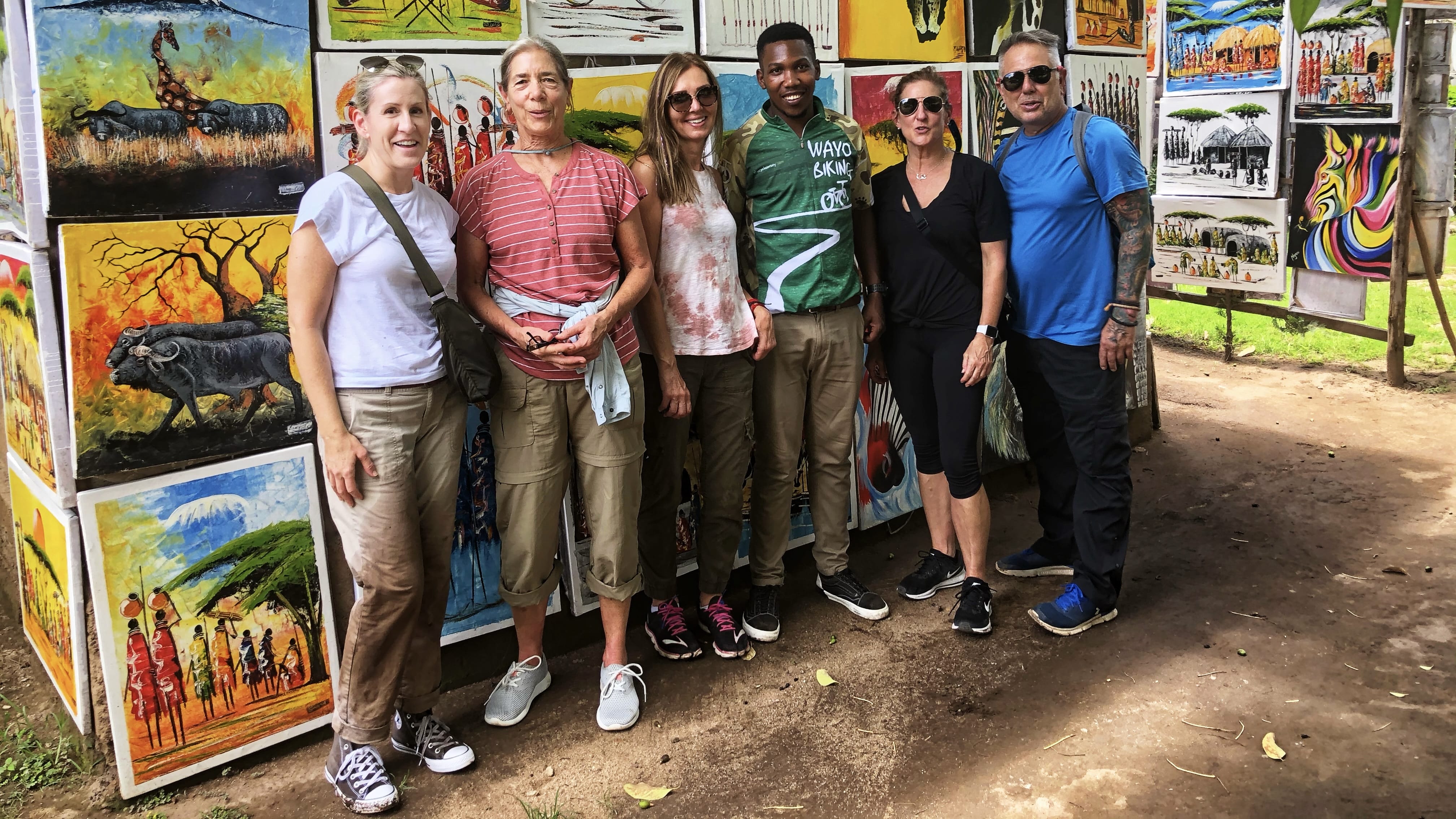
Afterward, we tried banana wine, which is popular here — faintly sweet, a little cloudy, and definitely banana-flavored. Interesting, but I was glad there was beer. Before leaving, we wandered through a local art gallery.

Group standing in front of colorful wildlife paintings at a local art stall in Mto wa Mbu, Tanzania, near Lake Manyara
Admiring some local art in Mto wa Mbu.

We climbed back into our 4×4 and slowly made our way toward our lodging for the night, passing through Lake Manyara National Park. The drive became our first game drive — about two and a half hours of stopping every few minutes because something else appeared along the roadside.

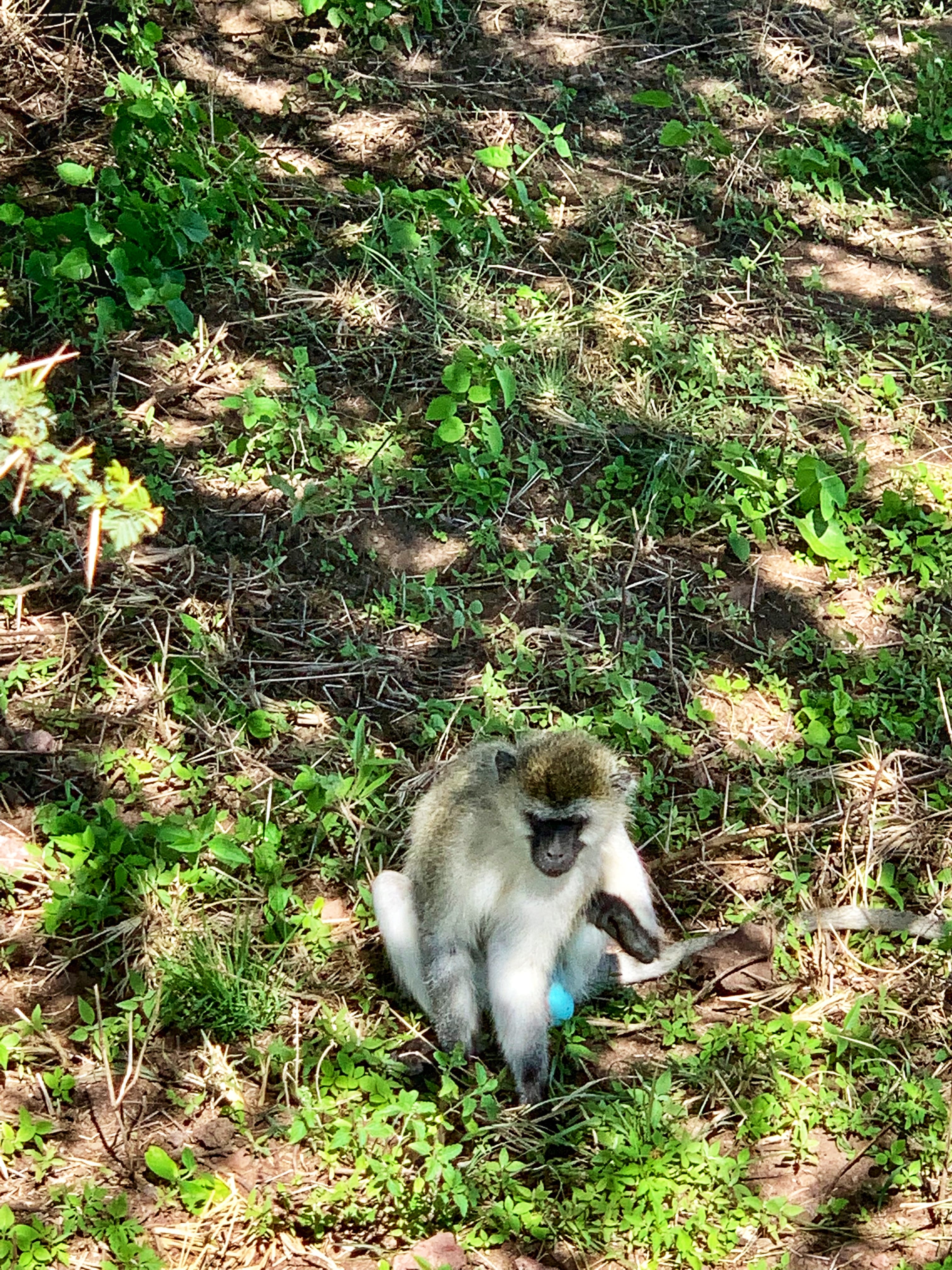
The first animals we saw were baboons — lots of them. Babies clung to their mothers’ bellies, others tumbled around in the brush, and a few sat right on the edge of the road. A little farther in, we spotted vervet monkeys — hard not to notice, especially the males with that bright blue coloring.

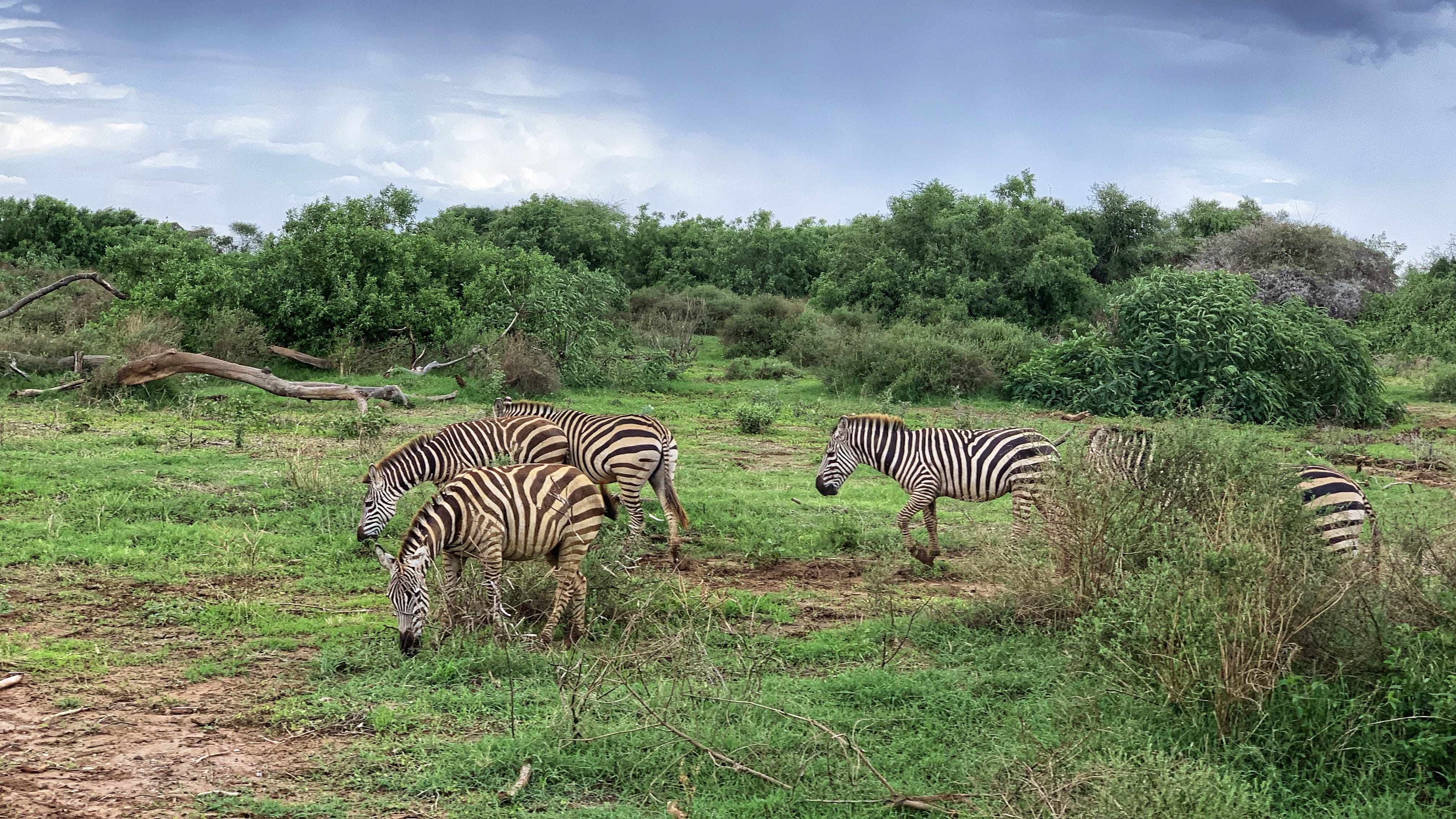
Further in, we passed a small group of zebras grazing in the open. There’s something incredibly beautiful about seeing them in their natural surroundings — those stripes against the green grass and low brush.

Herds of zebras grazing on green grass in Lake Manyara National Park, Tanzania
Zebras grazing.

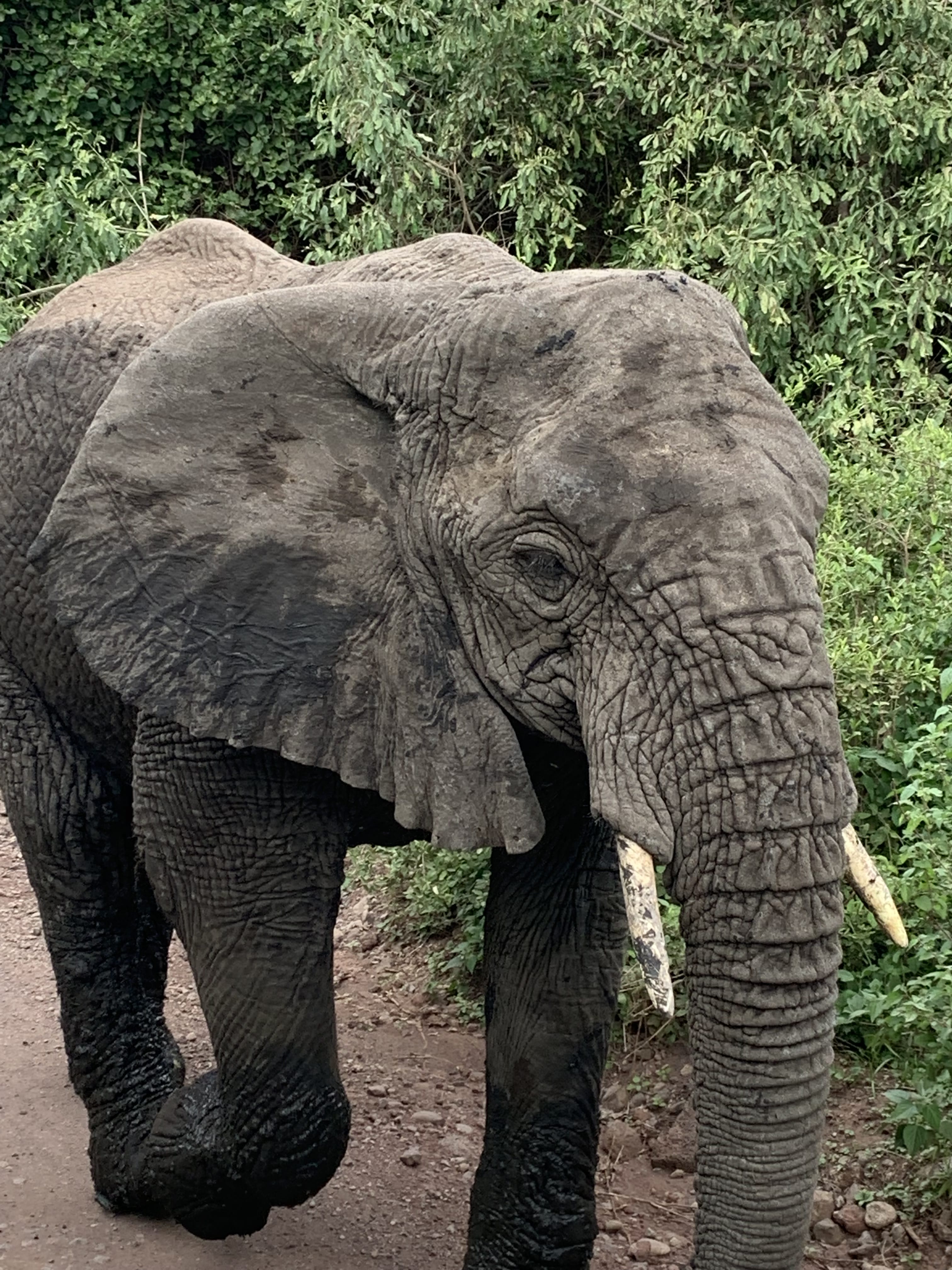
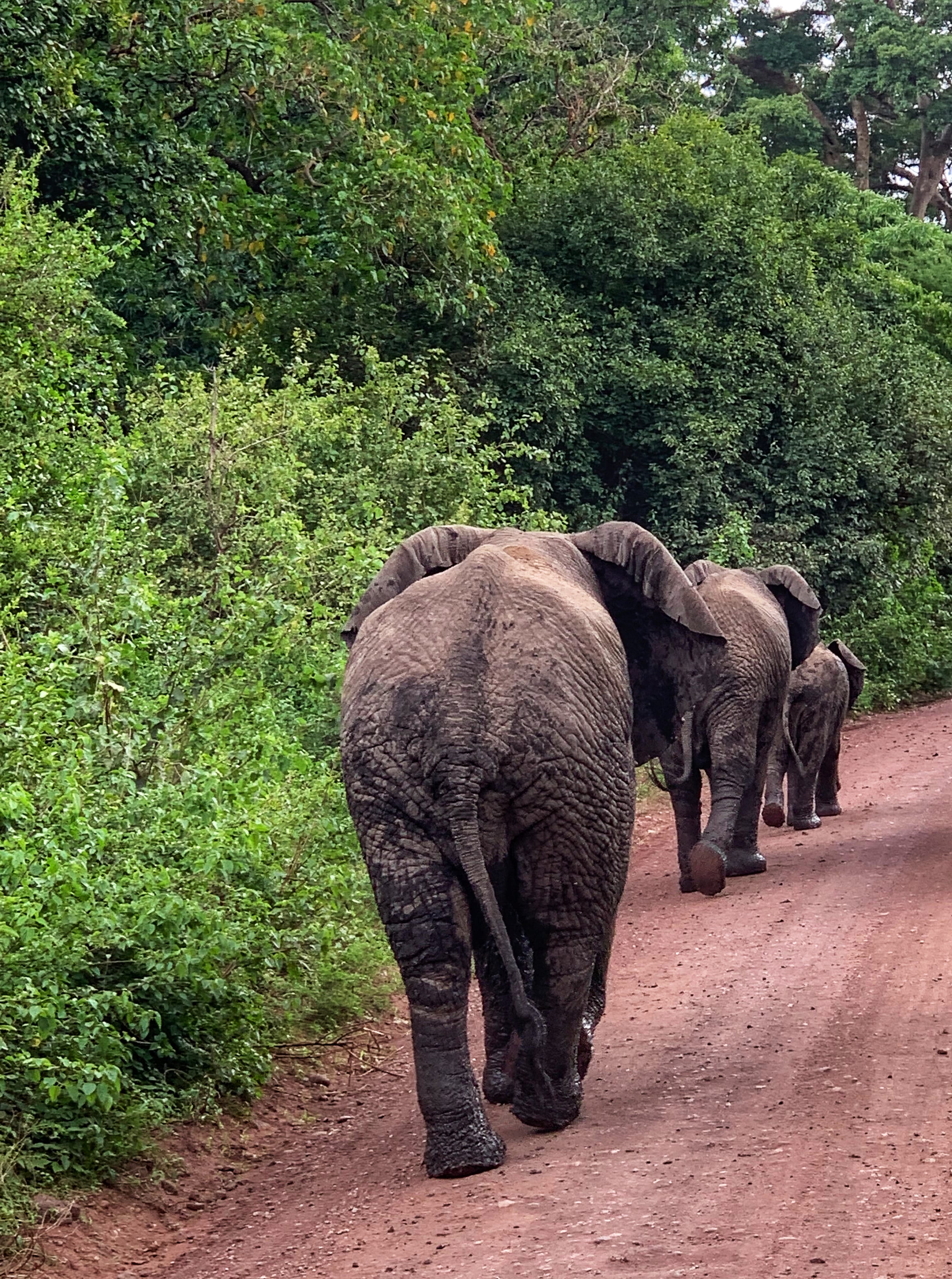
But the elephants — they were the real highlight. Toward the end of the drive, a small group — four or five, including a baby — appeared on the dirt road ahead of us and began walking straight toward our 4×4. They stayed in the road the entire time, moving in a calm, steady line.

One adult walked so close that I could see the texture of her skin and even the curve of her eyelashes.  It’s one thing to know you’ll “see elephants on safari,” and another to have them walk right past your vehicle.

By evening, we reached Lake Manyara Serena Lodge, perched high above the valley with views stretching across the Rift Valley. The lodge was beautiful—maybe even more so than the night before.

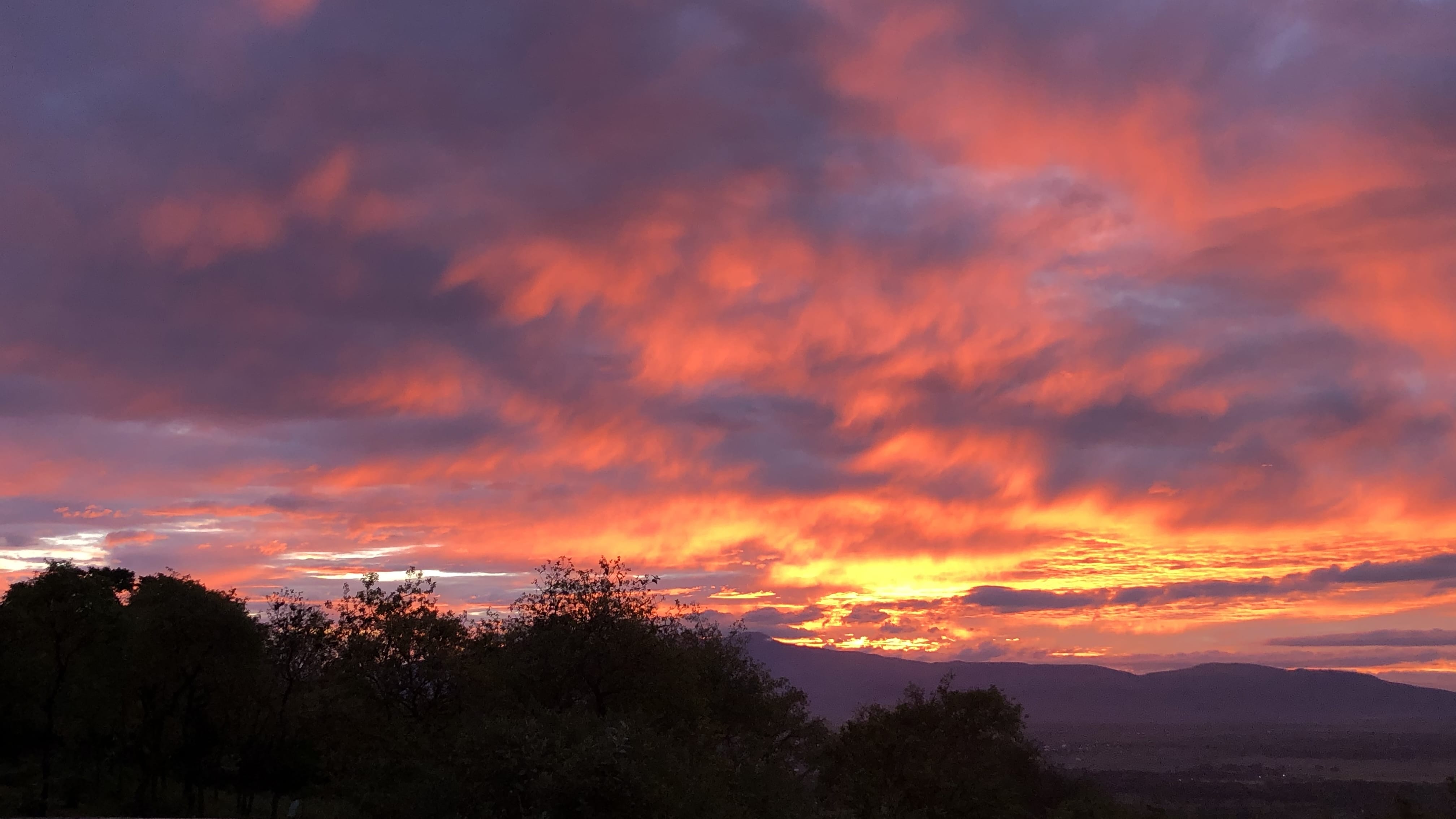
I still had time for a piña colada by the pool before dinner, watching the sky shift into layered oranges and pinks as the sun dropped behind the valley. It was a pretty perfect ending to a full day, and exactly the mix of movement and rest I’d hoped for on this Tanzania safari and yoga adventure.

Day 4: Serengeti via Olduvai Gorge

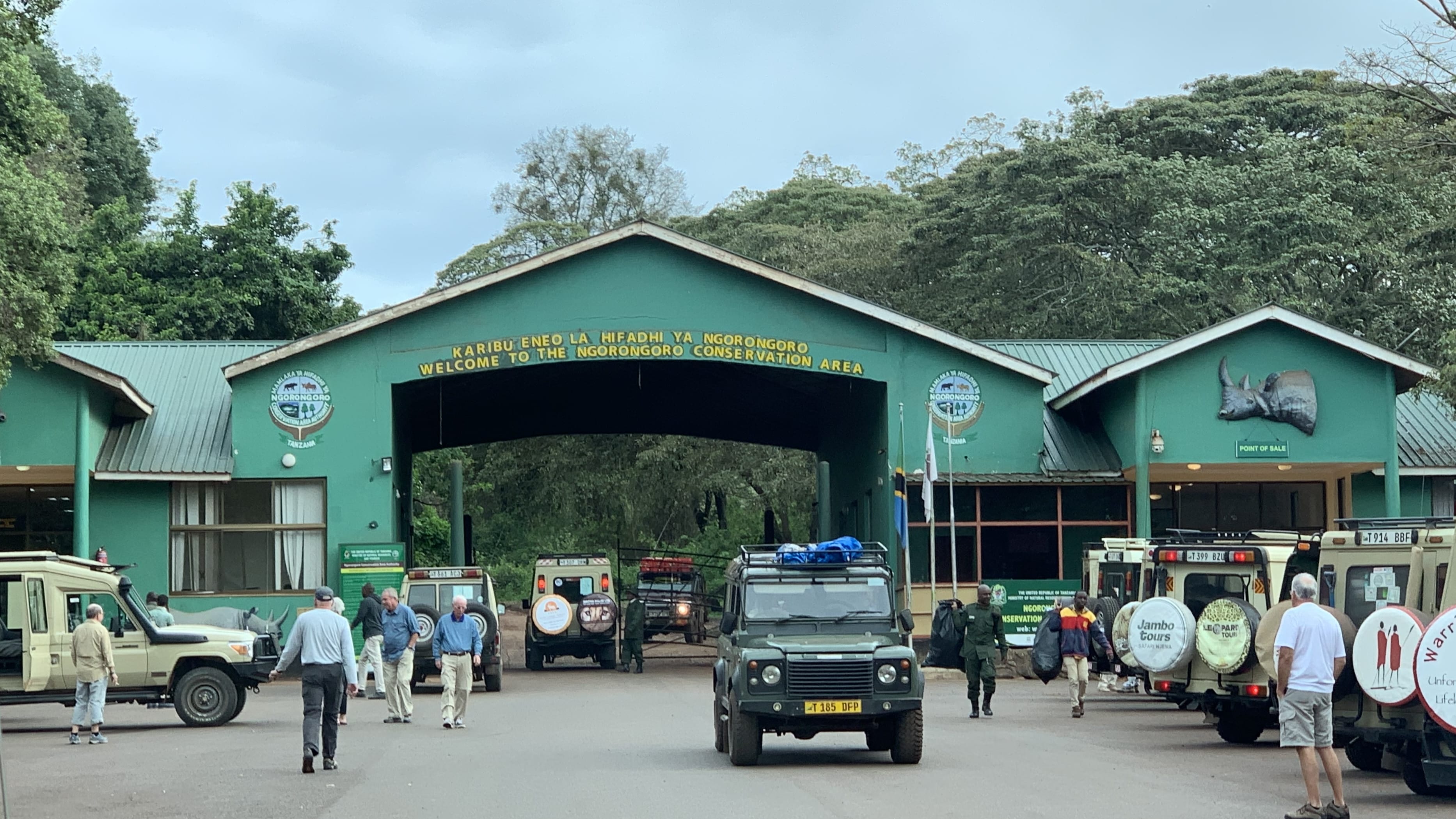
We began the morning by driving west toward the Ngorongoro Conservation Area, stopping at the entrance gate where lines of safari vehicles waited for permits. While our guide handled the paperwork, we stretched our legs, and someone took a photo of me with the only rhinoceros I’d end up seeing on the whole trip — a large rhino mural painted on the building. Once everything was approved, we continued across the highlands—the land opening wider as we drove.

Entrance gate to Ngorongoro Conservation Area with safari vehicles and travelers in Tanzania
Entering the Ngorongoro Conservation Area.
Traveler posing beside a painted rhino mural at the Ngorongoro Conservation Area visitor reception center in Tanzania
A quick stop at the Ngorongoro Conservation Area visitor center.

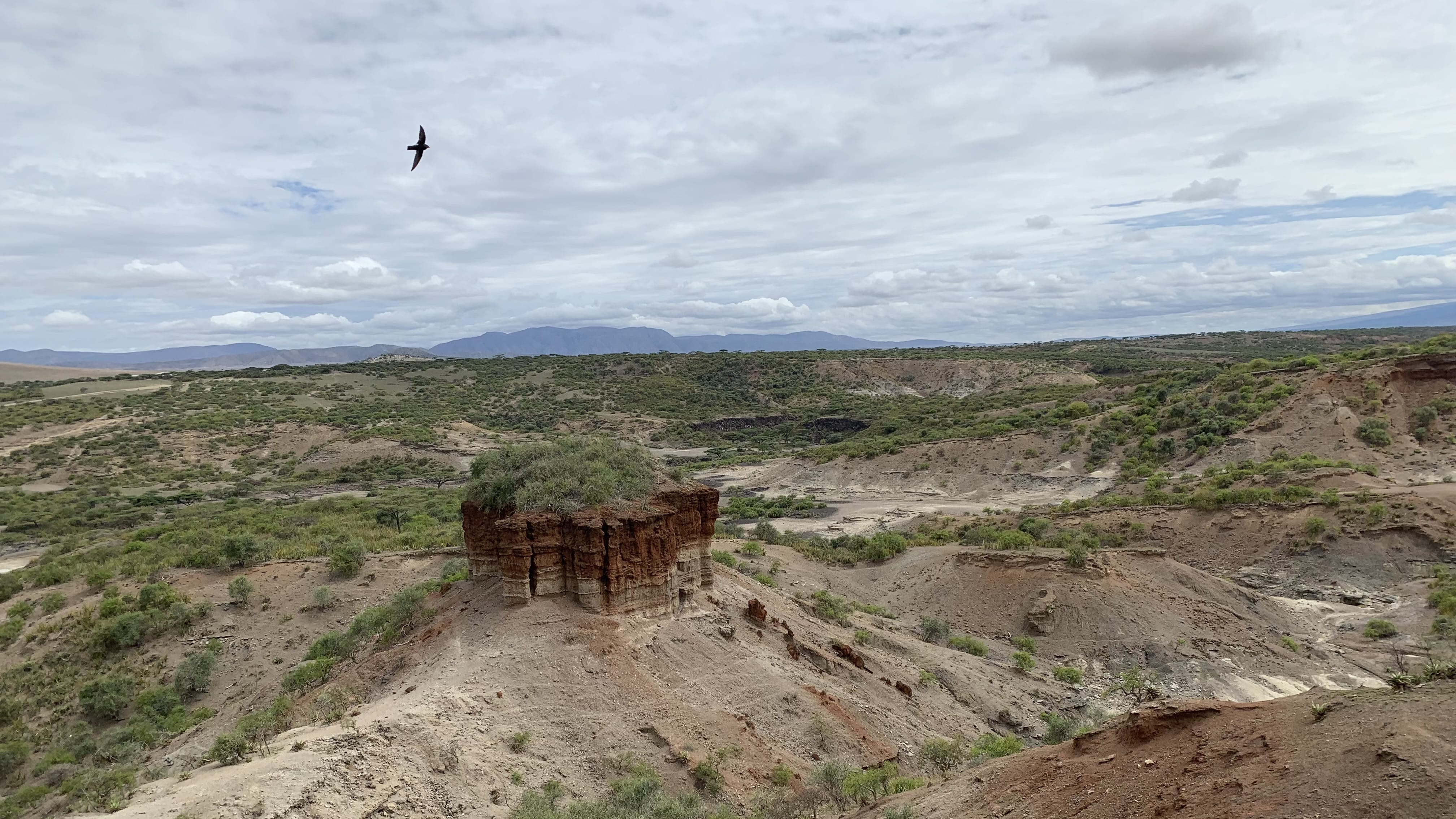
Our next stop was Olduvai Gorge, one of the most significant early-human archaeological sites in the world. From the overlook, the landscape looks simple at first—dry ridges and exposed layers of earth—but this region holds some of the earliest evidence of human ancestors: fossils, stone tools, and even ancient footprints dating back millions of years. It’s kind of hard to wrap your head around all of that.

Eroded cliff and a flat-topped rock formation at Olduvai Gorge, Tanzania in Ngorongor Conservation area.
Overlook at Olduvai Gorge in the Ngorongoro Conservation Area

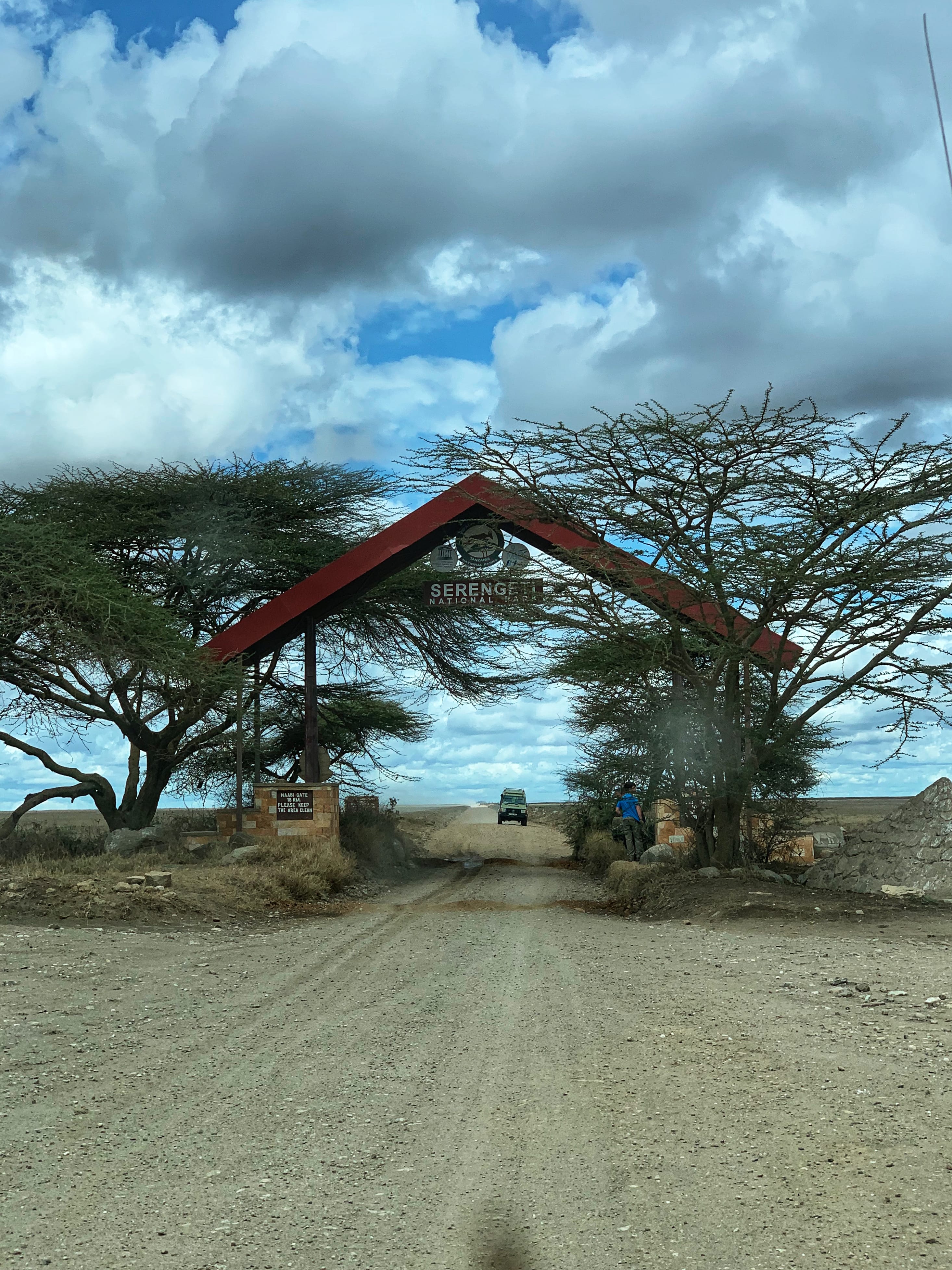
From Olduvai, the road dipped and stretched into flatter plains, and soon we were passing herds of grazing zebra scattered across the grasslands. A little farther on, we reached the green entrance gate to Serengeti National Park.

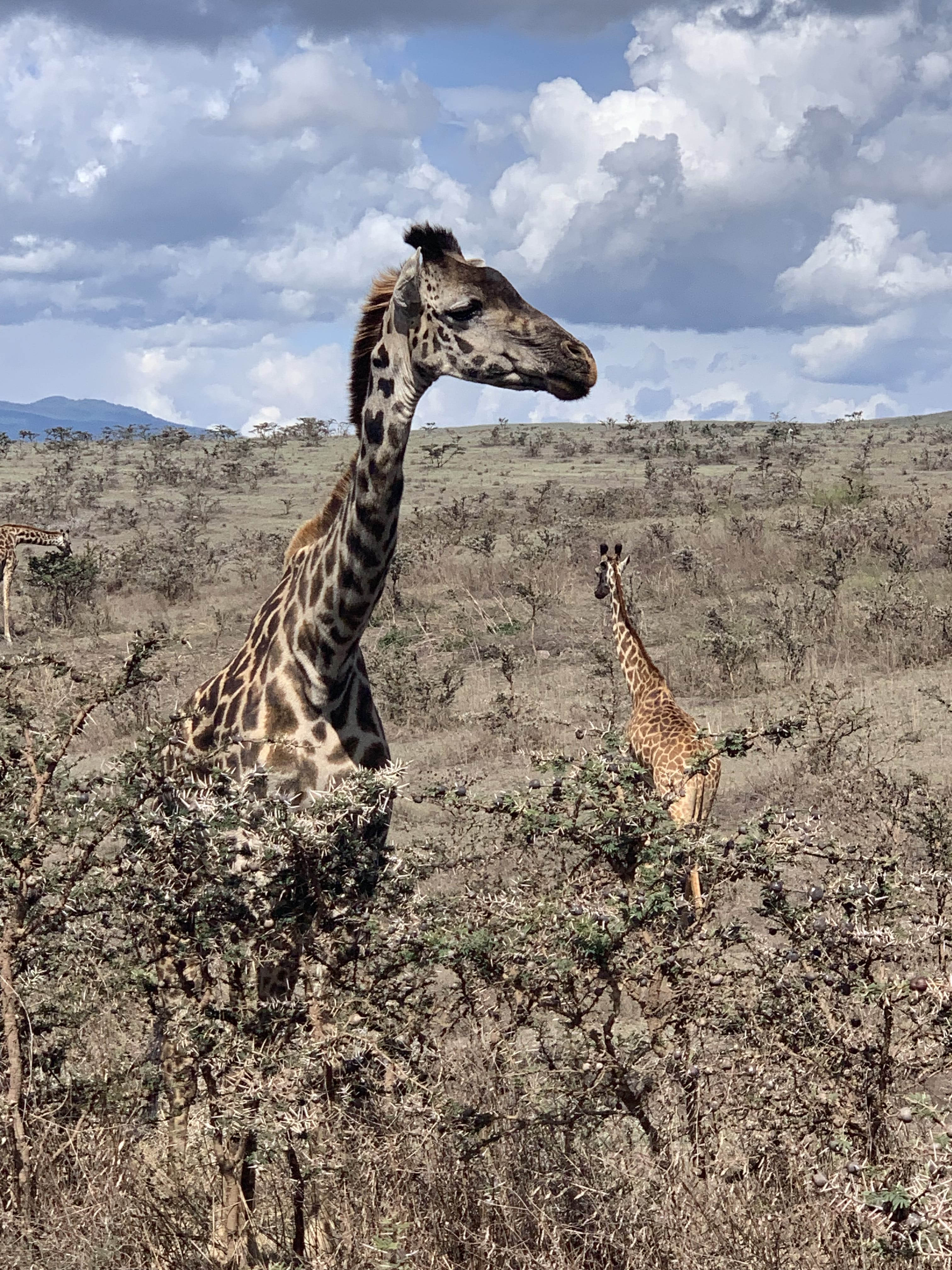
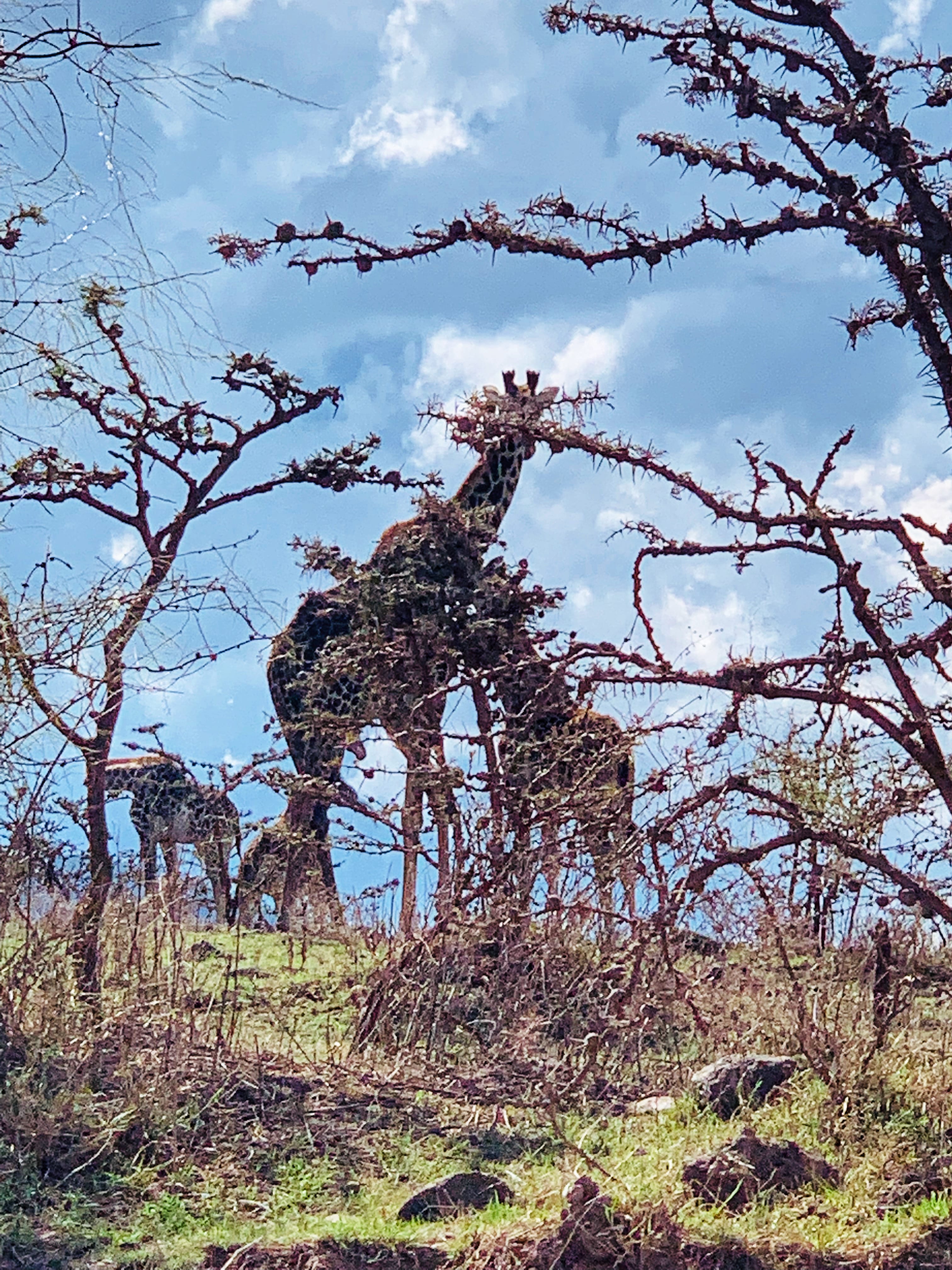
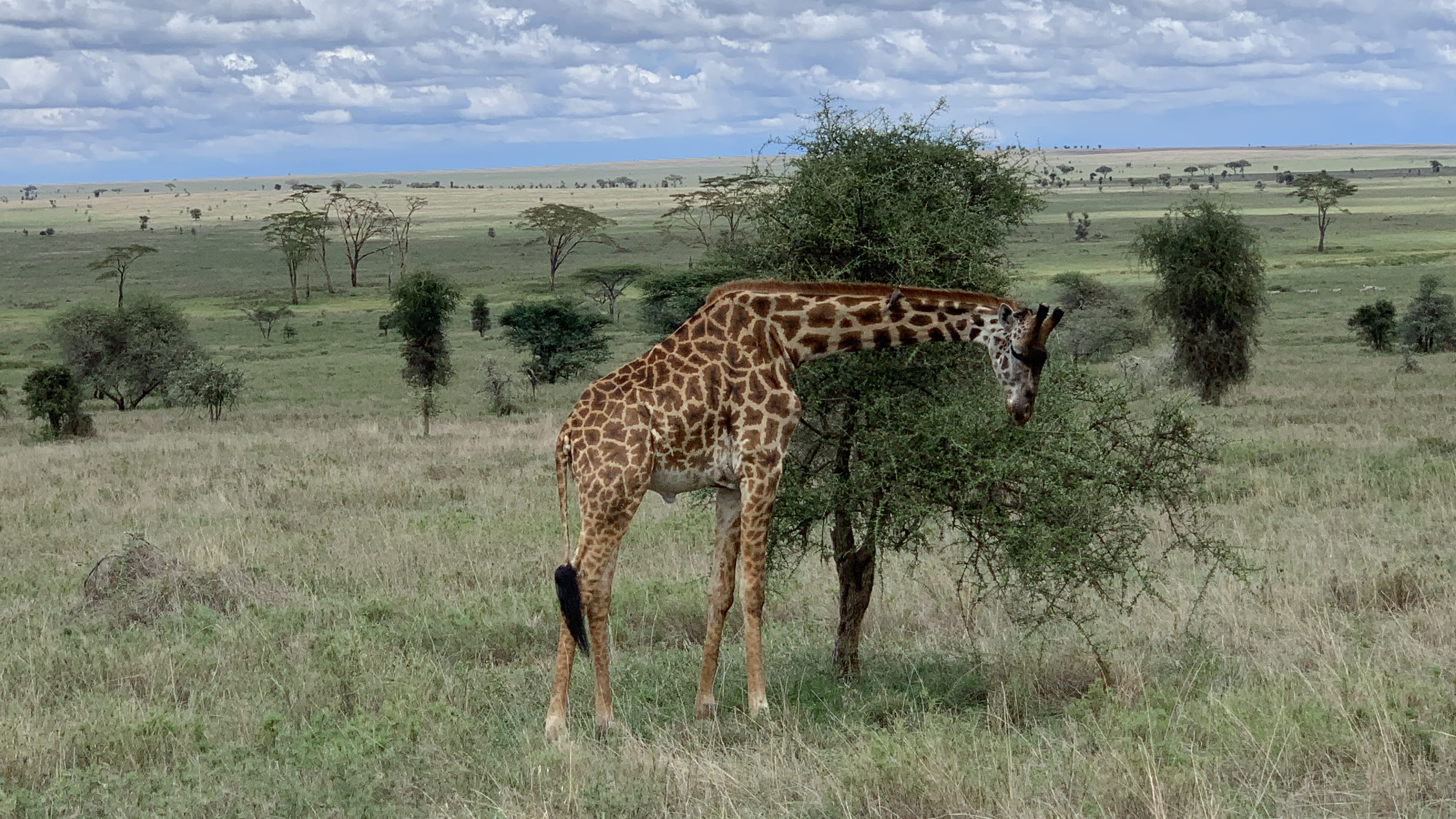
Inside the park, things only got better: gazelles sprinting across dusty patches of earth, more zebra, and the day’s highlight—giraffes leaning into acacia trees with that slow, deliberate way they move. I’d been excited to see them, and they didn’t disappoint. Seeing them up close, in their natural habitat, felt almost unreal.

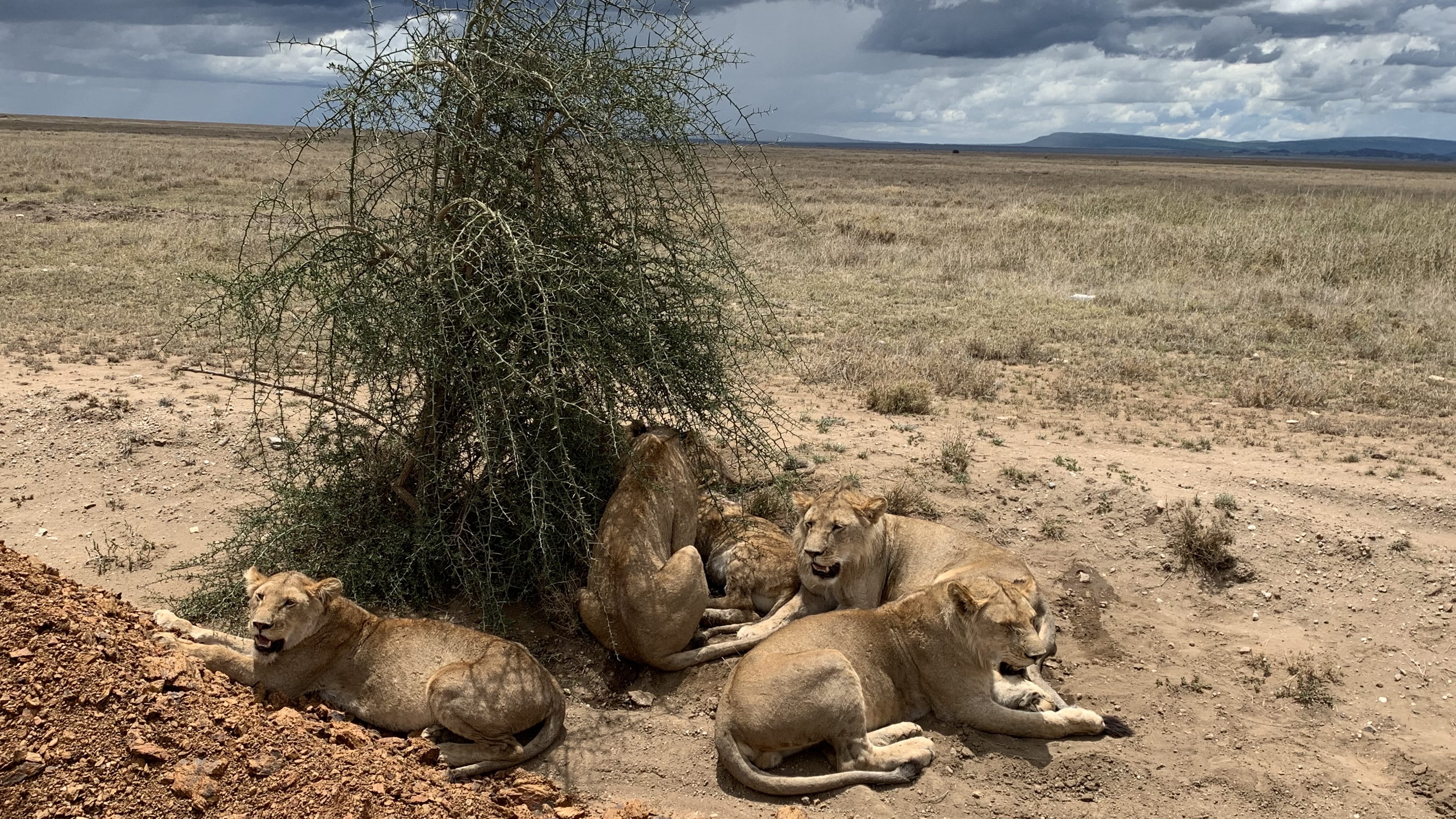
We also saw a pride of female lions resting near the roadside and a small group of hippos.

Zebra sighting in Serengeti National Park during 7-Day Tanzania Safari

We reached Serengeti Sopa Lodge by late afternoon, located high on the shoulder of the Nyarboro Hills with vast, open views.

That evening, we headed back out in the 4×4 and watched hippos piled into muddy pools, wildebeest in long single-file lines, more zebra, and a lone hyena. 

Back at the lodge, I watched as the plains faded into darkness, then called it a night — my first in the Serengeti.

Day 5: Serengeti Balloon Safari & Game Drives

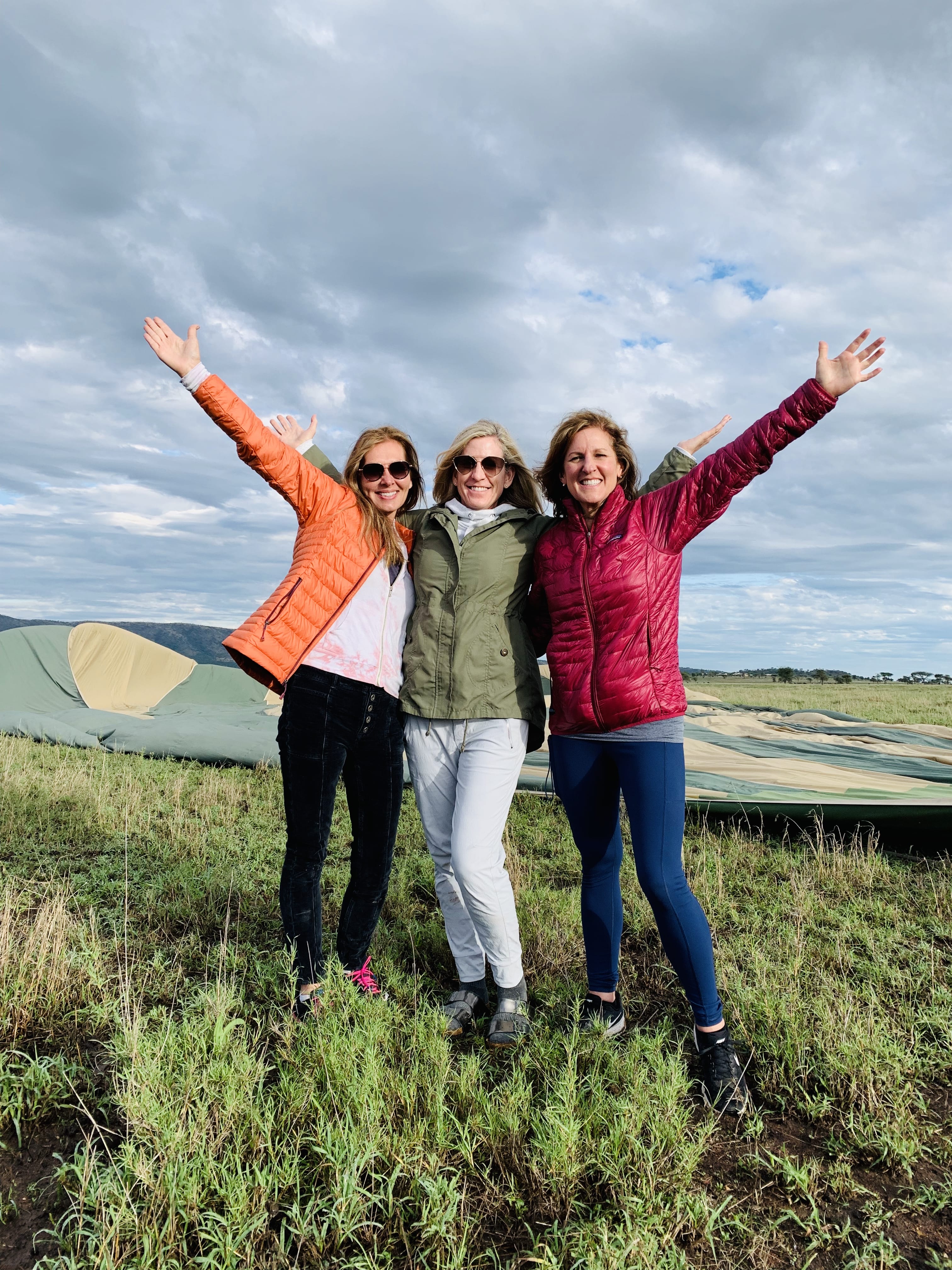
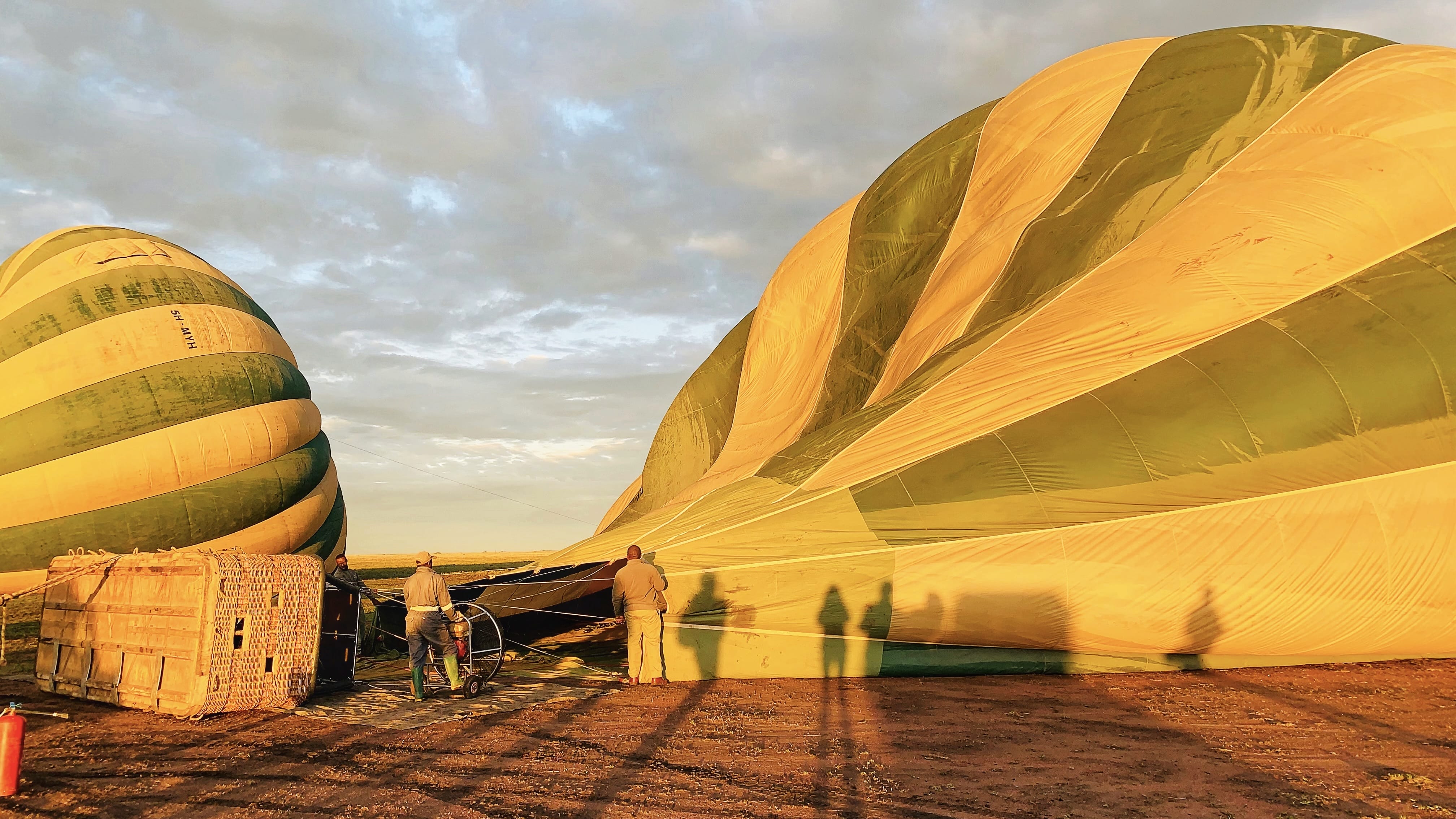
A 4:30 a.m. wake-up call led to one of the highlights of the entire trip: a sunrise hot air balloon safari over Serengeti National Park. Watching the balloon inflate was a moment in itself—the basket was tipped on its side, so we climbed in horizontally. As it filled, the basket slowly lifted upright, and then the balloon carried us into the air.

Hot air balloon being inflated at sunrise in Serengeti National Park, Tanzania, before a morning balloon safari
Watching the balloon inflate.

This balloon was larger than the one I rode in Barcelona, holding about ten people comfortably, and the flight lasted almost an hour—long enough to watch the sun rise fully over the Central Serengeti plains.

Aerial view of the Serengeti from a hot air balloon with winding dirt road and open grasslands below
Aerial view.

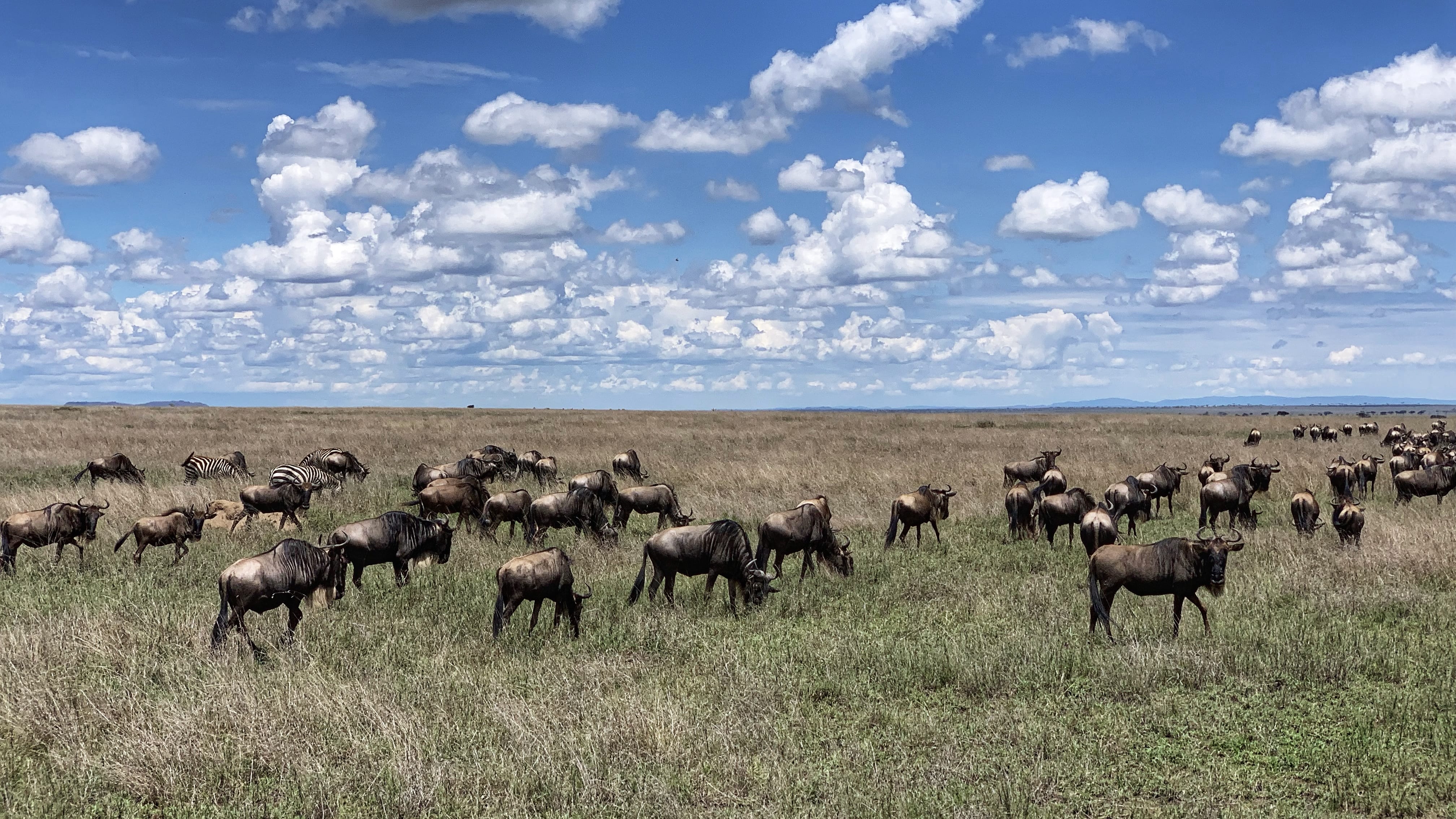
Once we were up, the quiet was what stood out. You just glide—no jolting, no engine noise—only the occasional burst from the burner. Below us, long dotted lines of wildebeest (along with a few zebras) moved across the grasslands. The light shifted from lavender to soft gold, and it was one of those rare travel moments that almost felt unreal.

Wildebeest and zebras grazing together on the Serengeti plains during a Tanzania safari
Wildebeest and zebras grazing together on the Serengeti plains.

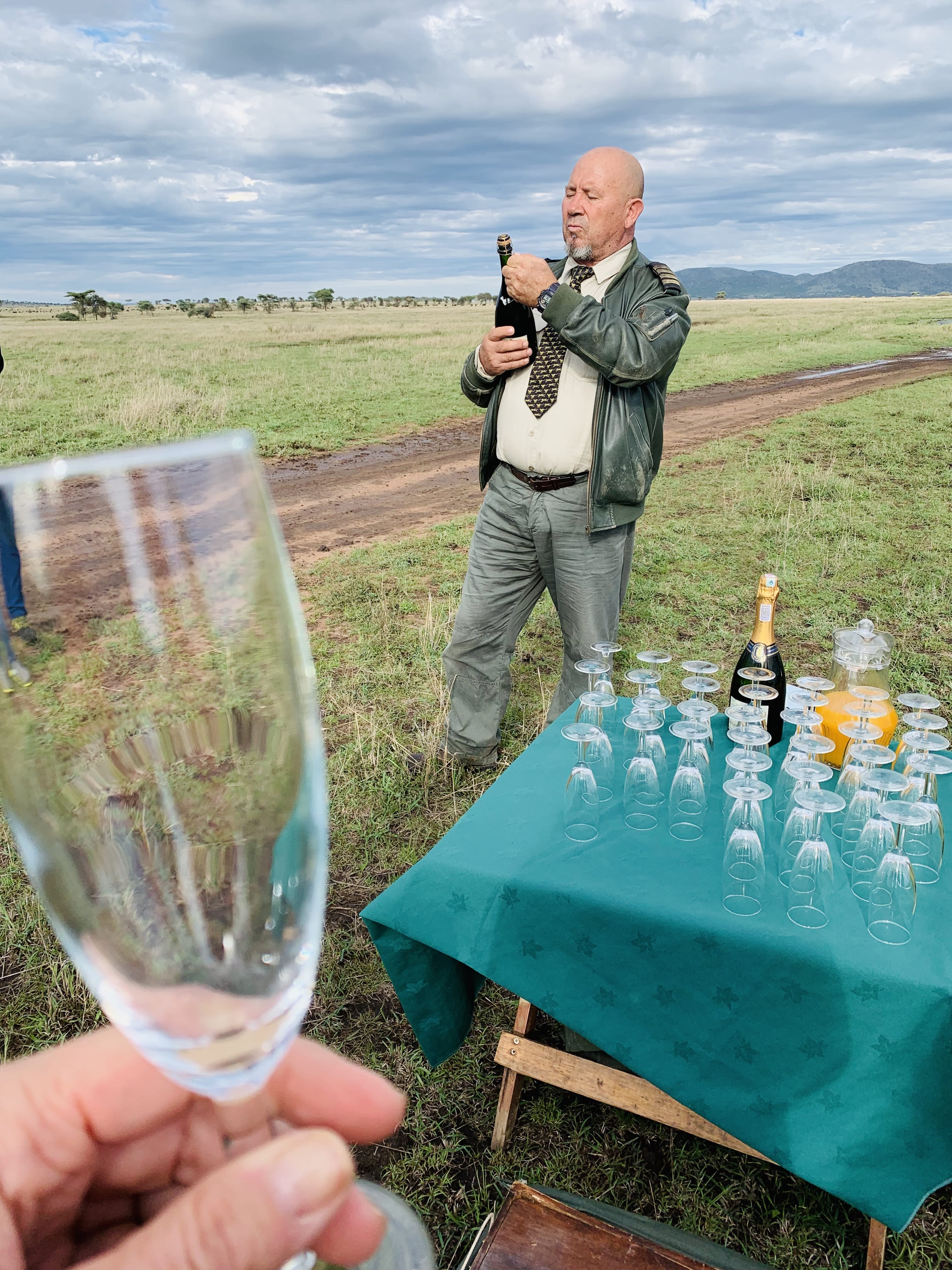
Touching down was followed by a classic bush breakfast—eggs over an open flame, pastries, fruit, and delicious coffee, served on real plates with silverware, all set out in the open— a perfect ending to the morning.

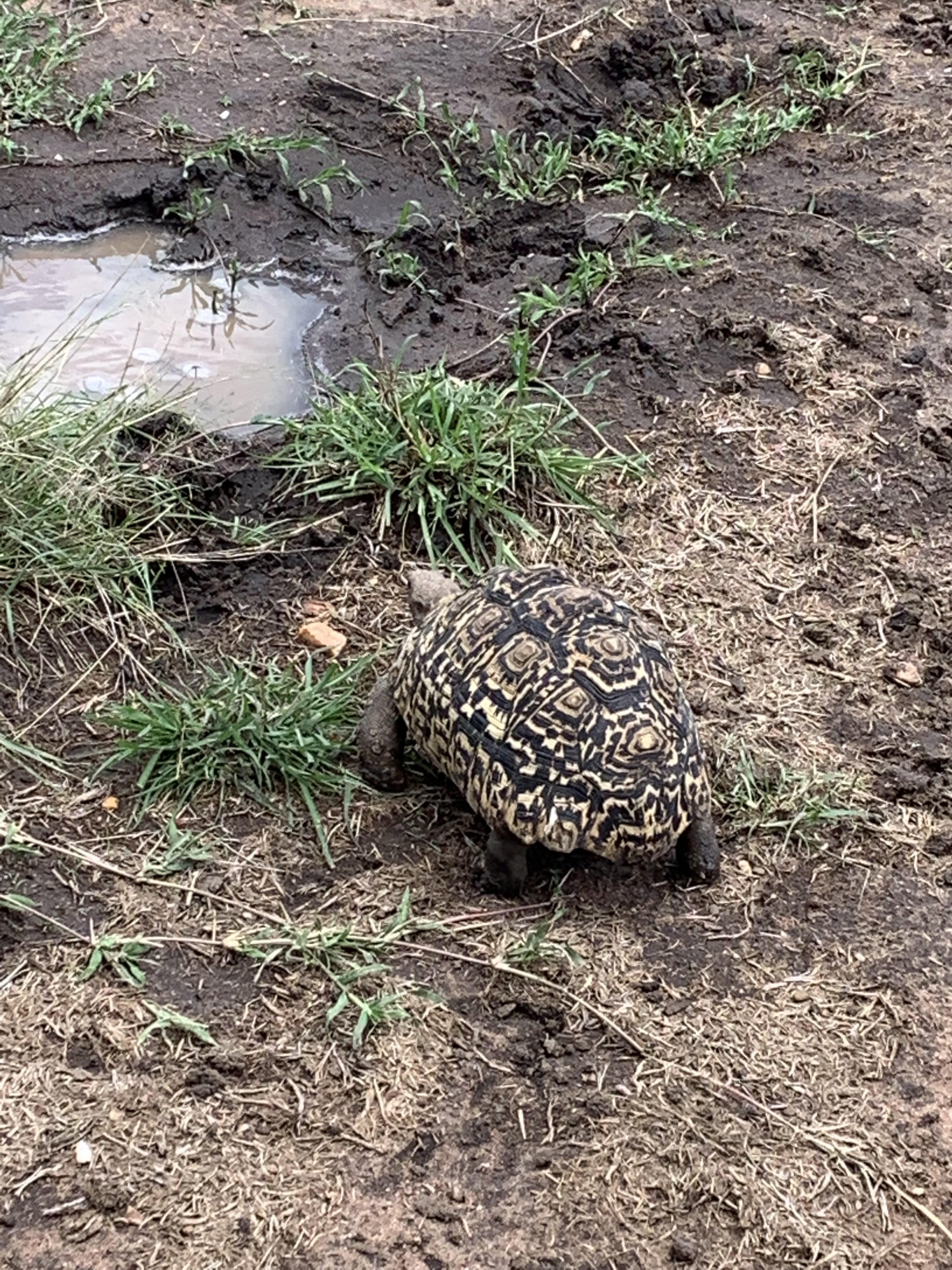
The rest of the day was safari time: we saw lions stretched beneath acacia shade, a leopard draped across a high branch, and endless stripes of zebra and wildebeest that somehow never stopped being interesting. Ostriches crossing the plains, a patterned tortoise, and crocodiles resting near the water rounded out the afternoon.

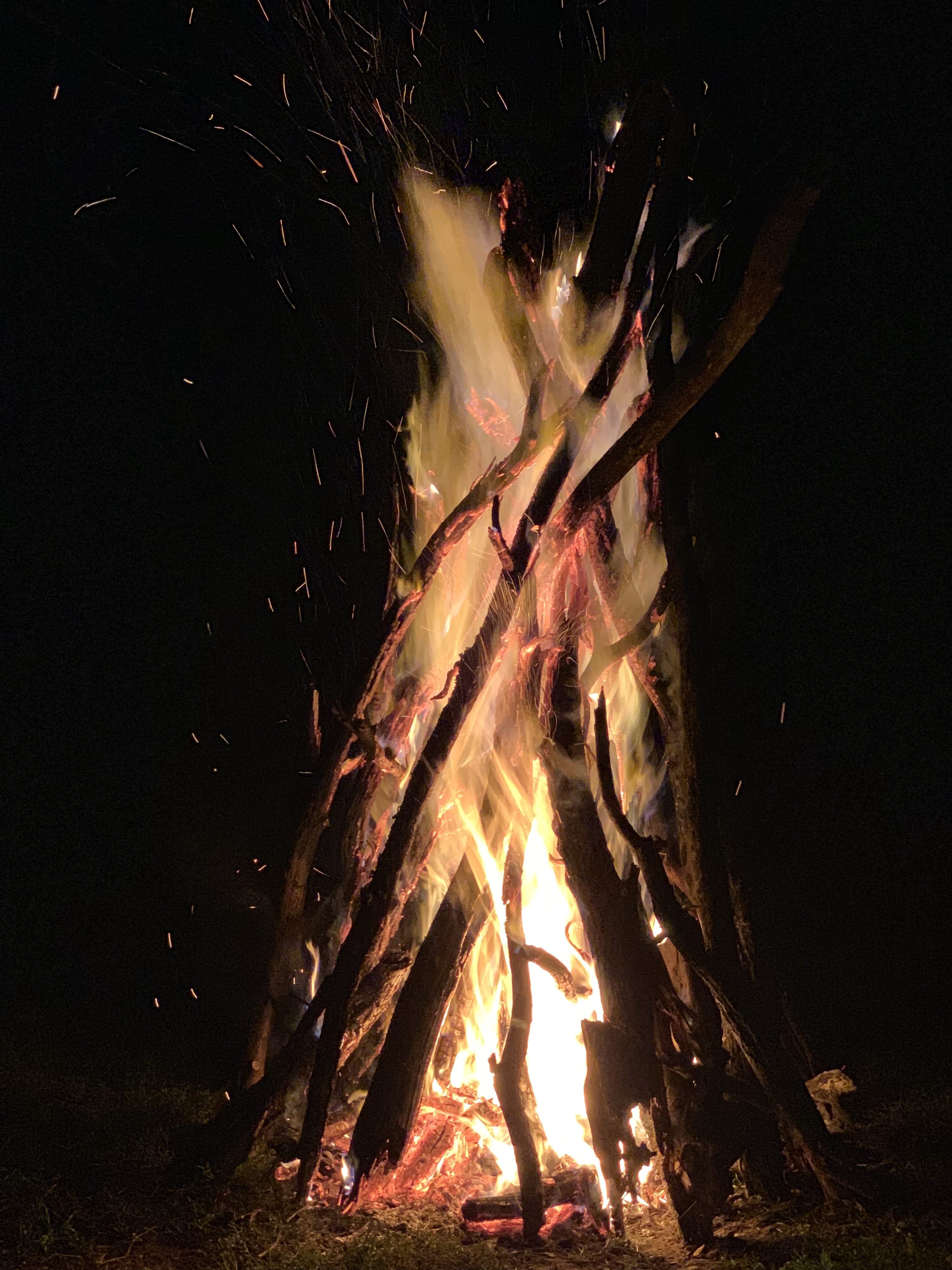
That night we had dinner in the bush—a cookout right in the wild. Tables sat directly on the grass under a simple canvas covering, with lanterns lighting everything just enough. A high fire burned beside us—to deter wildlife, mostly lions. Men tended it constantly, stacking branches and adjusting the wood so it wouldn’t burn down.

Dinner came straight off the fire: grilled vegetables and meat, foil-wrapped baked potatoes, a couple of stews, and salad. All the vegetarian dishes were delicious. There were woven chargers, real plates, bottled drinks, and silverware—elegant and a little surreal at the same time.

Outside the circle of light was full darkness. Every so often we could hear lions somewhere in the distance—not too close, just close enough to remind me where I was. When we looked up, the sky was full of sharp stars, clearer than almost anywhere I’ve ever seen—no haze, no artificial glow, just a sweep of light overhead.

Eating dinner in the bush under that sky, knowing wildlife was somewhere beyond what we could see, was calm and thrilling all at once. One of those experiences that lodges itself in your memory even while you’re living it.

Day 6 – Goodbye Serengeti, Hello Ngorongoro

There were signs all over the lodge: Do not feed the monkeys. The real issue, though, wasn’t feeding them—it was the open windows. We were in morning yoga with the windows wide open, and my cellphone was on a table behind me.

I turned after hearing a rustle and caught a monkey mid-decision, eyeing what it could steal. My gasp startled him, and in his scramble to escape back through the window, he knocked my phone off the table and onto the stone floor. 

The screen cracked, and the sidebar stopped working, but the camera still worked, which was all that mattered. Not many people can say their phone was broken by a monkey—but now I can.

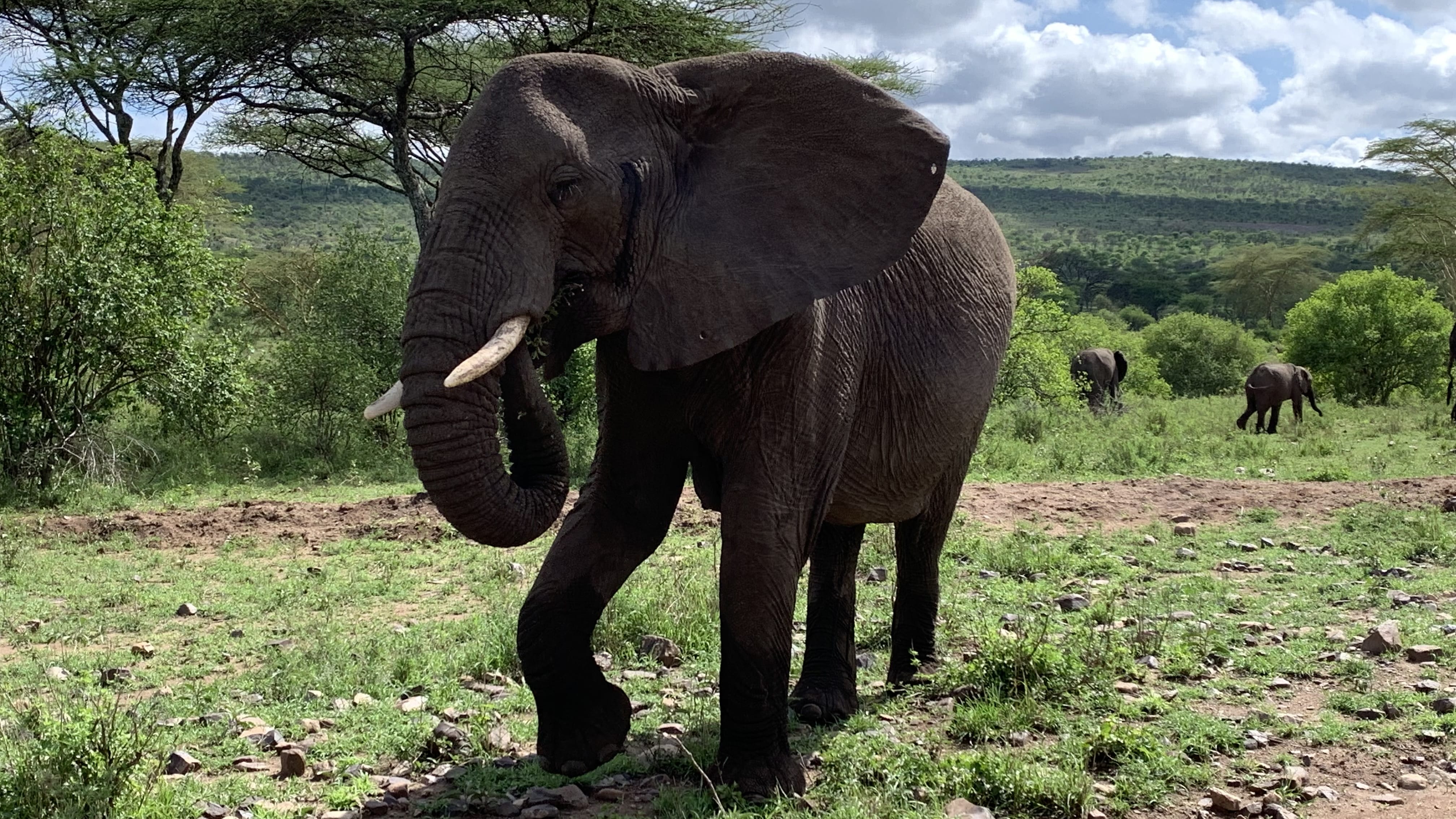
After breakfast, we headed out for one last game drive in the Serengeti. Even after days of wildlife, that familiar anticipation still hit when the engine started. We saw a large group of elephants, and one gave a mock charge toward the jeep—thrilling and unnerving at once. More wildebeest, impalas, ostriches, zebras, and a secretary bird rounded out the morning.

African elephant walking toward the safari vehicle in the Serengeti during a 7-Day Tanzania Safari
A close-up look at African elephants on our Serengeti game drive.
Herd of elephants walking along a dirt road in the Serengeti on a 7-Day Tanzania Safari
Watching a herd of elephants slowly take over the road.

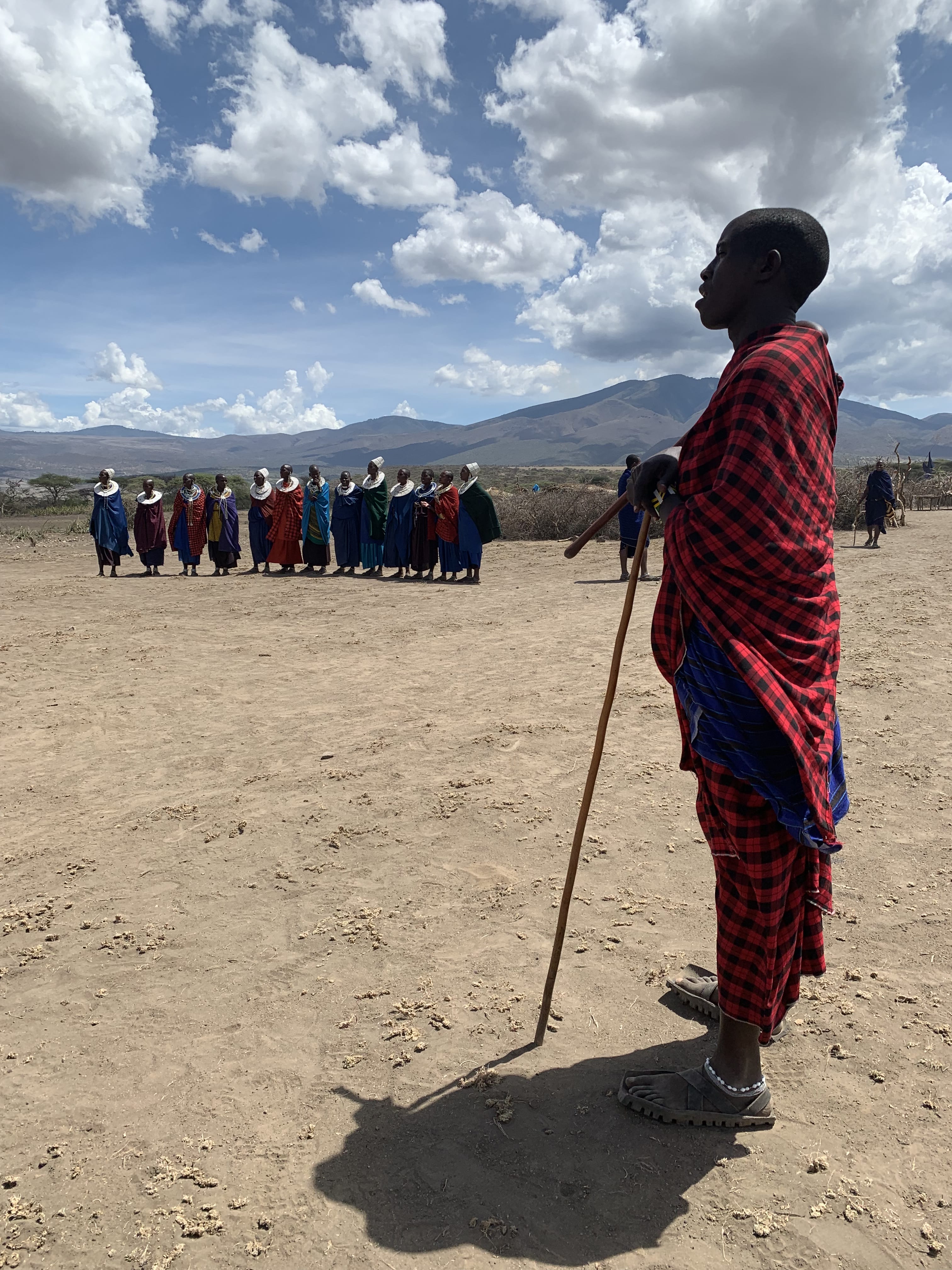
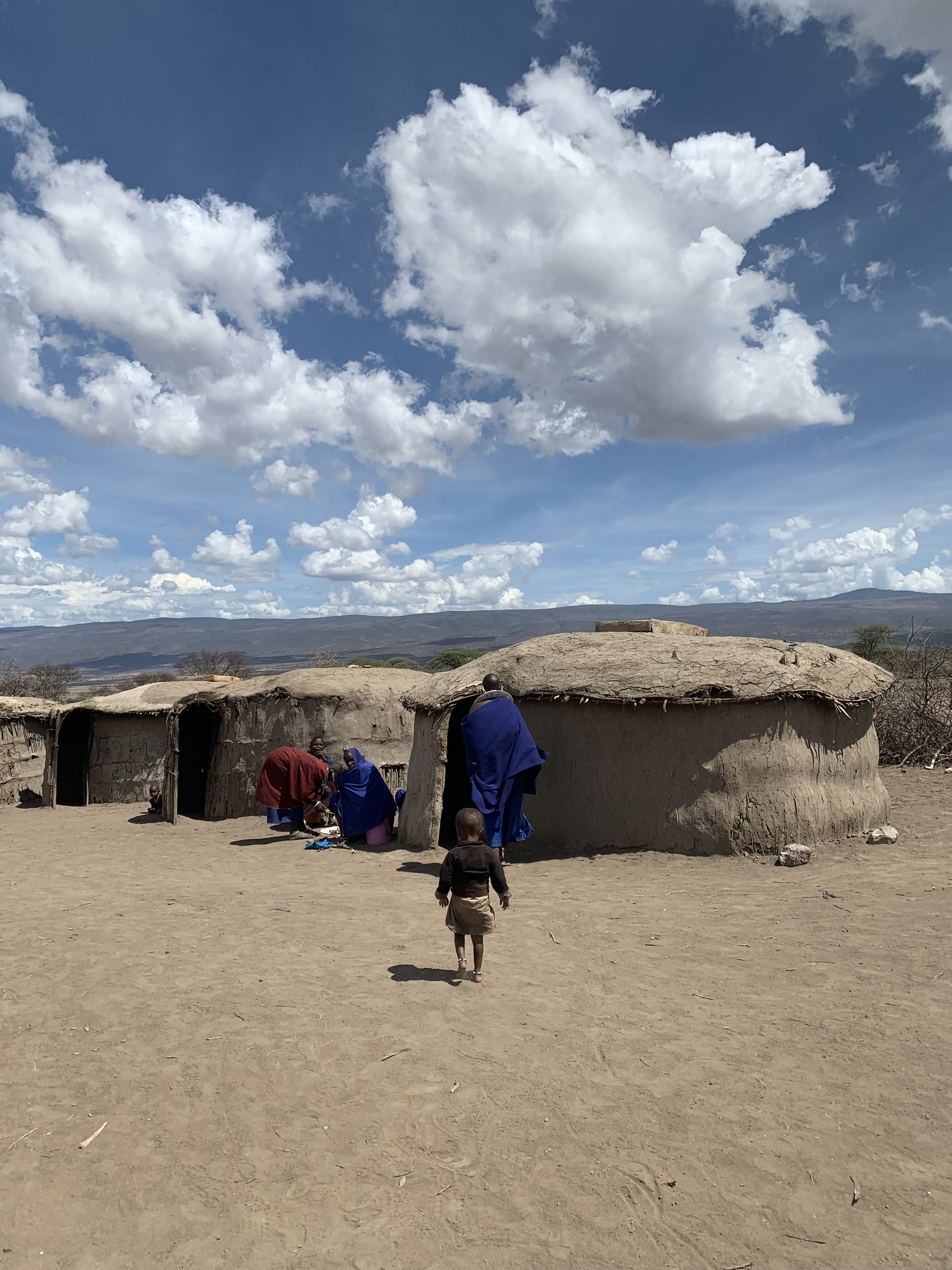
Leaving the park, we stopped at a Maasai village, where we were welcomed with singing and led through the bomas—traditional homes made of branches, mud, and dung. Some of the women placed their circular beaded collars around our shoulders, and we joined a short dance. One man who introduced himself as a prince—and said he had three wives—asked if I wanted to be the fourth.

Travelers and Maasai villagers standing in a line during a cultural visit on a 7-Day Tanzania Safari
Joining a line dance during our visit to a Maasai village.

 Visits like this are complicated. The traditions are real, but the presentation is clearly shaped for tourism. It provides needed income, and I’m glad for that, but I’m also aware that it’s a performance of everyday life rather than everyday life itself. I was glad to experience it once, but if I returned, I’d probably use that time for a hike or another game drive.

We continued into the Ngorongoro Conservation Area, and the scenery shifted to wide plains and scattered acacia trees. Giraffes moved slowly through the brush—still my favorite to watch—and someone pointed out an oryx before we began ascending toward the crater rim. It had been a week of early mornings, dusty roads, and more animals than I ever imagined seeing up close.

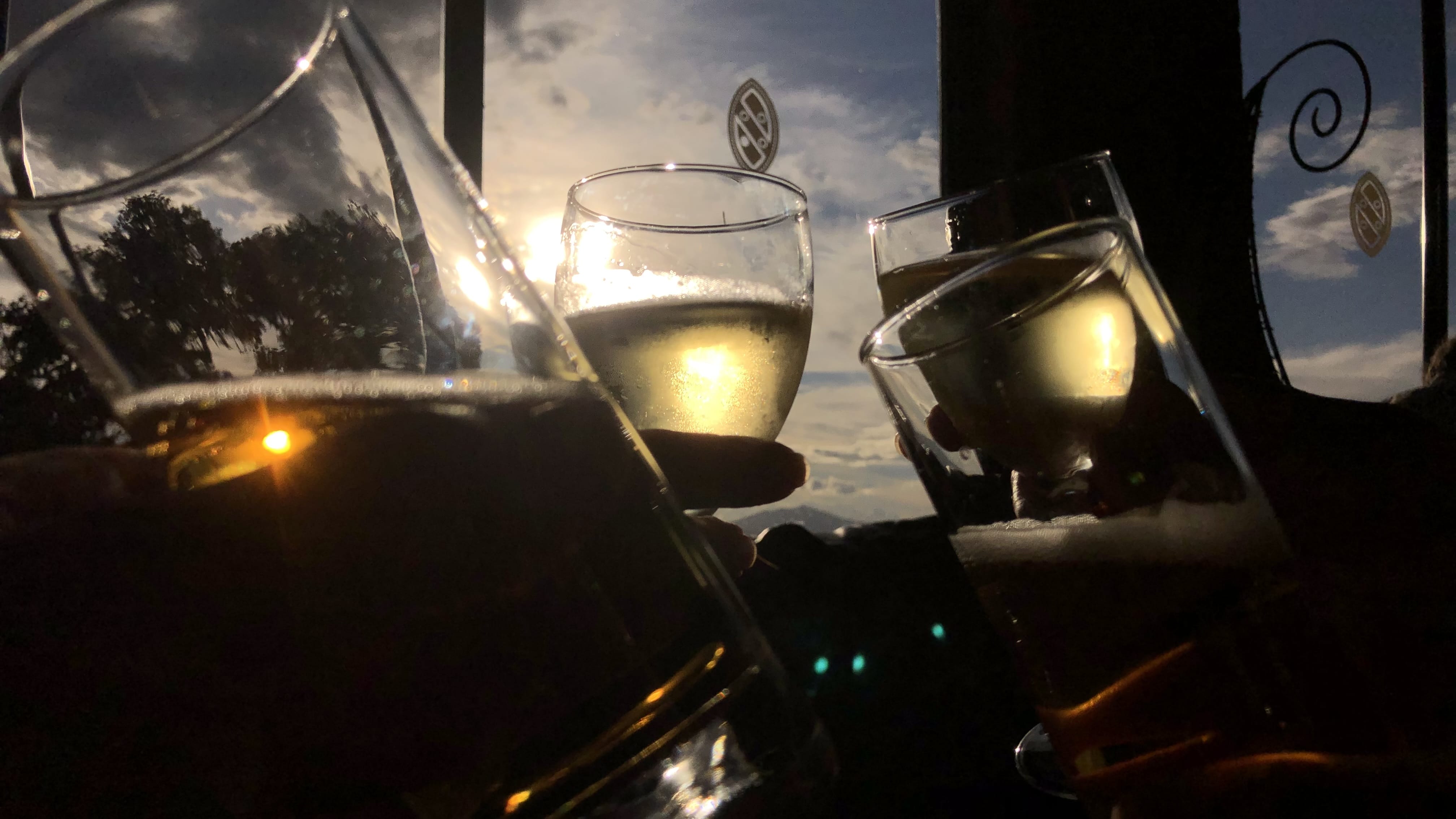
By evening, we arrived at the Ngorongoro Sopa Lodge, set along the crater rim. The view stretched below like a natural amphitheater. I sat on the terrace with the rest of my group, glass of white wine in hand, watching the light fade and replaying everything I’d seen—lions, giraffes, wildebeest crossings, that elephant mock charge.

Drinks raised at sunset during a 7-Day Tanzania Safari at the Ngorongoro Crater Rim
Sunset drinks at the end of a wonderful day.

Day 7 – Ngorongoro Crater & Lake Duluti

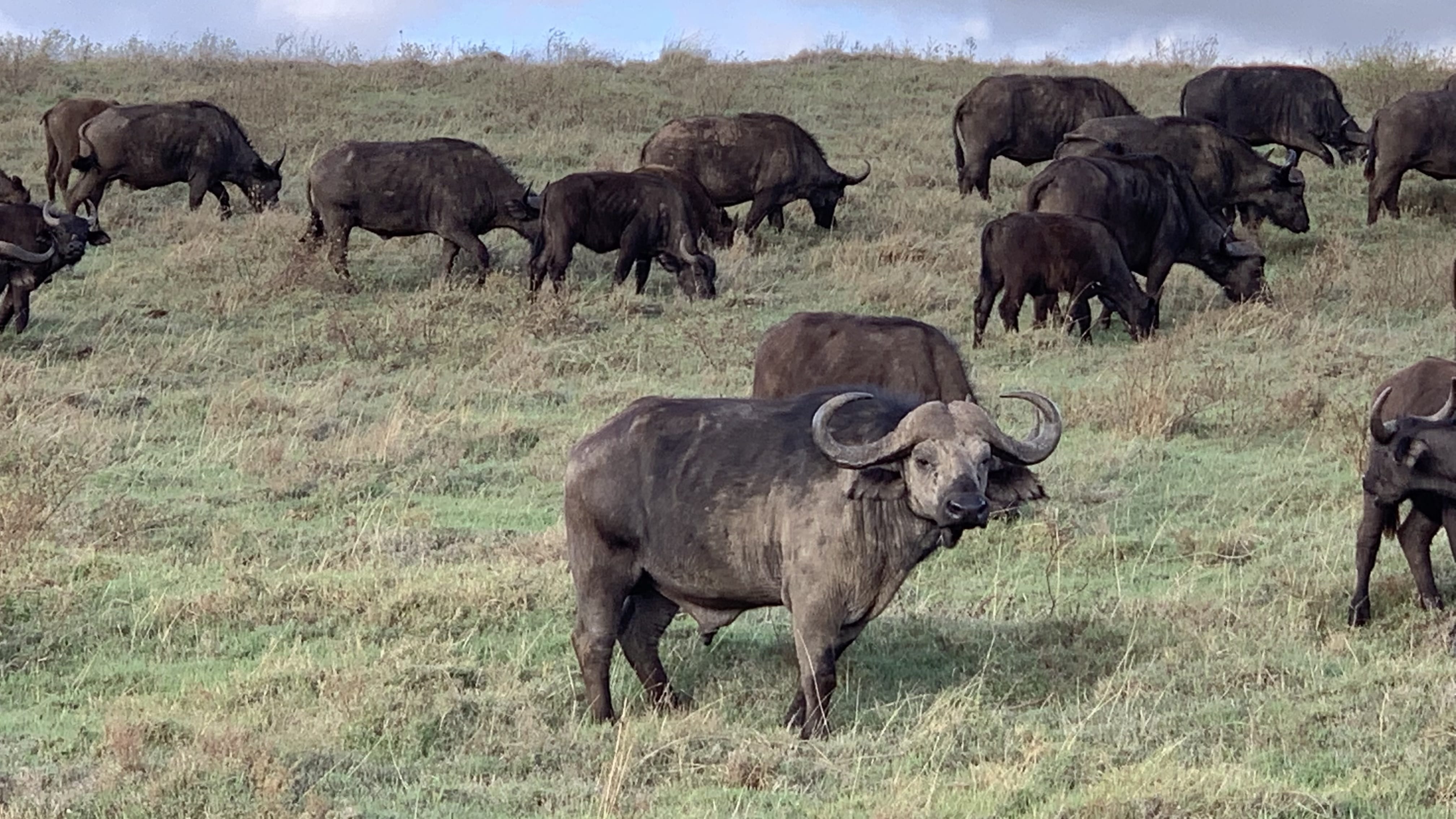
At dawn, we descended into the Ngorongoro Crater, often described as one of the most extraordinary wildlife sanctuaries on earth. I’d have to agree. The sun was just hitting the rim as we reached the crater floor, and within minutes, animals began appearing everywhere we looked. We saw elephants, African buffalo, wildebeest, zebra, lions resting in the grass, and even the elusive black rhino. A lone hyena paced along the roadside, stopping every so often to glance back at us.

Herd of African buffalo grazing on open grassland inside Ngorongoro Crater, Tanzania
Herd of African buffalo.

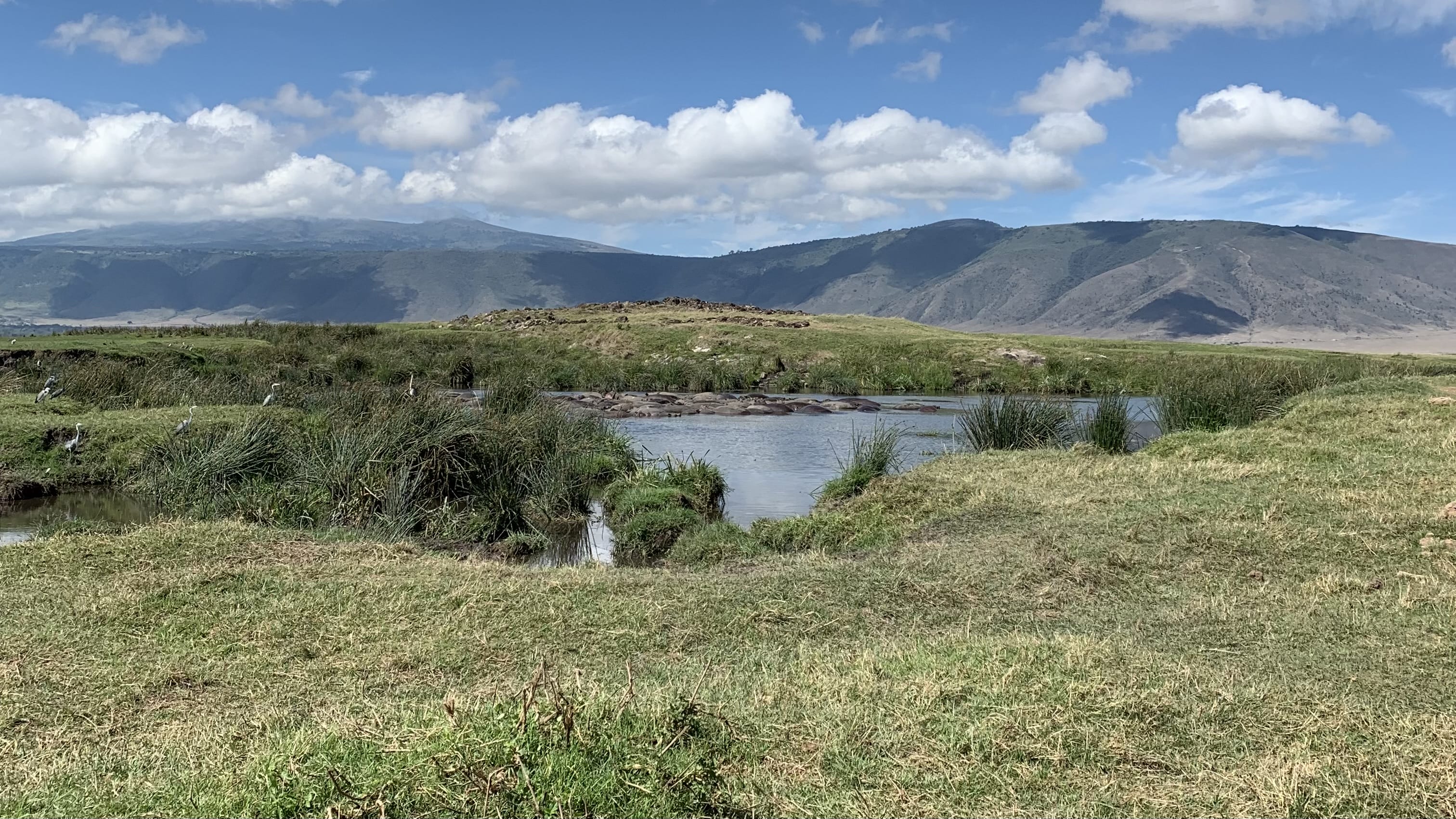
We stopped for a picnic lunch beside a hippo pool, watching the hippos sink beneath the surface like giant gray rocks and then rise again. The air was still, the water perfectly flat except for its slow ripples.

Hippos resting in a shallow pool inside Ngorongoro Crater with grassy banks and crater walls in the background
A herd of hippos.
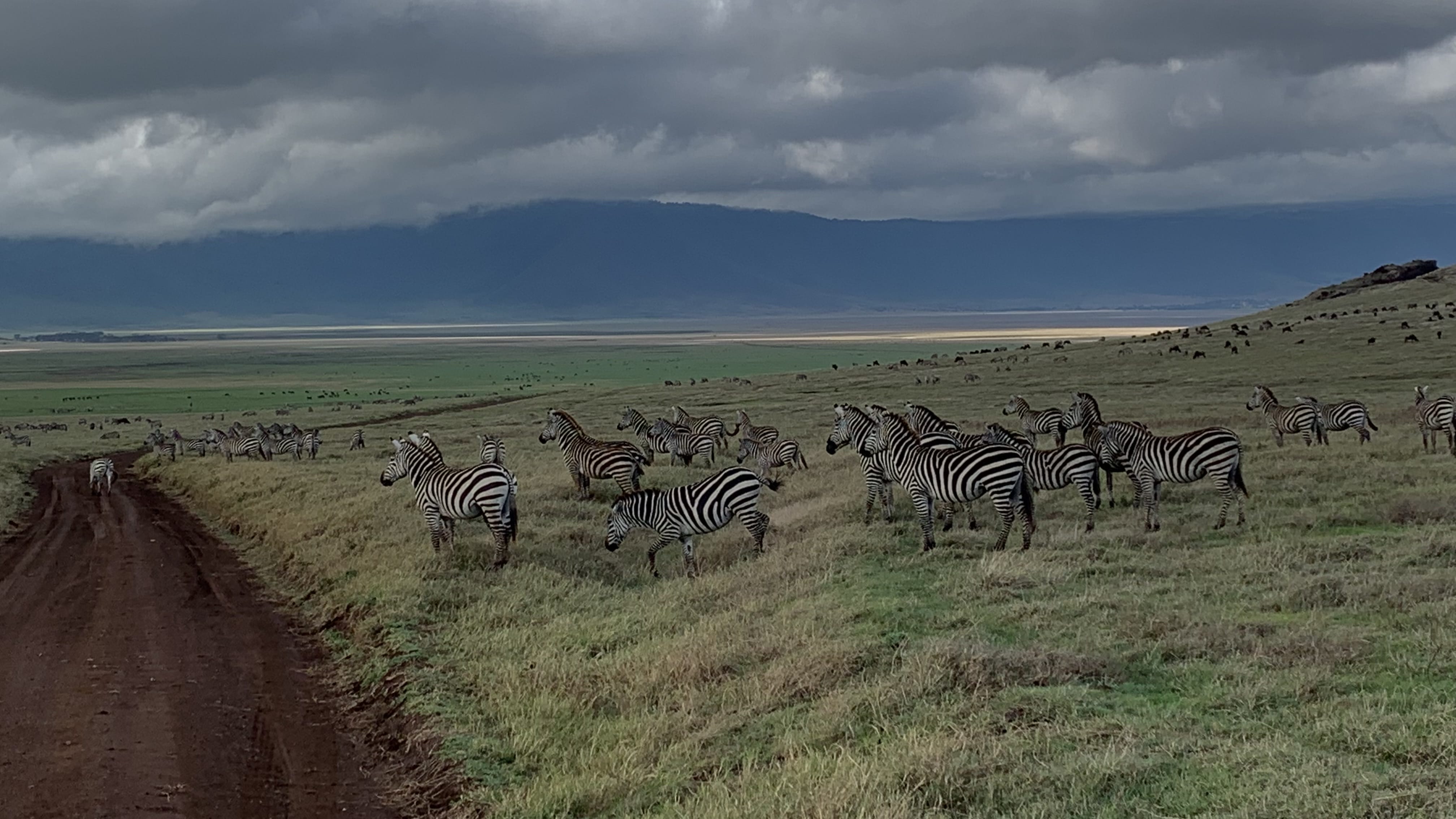
Plains zebras scattered across grassy hills inside Ngorongoro Crater with distant mountains and storm clouds
More zebra!

By mid-afternoon, we drove back up the crater road, winding along switchbacks until we reached the rim again. From the top, the crater spread out behind us—wide, green, and full of movement—almost unreal.

Later that afternoon, we returned to Arusha and checked into Lake Duluti Lodge for our final night. I sat by the pool with a drink (yes, another piña colada—clearly my drink of choice in Tanzania) and a bowl of nuts, feeling that familiar end-of-trip mix of gratitude and disbelief. After a week of early mornings, dusty drives, wildlife sightings, and yoga in all sorts of wonderful settings, I decided a massage was completely justified (deep tissue, thank you). I booked one and didn’t regret it for a second.

It was the perfect way to end the week—quiet, warm light, and the satisfaction of knowing I’d seen something rare and beautiful.

The Next Morning

After breakfast and one final yoga session, I transferred to the airport for the short flight to Zanzibar—an add-on I knew I wanted because I wasn’t ready to head home just yet. The safari chapter was ending, and it felt like the right moment to trade game drives for a few slower beach days.

Looking back, the week felt impossibly full. Well, except for a monkey knocking my phone to the floor and cracking it—but even that became part of the story. Every place we stayed was beautiful, the group was small, and each day held something entirely different. I knew I wasn’t ready for it to end. 

Planning Notes (If You’re Thinking About This Trip)

I went in late October, and the weather was ideal. Most days I only needed a light sweater, and in the evenings a thin jacket was enough—warm during the day, crisp at night, and never uncomfortable.

The Kilimanjaro day hike involved a moderate climb, beginning near 1,879 meters (about 6,100 feet) and reaching around 2,720 meters (about 8,900 feet) at the Mandara Huts. It was steady but very doable, and absolutely worth it for the rainforest setting alone.

Driving distances varied depending on the park, but most days involved a couple of hours in the vehicle—not unpleasant, just part of safari life. The drives became their own experience, passing markets, small towns, herds of cattle, and long golden stretches of land that didn’t seem to end.

Related Blogs

JoAnne Cross headshot

About the Author

Hi, I’m JoAnne—writer, wanderer, and lover of places that surprise me. I’ve traveled to 60+ countries (and counting), usually with a camera in one hand and a notebook in the other. I’m drawn to mosaics, markets, and mountains, and I write to remember what moved me. When I’m not traveling, I’m working on my blog Travels Afoot, trying new creative projects, or planning my next adventure.

📍 More about me | ✈️ Explore destinations